Functional Apparel Market - Regional Analysis
North America Market Insights
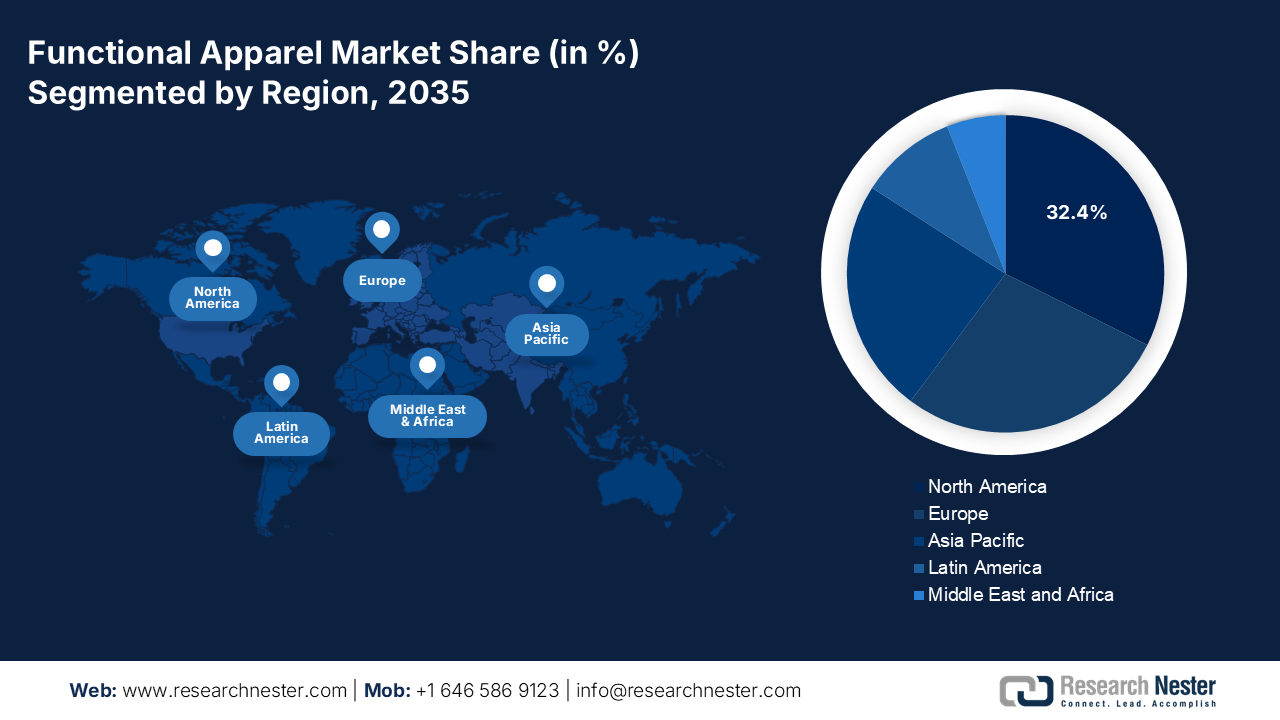
North America is dominating the functional apparel market and is poised to hold the market share of 32.4% by 2035. The market is driven by high consumer spending, a strong sports culture, and strong workplace safety regulations. The key trends include the dominance of e-commerce demand for sustainable and technical fabrics and the blurring of lines between performance and lifestyle wear. The functional apparel market is defined by innovation with significant R&D in smart procurement, which provides a stable B2B demand stream for protective and high-performance gear. Canada’s federal support for the outdoor recreation and cold climate industries further accelerates the demand for specialized apparel. The region's advanced retail logistics and high digital penetration further solidify its leading position, creating a mature ecosystem for both product innovation and consumer access.
The U.S. functional apparel market is defined by robust innovation and regulatory-driven demand. A key trend is the integration of smart textile technologies supported by the federal R&D funding via institutes such as the AFFOA. The demand is structurally supported by the mandatory occupational safety standards from the OSHA, ensuring a consistent B2B procurement of the protective apparel across industries such as utilities and construction. Further, a substantial and consistent department of defense spending on soldier clothing and individual equipment, as detailed in the annual budget documents, creates a high value performance-oriented procurement channel. On the other hand, the polyester staple fiber woven fabrics are a core input material used in functional apparel such as workwear, military uniforms, healthcare garments, sportswear, and protective clothing. According to the OEC report in 2023 U.S. has imported USD 7.34 million of woven fabric polyester staple fibers, making it relevant for supply-chain, trade, and demand-side functional apparel market analysis.
The functional apparel market in Canada is shaped by the climate and a strong outdoor recreation system. The demand is driven by the need for advanced technical apparel for the harsh winter conditions and activities such as skiing, hiking, and camping, supported by the federal investments in the parks and recreational infrastructure via Parks Canada. Further, the wool apparel, cotton or man-made fibre apparel, fabrics, and spun yarn represent the raw materials and intermediate inputs used in the production of the functional apparel, such as workwear, protective clothing, uniforms, and performance garments. The report from Global Affairs Canada in December 2025 depicts that 364,515 SME units of wool apparel are imported from Mexico, representing 52% utilization of the negotiated import level, compared with 40% in the previous year, indicating rising inbound reliance on specialty wool garments used in cold-weather workwear and uniforms.
Import Apparel Utilization Data
|
Unit |
Product Description |
Negotiated Level |
Utilization (Year to Date) |
Current Year (%) |
Previous Year (%) |
|
SME |
Wool Apparel (Import) |
700,000 |
364,515 |
52% |
40% |
|
SME |
Cotton or Man-Made Fiber Apparel (Import) |
20,000,000 |
755,369 |
4% |
11% |
|
SME |
Cotton or Man-Made Fiber Fabrics and Made-Up Goods (Import) |
15,000,000 |
0 |
0% |
0% |
|
KGM |
Cotton or Man Made Fiber Spun Yarn (Import) |
1,000,000 |
10,082 |
1% |
3% |
Source: Global Affairs Canada December 2025
APAC Market Insights
Asia Pacific is the fastest growing functional apparel market and is expected to grow at a CAGR of 7.4% during the forecast period 2026 to 2035. The market is driven by the expanding middle class population and increasing participation in fitness and outdoor activities. The key growth include the heightened health awarness post pandemic and a strong government initiatives promoting sports. The functional apparel market is defined by a powerful manufacturing ecosystem enabling innovaiton and competitive pricing. A dominant trend is the seamless integration of the e-commerce and socal commerce platforms with th edigital first brands and the live shopping revolutionizing retail. Furhter the athleisure into everyday wear and a growing emphasis on the sustainable and technically advanced materials are shaping the consumer preferences. The region is further driven by the mass market expansion and increasing formal workplace adoption of the functional business causual wear.
The functional apparel market in China is propelled by the massive domestic demand, government led fitness campaigns, and the rise of the Guochao nationalism, favoring local brands such as the ANTA and Li Ning. The state is actively promoting the sports industry as a strategic economic pillar. The report from the State Council Information Office in December 2025 has predicted that the national per capita consumption expenditure on sports and recreation grew by 11.1% in 2024, reflecting the sustained investment in active lifestyles. This growth is further fueled by the country’s dominant position as the global textile manufacturing hub, enabling rapid innovation and scaling of technical fabrics. The market is defined by a highly integrated digital ecosystem, where e-commerce and social commerce platforms like Tmall and Douyin are primary sales and discovery channels, driving both mass-market and premium segments.
Japan’s market is mature and advanced in the functional apparel market and is driven by technological innovation, a premiumization trend, and the needs of an aging demographic seeking health-focused apparel. The demand is underpinned by a deep-rooted outdoor culture and a society with a high discretionary spending on quality and specialized gear. The government initiatives promoting sports across all age groups support a steady demand. According to JSPIN statistics from August 2023, 72.9% of individuals participated in sports and other physical activities in 2022. This stable, engaged user base aids a high-value market for technical outdoor wear, smart textiles, and advanced functional materials from domestic leaders like Goldwin and Descente.
Europe Market Insights
The functional apparelmarket in Europe is expanding rapidly and is defined by the high consumer spending power, a strong outdoor sports culture, and robust regulatory frameworks. The key drivers include the deep integration of sustainability into the product design, driven by the Eu’s Green Deal and Circular Economy Action Plan that pushes for eco-friendly materials and production. The market also benefits from the innovation in smart textiles and technical fabrics, aided by initiatives such as the European Smart Textiles Alliance. There is a strong demand for the premium versatile apparel that links performance and every data lifestyle wear. The growth is further supported by the digitalization, with e-commerce being a dominant sales channel, and by rising health consciousness post pandemic that has sustained demand for the activewear.
Germany’s functional apparel market is the largest in Europe and is driven by the consumer purchasing power, a deep-seated appreciation for the technical quality, and a widespread organized sports culture via clubs. The demand is consistently strong for th ehigh performance outdoor cycling and fitness apparel. The sustainability s a vital purchasing factor stimulated by the government policies promoting a circular economy. A key statistic highlighting the robust consumer economy underpinning this functional apparel market is the growth in the retail trade in sports equipment games and toys. The report from the Federal Ministry for the Environment, Climate Action, Nature Conservation, and Nuclear Safety in January 2023 states that Germany has witnessed 53 million tourists in National Parks annually, which directly supports demand for functional apparel, including outdoor jackets, thermal wear, moisture-management clothing, hiking apparel, and weather-resistant garments.
The functional apparel market in the UK is defined by a powerful blend of globally influential fashion, a strong outdoor heritage, and the pervasive athleisure trend. The demand is driven by the high participation in running, gym fitness, and hiking, aided by the public health campaigns and digital fitness platforms. The government’s role is significant for example, Sport England data in April 2024 depicts that the Uniting the Movement strategy invests over £250 million of public and lottery funding to tackle the inequities in sports participation, directly stimulating the demand for sportswear. A clear market indicator is the sustained growth in online sales, with non store retailing sector seeing an increase in sales volume as reported by the Office for the National Statistics, underscoring the critical digital channel for functional apparel.