Food and Beverage Chemicals Market Outlook:
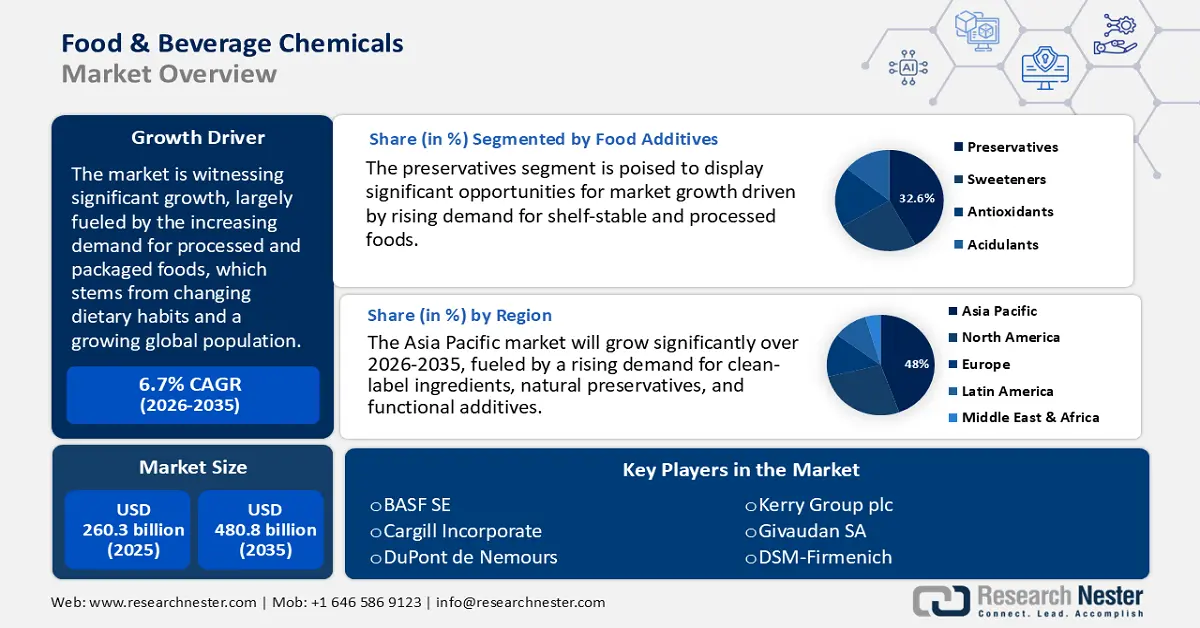
Food and Beverage Chemicals Market size is valued at USD 260.3 billion in 2025 and is projected to reach USD 480.8 billion by the end of 2035, rising at a CAGR of 6.7% during the forecast period, i.e., 2026-2035. In 2026, the industry size of food and beverage chemicals is estimated at USD 298.5 billion.
The food and beverage chemicals market is witnessing significant growth, largely fueled by the increasing demand for processed and packaged foods, which stems from changing dietary habits and a growing global population. The USDA reports a consistent rise in per capita food consumption, especially in developing regions of Asia and Africa. The FAO notes a swift increase in global food processing to cater to the needs of more urbanized communities. Government initiatives aimed at enhancing food fortification and extending shelf life, such as the U.S. FDA’s Food Safety Modernization Act (FSMA), have led to a greater reliance on preservatives, stabilizers, and flavoring agents. Additionally, advancements in food-grade chemicals are being supported by favorable fiscal policies. National Patterns projections show that in 2022 40% and 37% of fundamental research is sponsored by the federal government and corporations, respectively, underscoring the critical role of chemical applications in contemporary food production.
The supply chain sector is experiencing a strategic transformation characterized by a rise in international trade and an expansion of domestic capacity. As per the U.S. International Trade Commission, as a result of changing trade dynamics, U.S. chemical exports decreased to $229.2 billion, with domestic exports down 6.4% and re-exports up 4.3%, while imports increased 2.9% to $329 billion. Government-supported clean manufacturing initiatives, including those from the Department of Energy, are promoting automation in the production of additives. The rising exports of U.S. food-grade chemicals and a significant increase in import activities in Southeast Asia highlight the momentum in the global market, which is further strengthened by enhanced research funding for clean-label and biocompatible chemical solutions.