EV Charger Cellular Connectivity Market Outlook:
EV Charger Cellular Connectivity Market size was valued at USD 2.7 billion in 2025 and is projected to account for USD 9.7 billion by 2035, rising at a CAGR of 13.6% during the forecast period, i.e., 2026-2035. In 2026, the industry size of EV charger cellular connectivity is estimated at USD 3.1 billion.
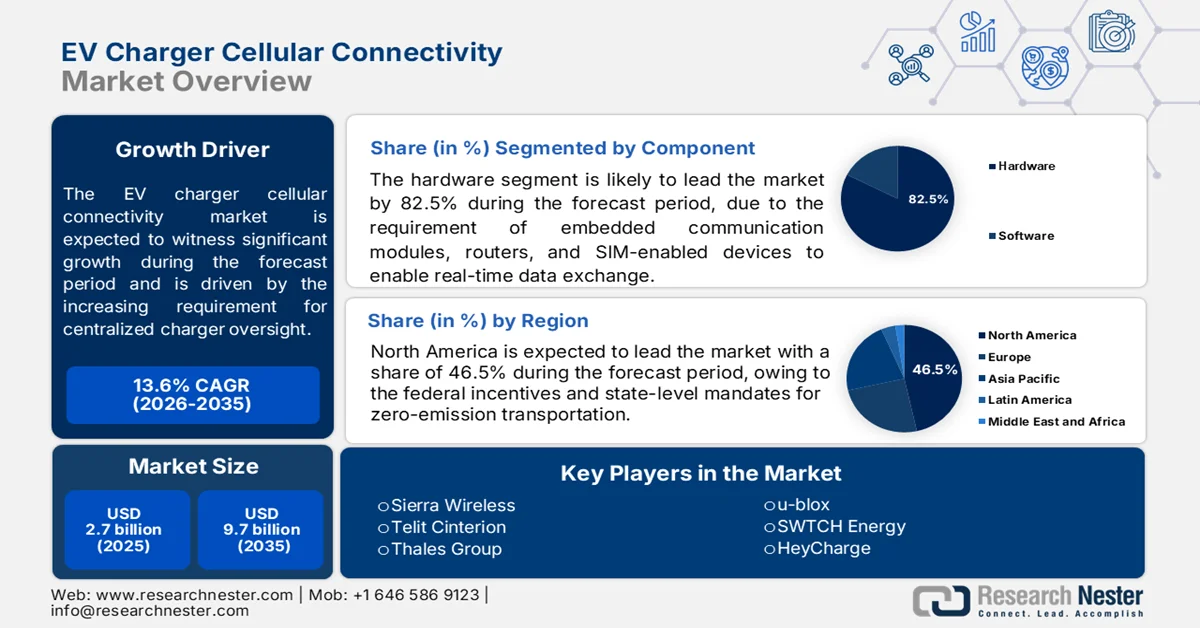
The EV charger cellular connectivity market is expanding alongside the rapid buildout of charging infrastructure and the increasing requirement for centralized charger oversight. Cellular connectivity has become a core operational layer for charging networks, supporting asset monitoring, maintenance coordination, software management, transaction processing, and utilization analytics across geographically dispersed installations. According to the International Energy Agency (IEA) 2025 data, the global stock of public charging points added 1.3 million in 2024, representing an increase of more than 30% compared with 2023. As charging networks scale, operators are investing in connectivity architectures that can support higher charger densities, greater data volumes, and interoperability requirements across multiple charging locations.
Market development is also being supported by government-led electrification programs and the growing number of connected vehicles entering operation. Cellular connectivity enables charging network operators, fleet managers, and infrastructure owners to manage charging assets remotely while reducing field-service requirements and improving network availability. The International Energy Agency 2025 data reported that global electric car sales exceeded 17 million units, reflecting continued growth in the vehicle base that depends on accessible and efficiently managed charging infrastructure. In the United States, the Joint Office of Energy and Transportation reported in 2025 that all states, the District of Columbia, and Puerto Rico had approved plans under the National Electric Vehicle Infrastructure program, supporting the deployment of a nationwide charging ecosystem.
Key EV Charger Cellular Connectivity Market Insights Summary:
Regional Highlights:
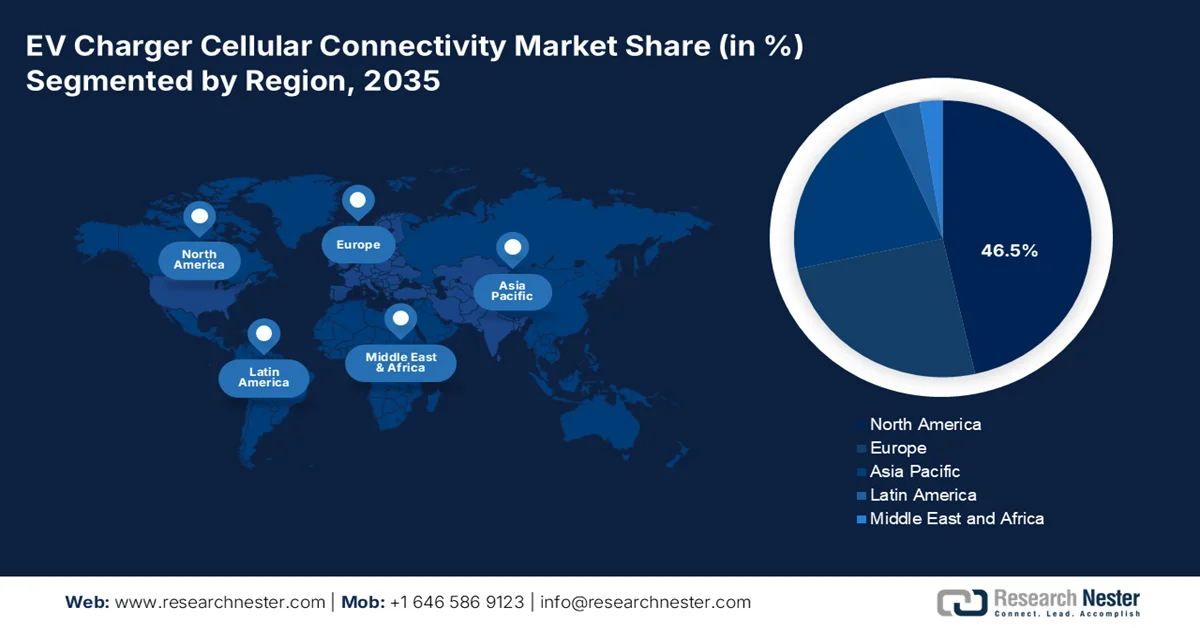
- North America isnticipa ated to command 46.5% of the EV charger cellular connectivity market by 2035, fueled by rapid infrastructure expansion supported by federal incentives and state-level zero-emission transportation mandates
- Asia Pacific is projected to witness the fastest growth in the market during 2026-2035, bolstered by massive government-backed electrification initiatives
Segment Insights:
- The hardware segment is projected to capture 82.5% of the EV charger cellular connectivity market by 2035, propelled by the increasing deployment of public charging infrastructure
- The charging network operators segment is expected to maintain a leading position throughout 2026-2035, attributed to the rapid expansion of public charging infrastructure
Key Growth Trends:
- Rising public investment through the U.S. charging
- Government funding for national EV charging infrastructure
Major Challenges:
- Network coverage gaps
- High module certification costs
Key Players: Sierra Wireless (Canada), Telit Cinterion (Germany), Thales Group (France), u-blox (Switzerland), SWTCH Energy (Canada), HeyCharge (Germany).
Global EV Charger Cellular Connectivity Market Forecast and Regional Outlook:
Market Size & Growth Projections:
- 2025 Market Size: USD 2.7 billion
- 2026 Market Size: USD 3.1 billion
- Projected Market Size: USD 9.7 billion by 2035
- Growth Forecasts: 13.6% CAGR (2026-2035)
Key Regional Dynamics:
- Largest Region: North America (46.5% share by 2035)
- Fastest Growing Region: Asia Pacific
- Dominating Countries: United States, China, Germany, Japan, South Korea
- Emerging Countries: India, Canada, United Kingdom, France, Australia
Last updated on : 24 July, 2026
EV Charger Cellular Connectivity Market - Growth Drivers and Challenges
Growth Drivers
- Rising public investment through the U.S. charging: The U.S. Department of Transportation September 2024 data depicts that USD 2.5 billion is allocated to support community and corridor charging projects. These investments expand charging coverage in urban, rural, and underserved regions where cellular connectivity often serves as the primary communications medium. As more charging sites are installed across geographically dispersed regions, demand for secure and resilient connectivity solutions continues to increase. Connectivity providers are therefore benefiting from a larger installed base of charging assets requiring long-term communication services and network management capabilities.
- Government funding for national EV charging infrastructure: Government spending on EV charging infrastructure remains one of the strongest demand drivers for EV charger cellular connectivity solutions. Public authorities are allocating substantial capital to expand charging networks, creating a corresponding need for reliable communications between chargers and backend management platforms. In the United States, the Department of Energy February 2022 announced USD 5 billion for EV charging deployment, supporting interconnected charging corridors nationwide. Each newly deployed public charger requires connectivity for remote monitoring, transaction processing, maintenance management, and performance reporting.
Challenges
- Network coverage gaps: Rural and underground parking sites often lack reliable cellular signals, causing transaction failures. Manufacturers must integrate multi-carrier modules or satellite backup. Sierra Wireless addresses this through dynamic carrier selection, while Telit Cinterion offers roaming-enabled chipsets that automatically switch networks to maintain continuous connectivity for charging sessions.
- High module certification costs: Cellular modules require expensive carrier and regulatory certifications across regions, delaying time-to-market. Thales Group streamlines this with pre-certified eSIM solutions, while u-blox provides globally approved module variants, reducing duplicate testing efforts for charger OEMs entering multiple international markets simultaneously.
EV Charger Cellular Connectivity Market Size and Forecast:
| Report Attribute | Details |
|---|---|
|
Base Year |
2025 |
|
Forecast Year |
2026-2035 |
|
CAGR |
13.6% |
|
Base Year Market Size (2025) |
USD 2.7 billion |
|
Forecast Year Market Size (2035) |
USD 9.7 billion |
|
Regional Scope |
|
EV Charger Cellular Connectivity Market Segmentation:
Component Segment Analysis
Under the component segment, the hardware is leading in the EV charger cellular connectivity market and is poised to hold the share value of 82.5% by the end of 2035. The segment is driven because every connected charging station requires embedded communication modules, routers, gateways, antennas, and SIM-enabled devices to enable real-time data exchange. As charging networks expand, operators prioritize reliable connectivity hardware to support remote monitoring, diagnostics, firmware updates, and payment processing. The increasing deployment of public charging infrastructure continues to drive demand for advanced communication equipment. According to the PBS January 2025 data, the United States had more than 203,000 public EV charging ports in 2025, highlighting the growing installed base that requires cellular connectivity hardware.
End user Segment Analysis
Charging network operators represent the leading end-user segment because they manage large fleets of connected chargers and rely heavily on cellular communication for station monitoring, maintenance, utilization tracking, and customer services. These operators require secure and scalable connectivity solutions to maintain charger uptime and support network-wide operations. The rapid expansion of public charging infrastructure is increasing demand for centralized connectivity management platforms. According to the GAO July 2025 data, the number of public EV charging stations in the United States exceeded 77,000 locations, reinforcing the need for robust cellular connectivity solutions among charging network operators.
Application Segment Analysis
Operation management is the leading application segment in the market because cellular connectivity is essential for real-time charger supervision, fault detection, predictive maintenance, software updates, and network performance optimization. Charging operators use connected systems to improve reliability, reduce downtime, and efficiently manage geographically distributed assets. As EV charging infrastructure scales, effective operational oversight becomes increasingly important. According to the U.S. Joint Office of Energy and Transportation, the National Electric Vehicle Infrastructure (NEVI) program had approved plans allocating EV charging deployment across states, supporting the expansion of connected charging networks that depend on advanced operation management capabilities.
Our in-depth analysis of the EV charger cellular connectivity includes the following segments:
|
Segment |
Subsegments |
|
Charging Site |
|
|
Component |
|
|
Charger Type |
|
|
Connectivity |
|
|
End user |
|
|
Application |
|

Vishnu Nair
Head - Global Business DevelopmentCustomize this report to your requirements — connect with our consultant for personalized insights and options.
EV Charger Cellular Connectivity Market - Regional Analysis
North America Market Insights
North America is dominating the EV charger cellular connectivity market and is expected to hold the regional revenue share of 46.5% by the end of 2035. The region is driven by the rapid infrastructure expansion driven by federal incentives and state-level mandates for zero-emission transportation. Manufacturers face a fragmented landscape where cellular coverage varies significantly between dense urban corridors and remote interstate highways, necessitating multi-network roaming capabilities. The market is heavily influenced by stringent cybersecurity and data privacy regulations, compelling suppliers to embed robust encryption directly into cellular modules. Additionally, interoperability with existing utility grids and payment ecosystems remains a priority, pushing companies toward software-defined connectivity solutions.
The continued investment in electric vehicle infrastructure and the increasing need for reliable communications across charging networks is shaping the EV charger cellular connectivity market in the U.S. Cellular connectivity is being integrated into charging stations to enable remote diagnostics, real-time monitoring, software management, and secure payment processing. Demand is particularly strong among charging network operators seeking scalable solutions for geographically dispersed assets. According to the Congress.gov June 2025 data, more than USD 3.3 billion in NEVI Formula Program funding had been made available to states to support the deployment of a nationwide EV charging network. This substantial public investment is accelerating charger installations and creating significant opportunities for cellular connectivity providers supporting network operations and asset management.
The increase investments in connected charging infrastructure to support the country's electrification goals is shaping the EV charger cellular connectivity market in Canada. Cellular connectivity is increasingly used to enable remote charger monitoring, maintenance management, payment processing, and network optimization, particularly in geographically dispersed locations where wired communications may be less practical. Growth is being supported by federal programs aimed at expanding public charging access across urban and rural regions. According to the Government of Canada March 2026, the federal government had deployed 84,500 chargers through funding commitments under the Zero Emission Vehicle Infrastructure Program (ZEVIP). This growing charging footprint is creating sustained demand for reliable cellular connectivity solutions across Canada's EV charging ecosystem.
APAC Market Insights
The Asia Pacific is set to grow rapidly in the market during the preferred period, 2026 to 2035. The region is driven by the extreme diversity, ranging from technologically advanced ecosystems in Japan and South Korea to rapidly expanding, cost-sensitive markets across Southeast Asia and India. Manufacturers must navigate fragmented telecom infrastructures, inconsistent 4G/5G rollouts, and varying regulatory frameworks across countries. The market is heavily influenced by massive government-backed electrification initiatives, pushing suppliers toward high-volume, low-cost module production. Urban mega-cities demand ultra-dense connectivity with low latency for smart-grid integration, while rural areas require extended coverage and power-efficient solutions.
The electric mobility infrastructure and increasing investments in digitally managed charging networks is shaping the EV charger cellular connectivity market in India. Cellular connectivity is becoming essential for charger monitoring, remote diagnostics, user authentication, payment processing, and integration with charge point management systems. The market is benefiting from government initiatives promoting EV adoption and public charging deployment across cities and highways. According to the DIYguru February 2026 data, India had over 26,000 public EV charging stations installed by early 2025, reflecting significant growth in charging infrastructure nationwide. As operators scale their networks and seek efficient management of distributed charging assets, demand for 4G and emerging 5G connectivity solutions is expected to strengthen across the Indian market.
The government's acceleration of the deployment of large-scale charging infrastructure across the country is driving the EV charger cellular connectivity market in China. Cellular connectivity is increasingly essential for managing charger networks, enabling remote monitoring, software updates, payment transactions, and real-time operational oversight. The market is benefiting from national initiatives aimed at supporting widespread EV adoption and improving charging accessibility. According to the People’s Republic of China October 2025 data, the country aims to establish a nationwide network of 28 million charging facilities by the end of 2027, with public charging capacity exceeding 300 million kilowatts, sufficient to serve more than 80 million EVs. This ambitious expansion is expected to significantly increase demand for cellular connectivity solutions across China's charging ecosystem.
Europe Market Insights
The Europe market is shaped by stringent regulatory frameworks, including the Alternative Fuels Infrastructure Regulation and GDPR-compliant data handling mandates. Manufacturers must ensure seamless cross-border roaming capabilities, as charging networks span multiple countries with diverse mobile operators. The market prioritizes interoperability and open standards, pushing suppliers toward modular, future-proof cellular designs that support V2G communication and smart-grid integration. Sustainability concerns drive demand for energy-efficient modules with extended lifecycles. Additionally, fierce competition from established telecom players and agile startups compels continuous innovation in security, latency reduction, and remote management.
The electric mobility infrastructure and the deployment of connected charging stations is driving the EV charger cellular connectivity market in Germany. Cellular connectivity is widely used to support remote charger monitoring, diagnostics, payment processing, software updates, and network management across public and private charging networks. According to the German Federal Network Agency (Bundesnetzagentur) January 2026 data, Germany had more than 161,000 publicly accessible charging points. The continued expansion of charging infrastructure is creating substantial opportunities for cellular connectivity providers, particularly as operators increasingly adopt digital management platforms to oversee large and geographically distributed charging networks.
The increasing electric vehicle adoption and nationwide decarbonization goals is driving the market in the UK. Cellular connectivity is a critical enabler for charger monitoring, remote maintenance, software updates, payment processing, and network management across public charging networks. Demand is increasing among charge point operators seeking reliable communication solutions for distributed charging assets. According to the Government of UK February 2025 data, the UK had 73,334 public EV charging devices installed. This continued expansion of charging infrastructure is driving greater adoption of cellular connectivity technologies to ensure efficient operation and management of charging networks throughout the country.
Key EV Charger Cellular Connectivity Market Players:
- Sierra Wireless (Canada)
- Telit Cinterion (Germany)
- Thales Group (France)
- u-blox (Switzerland)
- SWTCH Energy (Canada)
- HeyCharge (Germany)
- Company Overview
- Business Strategy
- Key Product Offerings
- Financial Performance
- Key Performance Indicators
- Risk Analysis
- Recent Development
- Regional Presence
- SWOT Analysis
- Sierra Wireless is a leading player in the market offers rugged LTE-M and 5G modules for EV charging, enabling cloud-based remote updates and load balancing. Their edge-computing approach reduces latency for authentication, ensuring reliable real-time connectivity while optimizing cellular bandwidth usage for charge point operators.
- Telit Cinterion delivers integrated GNSS and cellular modules in the in the market supporting multi-carrier roaming for cross-border charger networks. Their predictive maintenance platform monitors signal integrity, while hardware-based security protects payment transactions, making them ideal for public infrastructure requiring stable, always-on connectivity.
- Thales Group provides advanced eSIM and iSIM solutions in the market, enabling remote network-switching without physical SIM changes. Their cryptographic security facilitates secure vehicle-to-grid communication, ensuring authenticated transactions and seamless plug-and-charge experiences across diverse geographical regions.
- u-blox focuses on ultra-low-power cellular modules with power-saving modes, in the market ideal for off-grid solar-powered chargers. Their precise timing synchronization enables accurate energy logging, supporting smart-grid demand-response programs while extending equipment lifespan in energy-constrained deployment scenarios.
- SWTCH Energy deploys a software-driven connectivity platform that optimizes cellular data usage through intelligent scheduling in the market. Their remote troubleshooting and adaptive current management reduce on-site visits, enabling multi-tenant residential complexes to maximize charger uptime and operational efficiency.
The global market for EV charger cellular connectivity modules is moderately consolidated, dominated by a few key industrial IoT and telecommunications manufacturers that have leveraged existing cellular module expertise to capture significant share in the EV infrastructure sector. These leaders compete primarily on global carrier certifications, wide temperature range tolerances, and long-term supply commitments crucial for automotive-grade applications. Regional specialists in Europe and Asia are gaining traction with integrated GNSS and secure edge-computing features, differentiating through power efficiency and protocol stack customization.
Corporate Landscape of the Market:
Recent Developments
- In April 2026, SWTCH Energy announced the launch of SWTCH Tap™, which is a new capability within the SWTCH Cortex platform that lets drivers start a charging session with a single smartphone tap — even when a cellular signal is unavailable.
- In March 2026, HeyCharge announced HeyCharge Connect, which is a new product line of retrofit adapters designed to add smart energy management to existing EV chargers. The first product in the line, the MagicBox, targets home EV owners and fleet operators, and will be made available to Easee customers across the DACH region.
- Report ID: 6682
- Published Date: Jul 24, 2026
- Report Format: PDF, PPT
- Explore a preview of key market trends and insights
- Review sample data tables and segment breakdowns
- Experience the quality of our visual data representations
- Evaluate our report structure and research methodology
- Get a glimpse of competitive landscape analysis
- Understand how regional forecasts are presented
- Assess the depth of company profiling and benchmarking
- Preview how actionable insights can support your strategy
Explore real data and analysis
Frequently Asked Questions (FAQ)
About this Report
Connect with our Expert


Report, 2026-2035



Copyright @ 2026 Research Nester. All Rights Reserved.
