Esoteric Testing Market Outlook:
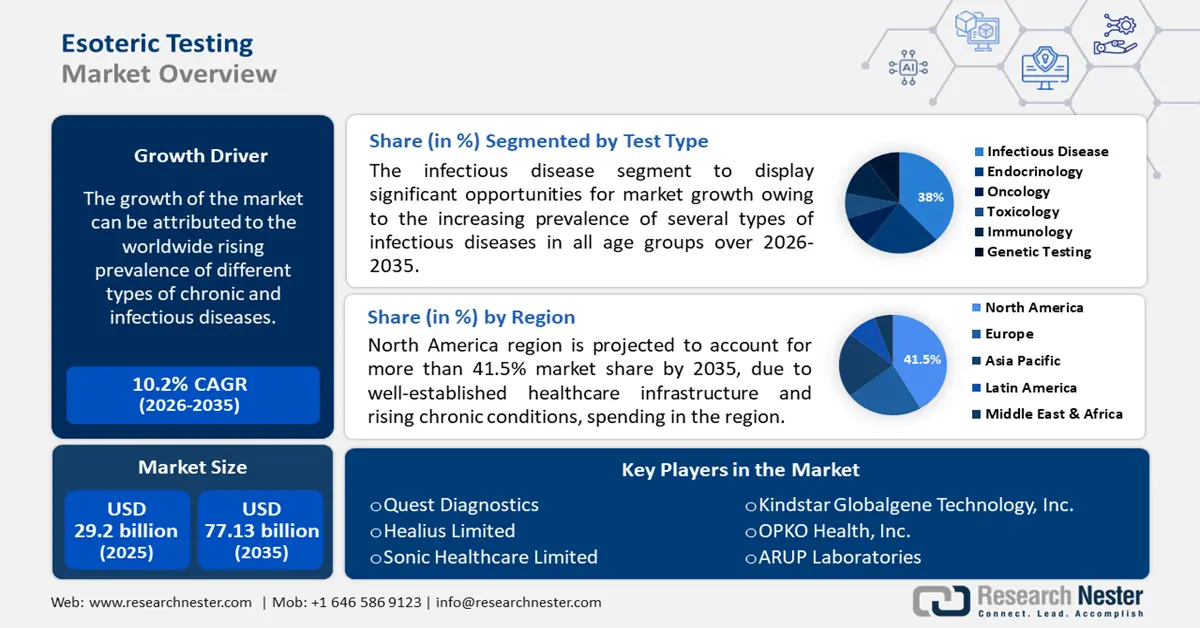
Esoteric Testing Market size was valued at USD 29.2 billion in 2025 and is expected to reach USD 77.13 billion by 2035, registering around 10.2% CAGR during the forecast period i.e., between 2026-2035. In the year 2026, the industry size of esoteric testing is evaluated at USD 31.88 billion.
The growth of the market can be attributed to the worldwide rising prevalence of different types of chronic and infectious diseases. For instance, the prevalence of chronic diseases increased globally by around 57% by the end of 2020. Further, the rapidly growing proportion of the aged population is also expected to add to the market growth. Since aged people are more prone to get infections and falling sick, hence this factor is estimated to dynamically propel the growth of the market in the coming years.
In addition to these, factors that are believed to fuel the market growth of esoteric testing include the soaring effectiveness and demand for enzyme-linked immunosorbent assay (ELISA) as of their high accuracy, coupled with the effectiveness of real-time polymerase chain reaction (RT-PCR) tests across the globe. For instance, based on a clinical study result, the RT-PCR sensitivity in LFIA assays {immunoglobulin G (IgG) and/or immunoglobulin M (IgM)} was nearly 0.67 {96% statistical interval (PrI): 0.63, 0.73}. In the initial week, IgG/M sensitivity was 0.32 (95% PrI:0.23; 0.41) and steadily increased. For the second and third weeks after symptom start, it was 0.75 (95% PrI: 0.67; 0.84) and 0.93 (96% PrI: 0.87; 0.98), respectively. Whereas, ELISA tests are nearly 99% accurate when combined with the confirmatory western blot test. Additionally, an expansion of funding from private and government bodies for diagnostic service centers, and technical breakthroughs in esoteric testing are predicted to present the potential for market expansion over the projected period.