Electric Powertrain Market Outlook:
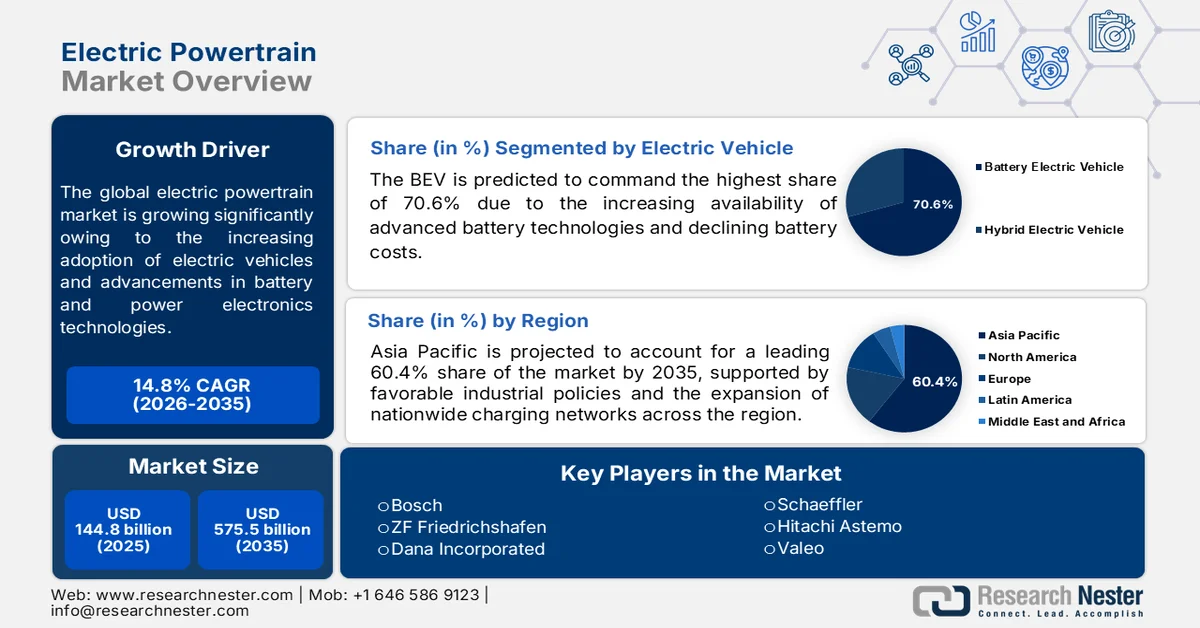
Electric Powertrain Market size was over USD 144.8 billion in 2025 and is projected to cross USD 575.5 billion by the end of 2035, growing at more than 14.8% CAGR during the forecast period i.e., between 2026-2035. In 2026, the industry size of electric powertrain is evaluated at USD 166.2 billion.
The electric powertrain market is projected for strong growth owing to the increasing adoption of electric vehicles and advancements in battery and power electronics technologies. In addition, rising demand for efficient and sustainable transportation solutions and supportive initiatives promoting vehicle electrification are positioning the market for sustained expansion. In January 2024, the U.S. Department of Energy (DOE) allocated almost USD 131 million to promote advancements in electric vehicle batteries, charging solutions, and domestic supply chains. This particular investment will help reduce EV costs, improve battery performance, expand driving range, and encourage the use of sustainable materials, thus elevating the growth potential of the market.
Furthermore, automakers are highly focused on developing advanced electric powertrain systems with improved performance, reliability, and energy efficiency in order to meet continuously evolving consumer preferences and regulatory requirements. Apart from this, surging investments in electric mobility infrastructure, continuous innovation in drivetrain components, and the expansion of electric vehicle applications are reshaping market dynamics. In July 2026, ABB completed the acquisition of Specialtrasfo S.p.A., a prominent manufacturer of specialized medium-voltage transformers, to strengthen its power solutions portfolio. The acquisition will help ABB meet rising global electricity demand by expanding transformer capabilities for industries such as energy, mining, metals, and industrial processing, thus denoting a positive market outlook.
Key Electric Powertrain Market Insights Summary:
Regional Highlights:
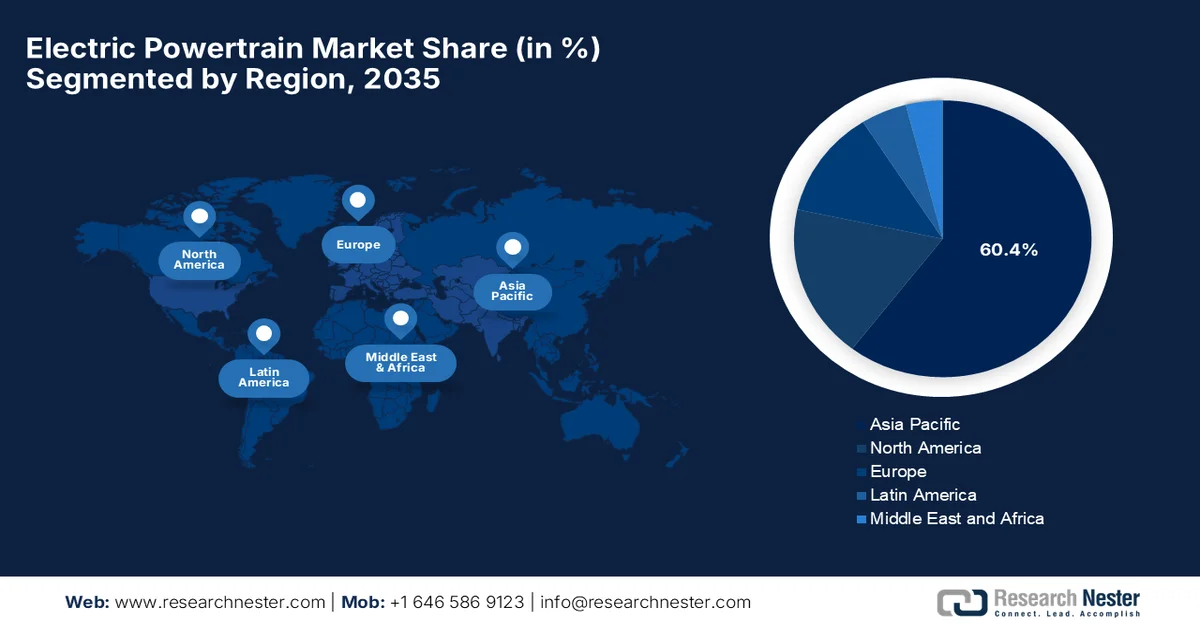
- Asia Pacific is projected to account for 60.4% of the electric powertrain market by 2035, underpinned by suitable government initiatives, including aggressive clean-energy subsidies, favorable industrial policies, and substantial investments in nationwide charging networks
- North America is poised to witness considerable growth throughout 2026-2035, supported by the continued expansion of domestic battery manufacturing and stringent emission regulations
Segment Insights:
- The BEV segment is anticipated to capture 70.6% of the electric powertrain market share by 2035, bolstered by the increasing availability of advanced battery technologies and declining battery costs
- The Battery segment is expected to secure a noteworthy share throughout 2026-2035, fueled by the rising demand for higher-capacity energy storage solutions, continuous advancements in battery chemistry, and efforts by automotive manufacturers to improve vehicle range and performance
Key Growth Trends:
- Growing demand for sustainable transportation
- Expansion of charging infrastructure
Major Challenges:
- Supply chain constraints for critical materials
- Technological complexity and integration challenges
Key Players: Bosch, ZF Friedrichshafen, Dana Incorporated, Schaeffler, Hitachi Astemo, Valeo, Nidec, Chery, Magna International.
Global Electric Powertrain Market Forecast and Regional Outlook:
Market Size & Growth Projections:
- 2025 Market Size: USD 144.8 billion
- 2026 Market Size: USD 166.2 billion
- Projected Market Size: USD 575.5 billion by 2035
- Growth Forecasts: 14.8% CAGR (2026-2035)
Key Regional Dynamics
- Largest Region: Asia Pacific (60.4% share by 2035)
- Fastest Growing Region: North America
- Dominating Countries: China, United States, Japan, Germany, South Korea
- Emerging Countries: India, Canada, United Kingdom, France, Thailand
Last updated on : 5 August, 2026
Electric Powertrain Market - Growth Drivers and Challenges
Growth Drivers
- Growing demand for sustainable transportation: The focus on sustainable transportation solutions is considered to be an important factor that is propelling the adoption of electric powertrains. Both organizations and governments are showcasing priority towards cleaner mobility alternatives in order to reduce environmental impact. This is creating remarkable growth opportunities for manufacturers in the market. In January 2025, the DOE’s Loan Programs Office announced a conditional commitment of up to USD 705.1 million to support Zum’s battery-electric school bus project with vehicle-to-grid technology. This particular project will deploy electric buses, charging infrastructure, and virtual power plant systems with a main goal of providing clean transportation, thus heightening demand for electric powertrains.
- Expansion of charging infrastructure: The expansion of electric vehicle charging infrastructure is supporting market growth by addressing range anxiety and improving EV accessibility. Investments in terms of public and private charging networks are encouraging more consumers and businesses to adopt electric vehicles. In May 2025, the Press Information Bureau (PIB) in May 2025 reported that India’s PM E-Drive scheme will generously invest around USD 230 million to develop around 72,000 public EV charging stations in cities, highways, airports, and industrial corridors. The initiative aims to strengthen EV adoption by creating a nationwide charging network and a unified digital platform for easy access to charging services, thus suitable for bolstering the market’s growth globally.
Challenges
- Supply chain constraints for critical materials: The availability and price volatility of all the essential raw materials are considered to be a major challenge for manufacturers in the market. Materials such as lithium, nickel, cobalt, copper, and rare earth elements are essential for producing batteries, electric motors, and power electronics. Therefore, any type of supply chain disruptions, cross-border uncertainties, mining limitations, and regional concentration of mineral processing capabilities can negatively impact production stability and increase manufacturing costs. In this context, companies are highly focused on securing long-term supply agreements and improving recycling capabilities in order to reduce dependency on limited resources.
- Technological complexity and integration challenges: The development of efficient electric powertrains requires proper integration of multiple technologies, which includes electric motors, power electronics, battery systems, software controls, and thermal management solutions. Achieving high efficiency and performance while reducing system weight and cost is a major challenge for the market globally. Manufacturers need to continuously innovate to improve charging speeds, driving range, energy density, and overall vehicle performance. In addition, compatibility issues between different vehicle platforms and electrification architectures can increase development complexity, thus causing hindrance to the market’s growth.
Electric Powertrain Market Size and Forecast:
| Report Attribute | Details |
|---|---|
|
Base Year |
2025 |
|
Forecast Year |
2026-2035 |
|
CAGR |
14.8% |
|
Base Year Market Size (2025) |
USD 144.8 billion |
|
Forecast Year Market Size (2035) |
USD 575.5 billion |
|
Regional Scope |
|
Electric Powertrain Market Segmentation:
Electric Vehicle Segment Analysis
The BEV is predicted to command the highest share of 70.6% in the electric vehicle segment during the assessed timeframe. The segment’s dominant position in the electric powertrain market is propelled mainly by the increasing availability of advanced battery technologies and declining battery costs. In addition, improvements in driving range, charging capabilities, and vehicle performance are enhancing consumer acceptance of BEVs in different applications. In August 2026, Maruti Suzuki reported that it started production of its first battery electric vehicle (BEV), e VITARA, in Gujarat, with plans to export it to more than 100 countries. The company has also gained local manufacturing of lithium-ion battery cells and electrodes in India, thus strengthening the country’s EV and hybrid vehicle supply chain.
Component Segment Analysis
The battery, which is under the component segment, is forecasted to hold a noteworthy share from 2026 to 2035 in the electric powertrain market. The segment’s growth is attributable to the rising demand for higher-capacity energy storage solutions, continuous advancements in battery chemistry, and efforts by automotive manufacturers to improve vehicle range and performance. On the other hand, recycling technologies and localized supply chains are supporting the expansion of battery production for electric vehicles. In July 2025, Panasonic Energy inaugurated and started mass production at its new lithium-ion battery factory in Kansas, with a planned annual capacity of 32 GWh to support EV growth. The facility is one of North America’s largest EV battery plants and will significantly expand Panasonic’s U.S.-based battery production capacity, thus denoting a wider segment scope.
Vehicle Type Segment Analysis
By 2035, passenger cars are expected to hold a lucrative share in the electric powertrain market due to rapid adoption of electric vehicles and increasing government support for zero-emission mobility. Besides advancements in battery technology, declining battery costs, and rising consumer demand for vehicles with improved driving range, performance, and lower operating costs are positioning the sub-segment for extensive growth in the upcoming years. Automakers are also accelerating investments in EV platforms and next-generation electric powertrain systems, which include more efficient motors, inverters, and battery management technologies, thereby supporting growth in the passenger car segment.
Global Export Statistics of Electric Motors and Generators by Leading Exporting Countries, 2024
|
Exporting Country |
Export Value (1000 USD) |
Quantity (Items) |
|
China |
15,772,997.88 |
2,741,550,000 |
|
European Union |
10,024,989.14 |
175,161,000 |
|
Germany |
8,825,686.97 |
- |
|
U.S. |
5,168,626.79 |
47,708,900 |
|
Mexico |
4,669,566.06 |
- |
|
Japan |
3,520,577.63 |
107,858,000 |
|
France |
2,824,674.98 |
- |
|
Italy |
2,231,365.21 |
66,014,500 |
|
Hungary |
2,138,306.37 |
28,541,800 |
|
Switzerland |
1,859,666.84 |
123,925,000 |
Source: WITS
Our in-depth analysis of the electric powertrain market includes the following segments:
|
Segment |
Subsegments |
|
Electric Vehicle |
|
|
Component |
|
|
Vehicle Type |
|

Vishnu Nair
Head - Global Business DevelopmentCustomize this report to your requirements — connect with our consultant for personalized insights and options.
Electric Powertrain Market - Regional Analysis
APAC Market Insights
Asia Pacific electric powertrain market is anticipated to grow with the highest share of 60.4% during the forecast period. The region’s dominance is effectively driven by suitable government initiatives, which include aggressive clean-energy subsidies, favorable industrial policies, and substantial investments in nationwide charging networks. Asia Pacific also benefits from a dominant domestic supply chain, hosting the world's leading rare-earth element suppliers and raw material processors, which streamlines production logistics for local automakers. In October 2023, the Ministry of Economy, Trade and Industry released certain guidelines for promoting the development of EV charging infrastructure in order to support the country's goal of making all new passenger vehicle sales electrified by 2035. The factors are highly focused on creating a convenient and sustainable charging network by doubling the EV charger target, installing higher-power chargers, and thus providing a positive outlook for electric powertrains.
The strong government support, favorable consumer adoption rates, and a prominent manufacturing ecosystem are responsibly uplifting the market in China. The country’s market is making a shift toward highly integrated powertrain systems such as 3-in-1 and 8-in-1 architectures, which combine the motor, inverter, and gearbox to enhance vehicle efficiency, reduce overall weight, and lower production costs. Based on government data published in April 2025, China aims to make pure electric vehicles the mainstream of new car sales by 2035 as part of its strategy to integrate transport infrastructure with renewable energy systems. In addition, this particular policy deliberately promotes the adoption of new energy heavy-duty trucks, green fuels, and clean energy use in roads, railways, ports, aviation, and logistics.
The India market is gaining enhanced traction, which is facilitated by government manufacturing incentives and localized production initiatives. The country’s market also benefits from the two-wheel and three-wheel vehicle categories, which dominate the country's electric mobility transition due to their affordability and commercial utility. Domestic manufacturers and component suppliers are focusing on localizing the production of traction motors, motor controllers, and battery packs with a main goal of reducing import dependencies and lowering vehicle costs. In this context, the Press Information Bureau (PIB) in February 2026 stated that India is proactively promoting electric vehicle adoption through initiatives such as the FAME-II, PM E-DRIVE, PLI Auto, PLI ACC Battery, PM e-Bus Sewa, and SPMEPCI schemes, which provide suitable incentives for EV manufacturing, battery production, vehicle purchases, and electric bus deployment.
India Export Statistics of Electric Motor & Generator Parts by Country, 2024 - WITS Trade Data Analysis
|
Partner Country |
Trade Value (1000 USD) |
|
World |
1,274,747.09 |
|
U.S. |
333,177.41 |
|
Germany |
230,670.74 |
|
Greece |
91,702.76 |
|
Finland |
88,123.92 |
|
South Africa |
69,214.19 |
|
Turkey |
53,264.75 |
|
Italy |
40,155.95 |
|
Sweden |
34,483.89 |
Source: WITS
North America Market Insights
North America electric powertrain market is expected to grow at a considerable rate during the stipulated timeframe. The region benefits from the continued expansion of domestic battery manufacturing and stringent emission regulations. Automakers are making strong investments in localizing supply chains in order to comply with regional trade agreements and secure tax incentives, in turn leading to the construction of numerous gigafactories. In this context, in December 2023, Toyota Motor North America entered into a partnership with Cirba Solutions to solidify its electric vehicle battery recycling network and support the development of a sustainable, closed-loop battery ecosystem. Besides, this collaboration covers the collection, transportation, storage, testing, dismantling, and recycling of end-of-life batteries from hybrid electric vehicles, plug-in hybrid electric vehicles, and battery electric vehicles.
The emergence of strict localized sourcing directives and a booming rise in hybrid propulsion demand are fueling growth in the U.S. market. Innovations are highly optimized for full-size pickup trucks, commercial delivery vans, and large utility vehicles that require high-torque dual-motor setups and robust e-axles. For instance, Ford, in April 2024, announced that it was adjusting the launch schedule for upcoming electric vehicles while continuing to invest in EV manufacturing and expanding its hybrid vehicle lineup to meet changing customer demand. In addition, the company reaffirmed its focus on developing next-generation, software-enabled electric vehicles while increasing hybrid offerings across its regional portfolio.
The Canada market is gaining enhanced traction, which is propelled by its position as a major supplier of critical battery materials and specialized electric drive components. The country is establishing a vertically integrated supply chain that is structured around processing domestic lithium, nickel, and cobalt to be used in advanced anode and cathode manufacturing. Based on government data published in July 2026, Canada has implemented a strategy to accelerate electric vehicle adoption through purchase incentives, charging infrastructure, public awareness initiatives, and surging investments in research and development. Besides, the government is also highly focused on strengthening the EV value chain by supporting battery production, critical minerals, and advanced automotive technologies.
Europe Market Insights
The Europe electric powertrain market is projected to attain a noteworthy share during the forecast period. The region benefits from a strict regulatory push toward zero-emission transportation. In addition, the regional manufacturers are pioneering circular economy initiatives, with an intense focus on sustainable powertrain design, rare-earth-free synchronous motors, and closed-loop recycling for stator and rotor materials. In June 2026, the European Federation for Transport and Environment stated that a coalition of industry groups and civil society organizations urged accelerating vehicle electrification rather than only reducing climate ambitions. The report also outlined that electric vehicles can reduce oil dependency, improve energy security, and support Europe’s economic resilience.
The country’s strong automotive manufacturing base and growing focus on sustainable mobility solutions are positioning Germany market for extensive growth. The country’s market is also supported by investments in domestic battery production, charging infrastructure expansion, and collaborations between vehicle manufacturers and technology providers to strengthen the local EV ecosystem. Germany, in May 2026, launched a new electric vehicle subsidy portal providing financial support of up to USD 6,000 for low-income households purchasing or leasing eligible electric cars. Besides, the USD 3 billion program aims to support around 800,000 vehicles by 2029 and thereby encourage wider EV adoption and reduce transport emissions.
The UK market is growing exponentially, with an intense focus on high-performance engineering, lightweight vehicle architectures, and academic-industrial research collaboration. The market is also supported by national research centers and catapult programs that efficiently fast-track laboratory innovations into commercial power electronics and advanced battery pack integration. Based on government data published in December 2025, Mercedes announced a generous investment of USD 26.8 million in a UK-Germany electric vehicle technology project expected to create over 150 jobs across Northamptonshire and Oxfordshire. The initiative is supported by USD 13.4 million in UK government funding and will develop advanced electric drive systems for high-performance EVs, thus strengthening the automotive supply chain.
Key Electric Powertrain Market Players:
- Bosch (Germany)
- ZF Friedrichshafen (Germany)
- Dana Incorporated (U.S.)
- Schaeffler (Germany)
- Hitachi Astemo (Japan)
- Valeo (France)
- Nidec (Japan)
- Chery (China)
- Magna International (Canada)
- Company Overview
- Business Strategy
- Key Product Offerings
- Financial Performance
- Key Performance Indicators
- Risk Analysis
- Recent Development
- Regional Presence
- SWOT Analysis
- Bosch is leading in this market by offering integrated electrification solutions for passenger vehicles, commercial vehicles, and off-highway applications. The company achieved such a strong position, which is propelled by its global automotive OEM partnerships, extensive engineering capabilities, and focus on scalable electrification platforms.
- ZF Friedrichshafen is a major global supplier of electrified powertrain systems which is specializing in electric drives, e-axles, and integrated propulsion technologies for electric and hybrid vehicles. The firm benefits from its expertise in driveline systems and vehicle technologies to support automakers in developing electric vehicles.
- Dana Incorporated is a prominent manufacturer of electric powertrain solutions, and it has been providing integrated e-Drive systems, electric motors, thermal management technologies, and drivetrain solutions. The company is highly focused on strategic investments in advanced propulsion technologies and development capabilities.
- Schaeffler is a leading automotive technology manufacturer which is providing electric axles, electric motors, hybrid modules, and complete e-mobility solutions. The company boasts knowledge in terms of mechanical systems and electrification technologies to develop efficient propulsion systems for electric vehicles.
- Hitachi Astemo is a significant player in the market that is developing electric motors, inverters, and electrification systems. The company combines Hitachi’s technology expertise with automotive system capabilities to deliver advanced mobility solutions focused on reliability and performance.
Here is a list of key players operating in the global market:
The global electric powertrain market is hosting leading automotive technology manufacturers contending through integrated e-drive systems, e-axles, electric motors, and complete propulsion solutions. Global players such as Bosch, ZF, Dana, and Schaeffler captured strong positions in this sector which is through extensive OEM partnerships, advanced electrification capabilities, and broad geographic coverage. Apart from this, regional manufacturers are also expanding their presence, which is supported by rising EV production and localization initiatives. In June 2026, Dana Incorporated announced an agreement to combine with Eaton’s Mobility business to create a stronger global powertrain systems provider with expanded capabilities across commercial and light vehicle markets. This combination will integrate Dana’s powertrain, thermal, and sealing technologies with Eaton Mobility’s transmissions, electrification solutions, and advanced vehicle systems.
Corporate Landscape of the Market:
Recent Developments
- In July 2026, Magna announced a new partnership with Chery through a new 800V 2-speed eDrive powertrain program, which is aimed at improving EV performance and efficiency. This 250kW eDrive technology will be manufactured at Magna’s Wuhu facility in China, thereby enabling faster local production.
- In March 2026, Valeo inaugurated a new electric powertrain manufacturing line in Pune, India to produce advanced 3-in-1 e-Axles that integrate the motor, inverter, and reducer into a compact system. This facility will support Mahindra’s Born Electric platform, thereby enhancing local production capabilities for EV powertrain solutions.
- Report ID: 8716
- Published Date: Aug 05, 2026
- Report Format: PDF, PPT
- Explore a preview of key market trends and insights
- Review sample data tables and segment breakdowns
- Experience the quality of our visual data representations
- Evaluate our report structure and research methodology
- Get a glimpse of competitive landscape analysis
- Understand how regional forecasts are presented
- Assess the depth of company profiling and benchmarking
- Preview how actionable insights can support your strategy
Explore real data and analysis
Frequently Asked Questions (FAQ)
About this Report
Connect with our Expert


Report, 2026-2035



Copyright @ 2026 Research Nester. All Rights Reserved.
