Global Electric Ambulatory Infusion Pumps Market
- An Outline of the Global Electric Ambulatory Infusion Pumps Market
1.1. Market Definition and Segmentation
1.2. Study Assumptions and Abbreviations
- Research Methodology & Approach
2.1. Primary Research
2.2. Secondary Research
2.3. Data Triangulation
2.4. SPSS Methodology
- Executive Summary
- Growth Drivers
- Major Roadblocks
- Opportunities
- Prevalent Trends
- Government Regulation
- Growth Outlook
- Competitive White Space Analysis – Identifying Untapped Market Gaps
- Risk Overview
- SWOT
- Technological Advancement
- Technology Maturity Matrix for the Electric Ambulatory Infusion Pumps Market: Recent News
- Regional Demand
- Global Electric Ambulatory Infusion Pumps by Geography – Strategic Comparative Analysis
- Strategic Segment Analysis: Electric Ambulatory Infusion Pumps Demand Landscape
- Electric Ambulatory Infusion Pumps Demand Trends Driven by growing adoption of remote patient monitoring and telehealth integration and increasing use of ambulatory pumps for specialty biologics and precision medicine. (2027-2036)
- Root Cause Analysis (RCA) for discovering problems of the Electric Ambulatory Infusion Pumps Market
- Porter Five Forces
- PESTLE
- Comparative Positioning
- Global Electric Ambulatory Infusion Pumps – Key Player Analysis (2036)
- Competitive Landscape: Key Suppliers/Players
- Competitive Model: A Detailed Inside View for Investors
- Company Market Share, 2036 (%)
26.1. Shenzhen Mindray Bio-Medical Electronics Co., Ltd.
26.2. B. Braun Medical Inc.
26.3. Baxter
26.4. Fresenius Kabi AG
26.5. Terumo Medical Corporation
26.6. ICU Medical, Inc.
26.7. Medcaptain Medical Technology Co., Ltd.
26.8. Eitan Medical
26.9. Ace Medical
26.10. Vygon
26.11. Micrel Medical Devices SA
26.12. IHT
26.13. Applied Medical Technology
- Global Electric Ambulatory Infusion Pumps Market Outlook
27.1. Market Overview
27.1.1. Market Revenue by Value (USD Million) and Compound Annual Growth Rate (CAGR)
27.2. Electric Ambulatory Infusion Pumps Market Segmentation Analysis (2027-2036)
27.2.1. By Application
27.2.1.1. Chemotherapy, Market Value (USD Million), and CAGR, 2027-2036F
27.2.1.2. Anesthesia, Market Value (USD Million), and CAGR, 2027-2036F
27.2.1.3. Acute Pain Management, Market Value (USD Million), and CAGR, 2027-2036F
27.2.1.4. Palliative Care, Market Value (USD Million), and CAGR, 2027-2036F
27.2.1.5. Others, Market Value (USD Million), and CAGR, 2027-2036F
27.2.2. By End user
27.2.2.1. Hospital, Market Value (USD Million), and CAGR, 2027-2036F
27.2.2.1.1. Public, Market Value (USD Million), and CAGR, 2027-2036F
27.2.2.1.2. Private, Market Value (USD Million), and CAGR, 2027-2036F
27.2.2.2. Clinics, Market Value (USD Million), and CAGR, 2027-2036F
27.2.2.2.1. Oncology Clinics, Market Value (USD Million), and CAGR, 2027-2036F
27.2.2.2.2. Day-care Surgery Centers, Market Value (USD Million), and CAGR, 2027-2036F
27.2.2.3. Others, Market Value (USD Million), and CAGR, 2027-2036F
27.2.3. By Product Features
27.2.3.1. Functional Capability, Market Value (USD Million), and CAGR, 2027-2036F
27.2.3.1.1. Single-channel PCA Pumps, Market Value (USD Million), and CAGR, 2027-2036F
27.2.3.1.2. Multi-channel PCA Pumps, Market Value (USD Million), and CAGR, 2027-2036F
27.2.3.2. Control & Safety Features, Market Value (USD Million), and CAGR, 2027-2036F
27.2.3.2.1. Lockout Interval Control, Market Value (USD Million), and CAGR, 2027-2036F
27.2.3.2.2. Dose Error Reduction Systems, Market Value (USD Million), and CAGR, 2027-2036F
27.2.3.2.3. Others, Market Value (USD Million), and CAGR, 2027-2036F
27.2.3.3. Power & Portability, Market Value (USD Million), and CAGR, 2027-2036F
27.2.3.3.1. Rechargeable Battery-powered Pumps, Market Value (USD Million), and CAGR, 2027-2036F
27.2.3.3.2. Rechargeable Battery-powered Pumps, Market Value (USD Million), and CAGR, 2027-2036F
27.2.3.4. Software & Connectivity, Market Value (USD Million), and CAGR, 2027-2036F
27.2.3.4.1. Standalone Pumps, Market Value (USD Million), and CAGR, 2027-2036F
27.2.3.4.2. Connected/Smart Pumps, Market Value (USD Million), and CAGR, 2027-2036F
27.2.4. By Distribution Channel
27.2.4.1. Direct Sales, Market Value (USD Million), and CAGR, 2027-2036F
27.2.4.2. Distributor, Market Value (USD Million), and CAGR, 2027-2036F
27.2.4.3. Others, Market Value (USD Million), and CAGR, 2027-2036F
27.2.5. Regional Synopsis, Value (USD Million), 2027-2036
27.2.5.1. North America Market Value (USD Million) and CAGR & Y-o-Y Growth Trend, 2027-2036F
27.2.5.2. Europe Market Value (USD Million) and CAGR & Y-o-Y Growth Trend, 2027-2036F
27.2.5.3. Asia Pacific, excluding Japan Market Value (USD Million) and CAGR & Y-o-Y Growth Trend, 2027-2036F
27.2.5.4. Latin America Market Value (USD Million) and CAGR & Y-o-Y Growth Trend, 2027-2036F
27.2.5.5. Middle East and Africa Market Value (USD Million) and CAGR & Y-o-Y Growth Trend, 2027-2036F
- North America Market
28.1. Overview
28.1.1. Market Value (USD Million), Current and Future Projections, 2027-2036
28.1.2. Increment $ Opportunity Assessment, 2027-2036
28.2. Segmentation (USD Million), 2027-2036, By
28.2.1. By Application
28.2.1.1. Chemotherapy, Market Value (USD Million), and CAGR, 2027-2036F
28.2.1.2. Anesthesia, Market Value (USD Million), and CAGR, 2027-2036F
28.2.1.3. Acute Pain Management, Market Value (USD Million), and CAGR, 2027-2036F
28.2.1.4. Palliative Care, Market Value (USD Million), and CAGR, 2027-2036F
28.2.1.5. Others, Market Value (USD Million), and CAGR, 2027-2036F
28.2.2. By End user
28.2.2.1. Hospital, Market Value (USD Million), and CAGR, 2027-2036F
28.2.2.1.1. Public, Market Value (USD Million), and CAGR, 2027-2036F
28.2.2.1.2. Private, Market Value (USD Million), and CAGR, 2027-2036F
28.2.2.2. Clinics, Market Value (USD Million), and CAGR, 2027-2036F
28.2.2.2.1. Oncology Clinics, Market Value (USD Million), and CAGR, 2027-2036F
28.2.2.2.2. Day-care Surgery Centers, Market Value (USD Million), and CAGR, 2027-2036F
28.2.2.3. Others, Market Value (USD Million), and CAGR, 2027-2036F
28.2.3. By Product Features
28.2.3.1. Functional Capability, Market Value (USD Million), and CAGR, 2027-2036F
28.2.3.1.1. Single-channel PCA Pumps, Market Value (USD Million), and CAGR, 2027-2036F
28.2.3.1.2. Multi-channel PCA Pumps, Market Value (USD Million), and CAGR, 2027-2036F
28.2.3.2. Control & Safety Features, Market Value (USD Million), and CAGR, 2027-2036F
28.2.3.2.1. Lockout Interval Control, Market Value (USD Million), and CAGR, 2027-2036F
28.2.3.2.2. Dose Error Reduction Systems, Market Value (USD Million), and CAGR, 2027-2036F
28.2.3.2.3. Others, Market Value (USD Million), and CAGR, 2027-2036F
28.2.3.3. Power & Portability, Market Value (USD Million), and CAGR, 2027-2036F
28.2.3.3.1. Rechargeable Battery-powered Pumps, Market Value (USD Million), and CAGR, 2027-2036F
28.2.3.3.2. Rechargeable Battery-powered Pumps, Market Value (USD Million), and CAGR, 2027-2036F
28.2.3.4. Software & Connectivity, Market Value (USD Million), and CAGR, 2027-2036F
28.2.3.4.1. Standalone Pumps, Market Value (USD Million), and CAGR, 2027-2036F
28.2.3.4.2. Connected/Smart Pumps, Market Value (USD Million), and CAGR, 2027-2036F
28.2.4. By Distribution Channel
28.2.4.1. Direct Sales, Market Value (USD Million), and CAGR, 2027-2036F
28.2.4.2. Distributor, Market Value (USD Million), and CAGR, 2027-2036F
28.2.4.3. Others, Market Value (USD Million), and CAGR, 2027-2036F
28.2.5. Country Level Analysis, Value (USD Million)
28.2.5.1. U.S. Market Value (USD Million) and CAGR & Y-o-Y Growth Trend, 2027-2036F
28.2.5.2. Canada Market Value (USD Million) and CAGR & Y-o-Y Growth Trend, 2027-2036F
- Europe Market
29.1. Overview
29.1.1. Market Value (USD Million), Current and Future Projections, 2027-2036
29.1.2. Increment $ Opportunity Assessment, 2027-2036
29.2. Segmentation (USD Million), 2027-2036, By
29.2.1. By Application
29.2.1.1. Chemotherapy, Market Value (USD Million), and CAGR, 2027-2036F
29.2.1.2. Anesthesia, Market Value (USD Million), and CAGR, 2027-2036F
29.2.1.3. Acute Pain Management, Market Value (USD Million), and CAGR, 2027-2036F
29.2.1.4. Palliative Care, Market Value (USD Million), and CAGR, 2027-2036F
29.2.1.5. Others, Market Value (USD Million), and CAGR, 2027-2036F
29.2.2. By End user
29.2.2.1. Hospital, Market Value (USD Million), and CAGR, 2027-2036F
29.2.2.1.1. Public, Market Value (USD Million), and CAGR, 2027-2036F
29.2.2.1.2. Private, Market Value (USD Million), and CAGR, 2027-2036F
29.2.2.2. Clinics, Market Value (USD Million), and CAGR, 2027-2036F
29.2.2.2.1. Oncology Clinics, Market Value (USD Million), and CAGR, 2027-2036F
29.2.2.2.2. Day-care Surgery Centers, Market Value (USD Million), and CAGR, 2027-2036F
29.2.2.3. Others, Market Value (USD Million), and CAGR, 2027-2036F
29.2.3. By Product Features
29.2.3.1. Functional Capability, Market Value (USD Million), and CAGR, 2027-2036F
29.2.3.1.1. Single-channel PCA Pumps, Market Value (USD Million), and CAGR, 2027-2036F
29.2.3.1.2. Multi-channel PCA Pumps, Market Value (USD Million), and CAGR, 2027-2036F
29.2.3.2. Control & Safety Features, Market Value (USD Million), and CAGR, 2027-2036F
29.2.3.2.1. Lockout Interval Control, Market Value (USD Million), and CAGR, 2027-2036F
29.2.3.2.2. Dose Error Reduction Systems, Market Value (USD Million), and CAGR, 2027-2036F
29.2.3.2.3. Others, Market Value (USD Million), and CAGR, 2027-2036F
29.2.3.3. Power & Portability, Market Value (USD Million), and CAGR, 2027-2036F
29.2.3.3.1. Rechargeable Battery-powered Pumps, Market Value (USD Million), and CAGR, 2027-2036F
29.2.3.3.2. Rechargeable Battery-powered Pumps, Market Value (USD Million), and CAGR, 2027-2036F
29.2.3.4. Software & Connectivity, Market Value (USD Million), and CAGR, 2027-2036F
29.2.3.4.1. Standalone Pumps, Market Value (USD Million), and CAGR, 2027-2036F
29.2.3.4.2. Connected/Smart Pumps, Market Value (USD Million), and CAGR, 2027-2036F
29.2.4. By Distribution Channel
29.2.4.1. Direct Sales, Market Value (USD Million), and CAGR, 2027-2036F
29.2.4.2. Distributor, Market Value (USD Million), and CAGR, 2027-2036F
29.2.4.3. Others, Market Value (USD Million), and CAGR, 2027-2036F
29.2.5. Country Level Analysis, Value (USD Million)
29.2.5.1. UK Market Value (USD Million) and CAGR & Y-o-Y Growth Trend, 2027-2036F
29.2.5.2. Germany Market Value (USD Million) and CAGR & Y-o-Y Growth Trend, 2027-2036F
29.2.5.3. France Market Value (USD Million) and CAGR & Y-o-Y Growth Trend, 2027-2036F
29.2.5.4. Italy Market Value (USD Million) and CAGR & Y-o-Y Growth Trend, 2027-2036F
29.2.5.5. Spain Market Value (USD Million) and CAGR & Y-o-Y Growth Trend, 2027-2036F
29.2.5.6. Netherlands Market Value (USD Million) and CAGR & Y-o-Y Growth Trend, 2027-2036F
29.2.5.7. Russia Market Value (USD Million) and CAGR & Y-o-Y Growth Trend, 2027-2036F
29.2.5.8. Switzerland Market Value (USD Million) and CAGR & Y-o-Y Growth Trend, 2027-2036F
29.2.5.9. Poland Market Value (USD Million) and CAGR & Y-o-Y Growth Trend, 2027-2036F
29.2.5.10. Belgium Market Value (USD Million) and CAGR & Y-o-Y Growth Trend, 2027-2036F
29.2.5.11. Rest of Europe Market Value (USD Million) and CAGR & Y-o-Y Growth Trend, 2027-2036F
- Asia Pacific Market
30.1. Overview
30.1.1. Market Value (USD Million), Current and Future Projections, 2027-2036
30.1.2. Increment $ Opportunity Assessment, 2027-2036
30.2. Segmentation (USD Million), 2027-2036, By
30.2.1. By Application
30.2.1.1. Chemotherapy, Market Value (USD Million), and CAGR, 2027-2036F
30.2.1.2. Anesthesia, Market Value (USD Million), and CAGR, 2027-2036F
30.2.1.3. Acute Pain Management, Market Value (USD Million), and CAGR, 2027-2036F
30.2.1.4. Palliative Care, Market Value (USD Million), and CAGR, 2027-2036F
30.2.1.5. Others, Market Value (USD Million), and CAGR, 2027-2036F
30.2.2. By End user
30.2.2.1. Hospital, Market Value (USD Million), and CAGR, 2027-2036F
30.2.2.1.1. Public, Market Value (USD Million), and CAGR, 2027-2036F
30.2.2.1.2. Private, Market Value (USD Million), and CAGR, 2027-2036F
30.2.2.2. Clinics, Market Value (USD Million), and CAGR, 2027-2036F
30.2.2.2.1. Oncology Clinics, Market Value (USD Million), and CAGR, 2027-2036F
30.2.2.2.2. Day-care Surgery Centers, Market Value (USD Million), and CAGR, 2027-2036F
30.2.2.3. Others, Market Value (USD Million), and CAGR, 2027-2036F
30.2.3. By Product Features
30.2.3.1. Functional Capability, Market Value (USD Million), and CAGR, 2027-2036F
30.2.3.1.1. Single-channel PCA Pumps, Market Value (USD Million), and CAGR, 2027-2036F
30.2.3.1.2. Multi-channel PCA Pumps, Market Value (USD Million), and CAGR, 2027-2036F
30.2.3.2. Control & Safety Features, Market Value (USD Million), and CAGR, 2027-2036F
30.2.3.2.1. Lockout Interval Control, Market Value (USD Million), and CAGR, 2027-2036F
30.2.3.2.2. Dose Error Reduction Systems, Market Value (USD Million), and CAGR, 2027-2036F
30.2.3.2.3. Others, Market Value (USD Million), and CAGR, 2027-2036F
30.2.3.3. Power & Portability, Market Value (USD Million), and CAGR, 2027-2036F
30.2.3.3.1. Rechargeable Battery-powered Pumps, Market Value (USD Million), and CAGR, 2027-2036F
30.2.3.3.2. Rechargeable Battery-powered Pumps, Market Value (USD Million), and CAGR, 2027-2036F
30.2.3.4. Software & Connectivity, Market Value (USD Million), and CAGR, 2027-2036F
30.2.3.4.1. Standalone Pumps, Market Value (USD Million), and CAGR, 2027-2036F
30.2.3.4.2. Connected/Smart Pumps, Market Value (USD Million), and CAGR, 2027-2036F
30.2.4. By Distribution Channel
30.2.4.1. Direct Sales, Market Value (USD Million), and CAGR, 2027-2036F
30.2.4.2. Distributor, Market Value (USD Million), and CAGR, 2027-2036F
30.2.4.3. Others, Market Value (USD Million), and CAGR, 2027-2036F
30.2.5. Country Level Analysis, Value (USD Million)
30.2.5.1. China Market Value (USD Million) and CAGR & Y-o-Y Growth Trend, 2027-2036F
30.2.5.2. Japan Market Value (USD Million) and CAGR & Y-o-Y Growth Trend, 2027-2036F
30.2.5.3. India Market Value (USD Million) and CAGR & Y-o-Y Growth Trend, 2027-2036F
30.2.5.4. South Korea Market Value (USD Million) and CAGR & Y-o-Y Growth Trend, 2027-2036F
30.2.5.5. Australia Market Value (USD Million) and CAGR & Y-o-Y Growth Trend, 2027-2036F
30.2.5.6. Indonesia Market Value (USD Million) and CAGR & Y-o-Y Growth Trend, 2027-2036F
30.2.5.7. Malaysia Market Value (USD Million) and CAGR & Y-o-Y Growth Trend, 2027-2036F
30.2.5.8. Vietnam Market Value (USD Million) and CAGR & Y-o-Y Growth Trend, 2027-2036F
30.2.5.9. Thailand Market Value (USD Million) and CAGR & Y-o-Y Growth Trend, 2027-2036F
30.2.5.10. Singapore Market Value (USD Million) and CAGR & Y-o-Y Growth Trend, 2027-2036F
30.2.5.11. New Zealand Market Value (USD Million) and CAGR & Y-o-Y Growth Trend, 2027-2036F
30.2.5.12. Rest of Asia Pacific Excluding Japan Market Value (USD Million) and CAGR & Y-o-Y Growth Trend, 2027-2036F
- Latin America Market
31.1. Overview
31.1.1. Market Value (USD Million), Current and Future Projections, 2027-2036
31.1.2. Increment $ Opportunity Assessment, 2027-2036
31.1.3. Year-on-Year Growth Forecast (%)
31.2. Segmentation (USD Million), 2027-2036, By
31.2.1. By Application
31.2.1.1. Chemotherapy, Market Value (USD Million), and CAGR, 2027-2036F
31.2.1.2. Anesthesia, Market Value (USD Million), and CAGR, 2027-2036F
31.2.1.3. Acute Pain Management, Market Value (USD Million), and CAGR, 2027-2036F
31.2.1.4. Palliative Care, Market Value (USD Million), and CAGR, 2027-2036F
31.2.1.5. Others, Market Value (USD Million), and CAGR, 2027-2036F
31.2.2. By End user
31.2.2.1. Hospital, Market Value (USD Million), and CAGR, 2027-2036F
31.2.2.1.1. Public, Market Value (USD Million), and CAGR, 2027-2036F
31.2.2.1.2. Private, Market Value (USD Million), and CAGR, 2027-2036F
31.2.2.2. Clinics, Market Value (USD Million), and CAGR, 2027-2036F
31.2.2.2.1. Oncology Clinics, Market Value (USD Million), and CAGR, 2027-2036F
31.2.2.2.2. Day-care Surgery Centers, Market Value (USD Million), and CAGR, 2027-2036F
31.2.2.3. Others, Market Value (USD Million), and CAGR, 2027-2036F
31.2.3. By Product Features
31.2.3.1. Functional Capability, Market Value (USD Million), and CAGR, 2027-2036F
31.2.3.1.1. Single-channel PCA Pumps, Market Value (USD Million), and CAGR, 2027-2036F
31.2.3.1.2. Multi-channel PCA Pumps, Market Value (USD Million), and CAGR, 2027-2036F
31.2.3.2. Control & Safety Features, Market Value (USD Million), and CAGR, 2027-2036F
31.2.3.2.1. Lockout Interval Control, Market Value (USD Million), and CAGR, 2027-2036F
31.2.3.2.2. Dose Error Reduction Systems, Market Value (USD Million), and CAGR, 2027-2036F
31.2.3.2.3. Others, Market Value (USD Million), and CAGR, 2027-2036F
31.2.3.3. Power & Portability, Market Value (USD Million), and CAGR, 2027-2036F
31.2.3.3.1. Rechargeable Battery-powered Pumps, Market Value (USD Million), and CAGR, 2027-2036F
31.2.3.3.2. Rechargeable Battery-powered Pumps, Market Value (USD Million), and CAGR, 2027-2036F
31.2.3.4. Software & Connectivity, Market Value (USD Million), and CAGR, 2027-2036F
31.2.3.4.1. Standalone Pumps, Market Value (USD Million), and CAGR, 2027-2036F
31.2.3.4.2. Connected/Smart Pumps, Market Value (USD Million), and CAGR, 2027-2036F
31.2.4. By Distribution Channel
31.2.4.1. Direct Sales, Market Value (USD Million), and CAGR, 2027-2036F
31.2.4.2. Distributor, Market Value (USD Million), and CAGR, 2027-2036F
31.2.4.3. Others, Market Value (USD Million), and CAGR, 2027-2036F
31.2.5. Country Level Analysis, Value (USD Million)
31.2.5.1. Brazil Market Value (USD Million) and CAGR & Y-o-Y Growth Trend, 2027-2036F
31.2.5.2. Argentina Market Value (USD Million) and CAGR & Y-o-Y Growth Trend, 2027-2036F
31.2.5.3. Mexico Market Value (USD Million) and CAGR & Y-o-Y Growth Trend, 2027-2036F
31.2.5.4. Rest of Latin America Market Value (USD Million) and CAGR & Y-o-Y Growth Trend, 2027-2036F
- Middle East & Africa Market
32.1. Overview
32.1.1. Market Value (USD Million), Current and Future Projections, 2027-2036
32.1.2. Increment $ Opportunity Assessment, 2027-2036
32.1.3. Year-on-Year Growth Forecast (%)
32.2. Segmentation (USD Million), 2027-2036, By
32.2.1. By Application
32.2.1.1. Chemotherapy, Market Value (USD Million), and CAGR, 2027-2036F
32.2.1.2. Anesthesia, Market Value (USD Million), and CAGR, 2027-2036F
32.2.1.3. Acute Pain Management, Market Value (USD Million), and CAGR, 2027-2036F
32.2.1.4. Palliative Care, Market Value (USD Million), and CAGR, 2027-2036F
32.2.1.5. Others, Market Value (USD Million), and CAGR, 2027-2036F
32.2.2. By End user
32.2.2.1. Hospital, Market Value (USD Million), and CAGR, 2027-2036F
32.2.2.1.1. Public, Market Value (USD Million), and CAGR, 2027-2036F
32.2.2.1.2. Private, Market Value (USD Million), and CAGR, 2027-2036F
32.2.2.2. Clinics, Market Value (USD Million), and CAGR, 2027-2036F
32.2.2.2.1. Oncology Clinics, Market Value (USD Million), and CAGR, 2027-2036F
32.2.2.2.2. Day-care Surgery Centers, Market Value (USD Million), and CAGR, 2027-2036F
32.2.2.3. Others, Market Value (USD Million), and CAGR, 2027-2036F
32.2.3. By Product Features
32.2.3.1. Functional Capability, Market Value (USD Million), and CAGR, 2027-2036F
32.2.3.1.1. Single-channel PCA Pumps, Market Value (USD Million), and CAGR, 2027-2036F
32.2.3.1.2. Multi-channel PCA Pumps, Market Value (USD Million), and CAGR, 2027-2036F
32.2.3.2. Control & Safety Features, Market Value (USD Million), and CAGR, 2027-2036F
32.2.3.2.1. Lockout Interval Control, Market Value (USD Million), and CAGR, 2027-2036F
32.2.3.2.2. Dose Error Reduction Systems, Market Value (USD Million), and CAGR, 2027-2036F
32.2.3.2.3. Others, Market Value (USD Million), and CAGR, 2027-2036F
32.2.3.3. Power & Portability, Market Value (USD Million), and CAGR, 2027-2036F
32.2.3.3.1. Rechargeable Battery-powered Pumps, Market Value (USD Million), and CAGR, 2027-2036F
32.2.3.3.2. Rechargeable Battery-powered Pumps, Market Value (USD Million), and CAGR, 2027-2036F
32.2.3.4. Software & Connectivity, Market Value (USD Million), and CAGR, 2027-2036F
32.2.3.4.1. Standalone Pumps, Market Value (USD Million), and CAGR, 2027-2036F
32.2.3.4.2. Connected/Smart Pumps, Market Value (USD Million), and CAGR, 2027-2036F
32.2.4. By Distribution Channel
32.2.4.1. Direct Sales, Market Value (USD Million), and CAGR, 2027-2036F
32.2.4.2. Distributor, Market Value (USD Million), and CAGR, 2027-2036F
32.2.4.3. Others, Market Value (USD Million), and CAGR, 2027-2036F
32.2.5. Country Level Analysis, Value (USD Million)
32.2.5.1. Saudi Arabia Market Value (USD Million) and CAGR & Y-o-Y Growth Trend, 2027-2036F
32.2.5.2. UAE Market Value (USD Million) and CAGR & Y-o-Y Growth Trend, 2027-2036F
32.2.5.3. Israel Market Value (USD Million) and CAGR & Y-o-Y Growth Trend, 2027-2036F
32.2.5.4. Qatar Market Value (USD Million) and CAGR & Y-o-Y Growth Trend, 2027-2036F
32.2.5.5. Kuwait Market Value (USD Million) and CAGR & Y-o-Y Growth Trend, 2027-2036F
32.2.5.6. Oman Market Value (USD Million) and CAGR & Y-o-Y Growth Trend, 2027-2036F
32.2.5.7. South Africa Market Value (USD Million) and CAGR & Y-o-Y Growth Trend, 2027-2036F
32.2.5.8. Rest of Middle East & Africa Market Value (USD Million) and CAGR & Y-o-Y Growth Trend, 2027-2036F
- Global Economic Scenario
33.1. World Economic Outlook
- About Research Nester
34.1. Our Global Clientele
34.2. We Serve Clients Across World
Electric Ambulatory Infusion Pumps Market Outlook:
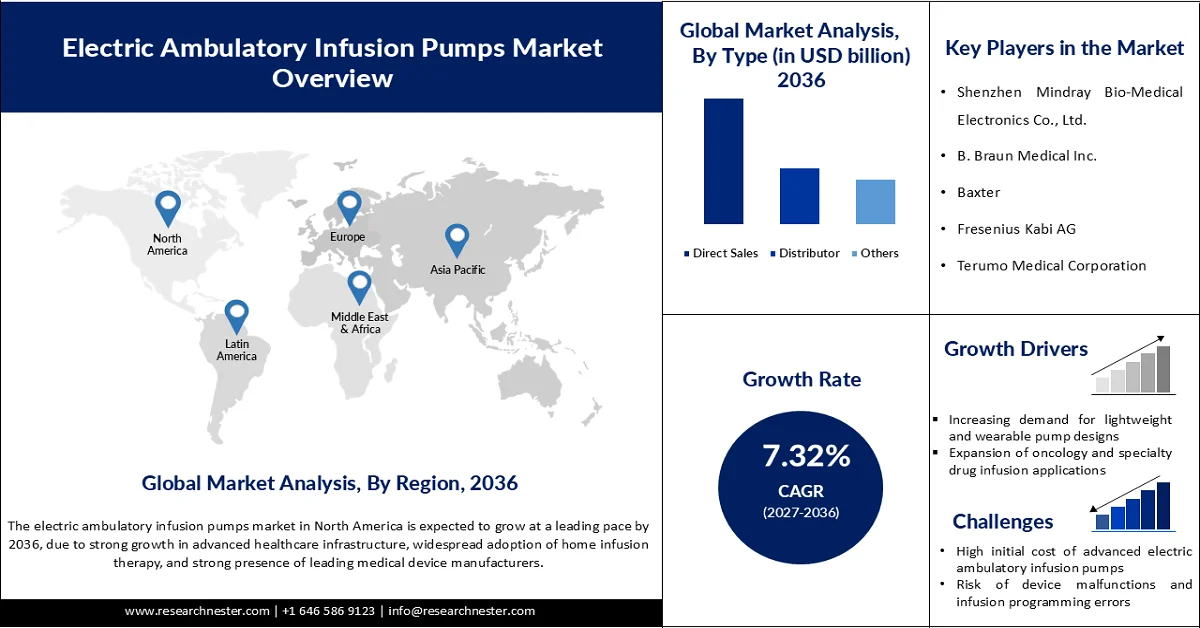
Electric Ambulatory Infusion Pumps Market size is valued at USD 1.67 billion in 2026 and is projected to reach USD 3.38 billion by 2036, growing at a CAGR of 7.32% from 2027 to 2036. In 2027, the industry size of electric ambulatory infusion pumps is estimated at USD 1.79 billion.
The rising global burden of chronic diseases is opening high-earning opportunities for electric ambulatory infusion pump manufacturers. The growing cases of cancer, gastrointestinal disorders, autoimmune diseases, and others are increasing the demand for advanced electric ambulatory infusion pump technologies. According to the World Health Organization (WHO), the incidence of cancer of both sexes totaled 20,636,441 in 2024.
Many of these therapies involve intravenous, subcutaneous, or epidural drug delivery over extended periods, which is driving the demand for electric ambulatory infusion pumps market. Continuous technological innovations and expansion of clinical trials are pushing the adoption of innovative electric ambulatory infusion pumps. Further, the supportive government policies and initiatives are set to propel the overall electric ambulatory infusion pumps market growth during the study period.
Incidence, Both sexes, in 2024 – All cancers (Continents)
|
Population |
Population code (ISO/UN) |
Number |
ASR (World) |
Crude Rate |
Cum. risk 74 |
|
Africa |
903 |
1,216,350 |
123.3 |
80.3 |
13.1 |
|
Latin America and the Caribbean |
904 |
1,581,498 |
184.0 |
238.4 |
18.0 |
|
Northern America |
905 |
2,765,310 |
357.0 |
717.7 |
33.7 |
|
Europe |
908 |
4,327,528 |
273.3 |
580.8 |
27.1 |
|
Oceania |
909 |
274,297 |
387.6 |
595.2 |
36.0 |
|
Asia |
935 |
10,471,458 |
167.3 |
219.9 |
17.2 |
|
Total |
- |
20,636,441 |
194.9 |
254.3 |
19.8 |
Source: WHO
Key Electric Ambulatory Infusion Pumps Market Insights Summary:
Regional Highlights:
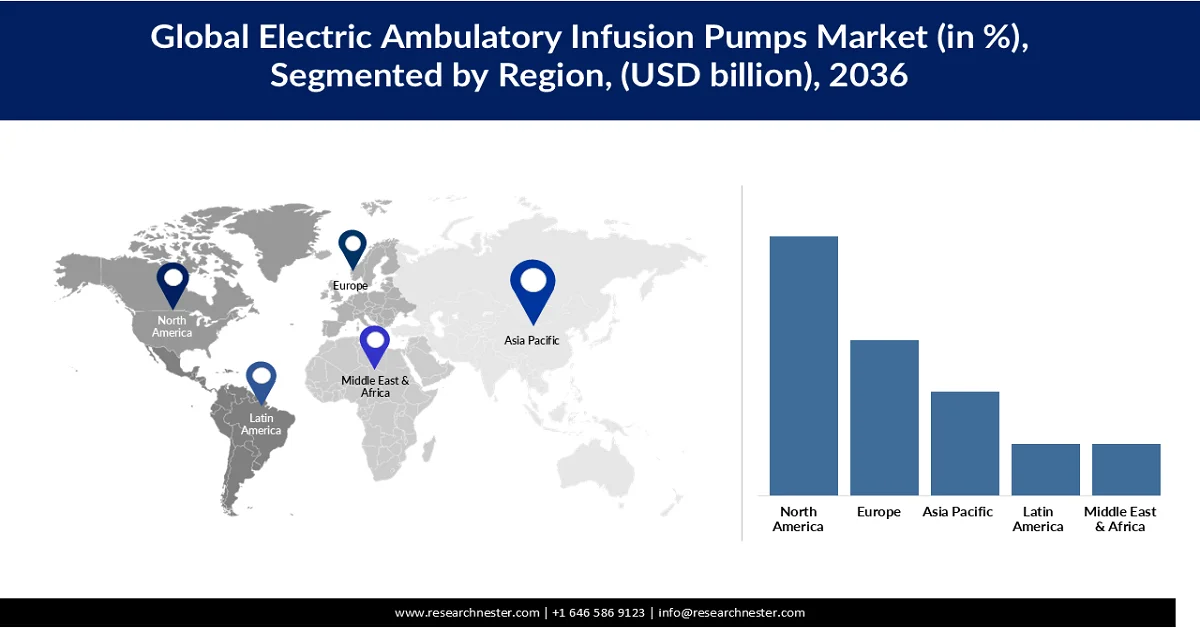
- The eletric ambulatory infusion pumps market is anticipated to see North America command the largest revenue share by 2036, fostered by advanced healthcare infrastructure and the rising adoption of outpatient and home-based infusion technologies
- Europe is expected to register notable growth in the market through 2036, buoyed by well-established healthcare systems, increasing chronic disease burden, and expanding investments in digital healthcare and home nursing services
- In 2023, the CDC reported that about 40.1 million people in the U.S. had diabetes, including both known and undiagnosed cases, which accounted for 12% of the population
- In Japan, the Foundation for Promotion of Cancer Research estimated 979,300 new cancer cases in 2024, with 558,300 in men and 421,000 in women
Segment Insights:
- The chemotherapy segment is projected to account for 44.5% of the electric ambulatory infusion pumps market share by 2036, accelerated by the rising global cancer incidence and the growing preference for outpatient cancer treatment
- The hospital segment is estimated to hold 61.5% of the global market share throughout the forecast period, underpinned by increasing volumes of complex infusion therapies and the continued prevalence of chronic diseases requiring specialized care
Key Growth Trends:
- Growing prevalence of chronic diseases
- Expansion of healthcare infrastructure
Major Challenges:
- High device costs
- Risk of device malfunctions
Key Players: Shenzhen Mindray Bio-Medical Electronics Co., Ltd. (China), B. Braun Medical Inc. (U.S.), Baxter (U.S.), Fresenius Kabi AG (Germany), Terumo Medical Corporation (Japan), ICU Medical, Inc. (U.S.), Medcaptain Medical Technology Co., Ltd. (China), Eitan Medical (Israel), Ace Medical (South Korea), Vygon (France), Micrel Medical Devices SA (Greece), IHT (Sweden), Applied Medical Technology (U.S.).
Global Electric Ambulatory Infusion Pumps Market Forecast and Regional Outlook:
Market Size & Growth Projections:
- 2026 Market Size: USD 1.67 billion
- 2027 Market Size: USD 1.79 billion
- Projected Market Size: USD 3.38 billion by 2036
- Growth Forecasts: 7.32% CAGR (2027-2036)
Key Regional Dynamics:
- Largest Region: North America
- Fastest Growing Region: Europe
- Dominating Countries: United States, Germany, Japan, United Kingdom, France
- Emerging Countries: China, India, South Korea, Brazil, Italy
Last updated on : 22 July, 2026
Electric Ambulatory Infusion Pumps Market - Growth Drivers and Challenges
Growth Drivers
- Growing prevalence of chronic diseases: The growing global burden of diabetes is propelling the sales of electric ambulatory infusion pumps. Senior citizens are more susceptible to chronic illnesses requiring long-term infusion therapies. The rapidly expanding elderly population worldwide is set to boost the need for advanced electric ambulatory infusion pumps. By 2050, the International Diabetes Federation expects about 1 in 8 adults, or nearly 853 million people, to have diabetes, marking a 46% increase. More than 90% of these cases are expected to be type 2 diabetes, which is influenced by social, economic, environmental, demographic, and genetic factors. Thus, as the prevalence of diabetes continues to rise, the demand for electric ambulatory infusion pumps is expected to grow sharply.
- Expansion of healthcare infrastructure: The modernization of healthcare infrastructure worldwide is directly increasing the demand for electric ambulatory infusion pumps. The rise in public-private investments is pushing the sales of medical devices and equipment, including electric ambulatory infusion pumps. NITI Aayog revealed that the hospital sector in India is attracting strong interest from both foreign and local investors. The government’s plan to raise public health spending to 2.5% of GDP is also likely to support this growth. Demand for healthcare is rising not only in big cities but also in Tier 2 and Tier 3 towns, where incomes are improving, and costs for land and labour are lower. These locations also serve people from nearby villages and smaller towns. Overall, continuous growth in infrastructure development in healthcare settings is set to fuel the adoption of advanced medical devices and technologies.
- Increasing demand for lightweight and wearable pump designs: The growing preference for lightweight and wearable medical devices is expected to drive innovations in electric ambulatory infusion pumps. Modern compact electric ambulatory infusion pumps gain popularity owing to their comfort and convenience. Manufacturers are also integrating rechargeable battery technologies to make the product more cost-effective. Thus, as patient-centric healthcare becomes a global priority, demand for lightweight and wearable electric ambulatory infusion pumps is set to boom.
Challenges
- High device costs: The sales of electric ambulatory infusion pumps are mainly hampered by their high costs. The integration of advanced technologies and specialized materials increases the final costs of the products. Small-scale enterprises often refrain from investing in these technologies owing to budget constraints. However, mass production, leasing, and subscription-based pricing models are expected to boost the adoption of electric ambulatory infusion pumps ahead.
- Risk of device malfunctions: The risk of device malfunctions and infusion programming errors is expected to hinder the sales of electric ambulatory infusion pumps. Programming mistakes by healthcare professionals or caregivers often lead to adverse clinical outcomes. Such errors lead to product recalls, hampering the goodwill of the manufacturers.
Electric Ambulatory Infusion Pumps Market Size and Forecast:
| Report Attribute | Details |
|---|---|
|
Base Year |
2026 |
|
Forecast Period |
2027-2036 |
|
CAGR |
7.32% |
|
Base Year Market Size (2026) |
USD 1.67 billion |
|
Forecast Year Market Size (2036) |
USD 3.38 billion |
|
Regional Scope |
|
Electric Ambulatory Infusion Pumps Market Segmentation:
Application Segment Analysis
The chemotherapy segment is projected to capture 44.5% of the global electric ambulatory infusion pumps market share through 2036. The increasing global incidence of cancer and the growing preference for outpatient cancer treatment are propelling the sales of advanced infusion pumps. According to eCancer, the number of people needing first-line chemotherapy each year is expected to increase from 9.8 million in 2018 to 15 million by 2040, a rise of 53% worldwide. The shift toward ambulatory oncology care is further strengthening demand for modern and compact infusion pump devices.
End user Segment Analysis
The hospital segment is estimated to account for 61.5% of the global electric ambulatory infusion pumps market share throughout the study period. The high volume of patients requiring complex infusion therapies and the availability of specialized healthcare professionals drive high demand for electric ambulatory infusion pumps from hospitals. The rising cancer admissions and the growing prevalence of chronic diseases continue to drive infusion therapy volumes within hospitals worldwide. Hospitals remain the largest purchasers and users of infusion pump devices due to their central role in managing complex, high-risk infusion therapies and delivering comprehensive patient care.
Distribution Channel Segment Analysis
The direct sales segment is anticipated to hold 55.5% of the global electric ambulatory infusion pumps market by the end of 2036. The prime factor is due to the fact that these devices are sophisticated medical systems that require technical consultation and product customization. Electric ambulatory infusion pumps also require routine maintenance, software upgrades, calibration, and preventive servicing throughout their operational lifecycle. This boosts the direct sales of electric ambulatory infusion pumps.
Our in-depth analysis of the electric ambulatory infusion pumps market includes the following segments:
|
Segments |
Subsegments |
|
Application |
|
|
End user
|
|
|
Product Features |
|
|
Distribution Channel |
|

Vishnu Nair
Head - Global Business DevelopmentCustomize this report to your requirements — connect with our consultant for personalized insights and options.
Electric Ambulatory Infusion Pumps Market - Regional Analysis
North America Market Insights
North America is expected to lead the sales of electric ambulatory infusion pumps throughout the forecast period. The advanced healthcare infrastructure and high adoption of infusion technologies are propelling the market growth. The increasing demand for outpatient and home-based care is opening high-earning opportunities for electric infusion pump manufacturers.
The U.S. is anticipated to witness significant demand for electric ambulatory infusion pumps between 2027 and 2036. The high prevalence of chronic diseases, including diabetes and cancer are pushing the trade of infusion pumps. In 2023, the CDC disclosed that around 40.1 million people in the U.S. were living with diabetes, including both diagnosed and undiagnosed cases. This was about 12.0% of the country’s population.
Canada’s market for electric ambulatory infusion pumps is anticipated to expand at a healthy pace from 2027 to 2036. The market growth is supported by its publicly funded healthcare system and increasing chronic disease burden. The strong emphasis on patient care and innovation drives the sales of electric ambulatory infusion pumps. According to 2023–2024 data from the Canadian Chronic Disease Surveillance System, 8.2% of adults in Canada were found to have diagnosed ischemic heart disease. Thus, the country's growing elderly population and rising prevalence of cardiovascular diseases are increasing the demand for infusion pump solutions.
Europe Market Insights
The Europe electric ambulatory infusion pumps market is expected to increase at a healthy pace during the forecast period. The market growth is supported by its well-established healthcare systems and increasing burden of chronic diseases. Technological innovations focused on programmable dosing and wireless connectivity are estimated to boost the revenues of key players in the years ahead. The growing investments in digital healthcare and expanding home nursing services are further propelling the sales of electric ambulatory infusion pumps.
The Germany electric ambulatory infusion pumps market is estimated to be driven by high healthcare expenditure and strong adoption of innovative medical technologies. The growing cases of cancer and diabetes are also propelling the sales of electric ambulatory infusion pumps. According to the Global Cancer Observatory, 566,587 new cancer cases were reported in Germany in 2024.
The UK market for electric ambulatory infusion pumps is set to expand steadily during the forecast period. The increasing prevalence of chronic diseases and continuous investment in modern healthcare services are fueling the trade of electric ambulatory infusion pumps. The UK market also benefits from a strong regulatory framework that emphasizes medical device safety and clinical performance.
Asia Pacific Market Insights
Asia Pacific is anticipated to emerge as a lucrative market for electric ambulatory infusion pump manufacturers. The market growth is driven by expanding healthcare infrastructure and a large and aging population. The increasing burden of chronic and infectious diseases is also contributing to the growing sales of electric ambulatory infusion pumps. China, India, Japan, and South Korea are some of the leading markets for electric ambulatory infusion pump companies.
China’s market for electric ambulatory infusion pumps is expanding owing to its vast population and expanding healthcare system. The rapidly growing pharmaceutical industry is also contributing to the market growth. The increasing prevalence of chronic diseases, including diabetes, hypertension, and cardiovascular disorders, is substantially increasing demand for electric ambulatory infusion pumps. The International Diabetes Federation reveals that the prevalence of diabetes in China is nearly 11.9%.
Japan’s electric ambulatory infusion pumps market is estimated to increase at a healthy pace during the study timeframe. The high healthcare standards and swiftly increasing aging population are propelling the sales of electric ambulatory infusion pumps. The increasing prevalence of chronic diseases such as diabetes, cancer, osteoporosis, and cardiovascular disorders is boosting the trade of electric ambulatory infusion pumps. The Foundation for Promotion of Cancer Research disclosed that an estimated 979,300 new cancer cases were reported in Japan in 2024, including about 558,300 among men and 421,000 among women.
Japan's advanced healthcare systems are also contributing to the increasing sales of electric ambulatory infusion pumps. Technological innovations are expected to double the revenues of key players in the years ahead. The public-private healthcare modernization initiatives are directly fueling the sales of electric ambulatory infusion pumps.
Cancer Case Statistics 2024
|
Male |
Female |
||
|
Cancer |
Share |
Cancer |
Share |
|
Prostate |
16% |
Breast |
22% |
|
Colon/Rectum |
15% |
Colon/Rectum |
16% |
|
Lung |
15% |
Lung |
10% |
|
Stomach |
14% |
Stomach |
9% |
|
Liver |
4% |
Uterus |
7% |
Source: Foundation for Promotion of Cancer Research
Key Electric Ambulatory Infusion Pumps Market Players:
- Shenzhen Mindray Bio-Medical Electronics Co., Ltd. (China)
- B. Braun Medical Inc. (U.S.)
- Baxter (U.S.)
- Fresenius Kabi AG (Germany)
- Terumo Medical Corporation (Japan)
- ICU Medical, Inc. (U.S.)
- Medcaptain Medical Technology Co., Ltd. (China)
- Eitan Medical (Israel)
- Ace Medical (South Korea)
- Vygon (France)
- Micrel Medical Devices SA (Greece)
- IHT (Sweden)
- Applied Medical Technology (U.S.)
- Company Overview
- Business Strategy
- Key Product Offerings
- Financial Performance
- Key Performance Indicators
- Risk Analysis
- Recent Development
- Regional Presence
- SWOT Analysis
- Shenzhen Mindray Bio-Medical Electronics Co., Ltd. has strengthened its position in the electric ambulatory infusion pumps market by offering technologically advanced, cost-effective infusion solutions for hospitals and outpatient care settings. The company focuses on integrating smart safety features, intuitive user interfaces, and digital connectivity into its infusion systems to improve medication accuracy and clinical efficiency. Its strong manufacturing capabilities, extensive distribution network, and growing international presence have enabled Mindray to expand across developed and emerging markets while continuously investing in product innovation and healthcare technology.
- B. Braun Medical Inc. is a leading player in the electric ambulatory infusion pumps market, recognized for its comprehensive infusion therapy portfolio and strong emphasis on patient safety. The company develops advanced infusion systems featuring programmable dosing, drug safety software, and reliable infusion management technologies. Its competitive advantage lies in combining medical devices, consumables, and digital solutions into integrated therapy platforms. Through continuous investment in research and development, regulatory compliance, and clinical training, B. Braun has established a strong presence across hospitals, ambulatory care centers, and home healthcare markets worldwide.
- Baxter maintains a strong competitive position in the electric ambulatory infusion pumps market through its broad portfolio of infusion systems designed for critical care, oncology, nutrition, and home infusion applications. The company focuses on enhancing medication safety by incorporating advanced software, wireless connectivity, and workflow optimization features into its infusion technologies. Baxter's extensive global distribution network, strong relationships with healthcare providers, and continuous investment in product development enable it to address evolving clinical needs while supporting the growing shift toward connected and patient-centered infusion therapy solutions.
- Fresenius Kabi AG is a prominent competitor in the electric ambulatory infusion pumps market, leveraging its expertise in infusion therapy, clinical nutrition, and intravenous pharmaceuticals. The company offers advanced infusion technologies designed to improve dosing precision, patient safety, and treatment efficiency across hospital and outpatient settings. Its integrated business model, combining infusion pumps with pharmaceuticals and infusion consumables, strengthens its market position. Continuous investments in innovation, quality assurance, and expansion of global healthcare partnerships enable Fresenius Kabi to remain a key participant in the evolving infusion therapy electric ambulatory infusion pumps market.
Below is the list of the key players, among several others, operating in the global electric ambulatory infusion pumps market:
The strong presence of regional and international companies characterizes the electric ambulatory infusion pumps market. Key players are focused on technological innovations to introduce next-gen solutions. They are also engaging in strategic collaborations with others to enhance their product offerings. Some established companies are exploring opportunities across high-potential economies to earn lucrative returns. Both organic and inorganic marketing strategies are projected to double the revenues of leading companies during the forecast period.
Corporate Landscape of the Global Electric Ambulatory Infusion Pumps Market:
Recent Developments
- In March 2026, WeInfuse launched InfuseTrack, a new software tool for infusion providers, specialty pharmacies, and home infusion teams. It gives sites a live, single view of equipment and assets, helping reduce manual work and improve compliance across care settings.
- In December 2025, Baxter International Inc., along with The University of Texas Medical Branch, shared results showing that connecting smart infusion pumps with hospital electronic medical records improved patient safety, helped clinicians work more efficiently at the bedside, and increased programming compliance. The findings were based on more than one million infusions using Baxter’s Spectrum IQ large-volume infusion pumps at UTMB and were presented at the ASHP 2025 Midyear Clinical Meeting.
- Report ID: 8683
- Published Date: Jul 22, 2026
- Report Format: PDF, PPT
- Explore a preview of key market trends and insights
- Review sample data tables and segment breakdowns
- Experience the quality of our visual data representations
- Evaluate our report structure and research methodology
- Get a glimpse of competitive landscape analysis
- Understand how regional forecasts are presented
- Assess the depth of company profiling and benchmarking
- Preview how actionable insights can support your strategy
Explore real data and analysis
Frequently Asked Questions (FAQ)
About this Report
Connect with our Expert


Report, 2027-2036



Copyright @ 2026 Research Nester. All Rights Reserved.
