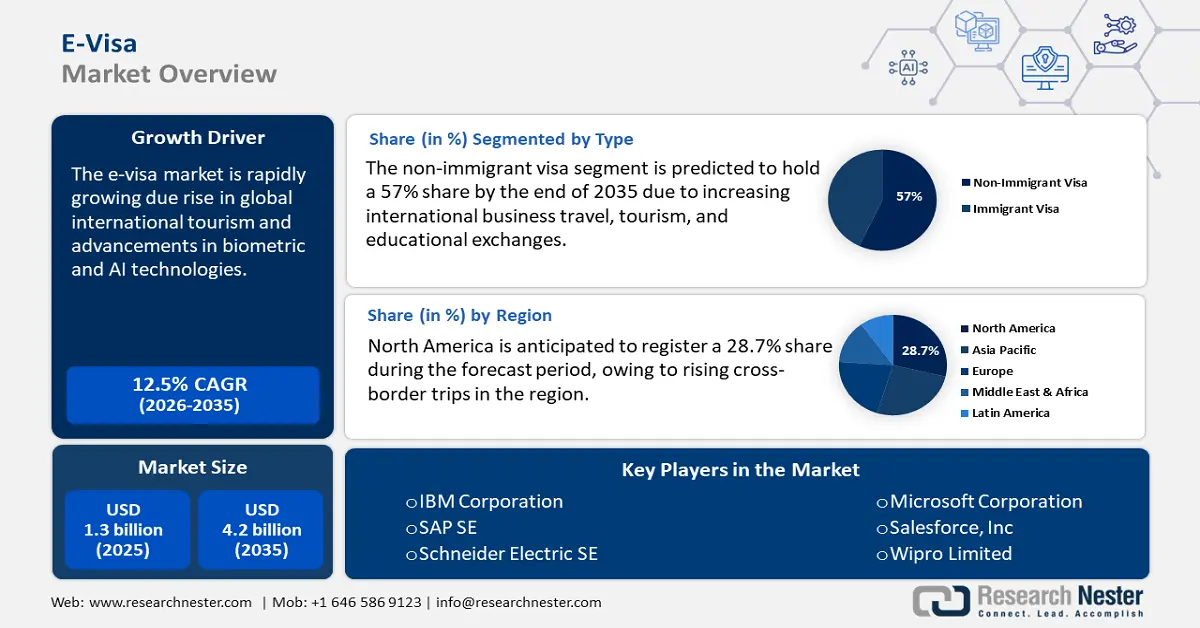
E-Visa Market Outlook:
E-Visa Market size was valued at USD 1.3 billion in 2025 and is projected to reach USD 4.2 billion by the end of 2035, rising at a CAGR of 12.5% during the forecast period, i.e., 2026-2035. In 2026, the industry size of e-visa is assessed at USD 1.4 billion.
The rapid rise in global international tourism is a major driver for the growth of the e-visa market. As global mobility rises, travelers demand quicker, convenient, and hassle-free visa application processes. Traditional visa procedures, often defined by long queues, extensive paperwork, and delays, no longer align with the expectations of modern, digitally savvy travelers. Governments around the globe are responding to this shift by adopting e-visa systems, which allow travelers to apply for visas online without visiting embassies or consulates. This not only improves consumer experience but also optimizes internal processing and resource allocation for immigration authorities.
India serves as an important example of how e-visa systems can fuel tourism growth. The government of India has expanded its e-visa program to citizens of over 172 countries, making it one of the most accessible visa regimes globally. This surge is directly linked to improvements in the digital visa experience, which includes simplified online forms, faster processing times, and multilingual support. As a result, tourism revenue has seen a substantial boost, supporting local economies and reinforcing the value of e-visa programs. Moreover, the outbreak of the COVID-19 pandemic has increased the demand for contactless and virtual services, encouraging the adoption of e-visas as a safer alternative to in-person processing. The intersection of rising global tourism and growing demand for easy digital services is pushing nations to modernize border entry systems, making e-visas a key tool in supporting economic growth through travel and tourism.
According to the UN Tourism’s latest World Tourism Barometer, around 1.4 billion people traveled internationally in 2024, nearly reaching 99% the levels before the pandemic. This indicates an 11% increase from 2023, with 140 million more tourists. The prime factor driving this growth after the pandemic is good performance from major travel markets and the continued recovery of destinations in Asia Pacific. Increasing investments in technology, such as USCIS’s inflation-adjusted premium processing fees, necessitate the demand for digital upgradation. On a global scale, the e-visa supply chain relies on trade in tech goods and services with international collaboration and regulatory guidelines as key to smooth operations.
|
The Middle East, Europe, and Africa see the strongest results in 2024 relative to 2019 |
|||
|
Region |
2024 Arrivals (Million) |
Change vs. 2019 |
Change vs. 2023 |
|
Middle East |
95 |
+32% |
+1% |
|
Africa |
74 |
+7% |
+12% |
|
Europe |
747 |
+1% |
+5% |
Source: UN Tourism