Dust Control Systems and Suppression Chemicals Market Outlook:
Dust Control Systems and Suppression Chemicals Market size was valued at USD 15.5 billion in 2025 and is projected to reach USD 23.7 billion by the end of 2035, registering around 4.4% CAGR during the forecast period, i.e., 2026-2035. In 2026, the industry size of dust control systems and suppression chemicals is estimated at USD 16.1 billion.
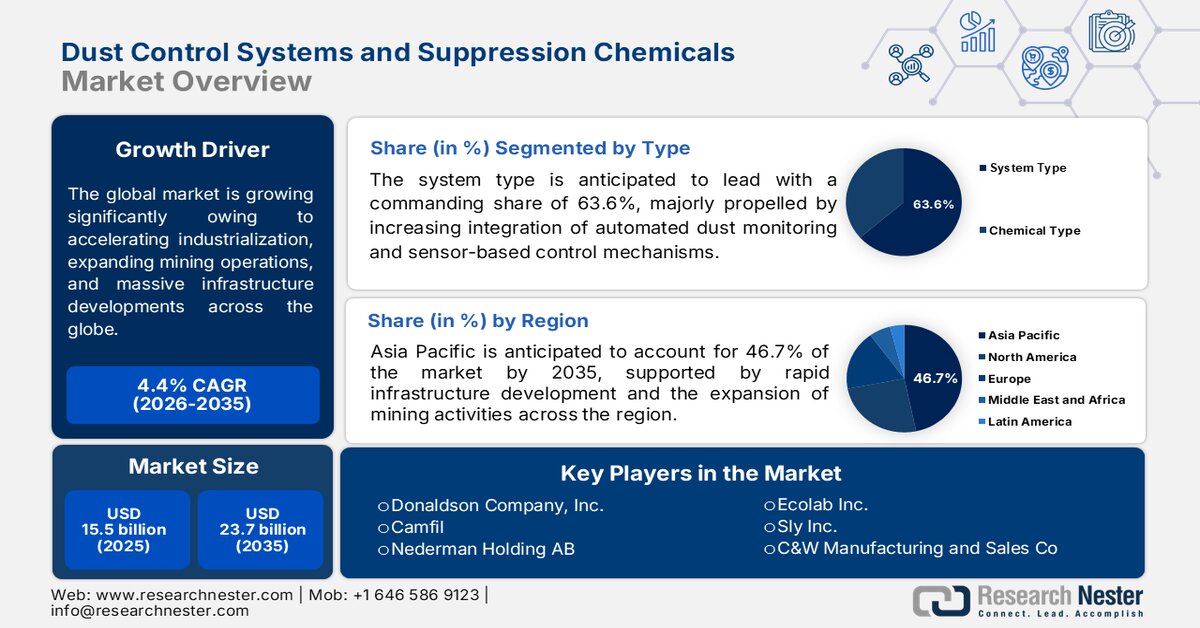
The global dust control systems and suppression chemicals market is poised for stable growth, which is driven by accelerating industrialization, expanding mining operations, and massive infrastructure developments across the globe. In addition, increasing awareness of occupational health hazards, especially respiratory illnesses such as silicosis, is forcing industrial operators to adopt advanced dust management solutions. In December 2023, the Centers for Disease Control and Prevention (CDC) stated that there is continued risk of respirable crystalline silica exposure among workers in metal and nonmetal mines, emphasizing the need for stronger prevention measures. It also outlined that analysis of more than 55,000 exposure samples collected found that many miners experienced silica levels above recommended safety limits across both surface and underground operations, thus reflecting an urgent need for suitable solutions.
Furthermore, the dust control systems and suppression chemicals market is being propelled by continued technological innovations, such as automated smart misting cannons, real-time particulate monitoring sensors, and highly efficient bio-based chemical surfactants. Apart from this, key sectors such as construction, agriculture, and power generation have a priority towards clean air initiatives and sustainable operations, due to which the demand for reliable dust suppression setups is expanding significantly. Press Information Bureau (PIB) in January 2023 reported that CMPDIL developed a patented dust control technology by using windbreak and vertical greenery systems to reduce fugitive dust pollution from mines, power plants, ports, and storage areas. On the other hand, the global trade of essential suppression chemicals supports the market by ensuring availability of effective moisture-retaining agents for industrial and infrastructure applications.
Calcium Chloride Import Trends: Top Importing Countries and Trade Statistics, 2024
|
Importing Country |
Trade Value (USD Thousand) |
Quantity (Kg) |
|
Saudi Arabia |
87,483.98 |
407,874,000 |
|
U.S. |
77,443.58 |
171,837,000 |
|
Canada |
45,079.87 |
127,923,000 |
|
Korea, Rep. |
43,571.71 |
— |
|
Chile |
32,024.63 |
140,734,000 |
|
Germany |
30,812.78 |
90,814,100 |
|
European Union |
27,512.47 |
44,630,600 |
|
France |
24,985.88 |
46,449,400 |
|
Japan |
23,353.80 |
69,153,400 |
Source: WITS
Key Dust Control Systems and Suppression Chemicals Market Insights Summary:
Regional Highlights:
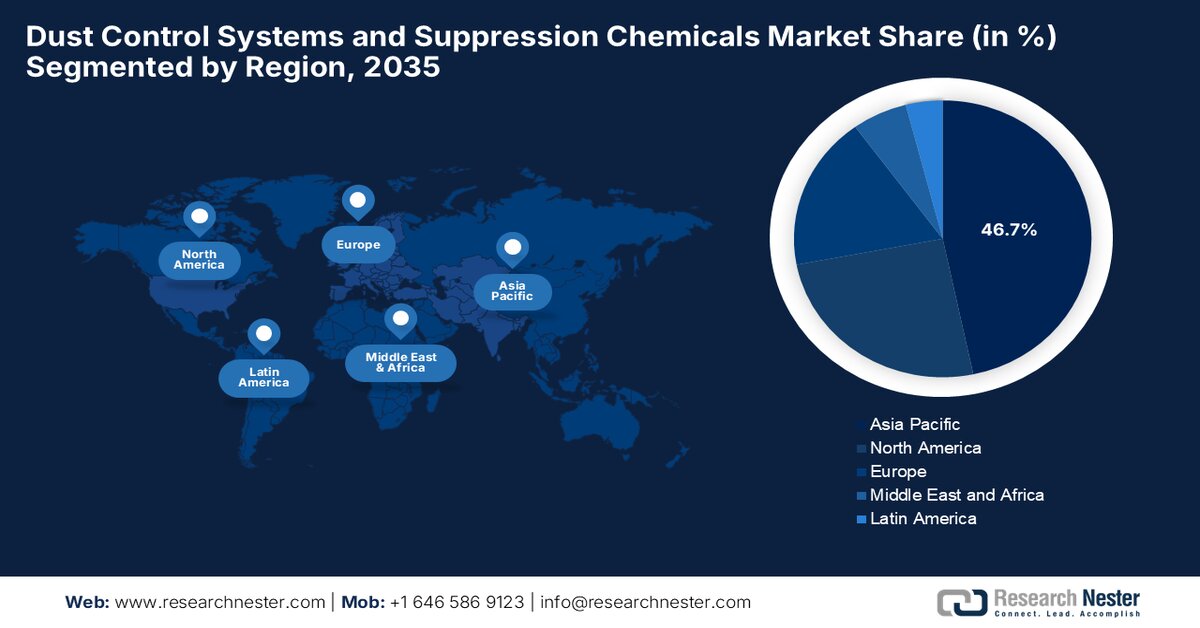
- Asia Pacific is forecast to capture the highest 46.7% share of the dust control systems and suppression chemicals market during 2026-2035, bolstered by massive infrastructure development and booming mining activities
- North America is poised for considerable growth during the forecast period, supported by stringent workplace safety regulations and rigorous environmental mandates concerning ambient air quality and emissions
Segment Insights:
- System type is projected to command a 63.6% share by 2035 in the dust control systems and suppression chemicals market, supported by increasing integration of automated dust monitoring, sensor-based control mechanisms, and centralized suppression technologies
- Mines and quarries are anticipated to maintain a leading position throughout 2026-2035, owing to intensive dust generation from drilling, blasting, crushing, and material transportation activities
Key Growth Trends:
- Rapid global industrialization
- Heightened workplace safety mandates
Major Challenges:
- Regulatory compliance & health mandates
- Water Scarcity & environmental bottlenecks
Key Players: Donaldson Company Inc. U.S., Camfil Sweden, Nederman Holding AB Sweden, Ecolab Inc. U.S., Sly Inc. U.S., C&W Manufacturing and Sales Co. U.S., Dust Control Technologies Inc. U.S., Savic Group UAE, Bosstek U.S., Emerson U.S., Camfil Air Pollution Control.
Global Dust Control Systems and Suppression Chemicals Market Forecast and Regional Outlook:
Market Size & Growth Projections:
- 2025 Market Size: USD 15.5 billion
- 2026 Market Size: USD 16.1 billion
- Projected Market Size: USD 23.7 billion by 2035
- Growth Forecasts: 4.4% CAGR (2026-2035)
Key Regional Dynamics:
- Largest Region: Asia Pacific (46.7% share)
- Fastest Growing Region: North America
- Dominating Countries: China, United States, India, Australia, Germany
- Emerging Countries: India, Indonesia, Vietnam, Brazil, Mexico
Last updated on : 10 August, 2026
Dust Control Systems and Suppression Chemicals Market - Growth Drivers and Challenges
Growth Drivers
- Rapid global industrialization: Globally accelerating industrialization and infrastructure projects are the primary catalyst for the dust control systems and suppression chemicals market. This exponential growth in global mining operations, roadway construction, and large-scale manufacturing activities deliberately generates immense volumes of fugitive dust, compelling operators to deploy advanced dust control systems. In this context, Rio Tinto in May 2025 commenced early development work and final assessments for the Kangwinan project at its Amrun bauxite operations in Queensland’s Cape York Peninsula by targeting production by 2029. This expansion could increase output by up to 20 million tons on a yearly basis and is supported by a new mining area and upgrades to the existing Amrun port facilities, thus enhancing uptake of dust control systems.
- Heightened workplace safety mandates: Escalating awareness for occupational health hazards is an important factor that fuels dust control systems and suppression chemicals market adoption. Besides, regulatory bodies across the globe are enforcing strict workplace air quality standards, which legally mandate industrial facilities to implement dust suppression protocols in order to protect personnel and minimize corporate liability risks. In January 2025, the U.S. Department of Labor’s Mine Safety and Health Administration introduced a new rule to reduce miners’ exposure to respirable crystalline silica, reducing the permissible limit to 50 micrograms per cubic meter over an 8-hour work shift. This regulation requires mine operators to implement stronger dust control measures, monitoring systems, and corrective actions when exposure levels exceed the limit, thus denoting a positive market outlook.
Challenges
- Regulatory compliance & health mandates: Stringent and evolving environmental regulations regarding ambient air quality, emissions reporting, and hazardous chemical runoff force rigorous industry compliance. This is mandating a transition toward certified eco-friendly, yet significantly more expensive, bio-based alternatives. On the other hand, expanding worker safety mandates in order to reduce health concerns requires highly costly electronic monitoring networks to satisfy international occupational healthcare standards. Regulatory bodies impose penalties on industrial firms when traditional chemical suppression agents leach accidentally into local aquifers or surrounding agricultural lands. Therefore, managing these complex regulations creates operational hurdles in the dust control systems and suppression chemicals market.
- Water Scarcity & environmental bottlenecks: Operational dependency on huge water volumes for industrial dust suppression creates severe bottlenecks in arid geographic regions. This, in turn, is triggering elevated procurement expenses and intense local community backlash. Major industries, i.e., mining, quarrying, and heavy construction, are continuously forced to source expensive chemical surfactants and crust-modifying polymers to artificially maximize water usage efficiency and bypass strict physical distribution limits. Apart from this, transporting essential water long distances through haulage trucks or pipelines increases fuel consumption and overall logistical complexity in the dust control systems and suppression chemicals market.
Dust Control Systems and Suppression Chemicals Market Size and Forecast:
| Report Attribute | Details |
|---|---|
|
Base Year |
2025 |
|
Forecast Year |
2026-2035 |
|
CAGR |
4.4% |
|
Base Year Market Size (2025) |
USD 15.5 billion |
|
Forecast Year Market Size (2035) |
USD 23.7 billion |
|
Regional Scope |
|
Dust Control Systems and Suppression Chemicals Market Segmentation:
Type Segment Analysis
The system type is anticipated to lead the type segment with a commanding share of 63.6% in the dust control systems and suppression chemicals market by the end of 2035. The segment’s dominating position is majorly propelled by increasing integration of automated dust monitoring, sensor-based control mechanisms, and centralized suppression technologies. These systems enable real-time particulate management, improve operational efficiency, and reduce maintenance requirements across industrial facilities. In this context, CDC in May 2026 disclosed that NIOSH has introduced the Dustinator, which is a compact dust collection system especially designed to reduce airborne dust and respirable crystalline silica levels at mining sites. This technology was developed through a collaboration with Benetech Inc., and it can be installed on existing bins, tanks, and conveyor systems to improve dust control.
Application Segment Analysis
The mines and quarries segment, which is under the application category, is anticipated to capture a remarkable share of the dust control systems and suppression chemicals market throughout the forecast period. The segment’s leading position is attributed to the intensive dust generation associated with mining activities, including drilling, blasting, crushing, and material transportation. In addition, increasing mineral extraction activities, expansion of aggregate production, and the adoption of advanced suppression technologies for improving operational efficiency and environmental performance are positioning it for sustained growth. Furthermore, the growing deployment of water-efficient suppression solutions and chemical-based dust binders at mining sites is expected to enhance segment expansion.
End user Industry Segment Analysis
Construction is forecasted to hold a substantial share in the dust control systems and suppression chemicals market during the stipulated timeframe. The sub-segment’s growth is supported by the rising complexity of modern construction activities, where large-scale projects such as high-rise developments, transportation networks, and urban infrastructure require continuous dust management solutions. In September 2025, the government of India reviewed eight major infrastructure projects worth more than USD 7.5 billion across mining, railways, power, water resources, and industrial corridors during the 49th PRAGATI meeting. It also mentioned that timely execution, better coordination, and quick resolution of bottlenecks to avoid rising costs and delays in public services, thus creating newer opportunities for the segment’s expansion.
Our in-depth analysis of the dust control systems and suppression chemicals market includes the following segments:
|
Segment |
Subsegments |
|
Type |
|
|
Application |
|
|
End user Industry |
|

Vishnu Nair
Head - Global Business DevelopmentCustomize this report to your requirements — connect with our consultant for personalized insights and options.
Dust Control Systems and Suppression Chemicals Market - Regional Analysis
APAC Market Insights
Asia Pacific dust control systems and suppression chemicals market is forecasted to hold the highest share of 46.7% during the assessed time frame. The region’s growth in this sector is largely attributable to massive infrastructure developments and booming mining activities. In addition, expansion of power generation, cement manufacturing, and agricultural sectors, all of which generate substantial particulate matter, also position the market for solid growth. In February 2025, the Environmental Protection Authority in Australia recommended approval for the expansion of the Fimiston Open Pit at Kalgoorlie-Boulder’s Super Pit, with conditions to manage dust, blasting, and noise impacts. This proposed project by Kalgoorlie Consolidated Gold Mines has the potential to expand mining infrastructure and extend operations until 2034, thus positively benefiting the region’s market.
The government's rigorous enforcement of national clean air initiatives and ecological protection policies is a main factor boosting growth in the China dust control systems and suppression chemicals market. The country’s transition toward greener manufacturing and sustainable mining has led industrial facilities, power plants, and massive infrastructure projects to implement dust mitigation strategies to avoid severe environmental penalties. Based on government data published in January 2024, China issued guidelines to promote ultra-low emission practices in the cement and coking industries through cooperation between key government ministries. This policy primarily focuses on reducing air pollution, improving industrial efficiency, and also encouraging cleaner production technologies across these high-emission sectors, thus elevating the growth potential of the market.
The dust control systems and suppression chemicals market in India is witnessing remarkable expansion, which is facilitated by the country's massive infrastructure development, roadway expansion, and surging coal mining operations. Intensifying enforcement by central and state pollution control boards, along with nationwide initiatives, is forcing industrial operators, power plants, and construction firms to strictly control fugitive emissions. PIB in October 2025 stated that NHAI introduced an SOP to reduce air pollution from highway construction, traffic, and road dust in Delhi-NCR. These measures include dust control practices, regular air quality monitoring, and others. In addition, the country’s imports of key dust suppression chemicals reflect strong demand and the role of global suppliers in supporting India's expanding market.
India’s Magnesium Chloride Imports by Origin Country, 2023: Import Value and Shipment Volume Analysis
|
Supplier Country |
Trade Value (USD Thousand) |
Quantity (Kg) |
|
China |
1,206.31 |
3,089,490 |
|
U.S. |
314.26 |
20,202 |
|
Czech Republic |
263.19 |
86,750 |
|
Switzerland |
17.01 |
360 |
|
Germany |
7.85 |
407 |
|
India |
6.36 |
30,000 |
|
Netherlands |
2.66 |
6,000 |
|
Korea, Rep. |
2.20 |
300 |
|
South Africa |
0.57 |
15 |
|
Italy |
0.31 |
250 |
Source: WITS
North America Market Insights
The North America dust control systems and suppression chemicals market is expected to expand at a considerable rate due to stringent workplace safety regulations and rigorous environmental mandates regarding ambient air quality and emissions. Market growth is also propelled by the continuous modernization of aging infrastructure, extensive oil and gas drilling operations, and robust mining activities across the region. The U.S. EPA strengthened the national ambient air quality standards for particulate matter in February 2024 to reduce health risks linked to fine particle pollution. The updated regulations set the annual PM 2.5 limit at 9.0 micrograms per cubic meter, thereby maintaining existing standards and thus supporting market growth.
Extensive highway construction, widespread aggregate quarrying, and thriving oil and gas extraction activities generate substantial fugitive dust, driving growth in the U.S. dust control systems and suppression chemicals market. In addition, a strong nationwide focus on protecting local watersheds and adhering to corporate environmental governance guidelines is accelerating a transition away from water-intensive methods and petroleum-based stabilizers toward highly bio-based chemical surfactants and biodegradable dust-binding polymers. Based on government data, the January 2025 Duck Creek Road project in Montana involves upgrading 4.8 miles of roadway to improve access, safety, drainage, and surface conditions near Fort Peck recreation areas. Besides, this work includes pavement reconstruction, gravel road improvements, dust control measures, and upgrades to visibility and snow management.
The Canada dust control systems and suppression chemicals market is being reshaped by extensive mining operations, oil sands extraction, and remote infrastructure development projects, all of which generate huge amounts of particulate matter. In addition, a strong national focus on protecting sensitive ecosystems and pristine watersheds is efficiently accelerating the adoption of advanced natural solutions. Based on the government data which was published in February 2023, the Giant Mine project team uses multiple dust suppression methods, including inspections, water application, road treatments, and environmentally safe products to control airborne dust. Furthermore, it also mentioned that a polymer-based suppressant called SoilTac is applied to tailings areas to form a protective crust and reduce dust movement for several years.
Europe Market Insights
The Europe dust control systems and suppression chemicals market is projected to grow steadily, which is propelled by the most stringent environmental and workplace safety regulations and strict occupational exposure limits for crystalline silica. Market growth in the region is largely propelled by a transition toward green industrial manufacturing, sustainable recycling operations, and extensive underground mining and tunneling infrastructure projects. In June 2025, the Health and Safety Authority launched a two-week national inspection campaign with a goal to reduce workers’ exposure to respirable crystalline silica dust on construction sites. In this context, inspectors assessed dust-generating activities and ensured effective controls, including water suppression, dust extraction, containment, and appropriate respiratory protection, thus promoting stronger workplace health and safety practices.
The nation's strict compliance with regional clean air directives and rigorous domestic environmental laws is responsible for driving the dust control systems and suppression chemicals market in Germany. The country’s industrial operators are highly focused on minimizing fugitive emissions and meeting low workplace exposure limits for hazardous fine dust. This regulatory landscape accelerates the deployment of the most advanced, automated engineering solutions, including Industry 4.0-integrated misting cannons and real-time, IoT-enabled particulate monitoring systems. In addition, corporate commitment to sustainability and circular economy principles is prompting a widespread transition toward zero-runoff, bio-based chemical surfactants and biodegradable dust-binding polymers.
The dust control systems and suppression chemicals market in the UK is expanding, due to a major focus on net-zero emissions, infrastructure ventures, rail network expansions, and urban brownfield redevelopments. This strict regulatory backdrop accelerates the domestic adoption of automated engineering solutions, attracting more players to make investments in this sector. In July 2025, based on government data, RSSB was seeking market engagement responses from suppliers with expertise in occupational health and silica dust research to support a study on respirable crystalline and amorphous silica risks during rail sander maintenance and replenishment activities. The anticipated six-month project is valued at around USD 135,000 (excluding VAT), thus positively benefiting the market’s expansion.
Key Dust Control Systems and Suppression Chemicals Market Players:
- Donaldson Company, Inc. (U.S.)
- Camfil (Sweden)
- Nederman Holding AB (Sweden)
- Ecolab Inc. (U.S.)
- Sly Inc. (U.S.)
- C&W Manufacturing and Sales Co. (U.S.)
- Dust Control Technologies, Inc. (U.S.)
- Savic Group (UAE)
- Bosstek (U.S.)
- Emerson (U.S.)
- Camfil Air Pollution Control (U.S.)
- Company Overview
- Business Strategy
- Key Product Offerings
- Financial Performance
- Key Performance Indicators
- Risk Analysis
- Recent Development
- Regional Presence
- SWOT Analysis
- Donaldson Company, Inc. is a leading industrial filtration company which is offering dust collectors, combustible dust management systems, and filtration solutions for various industries. The company contends in this sector through advanced filtration technologies, explosion protection solutions, and worldwide service capabilities.
- Camfil provides industrial dust collection, air pollution control, and chemical isolation and suppression systems. The firm’s solutions help industries to manage combustible dust risks through advanced filtration technologies, ATEX/NFPA-compliant safety systems, and customized applications.
- Nederman Holding AB is yet another prominent player in this industry that specializes in industrial air filtration, source extraction, and dust management solutions. The company provides extraction arms, industrial vacuum systems, and air purification technologies that are designed to control dust and fumes at the source.
- Ecolab Inc., through Nalco Water, provides chemical-based dust suppression solutions for mining and material handling applications. The firm’s portfolio includes foam suppressants, surfactants, binders, and tackifiers that improve dust control efficiency while reducing water consumption.
- Sly Inc. manufactures customized dust collection systems, including baghouses, cartridge collectors, cyclones, and explosion protection solutions. The company differentiates itself through certain engineered solutions, flexible manufacturing, and retrofit services for industrial air pollution control applications.
Here is a list of key players operating in the global dust control systems and suppression chemicals market:
The dust control systems and suppression chemicals market is a fragmented landscape with intense competition being witnessed among global industrial filtration manufacturers, mining equipment companies, and specialized dust suppression solution providers. Leading manufacturers in this field compete in terms of continued technological innovation and global service capabilities. Apart from this, regional manufacturers maintain strong positions in mining, construction, and industrial applications with suitable customized solutions. In this context, Dustcontrol AB, in November 2023, introduced the DC Tromb H a/c/L Turbo VFD, which is a high-performance dust extractor especially designed for asbestos removal and other hazardous dust applications. The system supports tasks such as floor grinding in industrial environments, thereby ensuring efficient dust control.
Corporate Landscape of the Dust Control Systems and Suppression Chemicals Market:
Recent Developments
- In October 2025, Camfil Air Pollution Control introduced the Gold Series III dust collector, which is an advanced upgrade to its established Gold Series platform, especially designed to improve filtration efficiency, reduce energy use, and simplify maintenance.
- In March 2025, Emerson introduced a smart dust collector monitoring and control solution that provides real-time equipment insights, advanced diagnostics, and seamless integration with plant automation systems. The solution helps industries improve filtration efficiency, reduce downtime, and lower maintenance costs.
- Report ID: 8734
- Published Date: Aug 10, 2026
- Report Format: PDF, PPT
- Explore a preview of key market trends and insights
- Review sample data tables and segment breakdowns
- Experience the quality of our visual data representations
- Evaluate our report structure and research methodology
- Get a glimpse of competitive landscape analysis
- Understand how regional forecasts are presented
- Assess the depth of company profiling and benchmarking
- Preview how actionable insights can support your strategy
Explore real data and analysis
Frequently Asked Questions (FAQ)
About this Report
Connect with our Expert


Report, 2026-2035



Copyright @ 2026 Research Nester. All Rights Reserved.
