Docking Station Market - Regional Analysis
North America Market Insights
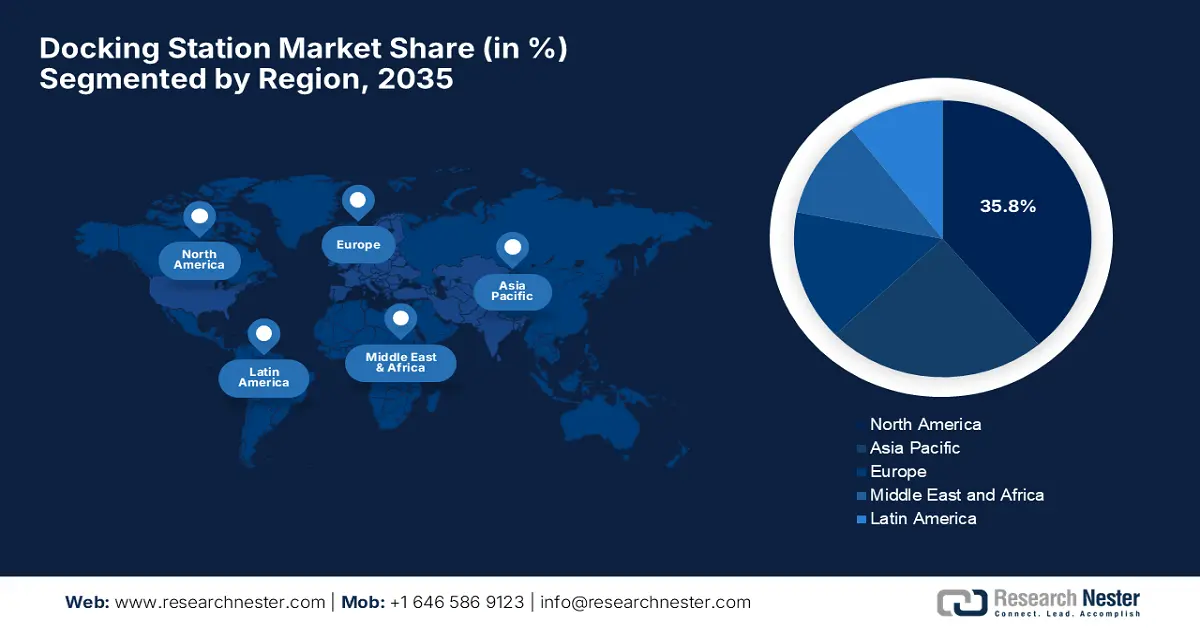
North America is predicted to lead with the highest share of 35.8% in the global docking station market throughout the discussed tenure. The leadership of the region in this sector is highly attributable to the widespread hybrid work adoption, a well-established enterprise IT ecosystem, and rapid integration of multi-device digital workflows. In January 2025, ASUS announced that the master thunderbolt 5 Dock DC510 is showcasing the rising shift toward ultra-high-performance docking solutions, which are suitable both for creators and power users. It has triple Thunderbolt 5 ports, which support the dual 8K or triple 4K displays, 80 Gbps data transfers, and 140-watt passthrough charging, representing how next-generation connectivity is reshaping advanced workstation setups. Furthermore, its toolless PCIe 4.0 SSD expansion, I/O, and modern design highlight the industry’s movement toward multifunctional, high-bandwidth docks.
The strong corporate technology investments, accelerated digital transformation, and the rise in employee-centric work environments are readily driving business in the U.S. docking station market. Enterprises in the country are deploying advanced docking solutions to enhance productivity and reduce complexities associated with IT across workplaces and shared office spaces. In January 2022, Synaptics introduced the Gemini reference design, which marks a major milestone in wireless connectivity, delivering the world’s first-ever true Wi-Fi 6/6E wireless docking experience with secure connect-on-approach and dual-4K display support. With an integration of tightly coupled hardware and software that range from MA-USB virtualization to adaptive display link compression, wherein the solution enables ultra-low-latency, cable-free docking that mirrors wired performance.
The docking station market in Canada is efficiently supported by its expanding remote-friendly workforce, as well as the government's strong emphasis on digital infrastructure modernization. Also, the adoption of modern laptop fleets across both public and private sectors has increased the need for reliable docking systems. In August 2025, StarTech.com introduced its driverless USB4 triple 4K60 dock, which is engineered for high-performance IT environments and has 10Gbps USB connectivity and 2.5GbE networking. The company also mentioned that the dock supports triple 4K displays through the laptop’s native GPU, enabling deployment without drivers across Windows and ChromeOS for scalable hybrid work setups. Furthermore, with enhanced peripheral flexibility, mounting options, and the firm’s connectivity tools suite, the solution is designed to streamline enterprise rollouts, thereby maximizing productivity in modern workspaces.
APAC Market Insights
Asia Pacific is expected to register lucrative growth in the regional docking station market, facilitated by rapid enterprise modernization, booming laptop penetration, and adoption of mobile-first work cultures. Besides, small and large businesses in the region are heavily investing in docking solutions with a collective goal of improving workspace flexibility, whereas the technological upgrades in major economies are elevating the demand for multi-port connectivity devices. In addition, the expansion of hybrid work policies across countries such as India, China, and India is accelerating the adoption of advanced docking ecosystems, prompting a favorable business environment in this region. Growing IT infrastructure spending and widespread digital transformation initiatives are further supporting sustained demand for high-performance connectivity accessories. Furthermore, the rising presence of docking station vendors and increased localization of manufacturing also help in sustaining the region’s long-term market growth.
China holds a most prominent position in the regional docking station market due to its strong capability in electronic manufacturing, increasing utilization of computing across technology, finance, and creative industries. The country’s market also benefits from growing demand for multi-monitor productivity setups, which is fueling the adoption of docking technologies. In September 2021, Good Way Technology announced the mass production of two Google-certified WWCB docking stations by expanding its portfolio to support Chrome OS laptops with compatibility across Windows, Mac, USB-C, USB4, and Thunderbolt systems. Besides, the lineup also includes a 14-port enterprise-grade dock supporting triple displays and a compact travel-friendly model, which is designed for portability and essential connectivity. Hence, the company aims to boost productivity across enterprise, education, as well as home-office environments by enhancing clean, efficient workspaces.
India is the frontrunner in the regional docking station market, backed by the IT hardware deployments, large-scale workforce expansion in tech, and ever-increasing adoption of BYOD, along with hybrid work policies. For instance, in November 2025, StarTech.com announced that it had officially launched in India by bringing its 40-year legacy of IT connectivity solutions to support the country’s growing tech infrastructure. The company offers a wide portfolio of products that includes multi-port adapters, USB and Thunderbolt hubs, and AV solutions, which are rigorously tested for compatibility and reliability to simplify IT deployments and reduce downtime. Furthermore, the rapid procurement capabilities of manufacturers, worldwide distribution networks, and a focus on sustainability help the country gain an increased consumer base.
Europe Market Insights
Europe is predicted to grow notably in the global docking station market, primarily shaped by strong regulatory support for technology standardization, fast adoption of USB-C ecosystems, and a sustained shift towards flexible work models. In September 2025, Other World Computing announced the launch of Thunderbolt 5 dual 10gbe network dock, which is a high-performance docking solution designed for creative and IT professionals. The company also underscored that the dock offers dual 10GbE ports, a 2.5GbE port, three Thunderbolt 5 ports, and four USB ports, enabling multi-network connectivity, ultra-fast NAS access, and expansion of multiple devices through a single cable. Furthermore, the dock is aimed at simplifying complex workflows while maintaining desktop-class speed and flexibility, hence making it suitable for overall market growth.
Germany has grabbed the dominating position in the regional docking station market, positively impacted by its advanced industrial landscape, emphasis on high-efficiency office infrastructure, and strong preference for standardized IT hardware. Engineering, manufacturing, and corporate service sectors in the country are relying on robust docking solutions to support precision workflows. For instance, in October 2025, Daimler Buses announced that it is expanding public charging infrastructure for electric buses and coaches across the region, starting with a pilot project in Cologne, which has four 400 kW fast-charging stations for intercity and tourist routes. It covers planning, construction, operation, and maintenance, offering a turnkey solution accessible 24/7 for operators of any brand. Hence, this initiative will boost the market by increasing demand for fast-charging infrastructure for electric buses in the region.
The U.K. in the docking station market is supported by its highly digital service economy, strong adoption of cloud-driven workflows, and widespread hybrid workforce models. Simultaneously, businesses in the country prioritize docking solutions that enable agile office reconfiguration, consistent user experience across devices, and attract more players to make investments in this field. In October 2025, the ROC + DOCK project, developed by HydroSurv in collaboration with South Devon College and BMT, showcased a completely integrated system for automating the deployment, recovery, recharging, and retasking of zero-emission uncrewed surface vessels in ports and coastal sites. The company stated that central to the project are a solar-powered docking station, a remote operations centre with BMT’s REMBRANDT simulator, and upgraded training vessels, enabling safe simulator-based training and hands-off USV operations, hence making it suitable for overall market growth.