Direct-to-Consumer Genetic Testing Market Outlook:
Direct-to-Consumer Genetic Testing Market size was over USD 2.5 billion in 2025 and is expected to reach USD 9.4 billion by the end of 2035, growing at around 14.4% CAGR during the forecast period, i.e., 2026-2035. In 2026, the industry size of direct-to-consumer genetic testing is estimated at USD 2.8 billion.
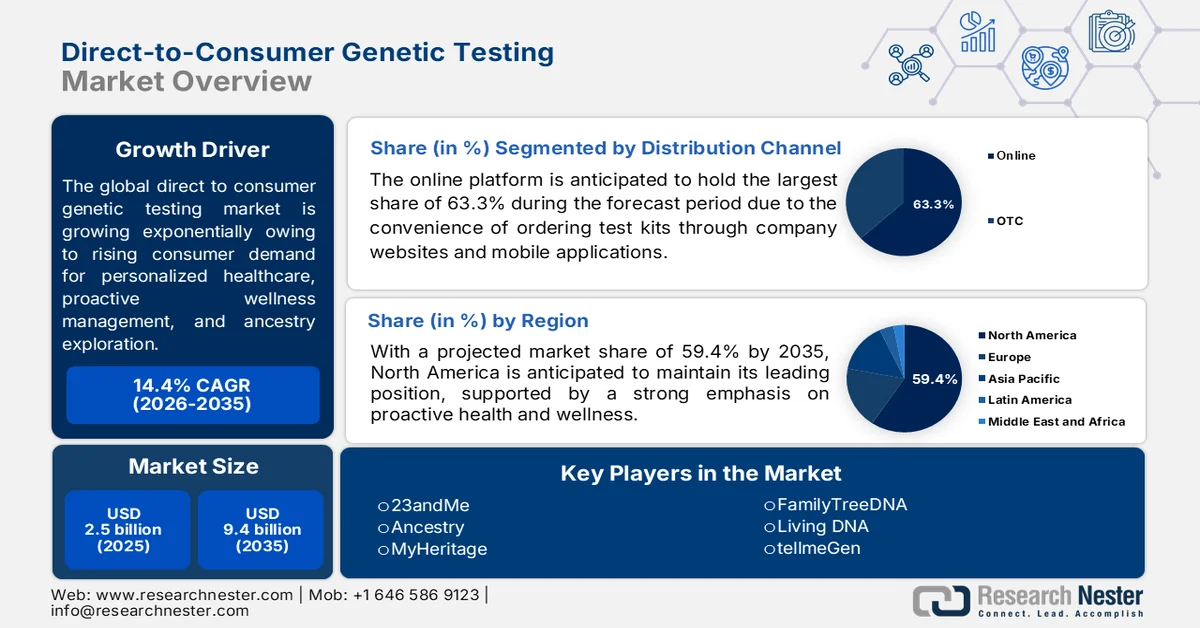
The global direct-to-consumer genetic testing market is positioned for strong evolution largely attributable to the rising consumer demand for personalized healthcare, proactive wellness management, and ancestry exploration. In addition, strategic partnerships between testing platforms and pharmaceutical companies for drug discovery are opening new corporate revenue streams, attracting more players to make investments in this field. As per an article published by the National Institutes of Health (NIH) in October 2025, direct-to-consumer genetic testing is witnessing growing adoption as individuals are looking for direct access to genetic insights without requiring healthcare provider involvement. It also stated that advancements in sequencing technologies, broader test availability, and declining testing costs are expanding consumer participation, thereby encouraging greater awareness of personalized health and ancestry information.
In parallel, technological advancements in next-generation sequencing are dramatically lowering operational costs, which allows providers to offer highly sophisticated genomic profiles directly to the public. Market expansion is also being fueled by the integration of artificial intelligence, which enhances data analysis and delivers more actionable understanding of individuals’ health. For instance, in November 2024, ProPhase Labs announced the launch of DNA Complete®, which is a direct-to-consumer genetic testing service that uses whole-genome sequencing to provide detailed insights into health, wellness, and ancestry. The company also introduced DNA Expand™, which is a subscription platform that enhances existing ancestry DNA data with advanced health reports and ongoing updates.
Key Direct-to-Consumer Genetic Testing Market Insights Summary:
Regional Highlights:
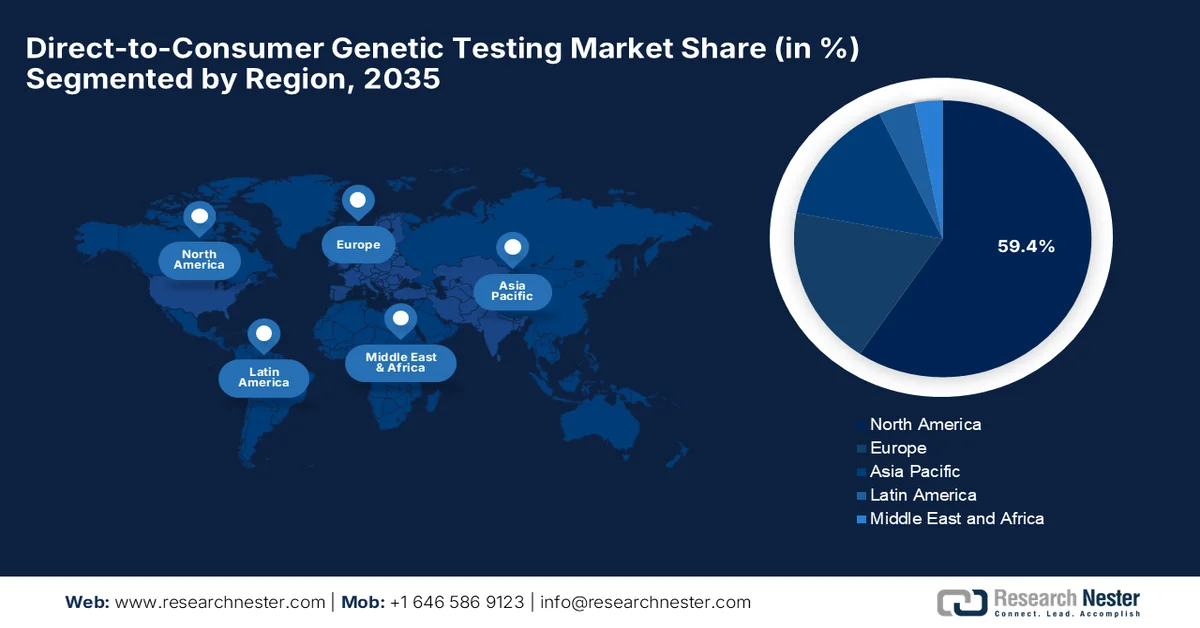
- North America is anticipated to secure 59.4% of the direct-to-consumer genetic testing market by 2035, underpinned by exceptionally high consumer awareness and a culture of proactive health management
- Asia Pacific is expected to register the fastest growth throughout the 2026-2035 forecast period, supported by rising middle-class disposable incomes and a significant cultural shift toward preventive healthcare
- The direct-to-consumer genetic testing market in the U.S. accounts for 84.7% of the share in North America owing to strong presence of leading market players, and favorable access to advanced genetic testing technologies
Segment Insights:
- The online platform segment is projected to account for 63.3% share by 2035 in the direct-to-consumer genetic testing market, benefiting from increasing internet penetration, expanding e-commerce adoption, and integration of telehealth and digital health platforms
- Whole-genome sequencing is anticipated to witness considerable growth during the 2026-2035 forecast period, fueled by declining sequencing costs and continuous advancements in next-generation sequencing technologies
Key Growth Trends:
- Rising demand for personalized wellness
- Expansion of ancestry and genealogy interest
Major Challenges:
- Data privacy and cybersecurity vulnerabilities
- Clinical oversight gaps and result misinterpretation
Key Players: 23andMe, Ancestry, MyHeritage, FamilyTreeDNA, Living DNA, tellmeGen, Nebula Genomics, Dante Genomics.
Global Direct-to-Consumer Genetic Testing Market Forecast and Regional Outlook:
Market Size & Growth Projections:
- 2025 Market Size: USD 2.5 billion
- 2026 Market Size: USD 2.8 billion
- Projected Market Size: USD 9.4 billion by 2035
- Growth Forecasts: 14.4% CAGR (2026-2035)
Key Regional Dynamics:
- Largest Region: North America (59.4% share by 2035)
- Fastest Growing Region: Asia Pacific
- Dominating Countries: United States, China, Germany, Japan, United Kingdom
- Emerging Countries: India, South Korea, Singapore, Australia, Brazil
Last updated on : 6 August, 2026
Direct-to-Consumer Genetic Testing Market - Growth Drivers and Challenges
Growth Drivers
- Rising demand for personalized wellness: Consumers are looking for health solutions which are suitable to their own DNA profiles. Direct to consumer genetic testing meets this demand by providing specific understandings, whereas this shift from reactive treatment to proactive wellness allows individuals to make highly informed lifestyle adjustments. In October 2023, 23andMe introduced the health action plan, which is a personalized digital tool for 23andMe+ members that efficiently combines genetic information, health history, and biomarker data to deliver suitable health recommendations. Besides, the company also notes that this particular platform provides actionable guidance based on their health profile, thus boosting adoption in the direct-to-consumer (DTC) genetic testing market.
- Expansion of ancestry and genealogy interest: Public interest regarding family history and heritage discovery is considered to be a powerful growth driver for the market. Companies across different nations have been refining their breakdown databases and relative-matching features in order to provide more accurate geographic understandings. In this context, AncestryDNA in October 2024 released one of its largest updates ever, which improves the accuracy and detail of ancestry results by matching customers to more than 3,000 locations and expanding its ancestral regions from 88 to 107. The company also notes that this particular update introduces new terminology such as ancestral regions, ancestral journeys, and additional subregions in Europe, with a main goal of providing a clearer and more personalized user experience.
Challenges
- Data privacy and cybersecurity vulnerabilities: This has emerged as a paramount challenge for the market. Genetic profiles contain highly sensitive and immutable personal information, making consumers increasingly concerned about how companies collect, store, monetize, and share their genetic data. On the other hand, high-profile data breaches and the secondary commodification of genomic information for pharmaceutical research have heightened public skepticism. Weak security measures can put users' data at risk, damaging a company's reputation and creating hesitation among buyers to use its services. Therefore, companies must make large investments in advanced encryption and transparent data-handling protocols to build trust and avoid catastrophic financial penalties.
- Clinical oversight gaps and result misinterpretation: The absence of clinical supervision, along with the risk of result misunderstandings, results in severe obstacles for the market globally. These tests are usually ordered without the guidance of a physician or genetic counselor. Raw data is highly complex, often leading consumers to misinterpret benign variants or overlook critical false negatives and false positives. The presence of this gap can trigger severe psychological distress, unnecessary medical anxiety, or a false sense of reassurance that leads to inappropriate lifestyle choices. Furthermore, when consumers turn to the primary healthcare system for clarity, it places an administrative burden on physicians who may lack the specialized training to interpret commercial genetic data, in turn creating systemic friction.
Direct-to-Consumer Genetic Testing Market Size and Forecast:
| Report Attribute | Details |
|---|---|
|
Base Year |
2025 |
|
Forecast Year |
2026-2035 |
|
CAGR |
14.4% |
|
Base Year Market Size (2025) |
USD 2.5 billion |
|
Forecast Year Market Size (2035) |
USD 9.4 billion |
|
Regional Scope |
|
Direct-to-Consumer Genetic Testing Market Segmentation:
Distribution Channel Segment Analysis
The online platform is anticipated to hold the largest share of 63.3% in the distribution channel segment of the direct-to-consumer (DTC) genetic testing market during the forecast period. The segment’s dominance is largely attributable to the convenience of ordering test kits through company websites and mobile applications, and doorstep sample collection. On the other hand, secure digital delivery of results and easy access to personalized genetic reports position the market for strong market dominance. Increasing internet penetration, expanding e-commerce adoption, and integration of telehealth and digital health platforms also strengthen consumer preference for online purchasing and result management.
Technology Segment Analysis
Whole-genome sequencing, which is a part of the technology segment, is projected to grow at a considerable rate in the market by the end of 2035. The growth of the segment is mainly propelled by declining sequencing costs and continuous advancements in next-generation sequencing technologies. Also, the expanding use of WGS for personalized health risk assessment, carrier screening, pharmacogenomics, and preventive healthcare applications is driving the segment’s growth. In July 2024, GeneDx announced enhancements to its whole genome sequencing services, which include rapid results in as little as five days, making diagnoses faster for patients with suspected genetic conditions. The company is also introducing non-invasive cheek swab sample collection and expanding its ability to detect repeat expansion disorders through a single test.
Test Type Segment Analysis
Predictive testing is expected to hold a substantial share in the market throughout the forecast period. The increasing consumer awareness of inherited disease risks and the growing emphasis on preventive healthcare are supporting the segment’s expansion. In addition, rising demand for early identification of genetic predisposition to conditions such as cancer, cardiovascular disorders, and neurodegenerative diseases, along with advancements in personalized health reporting, is efficiently driving the adoption of predictive genetic testing services. In February 2024, NIH-funded researchers improved polygenic risk scores by incorporating genetically diverse data, which makes disease risk predictions more accurate across different ancestral populations. This updated approach helps reduce biases that are found in traditional genetic assessments that often underrepresent non-Europe groups, thus supporting more equitable healthcare outcomes.
Our in-depth analysis of the direct-to-consumer genetic testing includes the following segments:
|
Segment |
Subsegments |
|
Distribution Channel |
|
|
Technology |
|
|
Test Type |
|

Vishnu Nair
Head - Global Business DevelopmentCustomize this report to your requirements — connect with our consultant for personalized insights and options.
Direct-to-Consumer Genetic Testing Market - Regional Analysis
North America Market Insights
North America market is forecasted to capture the dominating revenue share of 59.4% during the discussed timeframe. The region’s dominant position is largely propelled by exceptionally high consumer awareness and a culture of proactive health management. North America’s extensive e-commerce penetration and high disposable incomes facilitate early adoption of wellness technologies. In July 2023, Quest Diagnostics announced the launch of genetic insights which is a consumer-initiated genetic test that uses advanced next-generation sequencing technology to assess the risk of nearly two dozen inherited health conditions, including certain cancers, heart disorders, and carrier-status diseases. This particular service combines DNA analysis with health reports, physician oversight, and access to professional genetic counseling.
The presence of a deeply tech-savvy population and a commercial footprint of industry pioneers are driving growth of the U.S. direct-to-consumer genetic testing market. Growth in the country’s market is also driven by strategic collaborations between domestic testing platforms and major pharmaceutical corporations that are aiming to utilize huge amounts of genomic databases for targeted drug discovery. In this context, Helix and Recursion Pharmaceuticals in June 2024 entered a multi-year partnership to advance drug discovery by combining large-scale clinico-genomic data with artificial intelligence technologies. Under this agreement, Recursion will access de-identified genomic and longitudinal clinical data from Helix’s research network to develop AI models that can improve target identification, biomarker discovery, and patient stratification.
The distinct regulatory environment is reshaping the growth dynamics of Canada market. Compliance under Health Canada focuses on certain rigorous standards for test validity and consumer safety, creating a marketplace that is structured around data accuracy and ethical transparency. Growth is also being accelerated by high internet penetration and strong interest from diverse demographic groups exploring their cultural lineage. In addition, the country’s defensive regulatory stance reduces the influx of unverified lifestyle tests, ultimately building deeper consumer trust across the region. Hence, the presence of this secure environment encourages higher participation rates from previously hesitant, privacy-conscious demographics.
APAC Market Insights
The Asia Pacific direct-to-consumer (DTC) genetic testing market is forecasted to grow at the quickest rate during the stipulated timeframe. The region’s upliftment is mainly driven by rising middle-class disposable incomes and a significant cultural shift toward preventive healthcare. Local and international providers are adapting to this diverse marketplace by offering localized genetic panels that are suitable for regional genotypes and integrating services with ubiquitous mobile health applications. For instance, in April 2024, Genesis Healthcare Co. and GeneLife announced the launch of GeneLife CONNECT, which is a subscription-based genetic testing service that provides health, wellness, and ancestry insights through affordable ongoing access to personal genomic data. This platform enables users to store their DNA information, receive updated genetic reports, and access personalized features over time.
A massive population and a highly advanced digital ecosystem are driving the growth of the direct-to-consumer (DTC) genetic testing market in China. The country’s market growth is also being accelerated by the rising demand for specialized pediatric testing, wherein parents seek genetic insights into their children's talents, physical traits, and nutritional needs. In April 2025, Genetic Analysis AS and Thalys Medical Technology Group announced the launch of a direct-to-consumer microbiome testing service in China, which is based on the clinically validated GA-map® dysbiosis test and adapted specifically for the country’s consumers. This particular service provides insights into gut health, beneficial and harmful microbes, personalized probiotic recommendations, and metabolic health information through a mobile-based platform.
In India, the market is extensively supported by an expanding middle class, rapid urbanization, and a surging societal focus on preventive healthcare. The country’s market also benefits from widespread adoption of digital health platforms and affordable mobile data, which allow local startups to reach consumers across both major metropolitan hubs and tier-2 cities. For instance, India Brand Equity Foundation in November 2023 stated that India’s preventive healthcare sector is experiencing rapid growth, driven by rising awareness of chronic diseases, technological innovation, and increasing demand for early diagnosis, wellness, and personalized health solutions. The industry is supported by advancements in AI, machine learning, telehealth, remote monitoring, and digital health platforms, thus making it suitable for standard market growth.
Europe Market Insights
The Europe market is anticipated to progress at a considerable rate owing to the presence of a highly sophisticated consumer base that prioritizes preventative medicine, healthy ageing, and detailed ancestry exploration. Market progression across the continent is reshaped by stringent data protection mandates that enforce strict consumer privacy and give users absolute ownership over their genomic data. In September 2024, QIAGEN and Bode Technology formed a strategic partnership to expand the use of GEDmatch PRO, which is a leading forensic genetic genealogy database that helps law enforcement identify suspects and human remains using advanced DNA analysis. Under this agreement, Bode Technology will serve as the exclusive commercial partner, whereas QIAGEN will enhance the platform’s capabilities.
The presence of an advanced biotechnology ecosystem and well-established precision medicine initiatives is responsibly positioning Germany direct-to-consumer genetic testing market for sustained growth. The country’s market also benefits from active investment in genomic research through national initiatives, which strengthens the broader genomics ecosystem and promotes responsible use of genetic information. For instance, in July 2024, Germany advanced genomic medicine by launching a five-year nationwide pilot project that integrates genome sequencing into routine care for patients with rare diseases and cancer, following approval of the Genome Data Regulation (GenDV) by the Federal Council. This is backed by a total of USD 760 million from statutory health insurance funds, and it expands access to genomic diagnostics across participating clinical centers, thus underscoring demand for genomic testing in the country.
The UK direct-to-consumer (DTC) genetic testing market is expanding, with notable growth that is driven by high health literacy and a mature e-commerce infrastructure. Strategic partnerships between commercial genomics firms and the UK's life sciences research sector, along with stringent data protection laws, are responsibly accelerating the country's market growth by enhancing consumer trust in genetic data privacy. In October 2025, the RCGP updated its guidance on direct-to-consumer genetic testing, which advises healthcare professionals not to rely on results from non-accredited testing providers or third-party interpretation services. It also states that people with DTC genetic test results should receive the same NHS care as other patients, and such results should not influence access to treatments not routinely funded by the NHS, thus driving adoption of properly scrutinized solutions in the country.
Key Direct-to-Consumer Genetic Testing Market Players:
- 23andMe (U.S.)
- Ancestry (U.S.)
- MyHeritage (Israel)
- FamilyTreeDNA (U.S.)
- Living DNA (UK)
- tellmeGen (Spain)
- Nebula Genomics (U.S.)
- Dante Genomics (Italy)
- Company Overview
- Business Strategy
- Key Product Offerings
- Financial Performance
- Key Performance Indicators
- Risk Analysis
- Recent Development
- Regional Presence
- SWOT Analysis
- 23andMe is one of the leading manufacturers in the market, which offers saliva-based DNA tests that provide ancestry, health predisposition, carrier status, wellness, and pharmacogenetic reports. As part of a financial restructuring process, the company entered Chapter 11 bankruptcy proceedings, and despite the ownership transition, it continues to provide consumer genetic testing services.
- Ancestry is a prominent manufacturer in this field that specializes in genealogy and family history research. The firm deliberately combines its AncestryDNA testing service with one of the world's largest collections of historical records to help consumers identify genetic relatives and trace ancestral origins.
- MyHeritage is yet another prominent player in this sector that provides DNA kits that provide ethnicity estimates, DNA matching, and family tree integration. The company’s genetic testing platform is supported by multilingual genealogy services and an extensive collection of historical records.
- FamilyTreeDNA is a U.S.-based manufacturer that has been specializing in direct-to-consumer genetic tests for ancestry and genealogical research. The firm provides autosomal DNA, Y-DNA, and mitochondrial DNA (mtDNA) testing, which enables paternal, maternal, and family lineage analysis.
- Living DNA is a UK-based manufacturer of direct-to-consumer genetic testing kits that is focused on ancestry, family matching, and personalized health insights. Besides, the company also provides wellness and lifestyle reports through selected consumer offerings and collaborates with research institutions to improve genomic interpretation.
Here is a list of key players operating in the global market:
The direct-to-consumer (DTC) genetic testing market is characterized by a moderate level of consolidation, wherein a limited number of global manufacturers account for a significant share of consumer testing volumes, especially in terms of ancestry, health risk, wellness, and whole-genome sequencing services. Market competition in this sector is largely driven by the breadth of genetic reports, database size, testing accuracy, privacy features, AI-enabled interpretation, and continuous product innovation. In July 2025, Regeneron announced plans to acquire most of 23andMe’s assets for a total amount of USD 256 million through a bankruptcy auction, with the goal of continuing its consumer genetics services and expanding genetics-based medical research. By combining 23andMe’s large genetic database with Regeneron’s expertise in terms of drug discovery, the acquisition aims to support new scientific advances and improve human health outcomes.
Corporate Landscape of the Market:
Recent Developments
- In May 2026, 23andMe introduced reconstructed ancestors, which is an innovative feature that uses DNA data from tested relatives to estimate the genetic profiles and ancestry of ancestors who never took a DNA test. Along with this, the company also launched DNA relatives clustering, which automatically groups DNA matches into family branches.
- In October 2025, MyHeritage upgraded its DNA testing service to whole-genome sequencing, which allows it to analyze nearly the entire human genome instead of a limited number of genetic markers. This advancement is expected to improve the accuracy of DNA matches, ancestry estimates, and future genealogy tools.
- Report ID: 8731
- Published Date: Aug 06, 2026
- Report Format: PDF, PPT
- Explore a preview of key market trends and insights
- Review sample data tables and segment breakdowns
- Experience the quality of our visual data representations
- Evaluate our report structure and research methodology
- Get a glimpse of competitive landscape analysis
- Understand how regional forecasts are presented
- Assess the depth of company profiling and benchmarking
- Preview how actionable insights can support your strategy
Explore real data and analysis
Frequently Asked Questions (FAQ)
About this Report
Connect with our Expert


Report, 2026-2035



Copyright @ 2026 Research Nester. All Rights Reserved.
