Device as a Service (DaaS) Market - Growth Drivers and Challenges
Growth Drivers
- AI integration for lifecycle management: AI integration into DaaS platforms is a major growth driver, which makes predictive device health analytics, refresh cycles optimized, and robust endpoint security. This cognitive layer of management takes DaaS from a simple hardware subscription service to an intelligent, data-driven service. In May 2025, during its annual Think conference, IBM announced new hybrid cloud technologies, including advancements for its watsonx AI portfolio and AI-powered database management features. This software is designed to help businesses, particularly those with complex hybrid cloud environments, manage and scale enterprise AI applications and resources more efficiently.
- Enterprise focus on sustainability: Corporate sustainability goals and circular economy thinking are increasingly influencing IT purchasing, rendering DaaS an attractive model. Solution providers are responding by incorporating sustainability elements into their offerings, including device refurbishment, environmentally responsible recycling, and carbon footprint tracking. An example is Lenovo's launch of its TruScale DaaS with modular sustainability features in August 2025. The solution allows organizations to manage their carbon footprint and reduce IT costs by including carbon tracking and offset credits, linking directly IT operations to overall environmental objectives.
- Streamlined and bundled solutions: Businesses are seeking streamlined buying arrangements that combine hardware, software, connectivity, and managed services into a single, predictable subscription. It simplifies the administration of complexity while providing a single point of contact for IT support, particularly for remote workers. Highlighting this trend, Honeywell partnered with Verizon in January 2025 to offer a bundled DaaS solution. Such a solution, one that integrates hardware, 5G connectivity, and managed services, simplifies tech procurement for retail and logistics companies by providing an end-to-end, plug-and-play solution.
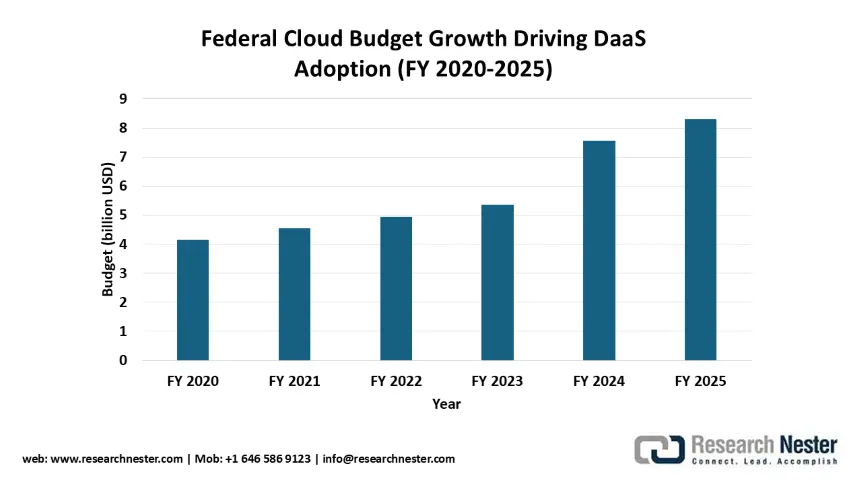
Federal Cloud Budget Growth Driving DaaS Adoption (FY 2020-2025)
The significant growth in federal cloud budgets, reaching $8.3 billion for FY 2025, directly accelerates Device-as-a-Service adoption by creating the infrastructure necessary for modern device management. This funding surge enables agencies to transition from capital-intensive device purchases to operational expense models that include regular refreshes and comprehensive support. The $2.2 billion budget jump between FY 2023-2024 particularly signals increased prioritization of digital transformation initiatives where DaaS plays a critical role.
Source: GovWin
Challenges
- Changing cybersecurity and data privacy regulations: The DaaS model, wherein third-party management of devices storing sensitive corporate and individual data occurs, is greatly threatened by the evolving nature of cybersecurity and data privacy regulations. Providers are confronted with a knotty mess of rules, which may vary significantly geographically. The release of India's draft Digital Personal Data Protection Rules in July 2025, for instance, imposes strict guidelines on the handling of personal data. This matters to DaaS providers, who must ensure their device management and data processing processes are fully compliant to provide services to clients in regulated sectors like BFSI and healthcare.
- Securing a distributed and heterogeneous device estate: DaaS vendors and their end-users have to deal with the constant challenge of protecting a distributed fleet of devices against an increasingly broad array of cyber threats. With hybrid work becoming the reality, the attack surface widens, requiring robust, multi-layered security solutions able to protect devices on and off the corporate network. Governments also exert pressure in the form of demanding higher security standards. In 2024, the U.S. Cybersecurity and Infrastructure Security Agency (CISA) released updated guidelines for endpoint and mobile device security, which in turn obliges DaaS providers in the public sector to offer pre-configured devices that meet these high-level security requirements.
Device as a Service (DaaS) Market Size and Forecast:
|
Base Year |
2025 |
|
Forecast Year |
2026-2035 |
|
CAGR |
29.5% |
|
Base Year Market Size (2025) |
USD 196.2 billion |
|
Forecast Year Market Size (2035) |
USD 2,602.5 billion |
|
Regional Scope |
|

