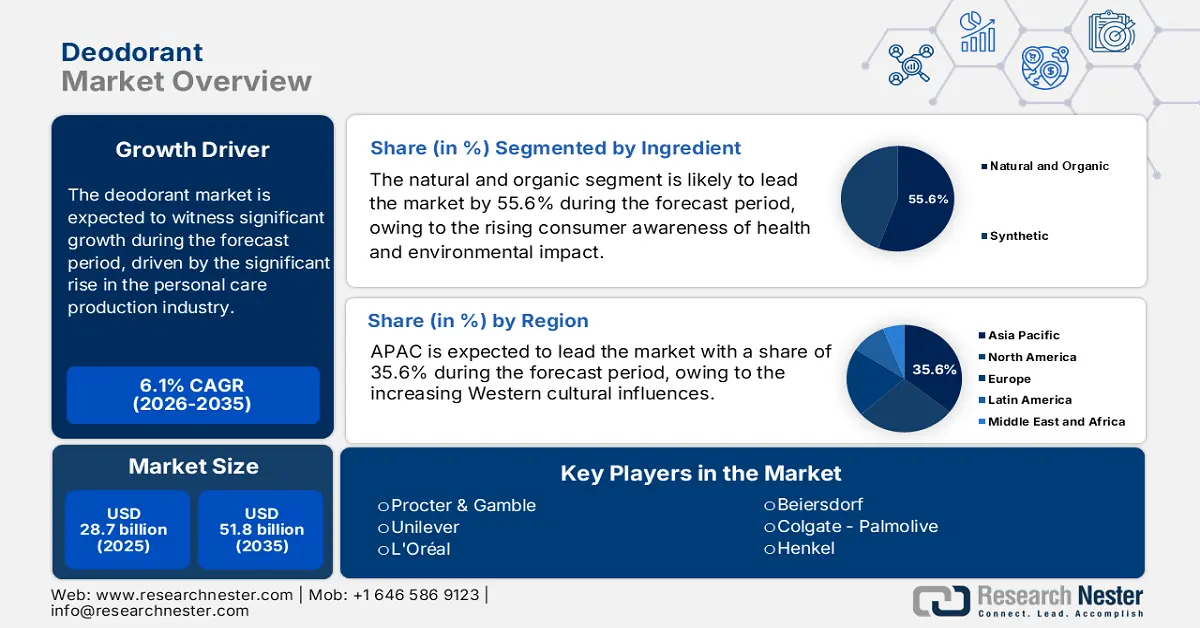
Deodorant Market Outlook:
Deodorant Market size was valued at USD 28.7 billion in 2025 and is projected to reach USD 51.8 billion by the end of 2035, rising at a CAGR of 6.1% during the forecast period, i.e., 2026-2035. In 2026, the industry size of deodorant is estimated at USD 30.4 billion.
The deodorant market constitutes a significant segment of the personal care production industry. In 2023, according to OEC data, worldwide trading of personal deodorants and antiperspirants was worth USD 4.91 billion. The import demand is largely concentrated in the emerging economies, mainly in Asia and Latin America, where the increase in disposable incomes and urbanization are the main factors that drive consumption. On the other hand, the WITS 2021 report depicts that the top exporters of personal deodorants and antiperspirants to the Netherlands were the UK, Germany, and the Russian Federation. This data reflects the rising demand and reliance on multinational supply chains. Further, these numbers demonstrate the industry's resiliency in the face of wider consumer goods instability and emphasize the significance of trade diversification tactics for producers and distributors.
Personal Deodorants and Antiperspirants Exports to the Netherlands in 2021
|
Country |
Trade Value (1000 USD) |
Quantity (Unit) |
|
United Kingdom |
61,700.22 |
8,617,820 |
|
Germany |
29,045.29 |
4,781,380 |
|
Russian Federation |
27,223.32 |
6,698,250 |
|
Italy |
15,718.39 |
2,639,660 |
|
France |
10,588.62 |
1,064,550 |
Source: WITS 2021
The operational landscape for manufacturers is actively redefined by the supply chain considerations and regulatory shifts concerning specific ingredients and packaging. The monitoring of the imports of the raw material, such as aerosol propellants, is vital for production planning and cost forecasting. The EPA provides data and guidelines affecting the lifecycle of these products from the sourcing of the materials to the environmental impact of packaging and volatile compound emissions from the aerosol variants. These factors are supporting the industry-wide evaluation of product formats and ingredient transparency. Furthermore, the FDA's ongoing review of OTC monographs, including those for antiperspirants, represents a potential driver for reformulation initiatives, requiring manufacturers to adapt to evolving regulatory standards and invest in relevant research and development to ensure continued compliance and market access.