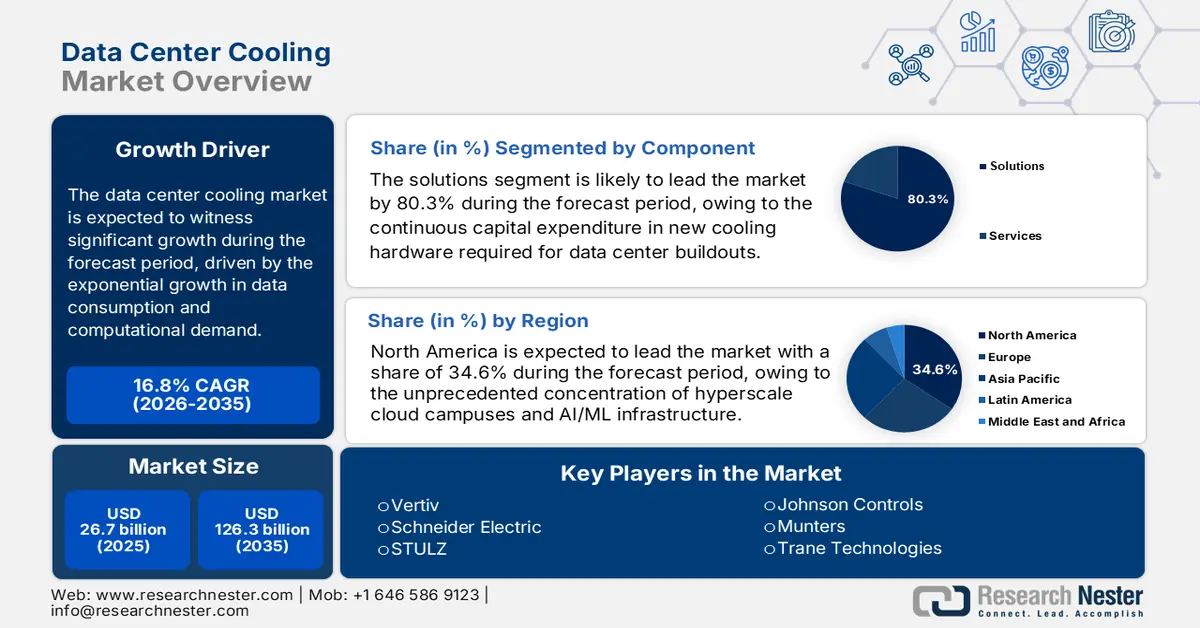
Data Center Cooling Market Outlook:
Data Center Cooling Market size was valued at USD 26.7 billion in 2025 and is projected to reach USD 126.3 billion by the end of 2035, rising at a CAGR of 16.8% during the forecast period, i.e., 2026-2035. In 2026, the industry size of data center cooling is estimated at USD 31.2 billion.
The data center cooling market is a critical and rapidly evolving segment of the global digital infrastructure sector and is driven mainly by the exponential growth in data consumption and computational demand. The expansion of cloud computing, artificial intelligence, and high-performance computing is significantly increasing the power density and thermal load within data center facilities, necessitating advanced thermal management solutions. The primary indicator of this growth is the substantial energy footprint of the sector. The report from the U.S. Department of Energy in December 2024 indicates that the data centers in the U.S. consumed 176 TWh in 2023, and this number is estimated to increase further. Moreover, over the consumption represents 4.4% of the nation’s total electricity use is consumed by cooling, accounting for a significant portion of this energy expenditure.
Key market drivers are linked to the national and international energy and environmental policy. Robust regulations such as the European Commission’s Energy Efficiency Directive are mandating continuous improvement in power usage effectiveness, pushing the facility operators to adopt more efficient cooling technologies such as liquid-based systems and advanced economization. These technologies can dramatically reduce the auxiliary energy used for cooling. The International Energy Agency data in April 2025 indicates that the global data center energy consumption is set to double by 2030 to 945 TWh. The energy efficiency gains from the technological improvements, including advanced cooling, have helped moderate this growth. The market is consequently shifting toward solutions that not only manage the higher heat loads from the AI servers but also align with the corporate and government sustainability targets.