The dairy blends market is witnessing stable growth due to the increasing demand for functional and convenient dairy products across the food and beverage industry. It is increasingly being used in bakery, confectionery, dairy products, beverages, and nutritional applications, as they offer improved functionality, consistent quality, and formulation flexibility. The growing demand for ready-to-eat food is further encouraging food manufacturers to participate in the market.
Across major economies, the market is also benefiting from the continuous expansion of the food processing industry and changing consumer dietary preferences. To improve product quality, enhance taste and texture, and extend product shelf life, food manufacturers are paying attention to ingredient innovation. Therefore, the use of dairy blends is increasing across several food and beverage applications.
According to the OECD-FAO Agricultural Outlook 2025-2034, global dairy consumption is anticipated to continue increasing over the medium term as population growth and rising incomes support demand for dairy products. The report also highlights the growing use of processed dairy food and dairy ingredients among food manufacturing applications, including bakery, confectionery, and infant nutrition.
Key Dairy Blends Market Insights Summary:
Regional Highlights:
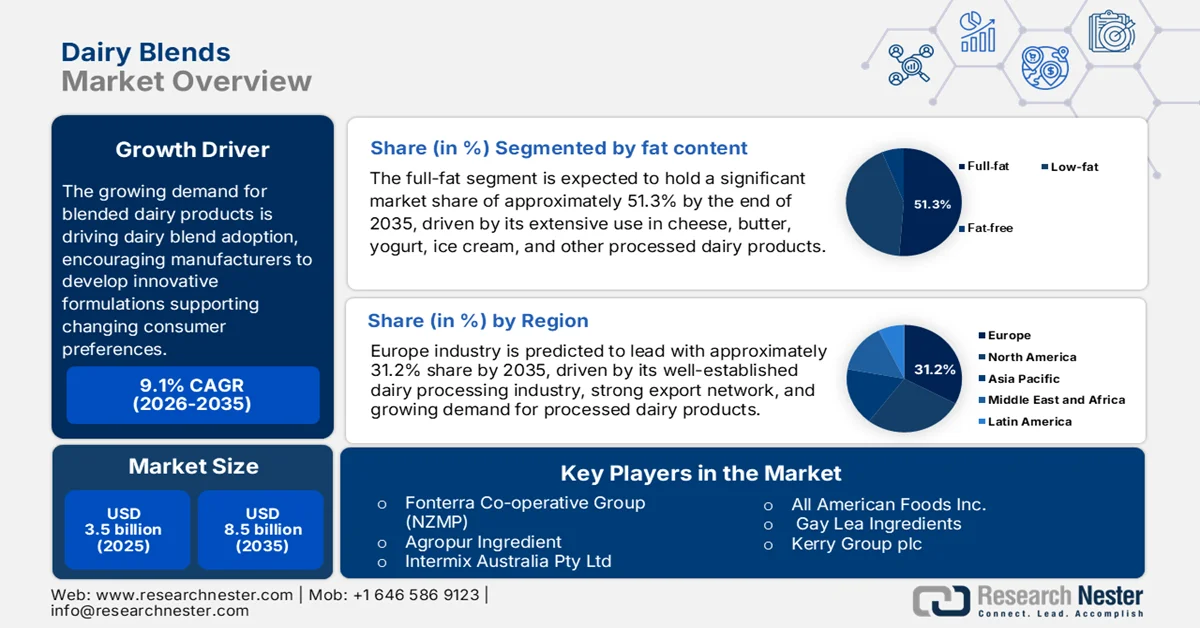
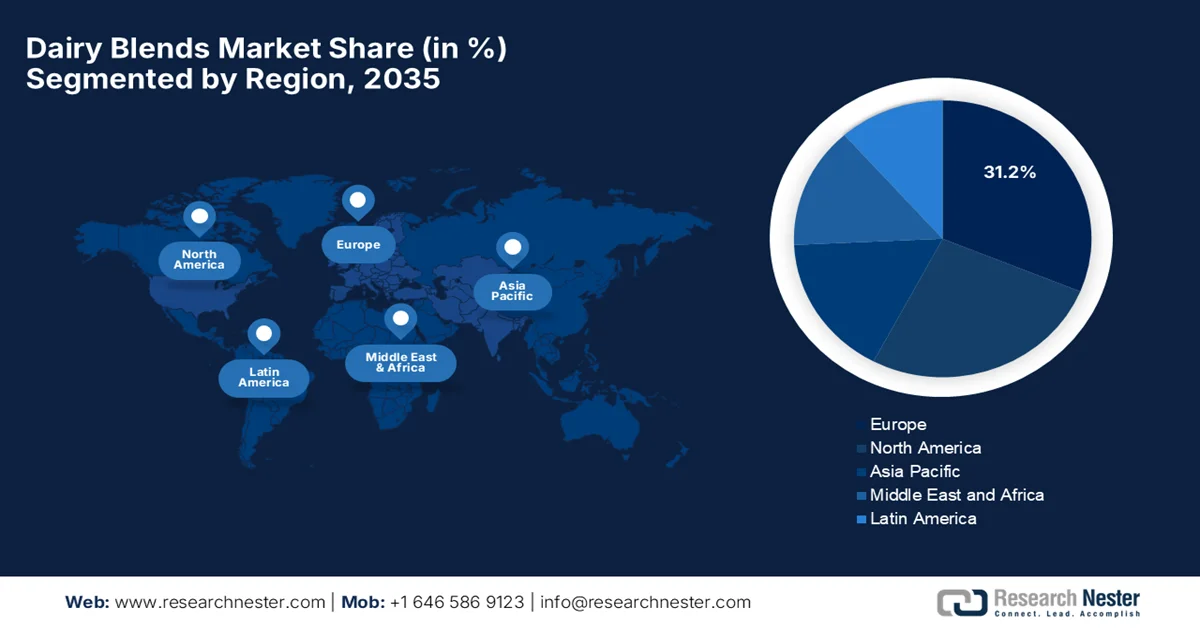
- Dairy blends market Europe is projected to capture 31.2% of the market by 2035, reinforced by its well-established dairy industry and expanding exports of processed dairy products
- North America is poised for notable expansion throughout the 2026-2035 period, fueled by increasing consumption of premium dairy products and the broadening use of dairy blends across processed food applications
Segment Insights:
- Dairy blends market full-fat is forecast to account for 51.3% of the market by 2035, underpinned by its extensive use in cheese, butter, yogurt, and ice cream for achieving preferred taste and texture
- Food applications are anticipated to secure the leading market share by 2035, bolstered by the expanding incorporation of dairy blends in bakery, confectionery, dairy desserts, beverages, sauces, and other processed foods
Key Growth Trends:
- Growing adoption of dairy blends in sports nutrition and functional beverages
- Rising preference for clean-label dairy products
Major Challenges:
- Fluctuations in raw milk prices
- Stringent food safety and quality regulations
Key Players: Fonterra Co-operative Group (NZMP) (New Zealand), Agropur Ingredients (Canada), Intermix Australia Pty Ltd (Australia), All American Foods Inc. (United States), Gay Lea Ingredients (Canada), Kerry Group plc (Ireland).
Global Dairy Blends Market Forecast and Regional Outlook:
Market Size & Growth Projections:
- 2025 Market Size: USD 3.5 billion
- 2026 Market Size: USD 3.9 billion
- Projected Market Size: USD 8.5 billion by 2035
- Growth Forecasts: 9.1% CAGR (2026-2035)
Key Regional Dynamics:
- Largest Region: Europe (31.2% share by 2035)
- Fastest Growing Region: North America
- Dominating Countries: Germany, United States, France, Netherlands, New Zealand
- Emerging Countries: China, India, Brazil, Japan, South Korea
Last updated on : 23 July, 2026
Dairy Blends Market - Growth Drivers and Challenges
Growth Drivers
- Growing adoption of dairy blends in sports nutrition and functional beverages: The increase of consumers focuses on health and fitness is encouraging manufacturers to incorporate dairy blends into protein drinks, meal replacement beverages, and wellness products. According to the International Food Information Council (IFIC), consumer interest in protein-rich foods and beverages is growing, which encourages innovation in health-focused food products. These blends support product quality by improving taste and texture while meeting the demand for nutrition-based products.
- Rising preference for clean-label dairy products: Consumers are looking for simple ingredients listed on a clean label, which is encouraging manufacturers to develop products that fulfil these requirements. Dairy blends help companies achieve consistent taste, texture, and product quality while meeting changing expectations related to food ingredients. According to the Food and Agriculture Organization (FAO), changing consumer preferences and rising demand for quality food products are influencing innovation across the dairy sector, supporting the development of improved dairy-based offerings.
- Increasing need for improved product stability and shelf-life performance: Manufacturers are encouraged to use dairy blends in different applications because of the growing need for food products with longer storage life and consistent quality. As companies increase their distribution networks and supply products across large markets, maintaining product stability has become an important consideration. According to the U.S. Department of Agriculture (USDA), advancements in food processing and preservation practices are supporting the production and availability of processed food products with improved quality and longer shelf stability.
Challenges
- Fluctuations in raw milk prices: Due to fluctuations in raw milk prices, the dairy blend market faces challenges, which affect the overall cost of production. Some factors which can influence raw material prices include changing weather conditions, feed costs, milk supply, and global dairy trade dynamics. Therefore, manufacturers find it hard to maintain steady production costs and profit margins. However, frequent price fluctuations can cause uncertainty in purchasing and production planning across the dairy value chain.
- Stringent food safety and quality regulations: Manufacturers operating in the market continuously face navigating food safety and quality regulations as a challenge. The products have to match guidelines which include quality, labeling, and safety requirements across different countries and regions. Due to this, the overall operating costs increase and make it more challenging to introduce new products into the market. As these regulations continue to increase, manufacturers often need to spend more time and resources to ensure their products comply with the required standards.
Dairy Blends Market Size and Forecast:
| Report Attribute | Details |
|---|---|
|
Base Year |
2025 |
|
Forecast Year |
2026-2035 |
|
CAGR |
9.1% |
|
Base Year Market Size (2025) |
USD 3.5 billion |
|
Forecast Year Market Size (2035) |
USD 8.5 billion |
|
Regional Scope |
|
Dairy Blends Market Segmentation:
Fat Content Segment Analysis
For the fat content segment, the full-fat sub-segment is expected to hold the largest share of the dairy blends market of approximately 51.3% throughout the forecast period. Full-fat dairy blends are largely used in products such as cheese, butter, yogurt, and ice cream due to their broad application across the food industry. They help manufacturers achieve the desired taste and texture in a wide range of food products. According to the Food Standards Australia New Zealand (FSANZ), dairy products are classified based on their fat composition, which highlights the importance of fat content in dairy product formulation. This is anticipated to support the leading position of the full-fat segment during the forecast period.
Application Segment Analysis
Based on the application segment, the food applications sub-segment is anticipated to hold the largest share of the market by the end of 2035. The global use of dairy blends in bakery products, confectionery, dairy desserts, beverages, sauces, and other processed foods is a key factor supporting this growth. Dairy blends help manufacturers achieve consistent texture, flavor, and functionality while allowing them to tailor formulations to different product requirements. They also enable the efficient use of dairy ingredients across a wide range of food applications. According to the International Dairy Federation (IDF), the global dairy sector continues to expand its portfolio of premium dairy products to meet changing consumer demand and evolving food manufacturing requirements. This continued growth in processed food production is expected to support the leading position of the food applications segment throughout the forecast period.
Product Type Segment Analysis
Among the product type segment, the milk blends sub-segment is projected to account for the largest share of the market by the end of the forecast year. The segment is supported by the excessive use of milk blends in dairy beverages, yogurt, infant nutrition, bakery products, and other processed food applications. Where milk blends provide manufacturers with a lot of formulation flexibility while helping in maintaining consistent product quality across a wide range of food products. According to the International Dairy Foods Association (IDFA), milk continues to be the primary ingredient used in the production of a broad range of dairy products, reflecting its importance across the food manufacturing industry. The continued demand for milk-based ingredients in food manufacturing is anticipated to be one of the reasons for being in the leading position of the milk blends segment during the forecast period.
Our in-depth analysis of the dairy blends includes the following segments:
|
Segment |
Sub-segment |
|
Product Type |
|
|
Form |
|
|
Application |
|
|
Fat Content |
|

Vishnu Nair
Head - Global Business DevelopmentCustomize this report to your requirements — connect with our consultant for personalized insights and options.
Dairy Blends Market - Regional Analysis
Europe Market Insights
Europe is anticipated to hold the largest share of the dairy blends market, holding approximately 31.2% by the end of 2035. The region continues to be a major market for dairy blends due to its established dairy industry and the growing demand for processed dairy products. Where manufacturers are expanding the use of dairy blends across a variety of food applications to meet evolving consumer preferences. According to the International Trade Centre (ITC), Europe is one of the world's leading exporters of dairy products, which reflects its strong position in the global dairy industry. This is expected to be one of the reasons for the growth of the market across the region during the forecast period.
Germany's dairy blends market is supported by investments in dairy processing capacity and the country's strong export network for value-added dairy ingredients, creating favorable opportunities for market growth. According to the German Federal Statistical Office (Destatis), Germany produced approximately 32.4 million tonnes of cow's milk in 2023, making it the largest milk producer in the European Union. The milk produced by these dairies, half of which is exported, reflects the country's strong processing capabilities and international presence.
France's dairy blends market is supported by the country's well-established premium dairy sector, which continues to create opportunities through the development of premium dairy ingredients and speciality cheese applications. The country is recognized for developing high-value dairy products that require consistent ingredient quality and specialized formulations. This emphasis on premium dairy production is expected to create stable demand for dairy blends across the food industry.
North America Market Insights
North America dairy blend market is anticipated to witness steady growth during the forecast period, supported by its developed dairy sector and the growing demand for premium dairy products. The region continues to experience strong consumption of processed foods, nutritional products, bakery items, and dairy-based beverages, which encourages manufacturers to enhance the use of dairy blends across wide food applications. According to the United States Department of Agriculture, the U.S. remains one of the world's leading producers of milk and dairy products. These factors are anticipated to support the continuous growth of the market across North America.
Dairy blends are being used more in bakery products, dairy beverages, protein-rich foods, and ready-to-eat products as manufacturers are enhancing their product offerings to match changing consumer preferences. The U.S. is contributing to the market through the continuous development of processed dairy products. The country's large manufacturing base and investments in innovations continue to support the increase of the market.
Canada is supporting the market through the growing demand for value-added dairy products, particularly cheese, butter, and other processed dairy products. Dairy companies are paying attention more to product diversification and the development of premium dairy offerings to meet changing consumer preferences. According to Statistics Canada, mozzarella and cheddar are among the most-produced cheese varieties in Canada, highlighting the country's strong cheese manufacturing industry.
APAC Market Insights
Asia Pacific is anticipated to witness stable growth in the market during the forecast period. The regional market is supported by increasing dairy processing activities, growing product innovation, and rising demand for premium dairy products across major countries. Across the region, rising urbanization and the expansion of the food processing industry are further creating opportunities for dairy blend manufacturers. According to the Food and Agriculture Organization (FAO), global milk production expanded in 2024, supported by significant output growth in Asia, which reflects the region's growing dairy industry.
Japan is supporting the dairy blends market through the growing production of fermented dairy products. The growing availability of yogurt and cultured milk drinks is creating opportunities for the use of dairy blends across various dairy applications. This trend is anticipated to support market growth during the forecast period.
Dairy companies are increasing their product portfolios that include infant nutrition, dairy beverages, yogurt, and other processed dairy products to meet evolving consumer demand. China dairy blends market, is contributing because of the rising demand for dairy products and the ongoing expansion of its food processing industry. The growing focus on product quality and diversified dairy offerings is expected to create favorable opportunities for the market during the forecast period.
Key Dairy Blends Market Players:
- Fonterra Co-operative Group (NZMP)(New-Zealand)
- Agropur Ingredients (Canada)
- Intermix Australia Pty Ltd (Australia)
- All American Foods Inc.) (United States)
- Gay Lea Ingredients (Canada)
- Kerry Group plc (Ireland)
- Company Overview
- Business Strategy
- Key Product Offerings
- Financial Performance
- Key Performance Indicators
- Risk Analysis
- Recent Development
- Regional Presence
- SWOT Analysis
- All American Foods is a leading U.S. manufacturer of customized dairy blends and specialty dairy ingredients. The company supplies dairy ingredient solutions to food manufacturers among bakery, confectionery, soups, sauces, and prepared food applications, which pay attention on customized products and consistent quality.
- Through its NZMP brand, Fonterra supplies customized dairy blend solutions to food and beverage manufacturers worldwide. Its portfolio supports applications across bakery, dairy, beverages, confectionery, and nutrition, helping customers achieve consistent functionality and processing performance.
- Agropur Ingredients develops customized dairy blend solutions for food manufacturers across bakery, confectionery, dairy products, beverages, and nutrition applications. The company provides specialty dairy solutions that help improve formulation flexibility, product consistency, and processing performance.
Here is a list of key players operating in the global market:
The global dairy blends market is shaped by manufacturers that are responding to changing requirements across the food and beverage industry. Rather than competing only on product range, companies are paying greater attention on ingredient performance, consistent quality, and application support. Investments in processing capabilities and sourcing networks are helping improve supply reliability, while close collaboration with food manufacturers is leading to blends designed for specific production requirements. As demand shifts across bakery, dairy, confectionery, and nutrition products, companies that combine technical expertise with flexible manufacturing are better positioned to address changing market requirements.
Corporate Landscape of the Market:
Recent Developments
- In March 2024, Kerry Dairy launched its Smug Dairy range, a blended oat and dairy product line combining traditional dairy with plant-based ingredients. The portfolio includes blended milk, cheese, and butter products developed to provide consumers with a hybrid dairy option while maintaining dairy taste and texture. The launch highlights the increasing demand for dairy blend products that combine nutritional, sustainability, and sensory benefits.
- Report ID: 8688
- Published Date: Jul 23, 2026
- Report Format: PDF, PPT
- Explore a preview of key market trends and insights
- Review sample data tables and segment breakdowns
- Experience the quality of our visual data representations
- Evaluate our report structure and research methodology
- Get a glimpse of competitive landscape analysis
- Understand how regional forecasts are presented
- Assess the depth of company profiling and benchmarking
- Preview how actionable insights can support your strategy
Explore real data and analysis
Frequently Asked Questions (FAQ)
About this Report
Connect with our Expert


Report, 2026-2035



Copyright @ 2026 Research Nester. All Rights Reserved.
