Cryo-electron Microscopy Market Outlook:
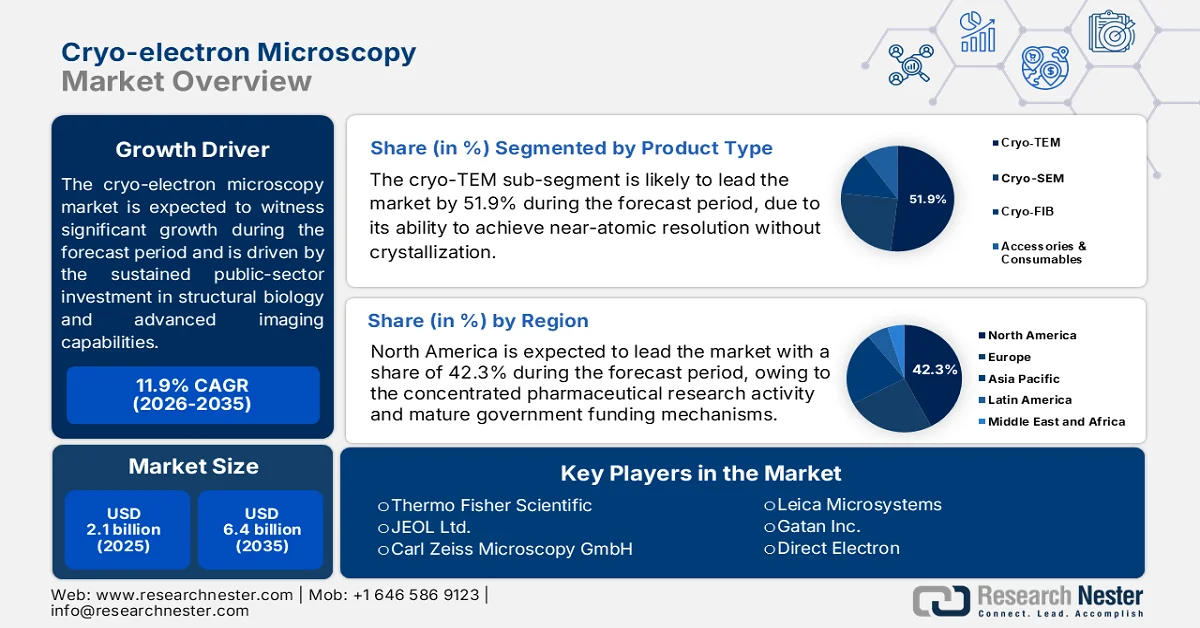
Cryo-electron Microscopy Market size was valued at USD 2.1 billion in 2025 and is projected to reach USD 6.4 billion by the end of 2035, rising at a CAGR of 11.9% during the forecast period, i.e., 2026-2035. In 2026, the industry size of cryo-electron microscopy is estimated at USD 2.3 billion.
The cryo-electron microscopy market is being supported by sustained public-sector investment in structural biology, biomedical research infrastructure, and advanced imaging capabilities. The NIH June 2024 data depicts that the National Institutes of Health (NIH) Common Fund launched the Transformative High Resolution Cryo-Electron Microscopy program to expand researcher access to high-end cryo-EM instrumentation and data-processing resources. NIH-funded national service centers have enabled thousands of investigators to access instruments that would otherwise require multimillion-dollar capital expenditures. The growing utilization of cryo-EM is closely tied to expanding structural biology output. According to the Cambridge February 2025 data, the number of experimentally determined macromolecular structures deposited globally exceeded 230,000, with cryo-EM representing one of the fastest-growing deposition categories.
Growth prospects are further reinforced by expanding investments in life-science research and translational medicine. NIH June 2025 data reported annual funding obligations exceeding USD 48 billion in recent fiscal years, creating a substantial funding base for advanced analytical technologies used in drug discovery and disease research. Cryo-EM has become increasingly important in federally supported programs focused on cancer, infectious diseases, neurodegenerative disorders, and rare diseases, where detailed molecular characterization is required. As pharmaceutical and biotechnology organizations seek higher-resolution structural insights to support candidate selection, biologics optimization, and regulatory documentation, procurement activity for cryo-EM instruments and associated services is expected to remain closely aligned with government-funded research spending, national infrastructure programs, and nonprofit scientific collaborations.
Key Cryo-electron Microscopy Market Insights Summary:
Regional Highlights:
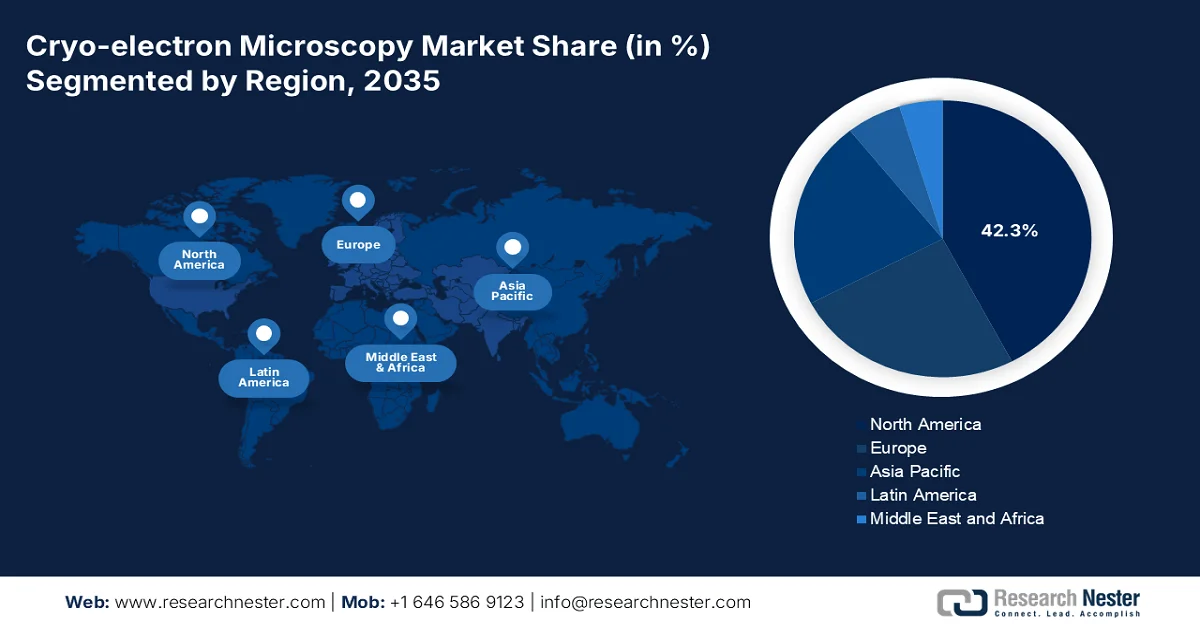
- North America cryo-electron microscopy market is anticipated to capture 42.3% of the regional revenue share by 2035, reinforced by concentrated pharmaceutical research activity and mature government funding mechanisms for structural biology
- Asia Pacific is set to witness the fastest expansion in the market throughout 2026-2035, fueled by aggressive government investments in structural biology infrastructure across Japan, China, India, South Korea, and Australia
Segment Insights:
- The cryo-TEM segment in the cryo-electron microscopy market is projected to account for 51.9% of the share by 2035, supported by its ability to achieve near-atomic resolution without crystallization
- Structural biology continues to lead the application segment during 2026-2035, benefiting from cryo-EM’s capability to image membrane proteins and complexes in near-native states, accelerating pharmaceutical R&D
Key Growth Trends:
- Strong economic contribution of NIH-funded biomedical research
- Rising federal R&D investments supporting advanced imaging technologies
Major Challenges:
- Extreme technical complexity
- Stringent regulatory & compliance hurdles
Key Players: Thermo Fisher Scientific (U.S.),JEOL Ltd. (Japan),Carl Zeiss Microscopy GmbH (Germany),Leica Microsystems (Germany),Gatan Inc. (U.S.),Direct Electron (U.S.),Nanoimaging Services (U.S.),Quantum Detectors (UK),Novalix (France).
Global Cryo-electron Microscopy Market Forecast and Regional Outlook:
Market Size & Growth Projections:
- 2025 Market Size: USD 2.1 billion
- 2026 Market Size: USD 2.3 billion
- Projected Market Size: USD 6.4 billion by 2035
- Growth Forecasts: 11.9% CAGR (2026-2035)
Key Regional Dynamics:
- Largest Region: North America (42.3% Share by 2035)
- Fastest Growing Region: Asia Pacific
- Dominating Countries: United States, China, Japan, Germany, United Kingdom
- Emerging Countries: India, South Korea, Australia, Singapore, Saudi Arabia
Last updated on : 30 June, 2026
Cryo-electron Microscopy Market - Growth Drivers and Challenges
Growth Drivers
- Strong economic contribution of NIH-funded biomedical research: The cryo-electron microscopy market is benefiting from the broad economic impact of NIH-funded biomedical research, which continues to drive demand for advanced molecular imaging technologies. According to the National Institutes of Health (NIH) April 2025 data, discoveries arising from NIH-supported research provide a foundation for the U.S. biomedical industry, which contributes more than USD 69 billion annually to U.S. GDP and supports over 7 million jobs. As government-funded institutions, academic centers, and biotechnology companies expand research activities, investments in cryo-EM infrastructure, imaging services, and data analysis capabilities are increasing. The economic scale of the biomedical sector therefore creates a sustained demand base for cryo-electron microscopy technologies.
- Rising federal R&D investments supporting advanced imaging technologies: Growing federal investment in research and development is a significant driver for the cryo-electron microscopy market. According to the Congress.gov December 2024 data, funding for basic research would increase by USD 1.6 billion (3%), applied research by USD 3.3 billion (7%), development activities by USD 2 billion (2%), and R&D facilities and equipment by USD 487 million (9%) compared with FY2024 estimates. Increased spending on research infrastructure and scientific equipment strengthens the purchasing capacity of universities, national laboratories, and biomedical research institutes that utilize cryo-EM systems. As federally funded organizations expand structural biology, life sciences, and pharmaceutical research programs, demand for high-resolution imaging instruments, computational resources, and facility upgrades is expected to grow steadily.
Challenges
- Extreme technical complexity: Cryo-EM requires expertise in electron optics, cryogenics, vibration isolation, and direct detector technology. New entrants lack multidisciplinary engineering teams. Gatan succeeded by focusing solely on detectors rather than full microscopes, demonstrating niche specialization as a viable strategy.
- Stringent regulatory & compliance hurdles: Export controls on high-resolution electron optics restrict cross-border sales. Manufacturers must navigate ITAR, dual-use regulations, and local certification processes. This slows market entry for non-U.S. and non-Japanese firms, particularly from emerging economies.
Cryo-electron Microscopy Market Size and Forecast:
| Report Attribute | Details |
|---|---|
|
Base Year |
2025 |
|
Forecast Year |
2026-2035 |
|
CAGR |
11.9% |
|
Base Year Market Size (2025) |
USD 2.1 billion |
|
Forecast Year Market Size (2035) |
USD 6.4 billion |
|
Regional Scope |
|
Cryo-electron Microscopy Market Segmentation:
Product Type Segment Analysis
Under the product type segment, the cryo-TEM is dominating and is poised to hold the share value of 51.9% by the end of 2035. The segment is driven by their ability to achieve near-atomic resolution without crystallization. Access to these high-cost instruments is often structured through hourly usage fees, reflecting substantial capital and operational expenses. According to the ISTEM April 2022 data, typical instrument charges in India, for example, are ₹7,500 per hour for universities, institutes, consultation, and national/state government R&D laboratories, while industrial users pay ₹20,000 per hour. This differential pricing model enables academic and government researchers to access advanced cryo-EM technology at subsidized rates, while industry clients—primarily pharmaceutical and biotech companies—contribute higher fees that help sustain facility operations. Such structured access accelerates structural biology research and drug discovery across both public and private sectors.
Application Segment Analysis
Within the application segment, the structural biology is leading in the cryo-electron microscopy market for drug discovery. This dominance stems from cryo-EM’s unique capability to image membrane proteins and complexes in near-native states, accelerating pharmaceutical R&D. The RCSB PDB November 2023 data that over 1,800 unique membrane protein structures deposited in the Protein Data Bank originated from cryo-EM. This marks a increase over prior two-year periods. Additionally, Cell Biology and Virology applications are expanding due to cryo-electron tomography for visualizing subcellular structures. Neuroscience and materials science remain niche but high-growth areas.
End user Segment Analysis
In the cryo-electron microscopy market, the end user segment is led by pharmaceutical & biotechnology companies, which represent the largest revenue-generating sub-segment. These organizations rely heavily on cryo-EM for structure-based drug discovery, particularly for challenging membrane proteins and macromolecular complexes that are difficult to crystallize. Unlike academic institutions that often focus on fundamental research, pharma and biotech firms integrate cryo-EM into early-phase drug development pipelines to identify binding sites and guide compound design. This commercial adoption is driven by the need for accelerated timelines and higher-resolution targets. Academic and government research institutes remain significant users, but pharmaceutical end users command premium pricing through service contracts and dedicated instrument access, reinforcing their market leadership.
Our in-depth analysis of the cryo-electron microscopy market includes the following segments:
|
Segment |
Subsegments |
|
Product Type |
|
|
Application |
|
|
End user |
|
|
Technology |
|
|
Component |
|
|
Workflow |
|

Vishnu Nair
Head - Global Business DevelopmentCustomize this report to your requirements — connect with our consultant for personalized insights and options.
Cryo-electron Microscopy Market - Regional Analysis
North America Market Insights
The North America is dominating the cryo-electron microscopy market and is expected to hold the regional revenue share of 42.3% by the end of 2035. The region is driven by concentrated pharmaceutical research activity and mature government funding mechanisms for structural biology. The United States leads through its network of regional core facilities that provide industry and academic users with access to high-end cryo-TEM instruments. Canada complements this with collaborative access models focused on infectious disease applications. Key trends include the shift from single-instrument laboratories to centralized multi-user facilities, increased adoption of automated sample preparation workflows, and growing integration of cryo-electron tomography for cellular imaging. Manufacturers prioritize service contracts and detector upgrade cycles over new instrument sales, as the installed base continues to mature and capacity constraints persist.
The substantial reliance on imported high-value scientific and analytical instruments is shaping the cryo-electron microscopy market in the U.S. In 2024, the U.S. was the world's largest importer of electron microscopes and related equipment, with imports valued at approximately USD 620 million, as per the OEC 2024 data, highlighting strong demand from research institutions, pharmaceutical companies, biotechnology firms, and government laboratories. This high level of import activity reflects continued investment in advanced imaging infrastructure and the adoption of next-generation microscopy technologies across the biomedical research sector. The dependence on imported systems further underscores the scale of U.S. research activities and laboratory modernization efforts. As federal research funding and biopharmaceutical innovation continue to expand, demand for sophisticated cryo-EM equipment is expected to remain robust.
The growing national investments in research and innovation, particularly across life sciences, biotechnology, and academic research institutions is driving the cryo-electron microscopy market in Canada. According to Government of Canada December 2024 data, the country's gross domestic expenditures on research and development (GERD) reached approximately CAD 51.7 billion in 2023, reflecting sustained growth in scientific activity and demand for advanced analytical infrastructure. In addition, the Government of Canada’s April 2024 data depicted that budget 2024 announced CAD 1.8 billion over five years to strengthen Canada’s research ecosystem, including support for research talent, infrastructure, and granting agencies. These investments are expected to increase the adoption of high-end imaging platforms such as cryo-EM, particularly within universities, research hospitals, and publicly funded biomedical research centers.
APAC Market Insights
The Asia Pacific is projected to emerge rapidly during the assessed period, 2026 to 2035 in the cryo-electron microscopy market. The region is driven by aggressive government investments in structural biology infrastructure across Japan, China, India, South Korea, and Australia. Japan maintains a mature installed base with emphasis on technology co-development, while China has rapidly expanded regional core facilities for pharmaceutical applications. India focuses on building trained personnel capacity through nationally coordinated cryo-EM missions. Emerging hubs in Malaysia and Indonesia are establishing first-generation facilities primarily for academic research. Key trends include cross-border service access agreements, localization of after-sales support, and development of climate-adapted cryo-sample preparation protocols. Manufacturers target service contracts and application training programs rather than instrument volume, as each facility typically operates multiple systems under shared management models.
The rapid expansion of the country's research and innovation ecosystem cryo-electron microscopy market in India. According to the PIB November 2025, India's Gross Expenditure on Research and Development (GERD) more than doubled from ₹60,196 crore in 2010–11 to ₹1,27 lakh crore in 2020–21, reflecting sustained investment in scientific infrastructure and advanced research capabilities. Innovation activity is also accelerating, with patent filings rising from 24,326 in 2020–21 to 68,176 in 2024–25, nearly a threefold increase. These trends indicate growing demand for sophisticated analytical instruments used in structural biology, biotechnology, and pharmaceutical research. As research institutions and life-science organizations expand their capabilities, adoption of high-resolution imaging platforms such as cryo-electron microscopy is expected to increase steadily across India.
Strong government investment in scientific research and innovation is driving the cryo-electron microscopy market in China. According to the People’s Republic of China September 2025 data, the country’s research and experimental development (R&D) expenditure reached RMB 3.61 trillion in 2024, representing a 8.3% increase over the previous year and maintaining China’s position among the world’s largest investors in research. In addition, the People’s Republic of China April 2024 data depicted that approximately RMB 31.8 billion in 2024 to support basic research and frontier scientific studies. These investments are strengthening China’s capabilities in structural biology, biotechnology, pharmaceutical development, and advanced imaging sciences. As universities, national laboratories, and biopharmaceutical companies continue expanding research capacity, demand for high-end cryo-electron microscopy systems and associated analytical technologies is expected to grow steadily.
Europe Market Insights
The cryo-electron microscopy market in Europe is characterized by a distributed, cross-border infrastructure model supported by multi-country funding consortia. Germany, France, the Netherlands, and the United Kingdom operate the most advanced facilities, with strong emphasis on open-access service models for both academic and pharmaceutical users. Unlike other regions, Europe prioritizes federated data processing networks and standardized sample exchange protocols across national nodes. Key trends include integration of cryo-EM with publicly funded drug discovery programs, expansion of cryo-electron tomography for cellular structural biology, and adoption of automated high-throughput data collection workflows. Manufacturers focus on interoperability and remote operation capabilities, as European facilities increasingly operate as 24/7 shared service centers rather than single-instrument laboratories.
The substantial public investment in scientific research, biotechnology, and advanced research infrastructure is driving the cryo-electron microscopy market in Germany. According to the GWS May 2025 data, Germany's expenditure on research and development reached approximately EUR 129.7 billion in 2023, equivalent to around 3.1% of GDP, highlighting the country's commitment to innovation-intensive sectors. In addition, the German Federal Ministry of Education and Research (BMBF) allocated billion for education and research in the 2024 federal budget, supporting universities, research institutes, and large-scale scientific facilities. These investments strengthen demand for advanced imaging technologies, including cryo-electron microscopy, across structural biology, drug discovery, molecular medicine, and materials science applications, reinforcing Germany’s position as a key European research hub.
The investment in research infrastructure and a strong scientific instrument sector is shaping he cryo-electron microscopy market in the UK. The Government of UK July 2025 data reported that UK Research and Innovation (UKRI) announced £650 million in infrastructure funding during 2024–2025, supporting the modernization of research facilities and access to advanced scientific equipment across universities and national laboratories. In addition, the UK exported approximately USD 115 million worth of microscopes in 2024 as per the OEC data, demonstrating the country's established capabilities in scientific instrumentation and its role in global research equipment supply chains. Together, these developments strengthen the domestic research environment and support greater adoption of advanced imaging technologies. As biomedical research, structural biology, and pharmaceutical development activities expand, demand for cryo-electron microscopy systems and related services is expected to increase across the UK.
Key Cryo-electron Microscopy Market Players:
- Thermo Fisher Scientific (U.S.)
- JEOL Ltd. (Japan)
- Carl Zeiss Microscopy GmbH (Germany)
- Leica Microsystems (Germany)
- Gatan Inc. (U.S.)
- Direct Electron (U.S.)
- Nanoimaging Services (U.S.)
- Quantum Detectors (UK)
- Novalix (France)
- Company Overview
- Business Strategy
- Key Product Offerings
- Financial Performance
- Key Performance Indicators
- Risk Analysis
- Recent Development
- Regional Presence
- SWOT Analysis
- Thermo Fisher Scientific holds a dominant leadership position in the cryo-electron microscopy market through its comprehensive Krios, Glacios, and Talos product lines. The company’s strategic initiatives include integrating automated data collection and AI-driven image analysis software to streamline cryo-EM workflows for high-resolution structural biology.
- JEOL Ltd. competes vigorously in the market with its CRYO ARM™ series, emphasizing high-throughput and stability for near-atomic resolution imaging. The company’s key strategic initiatives include developing automated cryo-sample exchange systems and phase plates to reduce radiation damage. In 2024, the company has made a net sales of 183 billion yen.
- Carl Zeiss Microscopy GmbH addresses the cryo-electron microscopy market primarily through integrated cryo-correlative light and electron microscopy (cryo-CLEM) solutions, notably the Crossbeam and Gemini platforms. Strategic initiatives include combining fluorescence microscopy with cryo-EM to enable precise target localization for rare event analysis. In 2025, the company has increased the revenue by 9% compared to last year.
- Leica Microsystems (part of Danaher) influences the cryo-electron microscopy market via specialized cryo-sample preparation and cryo-fluorescence solutions. Its strategic initiatives center on high-pressure freezing, cryo-ultramicrotomy, and the EM ICE platform for cryo-immobilization.
- Gatan Inc., as a subsidiary of AMETEK, is instrumental in the market through its direct electron detectors (K3 BioQuantum), energy filters (GIF Continuum), and cryo-holders. Strategic initiatives include developing higher-sensitivity cameras with faster readout for low-dose imaging and in-situ cryo-electron tomography.
Here is a list of key players operating in the global cryo-electron microscopy market:
The cryo-electron microscopy market is highly consolidated, dominated by a few global leaders with deep technological expertise, while a growing number of regional specialists provide sample preparation, accessories, and software. Key strategic initiatives include partnerships for AI-integrated data analysis, development of next-gen direct electron detectors, and expansion into structural biology for drug discovery. Top players lead hardware innovation, while others focus on cryo-specimen handling and automation. To lower entry barriers, major players offer end-to-end workflow solutions, and smaller firms focus on niche cryo-FIB milling and phase plates, intensifying R&D competition across North America, Europe, and Asia-Pacific.
Corporate Landscape of the Market:
Recent Developments
- In March 2026, Thermo Fisher Scientific launched a Cryo-Electron Microscopy Drug Discovery Center in South San Francisco, which is aimed at helping pharmaceutical and biotechnology companies develop new medicines faster and with greater confidence by integrating high-resolution structural biology into their research programs.
- In March 2024, the National Cancer Institute launched the National Cryo-EM Facility as a federally funded pilot effort to help meet the needs of cancer researchers in United States academic laboratories who do not have adequate access to cryo-electron microscopy instruments.
- Report ID: 7430
- Published Date: Jun 30, 2026
- Report Format: PDF, PPT
- Explore a preview of key market trends and insights
- Review sample data tables and segment breakdowns
- Experience the quality of our visual data representations
- Evaluate our report structure and research methodology
- Get a glimpse of competitive landscape analysis
- Understand how regional forecasts are presented
- Assess the depth of company profiling and benchmarking
- Preview how actionable insights can support your strategy
Explore real data and analysis
Frequently Asked Questions (FAQ)
About this Report
Connect with our Expert


Report, 2026-2035



Copyright @ 2026 Research Nester. All Rights Reserved.
