Cooking Robot Market Outlook:
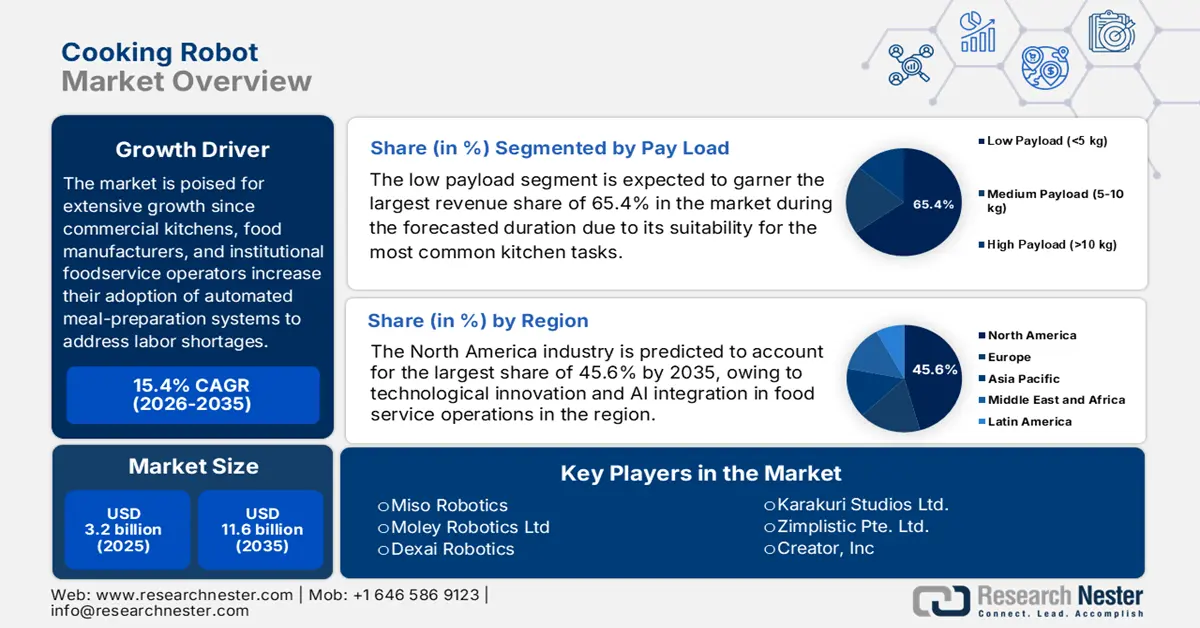
Cooking Robot Market size was valued at USD 3.2 billion in 2025 and is projected to reach USD 11.6 billion by the end of 2035, rising at a CAGR of 15.4% during the forecast period, i.e., 2026-2035. In 2026, the industry size of cooking robot is estimated at USD 3.6 billion.
The global cooking robot market is poised for extensive growth in the upcoming years since commercial kitchens, food manufacturers, and institutional foodservice operators increase their adoption of automated meal-preparation systems to address labor shortages and production scalability. In this regard, the article published by NIH in March 2023 observed how software-controlled cooking driven by 3D food printing and laser-based heating is advancing toward high-precision, customizable meal preparation. The study also stated that additive manufacturing can assemble and selectively cook multi-ingredient foods with millimeter-level control, enabling suitable nutrient composition, reduced handling, and improved food safety. In addition, the combination of precise deposition with laser-based heating, researchers successfully fabricated a seven-ingredient cake entirely relying on software, showcasing how digital cooking could emerge as a practical tool for both home and industrial food production.
This strengthens the innovations in terms of AI-enabled robots and flexible food manipulation systems. Furthermore, based on the Miso Robotics offering memorandum, which was disclosed in January 2025, the cooking robot market also benefits from considerable financial investment, wherein Miso has raised more than USD 77 million through various equity offerings as of early 2025. The primary driving factor was the urgent need to solve the growing labor crisis in the quick-service restaurant sector, a problem accelerated by rising minimum wages, such as California's USD 20 per hour mandate. Besides the core value proposition for products such as Flippy is the projected gross positive margin impact of USD 50,000 to USD 250,000 on a yearly basis per location by reducing labor, oil, and food waste costs while increasing revenue through faster service, thereby positively impacting market growth.