Connected Home Appliance Market Outlook:
Connected Home Appliance Market size was valued at USD 16.5 billion in 2025 and is further expected to expand to USD 44.3 billion by 2035, growing at a CAGR of 11.6% during the forecast period, i.e., 2026-2035. In 2026, the industry size of connected home appliance is evaluated at USD 18.4 billion.
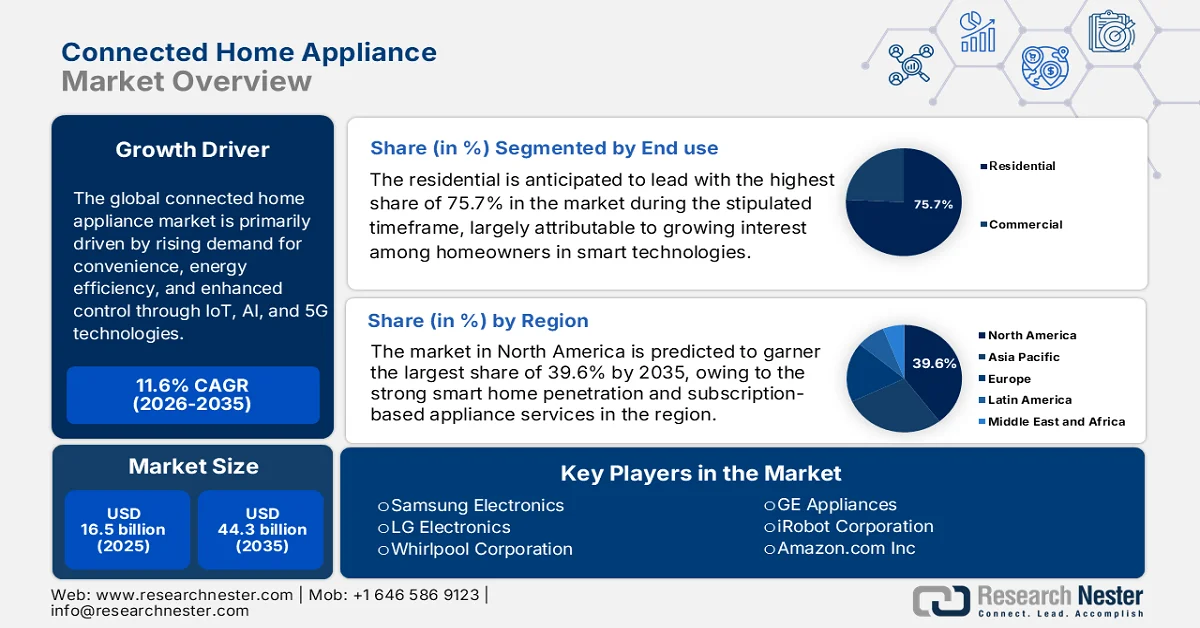
The global connected home appliance market is deliberately shaped by a major shift away from traditional smart devices to completely integrated and intelligent home ecosystems, which is influenced by consumer demand for energy efficiency and automation. Exemplifying this, the Central Statistics Office article in October 2024 disclosed that there has been a strong rise in smart home and IoT adoption in Ireland from the time span between 2022 to 2024, which reflects the growing integration of connected devices in everyday life. It also mentioned that smart home security usage nearly doubled from 17% in 2022 to 30% in 2024, whereas smart energy management tools such as thermostats and smart meters displayed a rise of almost 28% during the same time. Smart domestic appliances, i.e., robot vacuums and connected kitchen or garden devices, rose remarkably from 6% to 15%, thus denoting a lucrative growth opportunity for the market to grow in the next decade.
Smart Home & IoT Adoption Statistics, 2022-2024: CSO Ireland Smart Technology Usage Trends
|
Smart Technology Category |
2022 (%) |
2024 (%) |
Change (Percentage Points) |
|
Smart home security systems |
17% |
30% |
+13 pp |
|
Smart energy management (thermostats, smart meters, lighting) |
22% |
28% |
+6 pp |
|
Smart home appliances (inside + outside home) |
6% |
15% |
+9 pp |
|
Virtual assistants (Alexa, Google Home, etc.) |
41% |
41% |
- |
|
Internet-connected TV usage |
70% |
76% |
+6 pp |
|
Wearable smart devices |
- |
54% |
- |
|
E-health monitoring devices |
- |
11% |
- |
Source: Central Statistics Office
Furthermore, the market is witnessing a strategic shift toward subscription-based service models and a strong preference for connected kitchen and laundry appliances that efficiently simplify daily household routines. As per an article published by the European Commission in March 2026, there has been a shift toward interoperable, energy-smart home appliances, particularly washing machines, dishwashers, dryers, and HVAC systems that can communicate with energy management systems and the power grid. It also confirms that over 130 compliant appliance models are already in use across the region, thereby enabling coordinated energy use, demand flexibility, and lower household energy costs through connected operation. The framework shows expansion of appliances other than kitchen and laundry into energy ecosystems such as batteries, solar inverters, and EV chargers, reinforcing the move toward integrated smart home systems.
Global Trade Analysis of Automatic Washing Machines - 2024 Export, Import, and Market Statistics with Countries
|
Category |
Country / Indicator |
Value (2024) |
|
Global Overview |
Global Trade Value |
USD 9.54 Billion |
|
Growth (2023-2024) |
0.63% |
|
|
5-year CAGR |
2.39% |
|
|
Share of World Trade |
0.04% |
|
|
Product Complexity Index |
0.25 |
|
|
Complexity Rank |
1451 / 3119 |
|
|
Global Trade Rank |
395 / 5380 |
|
|
Top Importers |
China |
USD 3.79 Billion |
|
Poland |
USD 1.40 Billion |
|
|
Turkey |
USD 910 Million |
|
|
Germany |
USD 930 Million |
|
|
UK |
USD 695 Million |
|
|
Japan |
USD 636 Million |
|
|
Top Exporters |
China |
USD 3.79 Billion |
|
Poland |
USD 1.40 Billion |
|
|
Turkey |
USD 0.91 Billion |
Key Connected Home Appliances Market Insights Summary:
Regional Highlights:
- North America is projected to dominate with a 39.6% share by 2035 in the connected home appliance market, fueled by strong smart home penetration, subscription-based appliance services, and AI integration across ecosystems
- Asia Pacific is set to witness the fastest growth over 2026-2035, stimulated by rapid urbanization and rising disposable incomes
Segment Insights:
- Residential is anticipated to account for 75.7% share by 2035 in the connected home appliance market, attributed to growing interest among homeowners in smart technologies for enhanced convenience and automation
- Wi-Fi-enabled appliances sub-segment is expected to register a significant share by 2035, supported by seamless compatibility with smartphones and voice assistants enabling real-time monitoring and control
Key Growth Trends:
- Expansion of IoT, AI, and smart home ecosystems
- Growing focus on energy efficiency & sustainability
Major Challenges:
- Infrastructure limitations and user adoption barriers
- Interoperability and ecosystem fragmentation
Key Players: Samsung Electronics (South Korea), LG Electronics (South Korea), Whirlpool Corporation (U.S.), GE Appliances (U.S.), iRobot Corporation (U.S.), Amazon.com Inc. (U.S.), Google LLC (U.S.), BSH Hausgeräte GmbH (Germany), Robert Bosch GmbH (Germany), Electrolux AB (Sweden), Siemens AG (Germany), Miele & Cie. KG (Germany), Arçelik A.Ş. (Turkey), Panasonic Corporation (Japan), Sharp Corporation (Japan), Daikin Industries Ltd. (Japan), Haier Smart Home Co., Ltd. (China), Midea Group (China), Hisense Group (China), Xiaomi Corporation (China), Voltas Limited (India), Breville Group Ltd. (Australia), Panasonic India (India).
Global Connected Home Appliances Market Forecast and Regional Outlook:
Market Size & Growth Projections:
- 2025 Market Size: USD 16.5 billion
- 2026 Market Size: USD 18.4 billion
- Projected Market Size: USD 44.3 billion by 2035
- Growth Forecasts: 11.6% CAGR (2026-2035)
Key Regional Dynamics:
- Largest Region: North America (39.6% Share by 2035)
- Fastest Growing Region: Asia Pacific
- Dominating Countries: United States, China, Germany, Japan, United Kingdom
- Emerging Countries: India, South Korea, Brazil, Mexico, Indonesia
Last updated on : 20 April, 2026
Connected Home Appliance Market - Growth Drivers and Challenges
Growth Drivers
- Expansion of IoT, AI, and smart home ecosystems: There has been an increasing integration of IoT, AI, machine learning, and cloud connectivity, which is transforming traditional appliances into intelligent ones. At the same time, smart home platforms, i.e., voice assistants and connected hubs, are accelerating ecosystem adoption rather than single-device usage. In July 2024, Cedia Organization reported that the global smart home industry is poised for huge expansion, where the growth is largely supported by rising adoption, with 35% of U.S. businesses expecting 6% to15% revenue growth and 15% expecting over 30% growth. Meanwhile, in the UK, 34% forecast 6% to 15% growth, and 12% expect above 30% growth. Overall, increasing IoT adoption, post-COVID home automation demand, and energy-efficient technologies continue to drive rapid market expansion globally.
Connected Home Appliance Market Trends 2024-2025: Smart Home Ecosystem Expansion, AI Integration, and Matter-Based Interoperability Opportunities
|
Year |
Company |
Key Development |
Connected Home Appliance Market Opportunity |
Strategic Impact |
|
2025 |
Samsung - One UI + AI Home (India) |
Unified UI across appliances + AI-driven SmartThings ecosystem |
AI-led home automation, ecosystem lock-in, long-term software monetization |
High ecosystem consolidation and recurring software value |
|
2025 |
BSH (Bosch) -Matter-enabled appliances |
First Matter-enabled appliances (CES 2025) |
Cross-platform interoperability, universal device connectivity |
Platform-neutral smart home expansion |
|
2024 |
ABB India - free home (Matter Bridge) |
Multi-brand smart home integration with Matter support |
Retrofit smart home growth, energy optimization, unified control systems |
Accelerated smart home penetration in existing homes |
Source: Company Official Press Releases
- Growing focus on energy efficiency & sustainability: Connected appliances best help in optimizing energy and managing power usage, which is highly essential in the case of the rising electricity expenses and environmental concerns. At the same time, most of the governments and utilities are also encouraging the usage of energy-efficient appliances by providing incentives and suitable regulations. In May 2023, the U.S. Department of Energy (DOE) announced new efficiency standards for dishwashers, beverage vending machines, and electric motors that will save residents in the U.S. about USD 652 million annually in utility bills. In a span of 30 years, these rules are expected to deliver more than USD 10 billion in savings, cut carbon emissions by over 107 million metric tons, and conserve 240 billion gallons of water, hence positively benefiting the overall market.
- Rising disposable incomes & urbanization: There has been a rise in middle-class income levels and urban lifestyles, which are catalyzing the demand for modern, technologically advanced home appliances in order to save time and improve comfort. This is witnessed mostly in emerging economies, supporting the expansion of the market. The International Energy Agency (IEA) in June 2025 stated that energy efficiency is an important attribute in affordability as it reduces household energy bills, tackles energy poverty, and improves access to essential services. In advanced economies, efficiency measures can cut bills by up to one‑third, whereas in the case of emerging regions like sub‑Saharan Africa, high‑efficiency appliances make energy services accessible to 80% of households when compared to just 50% with low‑efficiency models. These savings positively impact the lower‑income families, freeing up disposable income and giving better access to appliances and comfort.
Challenges
- Infrastructure limitations and user adoption barriers: This is a major obstacle hindering the growth of the connected home appliance market, mostly in the developing regions. These appliances necessitate high-speed internet for smooth functioning of smart appliances, but still, most areas face unstable connectivity, thereby reducing device performance and usability. Meanwhile, from the consumer perspective, the complex setup processes and dependency on smartphone apps create usability challenges, particularly for elderly or non-tech-savvy users. The need for continuous software updates and app-based control can also discourage adoption among traditional consumers, ultimately causing limitations to market expansion. The lack of awareness about the benefits of smart appliances slows down demand growth and market penetration.
- Interoperability and ecosystem fragmentation: This is yet another major burden for the connected home appliance market due to the absence of a universally adopted standard across brands and ecosystems. Different manufacturers operate under their own platforms, which might not integrate with each other. This aspect creates a fragmented user experience wherein most of the consumers find it challenging to control all appliances from a single interface. The standards, such as Matter, aim to address this issue, but still adoption is in early stages and not uniformly implemented across product categories. As a result, consumers may be fixed into specific brand ecosystems, reducing flexibility and increasing switching costs. This lack of standardization also complicates third-party developer integration, ultimately slowing down innovation and limiting the creation of fully unified smart home environments.
Connected Home Appliance Market Size and Forecast:
| Report Attribute | Details |
|---|---|
|
Base Year |
2025 |
|
Forecast Year |
2026-2035 |
|
CAGR |
11.6% |
|
Base Year Market Size (2025) |
USD 16.5 billion |
|
Forecast Year Market Size (2035) |
USD 44.3 billion |
|
Regional Scope |
|
Connected Home Appliance Market Segmentation:
End use Segment Analysis
In the end use segment, residential is anticipated to lead with the highest share of 75.7% in the connected home appliance market during the stipulated timeframe. The segment’s dominance is largely attributable to growing interest among homeowners in smart technologies, which is driving this trend, as they look for greater convenience and automation of everyday tasks. The adoption of connected appliances such as smart refrigerators, washing machines, HVAC systems, and lighting that are integrated with mobile apps and voice assistants is positioning residential spaces as the main contributor to market growth. In May 2025, Ecobee announced that its smart doorbell camera now integrates with Google Home, thereby allowing hands-free control and live video feeds. It is combined with ecobee’s broader ecosystem and smart security subscription, and it transforms your front door into a connected hub for comfort and convenience.
Product Type Segment Analysis
By the conclusion of the forecast period, the Wi-Fi-enabled appliances sub-segment is predicted to grow with a significant share in the connected home appliance market. Their strong adoption is largely due to their compatibility with devices such as smartphones, tablets, and voice assistants, enabling users to remotely monitor and control household functions. By connecting directly to the internet, these appliances provide real-time updates, smooth software integration, and instant notifications, thereby enhancing both convenience and the overall smart home experience. In June 2024, Samsung announced its 2024 Family Hub update makes its smart refrigerators even more powerful, with AI Vision Inside recognizing more than 30 food items to simplify meal planning and shopping. The company also stated that its bespoke 4-door flex now supports tap view for instant screen sharing, plus a customizable app dock and dedicated YouTube app for seamless entertainment.
Application Segment Analysis
Under the application segment, the energy management is expected to capture a significant revenue share in the connected home appliance market over the forecasted years. The growth is largely attributable to the increasing emphasis on energy efficiency, along with supportive regulations and rising consumer interest in eco-friendly technologies. In this context, Europe’s Energy Smart Appliances initiative, which was launched in April 2024 by the Joint Research Centre and the European Commission, introduced a Code of Conduct to ensure interoperability among connected home appliances such as washing machines, dishwashers, heat pumps, and HVAC systems. The framework enables appliances from different manufacturers to communicate using common energy flexibility services, allowing functions such as flexible start times, power monitoring, and load limitation. This initiative improves coordination between devices and energy systems, and it supports demand-side flexibility, thereby helping households adjust electricity usage based on renewable energy availability and grid conditions.
Our in-depth analysis of the connected home appliance market includes the following segments:
|
Segment |
Subsegments |
|
End use |
|
|
Product Type |
|
|
Application |
|
|
Distribution Channel |
|

Vishnu Nair
Head - Global Business DevelopmentCustomize this report to your requirements — connect with our consultant for personalized insights and options.
Connected Home Appliance Market - Regional Analysis
North America Market Insights
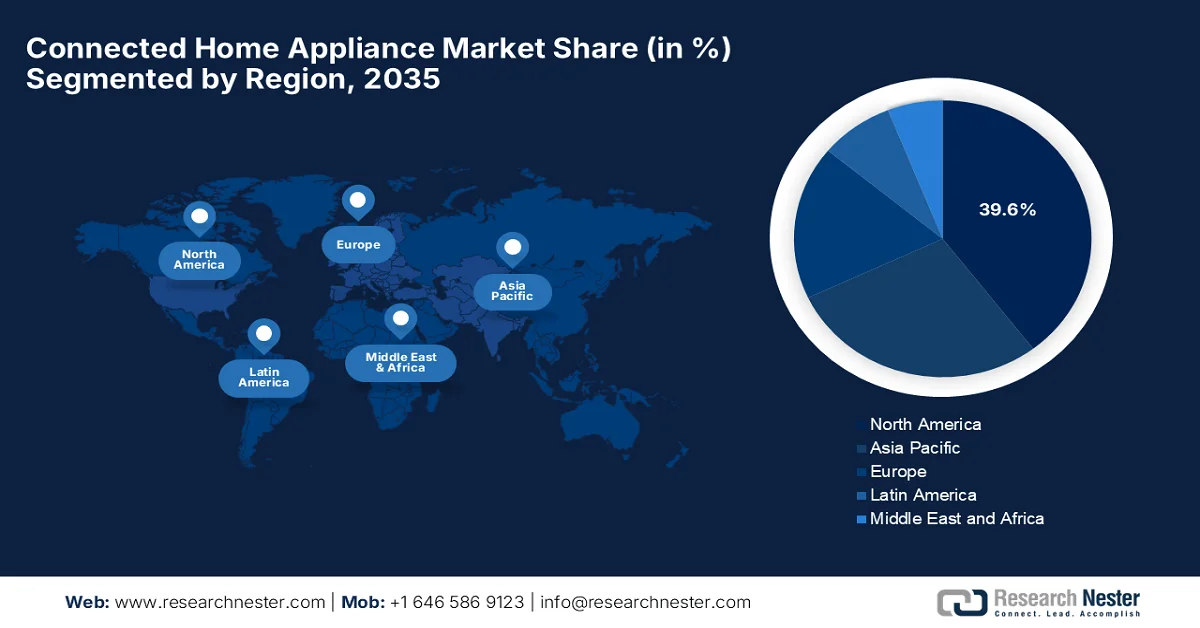
The North America connected home appliance market is anticipated to garner the highest share of 39.6% by the end of 2035. The region’s dominance is mostly propelled by strong smart home penetration, subscription-based appliance services, and AI integration in ecosystems such as SmartThings, Alexa, and Google. At the same time, replacement demand and premium upgrades dominate expansion. In December 2023, the article published by the U.S. Energy Information Administration stated that in U.S. homes, heating and air conditioning dominate energy use, accounting for about 52% of consumption in a year, whereas water heating, lighting, and refrigeration made up another 25%. The remaining 23% went to appliances and electronics such as washers, dryers, TVs, and computers, with usage varying by climate, home size, and household members, hence reflecting the consistent utilization rates.
The administrative support for energy efficiency and technological advancements in appliances is driving stronger adoption in the market in the U.S. At the same time, driven by AI and IoT adoption, major brands operating in the country are focusing on Wi-Fi-enabled products that connect to smartphones and voice assistants. In May 2024, the U.S. Environmental Protection Agency announced the launch of new ENERGY STAR resources to help households make energy-efficient upgrades with support from Inflation Reduction Act incentives. A new web tool lets families find rebates and tax credits by zip code, whereas the Home Upgrade Service Provider Partnership connects them with vetted companies for installation and financing. The presence of these initiatives aims to lower costs, simplify improvements, and deliver long-term savings and comfort, especially in the case of low-income households.
The high internet penetration and growing urbanization are responsibly driving the connected home appliance market in Canada. The country’s households are mostly technology-adapted, whereas due to rising residential construction, there is significant adoption of smart white goods such as connected refrigerators, washing machines, and cooking appliances, representing an optimistic market opportunity. Based on the government data published in July 2024, the country’s new Green Buildings Strategy underscores that smart home appliances are a key way to cut energy costs and emissions. Programs such as the Canada Greener Homes Affordability Program and Oil to Heat Pump Affordability Grant help households switch to efficient appliances such as heat pumps, saving families up to USD 4,500 on a yearly basis. The strategy promotes ENERGY STAR certified products and updates efficiency standards for appliances such as air conditioners, furnaces, and water heaters, thus denoting a positive market outlook.
APAC Market Insights
The Asia Pacific connected home appliance market is expected to grow at the fastest rate during the forecast period. The regional market is effectively driven by widespread urbanization and increasing disposable incomes. The region is witnessing high smartphone penetration, and the proliferation of super-apps is fostering ecosystem-led adoption, particularly in terms of dense urban areas. As per the January 2026 article published by Singapore’s National Environment Agency (NEA), it enforces minimum energy performance standards under its climate change and energy efficiency framework, requiring household appliances such as air-conditioners, refrigerators, televisions, lamps, and water heaters to meet strict energy efficiency thresholds before they get sold in the market. These regulations ensure that only NEA-registered products with approved energy labels and verified performance standards are available to consumers, promoting the adoption of more energy-efficient and environmentally friendly appliances.
The growth of smart kitchen appliances, cleaning robots, and white goods that offer remote management, along with a significant expansion in online retail channels, are certain drivers boosting the market in China. Domestic manufacturers dominate the landscape by focusing on AI integration and ecosystem compatibility, connecting various devices through centralized platforms. Based on the government data published in January 2026, the country has unveiled its 2026 subsidy program to encourage home appliance trade-ins and stimulate consumption. It mentions that shoppers can receive up to USD 213 per item when buying energy- and water-efficient appliances such as refrigerators, washing machines, and air conditioners. Smart and digital products such as mobile phones and tablets are also included, with subsidies capped at USD 71 each, thus suitable for bolstering the country’s market growth.
The heightened demand for premium, multifunctional devices that fit into modern lifestyle scenarios is supported by strong E-commerce penetration, driving the growth of the connected home appliance market in India. The extensive focus on domestic manufacturing and the Make in India electronics ecosystem encourages the local companies and global brands to design cost-sensitive, app-enabled appliances that are suitable for urbanizing households. In November 2025, India Brand Equity Foundation (IBEF) reported that the country’s appliance category is rapidly evolving, effectively fueled by rising incomes, urbanization, and digital penetration. On the other hand, smart appliances such as AI-enabled refrigerators, robotic vacuum cleaners, and intelligent security systems are reshaping homes, wherein the market is projected to reach USD 46.4 billion by 2030. In addition, the presence of government initiatives, e-commerce growth, and demand from tier 2 and 3 cities are fueling this transformation into connected, efficient living spaces.
Europe Market Insights
Europe connected home appliance market is entering a new phase of growth, mainly driven by a strong focus on interoperability, sustainability integration, and standardized digital energy ecosystems that connect household devices with broader smart grid infrastructure. At the same time, demand is being solidified by the region’s shift toward electrified homes and digitally controlled energy consumption. In May 2025, the region’s revised ecodesign rules set stricter limits on energy use in standby and networked standby modes for appliances such as Wi-Fi routers, wireless speakers, and even motor-operated furniture. These measures are expected to save 4 TWh of electricity annually by 2030, which is equal to powering over 1 million electric cars, and thereby cutting CO2 emissions by 1.4 million tons. Consumers will benefit from lower bills, with collective savings projected at USD 570 million per year, thus denoting a positive market outlook.
The integration of Matter standards for better device interoperability, smart meter deployment, and government incentives encouraging intelligent energy management are accelerating the growth of the market in Germany. Key players in the country are highly focused on AI diagnostics and automation, with significant growth in both major appliances and small appliances, largely sold through both online platforms and traditional retail channels. In March 2024, the country’s SmartLivingNEXT program, which is funded by the Federal Ministry for Economic Affairs and Climate Action, was launched to build a universal data ecosystem for smart living that integrates residential buildings, smart home systems, and energy-efficient digital services. This particular initiative brings together multiple research projects that are focused on areas such as energy management, AI-based assistance systems, interoperability of connected devices, and user-controlled data sharing within smart home environments.
The UK market maintains a strong position in the regional landscape, highly driven by rising energy costs and sustainability goals. At the same time, adoption is accelerated by remote monitoring, automation, and voice-assisted controls that enhance user convenience. In April 2025, the country’s government announced new smart appliance standards to help households cut energy bills as part of its Plan for Change. Heat pumps and electric vehicle chargers must now be sold smart-ready, allowing consumers to activate functions that shift usage to cheaper off-peak times. In this context, families can save about USD 415 for EV owners charging overnight, and around USD 125 for heat pump users compared to gas boilers. These reforms also enhance cybersecurity, and have the complete potential to save the energy system USD 50 billion to USD 62 billion by 2050.
Key Connected Home Appliance Market Players:
- Samsung Electronics (South Korea)
- LG Electronics (South Korea)
- Whirlpool Corporation (U.S.)
- GE Appliances (U.S.)
- iRobot Corporation (U.S.)
- Amazon.com Inc. (U.S.)
- Google LLC (U.S.)
- BSH Hausgeräte GmbH (Germany)
- Robert Bosch GmbH (Germany)
- Electrolux AB (Sweden)
- Siemens AG (Germany)
- Miele & Cie. KG (Germany)
- Arçelik A.Ş. (Turkey)
- Panasonic Corporation (Japan)
- Sharp Corporation (Japan)
- Daikin Industries Ltd. (Japan)
- Haier Smart Home Co., Ltd. (China)
- Midea Group (China)
- Hisense Group (China)
- Xiaomi Corporation (China)
- Voltas Limited (India)
- Breville Group Ltd. (Australia)
- Panasonic India (India)
- Company Overview
- Business Strategy
- Key Product Offerings
- Financial Performance
- Key Performance Indicators
- Risk Analysis
- Recent Development
- Regional Presence
- SWOT Analysis
- Samsung Electronics has positioned itself as the predominant leader in the connected home appliance space, which is facilitated by its SmartThings ecosystem that integrates appliances, mobile devices, and IoT platforms into a unified smart home environment. The company supplies a wide range of AI-based refrigerators, washing machines, and air conditioners, emphasizing personalization and energy efficiency.
- LG Electronics is also a strong competitor in this field, which benefits from its ThinQ AI platform, connecting a wide range of home appliances, including refrigerators, washers, dryers, and HVAC systems. The firm’s strategy emphasizes affectionate intelligence, where appliances learn user preferences and proactively optimize performance.
- Whirlpool Corporation is yet another major global appliance manufacturer that has a strong presence in North America, the Asia Pacific, and Europe. The company’s connected appliance strategy revolves around the Whirlpool app ecosystem, which enables remote monitoring, diagnostics, and appliance control.
- Haier Smart Home is one of the fastest-growing global players, driven by its ecosystem-based smart life strategy and strong presence in both consumer and commercial appliance segments. Besides, the company integrates IoT across its product lines through platforms such as U+ Smart Life, enabling appliances to interact across home environments.
- BSH Hausgerate is the home appliance subsidiary of Bosch, and the company is actively advancing matter-enabled interoperability, positioning itself as a leader in open-standard smart home adoption. The company is highly focused on high-end, energy-efficient appliances with strong engineering quality and sustainability features.
Below is the list of some prominent players operating in the global market:
The market is being dominated by a combination of players, i.e., established appliance manufacturers and technology-adopted platform companies, who are intensely competing through AI integration, IoT connectivity, and ecosystem control. Firms such as Samsung and LG lead in smart home platforms, whereas Europe-based companies such as BSH, Bosch, and Electrolux focus on premium engineering and energy efficiency. At the same time, U.S.-based players emphasize software ecosystems and voice assistant integration, which is led by Amazon and Google, along with traditional appliance makers such as Whirlpool. Strategic initiatives adopted by the pioneering companies in this field are AI integration, Matter interoperability, cloud-based appliance control, and expansion through acquisitions and ecosystem partnerships.
Corporate Landscape of the Connected Home Appliance Market:
Recent Developments
- In April 2026, LG Electronics debuted its redesigned dishwasher lineup at EuroCucina 2026 in Milan, which consists of a one-hour wash and dry cycle powered by QuadWash Pro, Dynamic Heat Dry+, and TrueSteam. The models deliver A-grade energy efficiency, ultra-quiet operation, and AI senseclean technology for smarter cleaning.
- In August 2025, Samsung Electronics expanded its One UI platform to smart home appliances, creating a unified software experience across smartphones, TVs, and appliances with consistent design, apps, and connectivity through SmartThings and services such as Bixby and Samsung TV Plus.
- In April 2025, Panasonic India announced the launch of its Smart Home Experience Centre in New Delhi, showcasing smart living solutions built around its Miraie IoT platform. The center is focused on wellness, security, and convenience, and it integrates HVAC systems, smart automation, and advanced security.
- In August 2024, LG unveiled the ThinQ ON AI home hub at IFA 2024, which is designed as the centerpiece of a connected smart home ecosystem. It is powered by affectionate intelligence, and it learns user habits, integrates with appliances and IoT devices, and offers secure, voice-driven control.
- Report ID: 811
- Published Date: Apr 20, 2026
- Report Format: PDF, PPT
- Explore a preview of key market trends and insights
- Review sample data tables and segment breakdowns
- Experience the quality of our visual data representations
- Evaluate our report structure and research methodology
- Get a glimpse of competitive landscape analysis
- Understand how regional forecasts are presented
- Assess the depth of company profiling and benchmarking
- Preview how actionable insights can support your strategy
Explore real data and analysis
Frequently Asked Questions (FAQ)
About this Report
Connect with our Expert


Report, 2026-2035



Copyright @ 2026 Research Nester. All Rights Reserved.
