Conductive Polymers Market Outlook:
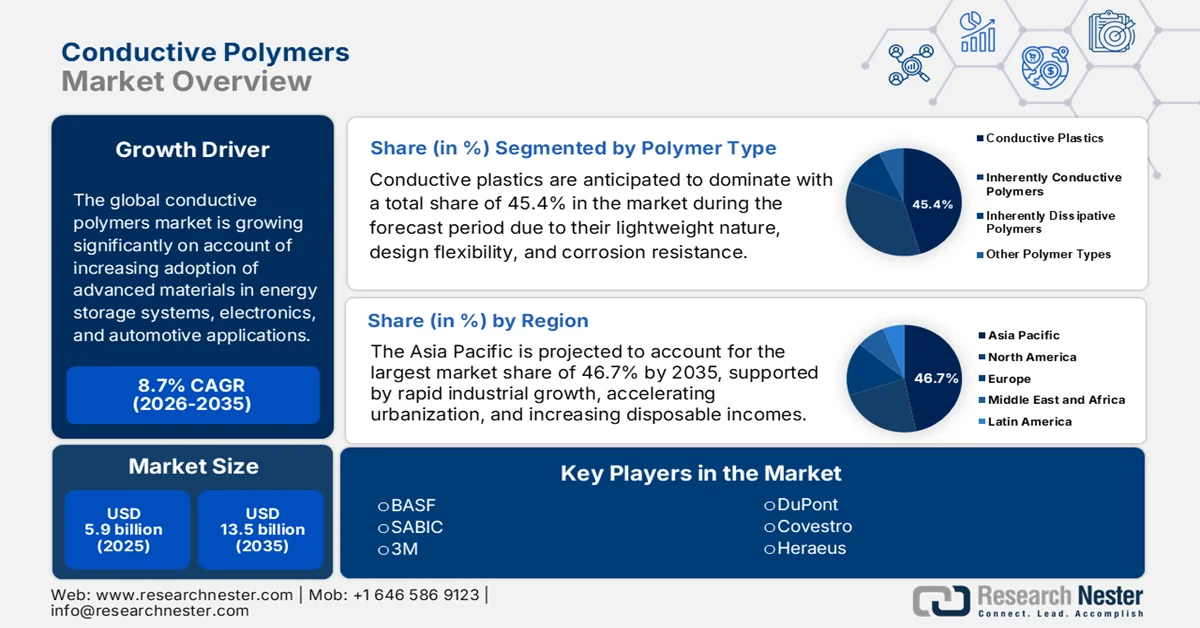
Conductive Polymers Market size was valued at USD 5.9 billion in 2025 and is expected to reach USD 13.5 billion by the end of 2035, registering around 8.7% CAGR during the forecast period, i.e., 2026-2035. In 2026, the industry size of conductive polymers is evaluated at USD 6.4 billion.
The accelerating electrification of the automotive industry and the miniaturization of consumer electronics are the important driving factors for the global conductive polymers market. Manufacturers across different nations are opting for lightweight, corrosion-resistant alternatives to traditional metals, in which these advanced materials are becoming vital for electromagnetic interference shielding, antistatic packaging, and energy storage technologies. For instance, in September 2025, the article published by the American Chemical Society revealed that conductive polymers have evolved from laboratory curiosities into commercially significant materials, combining the conductivity of metals with the flexibility of plastics. The report also outlined that they are increasingly important in biomedical applications such as biosensors, neural interfaces, and drug delivery systems since they can interface well with biological tissues. Recent advances allow these materials to be printed or injected, enabling bio-integrated devices for monitoring and therapy, thus allowing a steady market intake.
Key Conductive Polymers Market Insights Summary:
Regional Highlights:
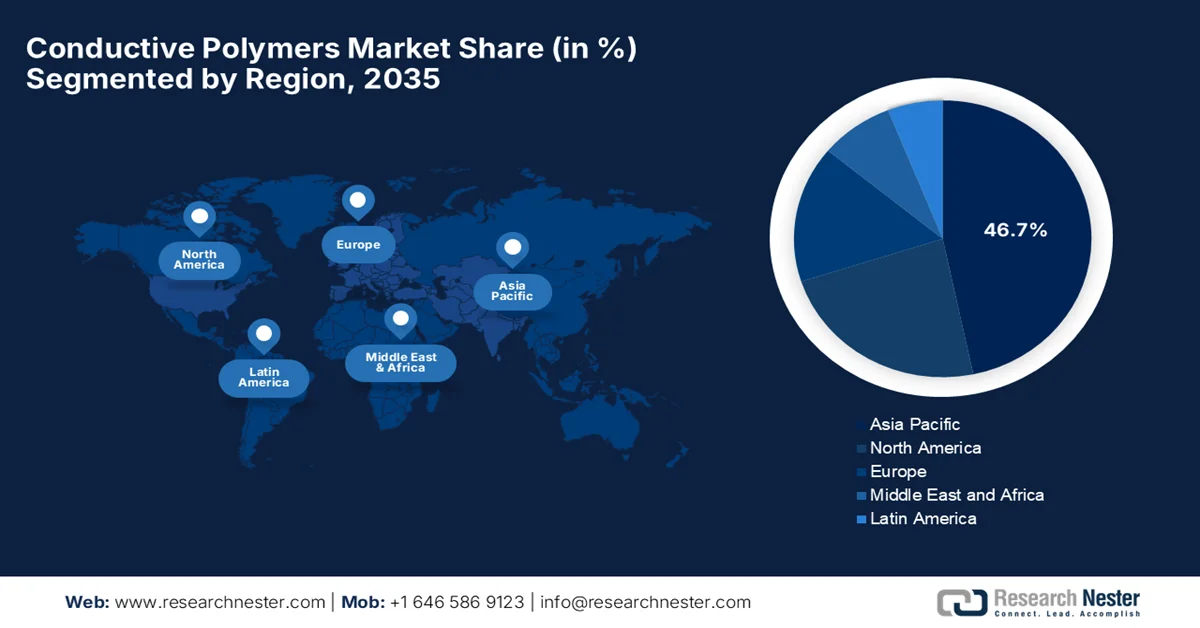
- The asia pacific is expected to capture 46.7% of the market by 2035, reinforced by massive industrialization, rapid urbanization, rising disposable incomes, and the booming electrical and electronics sectors
- North America is anticipated to witness robust growth in the conductive polymers market throughout 2026-2035, fueled by extensive research and development investments alongside rising demand for smart fabrics and flexible displays capable of maintaining electrical conductivity under mechanical stress
Segment Insights:
- The conductive plastics segment is projected to account for 45.4% of the conductive polymers market by 2035, underpinned by its lightweight nature, design flexibility, corrosion resistance, cost-effectiveness, and suitability for miniaturized electronic applications
- The product component segment is poised to secure a considerable revenue share during 2026-2035, stimulated by the increasing integration of conductive polymers into electronic components, sensors, printed circuit boards, displays, and electromagnetic interference shielding materials
Key Growth Trends:
- Growth in consumer electronics and miniaturization
- Expansion of energy storage applications
Major Challenges:
- Limited electrical conductivity compared to metals
- Limited large-scale commercial adoption and awareness
Key Players: BASF, SABIC, 3M, DuPont, Covestro, Heraeus, Avient Corporation.
Global Conductive Polymers Market Forecast and Regional Outlook:
Market Size & Growth Projections:
- 2025 Market Size: USD 5.9 billion
- 2026 Market Size: USD 6.4 billion
- Projected Market Size: USD 13.5 billion by 2035
- Growth Forecasts: 8.7% CAGR (2026-2035)
Key Regional Dynamics:
- Largest Region: Asia Pacific (46.7% Share by 2035)
- Fastest Growing Region: North America
- Dominating Countries: United States, China, Japan, Germany, South Korea
- Emerging Countries: India, Canada, United Kingdom, France, Italy
Last updated on : 16 June, 2026
Conductive Polymers Market - Growth Drivers and Challenges
Growth Drivers
- Growth in consumer electronics and miniaturization: The heightening demand for consumer electronics and miniature devices is boosting the conductive polymers market. This supports the development of compact, high-performance devices that are to be used in smartphones, wearables, and communication technologies worldwide. For instance, in October 2025, Murata Manufacturing introduced ULTICIRC, which is the world’s first-ever LCP flexible substrate with an inner cavity structure, achieving a dielectric constant (Dk) below 2.0. Besides, the company also notes that demand is increasing for thin, space-saving flexible substrates to support the continuing miniaturization of smartphones and communication equipment, particularly for future 6G applications, hence raising the market’s exposure.
- Expansion of energy storage applications: These conductive polymers are being used in batteries and supercapacitors propelled by their improved charge storage, conductivity, and stability. These polymers readily enhance electrode performance and support efficient energy cycling. Apart from this, the heightening demand for renewable energy integration and electric mobility is accelerating their adoption in energy storage systems globally, thus benefiting the overall market. As per an article published by the National Institute of Health in February 2026, conductive polymers have become promising materials for enhancing lithium-ion battery cathodes mainly due to their tunable conductivity, flexibility, and ability to improve electron transport within electrode structures. These materials and their composites help address certain challenges, such as electrode instability, interfacial degradation, and limited rate performance in conventional LIB systems.
- Growth in healthcare and wearable technologies: The healthcare sector is opting for conductive polymers for biosensors, medical implants, and smart wearable devices. Their biocompatibility and flexibility allow real-time health monitoring and advanced diagnostics. Therefore, the increasing demand for remote healthcare and continuous patient monitoring is significantly driving market expansion in medical applications. In July 2022, the article published by the National Institute of Health revealed that wearable health technologies are increasingly seen as tools that empower individuals to take greater responsibility for their health through continuous monitoring and self-management. Besides, devices such as smartwatches and fitness trackers enable real-time tracking of vital signs and behavior patterns. This supports early detection, improved awareness, and thus expands the market’s growth potential.
Challenges
- Limited electrical conductivity compared to metals: The conductive polymers offer advantages such as flexibility and lightweight nature, but still they exhibit lower electrical conductivity when compared to metals such as copper and aluminum. This aspect is adding restrictions to their usage in high-power or high-current applications. In most cases, conductive polymers need to be combined with certain other conductive fillers or materials to enhance performance, which adds complexity to product design and thereby increases costs. On the other hand, performance inconsistency under changing temperature, humidity, and environmental conditions causes limitations to their reliability in critical applications. As a result, their adoption in the market is largely confined to niche applications such as antistatic coatings, sensors, and flexible electronics.
- Limited large-scale commercial adoption and awareness: Another major challenge for the market is the limited large-scale adoption of these polymers in different industries. Most of the end users are still dependent on conventional materials influenced by their proven performance and established supply chains. This lack of awareness regarding the benefits of conductive polymers, along with concerns about reliability and cost, ultimately slows down market penetration. In addition, integration into existing manufacturing systems requires process modifications, which increases implementation complexity. Although research and development activities are increasing, commercialization is still concentrated in specific segments such as electronics and sensors.
Conductive Polymers Market Size and Forecast:
| Report Attribute | Details |
|---|---|
|
Base Year |
2025 |
|
Forecast Year |
2026-2035 |
|
CAGR |
8.7% |
|
Base Year Market Size (2025) |
USD 5.9 billion |
|
Forecast Year Market Size (2035) |
USD 13.5 billion |
|
Regional Scope |
|
Conductive Polymers Market Segmentation:
Polymer Type Segment Analysis
In the polymer type segment, conductive plastics are anticipated to dominate with a total share of 45.4% in the conductive polymers market during the forecast period. The segment’s dominance is largely attributable to its lightweight nature, design flexibility, corrosion resistance, and cost-effectiveness when compared with traditional conductive materials such as metals. In addition, conductive plastics offer adequate electrical conductivity while enabling component miniaturization, making them a preferred choice in consumer electronics, automotive electronics, electromagnetic interference shielding, and advanced communication devices. In April 2024, SABIC entered into a partnership with Cybershield, which is a U.S.-based supplier of metalized plastic components, to advance the use of plated ULTEM™ resins in aerospace applications, focusing on electroless plating for high-temperature performance.
Application Segment Analysis
On the basis of the application, the product component is projected to grow with a considerable revenue share in the market during the discussed timeframe. The segment’s growth is effectively propelled by the increasing integration of conductive polymers into electronic components, sensors, printed circuit boards, displays, and electromagnetic interference shielding materials. Their lightweight nature, flexibility, corrosion resistance, and ability to provide electrical conductivity make them a suitable alternative to traditional metal-based components. In addition, the advancements in terms of flexible and printed electronics are expanding the use of conductive polymers in next-generation electronic assemblies. Manufacturers across different nations are opting for conductive polymers to improve design freedom and simplify complex component architectures.
Class Segment Analysis
By the end of 2035, conjugated conducting polymers, which are under the class segment, are expected to hold a commendable share in the market. The segment’s growth is largely driven by its unique π-conjugated molecular structure, which enables efficient charge transport and tunable electrical properties. Increasing research activities focused on organic semiconductors, electrochromic devices, and advanced sensing technologies are also accelerating their adoption. Apart from this, their compatibility with solution-based processing techniques and potential for low-cost manufacturing also support wider commercialization across emerging high-tech applications. In addition, their growing integration into next-generation flexible and wearable electronic systems is strengthening their long-term market potential and thus encouraging more players to establish their footprint in this sector.
Our in-depth analysis of the conductive polymers includes the following segments:
|
Segment |
Subsegments |
|
Polymer Type |
|
|
Application |
|
|
Class |
|
|
End user Industry |
|

Vishnu Nair
Head - Global Business DevelopmentCustomize this report to your requirements — connect with our consultant for personalized insights and options.
Conductive Polymers Market - Regional Analysis
APAC Market Insights
The Asia Pacific conductive polymers market is forecasted to dominate with a total share of 46.7% during the discussed timeframe. The region’s dominance is largely driven by massive industrialization, rapid urbanization, and rising disposable incomes across economies such as China, Japan, India, and South Korea. The regional demand is also being propelled by the booming electrical and electronics sectors. For instance, in August 2023, Nippon Chemi-Con announced the expansion of its PXG Series of SMD-type conductive polymer aluminum solid capacitors by adding high-capacitance items rated at 25Vdc. These new capacitors deliver 20% to 40% higher capacitance when compared to existing products of the same size, supporting downsizing and efficiency in computers and servers, thus suitable for standard market growth.
The nation’s position as the central hub for advanced electronics manufacturing is allowing the continued growth of the conductive polymers market in China. This market experiences rapid innovation due to aggressive national initiatives targeting self-sufficiency in semiconductor fabrication and advanced materials science, resulting in localized production of high-purity polymer formulations. Based on government data published in December 2025, the country’s electronic information manufacturing industry reported steady growth from January to October 2025, with value-added industrial output rising 10.6% year-on-year. The article also mentions that operating revenues reached USD 1.98 trillion, whereas total profits climbed 12.8%. Production included 1.02 billion smartphones, which is up 0.7%, and 386.6 billion integrated circuits, up 10.2%, reflecting a strong growth opportunity for conductive polymers.
In India, the market is positioned for strategic growth owing to the digital manufacturing initiatives. A primary catalyst for this market is the transition toward electric mobility, where conductive polymers are increasingly utilized for vehicle lightweighting, battery component optimization, and sensor integration. In addition, expanding infrastructure projects and the modernization of the national power grid boost demand for conductive coatings and corrosion-resistant materials. In October 2025, the article published by Press Information Bureau (PIB) stated that India’s electronics manufacturing output surged to a significant value of USD 136 billion in 2024–25, which is a six-fold rise from the previous decade. Exports climbed eight times to nearly USD 39 billion, whereas mobile phone exports skyrocketed 127 times to around USD 24 billion, thereby positioning India as the world’s second-largest mobile phone producer, thus denoting a strong growth opportunity for conductive polymers.
North America Market Insights
The North America market is undergoing a profound transformation propelled by the extensive research and development investments across the U.S. and Canada. A primary growth catalyst is the surge in smart fabrics and flexible displays, which continually fuel the demand for materials capable of maintaining electrical conductivity under intense mechanical stress. For instance, in March 2023, scientists at Berkeley Lab developed a conductive polymer coating which is called HOS-PFM that could significantly boost lithium-ion battery performance for electric vehicles. The coating conducts both electrons and ions simultaneously, improving stability, charge/discharge rates, and extending battery life from about 10 years to nearly 15. Hence, such an ecosystem positions North America as a global leader in the conductive polymer industry.
The surging investments in semiconductor fabrication, aerospace engineering, and defense technologies are driving the growth of the U.S. conductive polymers market. Besides, the expansion of hyperscale data centers across the country fuels the continuous demand for superior electromagnetic interference shielding and antistatic packaging solutions. In addition to industrial and computing infrastructure, the U.S. healthcare sector is integrating these materials into medical devices, which include biosensors and wearable health monitors. In May 2026, the Semiconductor Industry Association reported that the semiconductor resurgence has seen over USD 645.3 billion in private investments across 140 projects in 30 states over the past six years, driven by tax credits and manufacturing grants. These initiatives are set to create and support 71,000 jobs in semiconductor facilities, 122,000 in construction, and 335,000 across the wider economy, thus denoting an encouraging opportunity for players operating in the country.
There is a strong growth opportunity for conductive polymers market in Canada owing to its focus on advanced manufacturing, clean technology, and resource sector modernization. The market benefits significantly from strong public-private research partnerships and federal initiatives supporting sustainable material development, particularly across industrial hubs in Ontario and Quebec. Besides, the country’s prominent aerospace and defense industries utilize these materials for certain reliable electromagnetic interference shielding and antistatic protection in harsh environments. The market is propelled by the digital transformation of Canada’s telecommunications infrastructure and resource extraction industries, where conductive polymers are integrated into ruggedized sensors and smart monitoring equipment. In this context, domestic chemical processors and material tech startups are proactively collaborating with global electronics firms to develop specialized, high-performance polymer blends.
Europe Market Insights
In Europe, the conductive polymers market is positioned for noteworthy expansion owing to its strict environmental regulations, sustainability mandates, and a strong focus on advanced technological engineering. The regional market is also being driven by pioneering research and development in high-purity, inherently conductive polymers such as PEDOT: PSS, which are highly essential for the expanding green energy infrastructure, including organic photovoltaics and next-generation solar cells. For instance, in January 2026, C-Therm Technologies appointed SciMed as its new distributor for the UK & Ireland, thereby expanding access to advanced thermal conductivity and thermal analysis solutions. This partnership will benefit different sectors, which include polymers, batteries, electronics, packaging, and building materials, driving innovation and product quality.
The industrial automation and advanced chemical manufacturing sectors are the main fueling factors behind the robust growth of the Germany conductive polymers market. This domestic innovation pipeline is also boosted by the medical technology sector, which adopts biocompatible conductive matrices for diagnostic tools, along with the renewable energy sector, utilizing these materials in next-generation solar cells and energy storage systems. In February 2025, TU Dresden and the Max Planck Institute of Microstructure Physics, Halle, achieved a breakthrough with a two-dimensional polyaniline crystal (2DPANI) that exhibits metallic charge transport both in-plane and out-of-plane. This material shows anisotropic conductivity of 16 S/cm in-plane and 7 S/cm out-of-plane, nearly three orders of magnitude, which is higher than that of typical polymers. Hence, this opens new possibilities for organic electronics, electromagnetic shielding, and hydrogen production through functional electrodes, marking a fundamental advance in polymer research.
The UK conductive polymers market is growing on account of a strong emphasis on high-value research, advanced engineering, and the commercialization of novel material sciences. A significant driver of the country’s market is the ongoing domestic push toward electrification, with automotive manufacturers and research consortia integrating conductive matrices into electric vehicle battery casings, sensors, and power electronics. For instance, in February 2023, the consortium project, which is led by Global Nano Network, secured almost USD 790,000 in funding from the UK’s Faraday Battery Challenge. It was also mentioned that over 12 months, the team has been working with the University of Warwick, Graphene Star Limited, Rapid Powders Limited, and Euriscus Limited, aiming to develop a thin, lightweight polymer current collector for lithium-ion batteries.
Key Conductive Polymers Market Players:
- BASF (Germany)
- SABIC (Saudi Arabia)
- 3M (U.S.)
- DuPont (U.S.)
- Covestro (Germany)
- Heraeus (Germany)
- Avient Corporation (U.S.)
- Company Overview
- Business Strategy
- Key Product Offerings
- Financial Performance
- Key Performance Indicators
- Risk Analysis
- Recent Development
- Regional Presence
- SWOT Analysis
- BASF is one of the world’s largest chemical companies that possesses a broader portfolio of products spanning chemicals, materials, and certain industrial solutions. The company also serves multiple end use categories, which include automotive, electronics, construction, and packaging.
- SABIC is a global diversified chemicals company that is headquartered in Saudi Arabia and is one of the leading producers of petrochemicals, plastics, and specialty chemicals. Besides, the firm operates in key segments such as polymers, agri-nutrients, and performance chemicals, allowing it to maintain a leading position in the conductive polymer industry.
- 3M is a diversified technology and manufacturing company that is best known for its wide range of industrial, safety, electronics, healthcare, and consumer products. The company applies materials science across multiple sectors, offering adhesives, films, coatings, and electronic materials.
- DuPont is also a global innovation-driven company that specializes in materials science, with operations across electronics, water, industrial technologies, and safety solutions. The company is a prominent provider of polymers, specialty materials, and electronic materials, which are to be used in semiconductor, mobility, and industrial applications.
- Covestro is a leading materials company that specializes in high-performance polymers, including polyurethanes and polycarbonates. In addition, the firm deliberately serves industries such as automotive, construction, electronics, and furniture with innovative material solutions.
Here is a list of key players operating in the global market:
The conductive polymers market hosts several leading multinational chemical and materials companies that are intensely competing through strong R&D capabilities and extensive product portfolios. BASF, SABIC, 3M, and Solvay are focused on developing high-performance, lightweight conductive materials for electronics, automotive, and energy storage applications. On the other hand, participants are opting for partnerships with electronics manufacturers, investments in nanomaterial-enhanced polymers, and expansion of sustainable conductive solutions with the main aim of achieving leading market positions. Additionally, mergers, acquisitions, and regional expansion strategies are being adopted to enhance market penetration. For instance, in May 2023, Henkel announced the launch of Loctite TLB 9300 APSi, which is a first-of-its-kind injectable thermally conductive adhesive for EV battery systems, combining structural bonding with high thermal conductivity of 3 W/mK.
Corporate Landscape of the Market:
Recent Developments
- In September 2025, Panasonic Industry announced the commercialization of two new conductive polymer tantalum solid capacitors models called 50TQT33M and 63TQT22M, which are designed to support USB Power Delivery 3.1. These capacitors achieve both ultra-high withstand voltage and high capacitance in a compact 3 mm low-profile package.
- In September 2025, Premix Group announced the inauguration of its first U.S. manufacturing facility in North Carolina, which marks a major transformation in conductive polymer production. The plant integrates AI-based formulation and end-to-end automation.
- In August 2025, scientists at La Trobe University developed a new electricity-conducting polymer using hyaluronic acid tethered directly to gold surfaces, creating ultra-thin, durable films with metallic-level conductivity.
- In April 2025, NICHICON CORPORATION introduced the PCY series of conductive polymer aluminum solid electrolytic capacitors, which are especially designed for next-generation communications systems. These capacitors deliver high heat and moisture resistance along with an extended 12,000-hour life at 125°C, making them ideal for demanding environments.
- Report ID: 8616
- Published Date: Jun 16, 2026
- Report Format: PDF, PPT
- Explore a preview of key market trends and insights
- Review sample data tables and segment breakdowns
- Experience the quality of our visual data representations
- Evaluate our report structure and research methodology
- Get a glimpse of competitive landscape analysis
- Understand how regional forecasts are presented
- Assess the depth of company profiling and benchmarking
- Preview how actionable insights can support your strategy
Explore real data and analysis
Frequently Asked Questions (FAQ)
About this Report
Connect with our Expert


Report, 2026-2035



Copyright @ 2026 Research Nester. All Rights Reserved.
