Coherent Optical Equipment Market Outlook:
Coherent Optical Equipment Market size was valued at USD 18.5 billion in 2025 and is projected to reach USD 37.9 billion by the end of 2035, registering around 7.5% CAGR during the forecast period, i.e., between 2026-2035. In 2026, the industry size of coherent optical equipment is estimated at USD 19.8 billion.
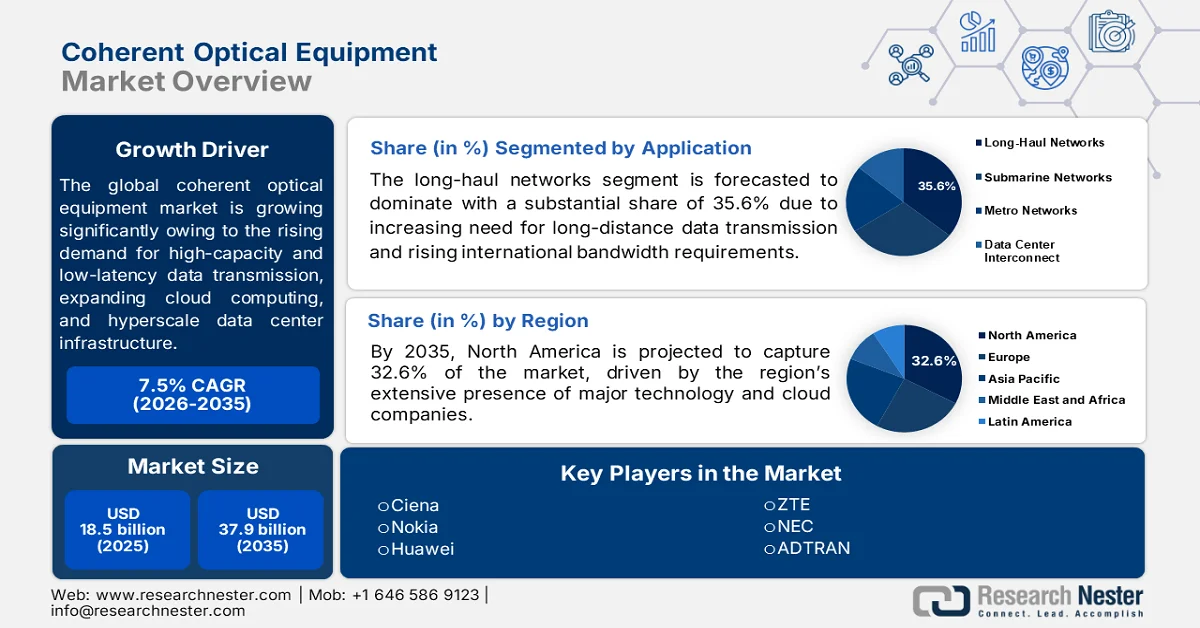
The coherent optical equipment market is growing significantly owing to the rising demand for high-capacity and low-latency data transmission, expanding cloud computing and hyperscale data center infrastructure. In addition, the continued deployment of advanced telecommunications networks and increasing data traffic from AI, streaming, and connected applications is positioning the industry for solid growth in the upcoming years. Research Institute of Economy, Trade and Industry in March 2026 disclosed that the global data center industry has expanded rapidly, with IT capacity reaching over than 55 GW by mid-2025, which is driven largely by AI and cloud workloads, thus creating sustained demand for coherent optical equipment globally.
Furthermore, the coherent optical equipment market is witnessing adoption of higher-speed coherent technologies, i. e, advanced pluggable optics and next-generation digital signal processing, which is encouraging network operators and enterprises to modernize optical infrastructure. In February 2024, Cisco and Microsoft demonstrated 800G transmission across the 6,234-km Amitié transatlantic submarine cable, which supports rising cloud and AI traffic demands. This trial used advanced coherent transmission over an SDM cable, and it achieved high spectral efficiency and demonstrated increased subsea network capacity. Hence, such instances denote the prominence of high-speed optical technologies in scaling reliable, high-capacity connectivity for AI and cloud services, thus positively benefiting the market’s expansion.
Key Coherent Optical Equipment Market Insights Summary:
Regional Highlights:
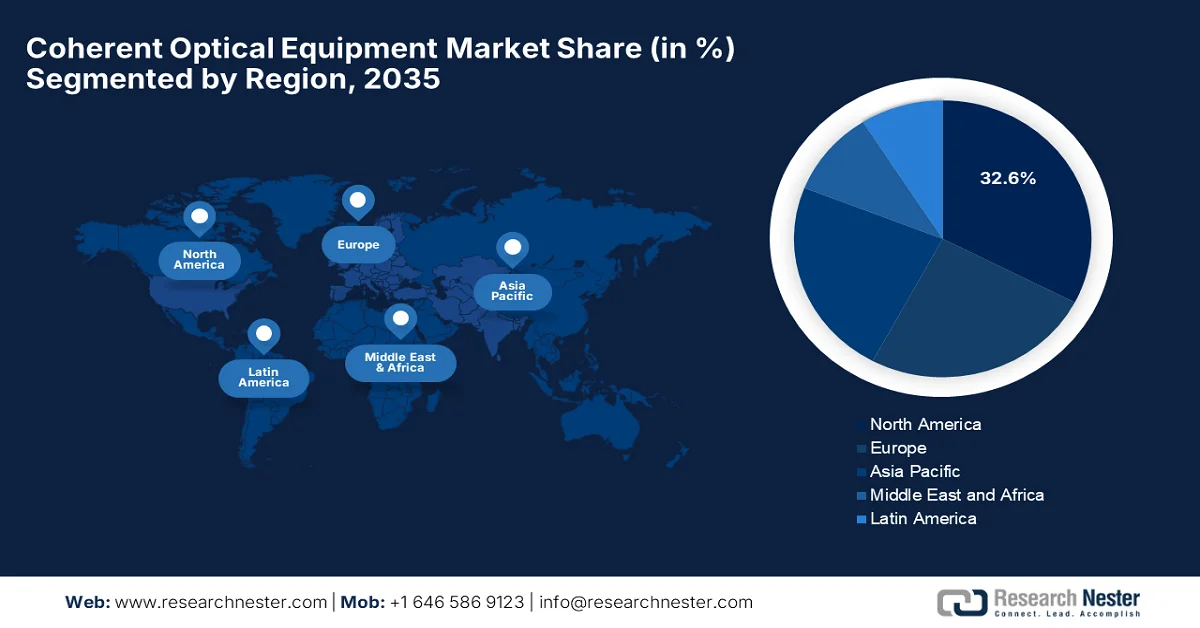
- North America is anticipated to command a 32.6% share during the 2026-2035 forecast period in the coherent optical equipment market, with growth underpinned by the massive concentration of technology giants and cloud providers and the rapid adoption of ultra-high-speed platforms for AI workloads, cloud applications, and hyperscale data centers.
- Asia Pacific is projected to register the fastest growth from 2026 to 2035, supported by extensive digital transformation initiatives, broadband expansion, and the rollout of next-generation 5G-Advanced and early 6G mobile infrastructure.
Segment Insights:
- Long-haul networks are projected to command a 35.6% share over the forecast period in the coherent optical equipment market, propelled by the increasing need for high-capacity, long-distance data transmission, rising international bandwidth requirements, and continuous optical network upgrades.
- Coherent transceiver & module is expected to retain a significant market share throughout the forecast period, owing to increasing deployment of high-speed 400G and 800G optical connectivity, alongside rising demand for compact and power-efficient networking components.
Key Growth Trends:
- Rising data traffic and bandwidth demand
- Evolution of open networking
Major Challenges:
- Integration complexity and multi-vendor interoperability
- Thermal management and power consumption constraints
Key Players: Ciena (U.S.), Nokia (Finland), Huawei (China), ZTE (China), NEC (Japan), ADTRAN (U.S.), Fujitsu (Japan), Tejas Networks (India).
Global Coherent Optical Equipment Market Forecast and Regional Outlook:
Market Size & Growth Projections:
- 2025 Market Size: USD 18.5 billion
- 2026 Market Size: USD 19.8 billion
- Projected Market Size: USD 37.9 billion by 2035
- Growth Forecasts: 7.5% CAGR (2026-2035)
Key Regional Dynamics:
- Largest Region: North America (32.6% Share by 2035)
- Fastest Growing Region: Asia Pacific
- Dominating Countries: United States, China, Japan, Germany, South Korea
- Emerging Countries: India, Canada, Singapore, Australia, Taiwan
Last updated on : 19 August, 2026
Coherent Optical Equipment Market - Growth Drivers and Challenges
Growth Drivers
- Rising data traffic and bandwidth demand: The surging rise in worldwide data traffic is considered to be an important factor driving the market globally. Video streaming, cloud applications, online gaming, IoT devices, and enterprise digital services need higher bandwidth. In this context, coherent optical technologies emerge as a proper solution that enables high-capacity, efficient data transmission over existing fiber infrastructure. International Telecommunication Union in October 2025 disclosed that the Commonwealth of Independent States (CIS) saw strong growth in broadband traffic over 5 years, wherein mobile traffic rose from 7 GB to 19 GB per subscription and fixed traffic from 96 GB to 228 GB. Besides, it also outlined that mobile traffic growth in the CIS outpaced the global average, whereas fixed broadband traffic rose from 141 GB to 311 GB per month.
- Evolution of open networking: The industrial transition toward open, disaggregated optical standards allows operators to break free from single-vendor ecosystems. Interoperable coherent equipment enables service providers to mix and match hardware from different manufacturers. The existence of this flexibility drives healthy market competition and accelerates deployment timelines. In this context, Adtran in March 2024 stated that its FSP 3000 open line system supported OIF’s largest-ever multi-vendor interoperability demonstration at OFC, delivering 400G OpenZR+ transmission over 1,000 km. This demonstration leveraged 47 companies, showcasing open, disaggregated optical networking and interoperability across multiple vendors, thereby contributing positively to the growth of the coherent optical equipment market.
Challenges
- Integration complexity and multi-vendor interoperability: Upgrading aging data networks with high-speed coherent optical equipment causes severe technical and operational architecture friction. Most of the established networks are highly fragmented and built on rigid, domain-specific hardware, which is in rare cases compatible with newer 800G or 1.6T pluggable modules. On the other hand, this mismatch forces companies to undertake complex, cost-heavy retrofitting projects to safely adjust wavelengths, multiplexing schemes, and interface standards across different network layers. The market does not possess standardized, open software control loops, which leads to severe multi-vendor interoperability hurdles, thus negatively impacting the market’s expansion.
- Thermal management and power consumption constraints: Data centers are scaling to handle intense AI and machine learning workloads, and coherent transceivers are pushed into increasingly compact form factors. Jamming advanced forward error correction decoders and high-order modulation DSP blocks into tiny modules causes a huge surge in energy density. On the other hand, approaching physical transmission limits necessitates substantial electricity, thereby creating severe power dissipation challenges in high-density network switches. The existence of this immense power consumption generates concentrated thermal energy that can degrade delicate optical chips and cause system failures, thus causing hindrance to market expansion.
Coherent Optical Equipment Market Size and Forecast:
| Report Attribute | Details |
|---|---|
|
Base Year |
2025 |
|
Forecast Period |
2026-2035 |
|
CAGR |
7.5% |
|
Base Year Market Size (2025) |
USD 18.5 billion |
|
Forecast Year Market Size (2035) |
USD 37.9 billion |
|
Regional Scope |
|
Coherent Optical Equipment Market Segmentation:
Application Segment Analysis
In terms of application, long-haul networks are projected to lead the coherent optical equipment market by accounting for a substantial 35.6% share over the forecast period. The sub-segment’s leadership is majorly propelled by increasing need for high-capacity, long-distance data transmission, rising international bandwidth requirements, and continuous upgrades of terrestrial and submarine optical networks. In addition, the growing deployment of advanced coherent technologies is also strengthening long-haul network capacity and efficiency. For instance, Nokia and Türk Telekom International in June 2024 achieved a world-record 800Gbps transmission over 2,300 km on a commercial C+L band WDM network without regeneration. By using Nokia’s PSE-6s coherent optics, the trial also demonstrated 700Gbps over 2,500 km and 600Gbps over 4,100 km, enabling higher capacity on existing infrastructure.
Component Segment Analysis
The coherent transceiver & module is expected to maintain a significant market share throughout the forecast period. The sub-segment is growing in the market on account of the increasing deployment of high-speed 400G and 800G optical connectivity, rising demand for compact and power-efficient networking components. On the other hand, expansion of data center interconnects and the need to upgrade existing optical infrastructure are driving the sub-segment’s growth in the component category. In February 2025, Arelion and Cisco completed an 800Gbps IP transmission over 1,069 km between Stockholm and Hamburg using Cisco 800G ZR+ coherent pluggables. This trial demonstrated major efficiency gains, with 66% lower CAPEX and 95% lower OPEX when compared with existing technologies.
End user Segment Analysis
By the end of the discussed timeframe, the telecom service providers segment is expected to hold a noteworthy share in the market. The growing emphasis on network automation and increasing adoption of software-defined optical infrastructure are main factors driving the sub-segment’s leadership. Moreover, the growing need for operational efficiency and centralized management of complex transport networks is also driving segment growth. Apart from this, the development of standardized management frameworks is also enabling operators to streamline network configuration, fault management, performance monitoring, and service provisioning, thus denoting a wider segment scope.
Our in-depth analysis of the coherent optical equipment includes the following segments:
|
Segment |
Subsegments |
|
Application |
|
|
Component |
|
|
End user |
|
|
Technology |
|

Vishnu Nair
Head - Global Business DevelopmentCustomize this report to your requirements — connect with our consultant for personalized insights and options.
Coherent Optical Equipment Market - Regional Analysis
North America Market Insights
North America coherent optical equipment market is anticipated to hold the highest share of 32.6% during the forecast period. The region’s leadership in this sector is majorly attributable to a massive concentration of tech giants and cloud providers. The region is experiencing rapid adoption of ultra-high-speed platforms engineered to support data-intensive artificial intelligence workloads, cloud-based applications, and hyperscale data center infrastructure. In this context, Lumen in September 2025 reported that it is expanding its network to meet soaring AI demand, targeting 47 million intercity fiber miles by 2028. In 2025, the company added 2.2 million fiber miles and 5.9+ Pbps of network capacity, while expanding 400G connectivity across over 100,000 route miles, thus making it suitable for standard market growth.
The nation’s status as a global hub for next-generation network architecture and cloud infrastructure innovation is driving growth of the U.S. coherent optical equipment market. In addition, domestic growth is propelled by the unrelenting expansion of hyperscale data centers, distributed artificial intelligence clusters, and nationwide 5G Advanced mobile networks. For instance, in November 2024 Verizon transmitted 1.6 Tbps over a single wavelength across a 118 km live Boston metro fiber network using Ciena’s WL6e coherent optical technology. This trial demonstrates how next-generation optical solutions can increase fiber capacity, support AI workloads, and deliver faster, more reliable connectivity, thus making them suitable for the country’s market growth.
The Canada coherent optical equipment market is experiencing immense growth, which is driven by the modernization of telecommunications infrastructure and growing data center footprints in major technology hubs. The country’s market also benefits from strong domestic engineering expertise and close collaborations with global networking pioneers, which accelerates the deployment of high-capacity communication frameworks. Based on the government data published in March 2024, researchers developed quantum-dot coherent comb lasers for B5G/6G networks, which enable low-noise, energy-efficient millimeter-wave generation and transmission. This technology demonstrated up to 16 Gb/s wireless transmission at 28 GHz over 25 km of fiber, followed by a 2-meter free-space link.
APAC Market Insights
The Asia Pacific market is anticipated to grow at the quickest rate from 2026 to 2035. The region’s leadership is largely driven by massive digital transformation initiatives, extensive broadband expansion, and the roll-out of next-generation 5G-Advanced and early 6G mobile infrastructures. Asia Pacific also benefits from a prominent ecosystem of domestic equipment manufacturers and telecom giants who are pioneering ultra-high-capacity transport frameworks to support mobile data consumption and smart city technologies. As of March 2025, C-DOT and IIT Bombay are developing an indigenous optical transceiver chipset for high-bandwidth 6G wireless links. This technology will enable coherent free-space optical connectivity for last-mile, rural, difficult-terrain, and satellite applications where fiber deployment is quite challenging.
A massive domestic ecosystem of telecom giants and advanced manufacturing platforms is driving growth of the market in China. The country’s growth is also propelled by suitable state-led digital infrastructure initiatives, including the strong rollout of all-optical networks and 5G-Advanced communication systems. In this context, China Telecom and ZTE, in March 2025, completed a live-network trial of an integrated C+L-band 80×800G WDM system on China Telecom’s ROADM backbone network. This trial validated 800G optical transmission across a 12-THz spectrum, flexible wavelength scheduling, and wavelength recovery, thus showcasing China’s continued deployment of advanced all-optical infrastructure.
The Japan coherent optical equipment market is expanding at a steady pace of progress, effectively fueled by a highly advanced technological ecosystem and strong collaboration between leading domestic telecommunications operators, continuously pushing the boundaries of ultra-high-capacity transmission speeds. Industrial demand is highly focused on upgrading metro and long-haul transport infrastructure to handle dense data traffic from smart cities, high-frequency trading networks, and expanding artificial intelligence workloads. Based on the government data published in September 2025, NTT’s IOWN initiative uses advanced optical and wireless technologies to address rising data traffic and energy demands driven by AI and digital services. This infrastructure aims to significantly increase transmission capacity and power efficiency while reducing network latency compared with conventional systems, thus indicating a positive market outlook.
Europe Market Insights
The Europe market is projected to grow at a notable rate mainly driven by ongoing upgrades of core metro and long-haul transport infrastructure. The market is witnessing a strong shift toward open, disaggregated networking frameworks and compact, pluggable transceivers that slot easily into existing legacy architectures. In April 2025, EXATEL selected Ciena’s WaveLogic 5 Nano 400G ZR+ coherent pluggables to strengthen its open, multi-vendor network infrastructure in Poland. This particular technology enables high-capacity, low-power connectivity across access, metro-regional, and data center interconnect applications, thus positioning Europe for sustained market expansion.
The continuous expansion of hyperscale data centers and widespread enterprise migration to multi-cloud environments are driving growth of the market in Germany. In addition, the country’s procurement aligns with sustainability mandates, driving optical innovations that increase bandwidth density while reducing power consumption per bit. In this context, Nokia in March 2025 upgraded Germany’s DFN research and education network with a scalable IP core that is especially designed to support growing high-bandwidth demands. This modernization increases interface speeds from 100G to 400G, with the flexibility to scale to 800G, while significantly increasing network capacity.
The UK market is growing exponentially on account of a growing digital economy and network modernization. In addition, the market is embracing open, disaggregated networking standards to foster vendor flexibility and accelerate deployment timelines across the country. In addition, growing demand for energy-efficient network infrastructure is encouraging operators to deploy advanced optical technologies with improved spectral efficiency. Also, the expansion of edge computing and distributed data processing is creating additional requirements for flexible optical connectivity. Furthermore, rising demand for resilient network architectures is deliberately supporting investment in scalable and programmable optical systems.
Key Coherent Optical Equipment Market Players:
- Ciena (U.S.)
- Nokia (Finland)
- Huawei (China)
- ZTE (China)
- NEC (Japan)
- ADTRAN (U.S.)
- Fujitsu (Japan)
- Tejas Networks (India)
- Company Overview
- Business Strategy
- Key Product Offerings
- Financial Performance
- Key Performance Indicators
- Risk Analysis
- Recent Development
- Regional Presence
- SWOT Analysis
- Ciena is a predominant leader in this sector, which offers coherent optical networking solutions, including Coherent ELS, supporting 100G to 800G coherent DWDM and up to 28.8 Tb/s system capacity. Besides, the company differentiates through compact designs, flexible configurations, automation, and solutions.
- Nokia competes in this market with its CSTAR coherent optical subassemblies and PSE coherent optics. The firm’s CSTAR portfolio supports 200G, 400G, and 800G applications for DCI, metro, regional, and long-haul networks.
- Huawei provides high-capacity coherent WDM solutions, which include 100G coherent technology especially designed for backbone, data-center, and enterprise networks. Besides, its solutions emphasize extended transmission distances, high bandwidth utilization, flexible network deployment, and reduced electrical regeneration requirements.
- ZTE is a central player in this sector that offers high-speed coherent optical technologies focused on increasing backbone network capacity. The company’s portfolio includes 800G coherent optical technologies and advanced optical devices.
- NEC provides coherent optical transceivers including 400G QSFP-DD DCO, 400G CFP2-DCO, and 100G QSFP28 ZR DCO. Its products are structured around metro, regional, long-haul, and DCI applications, and differentiation is based on high-capacity transmission, compact pluggable formats, and extended transmission distances.
Here is a list of key players operating in the global market:
The global coherent optical equipment market is hosting leading manufacturers such as Ciena, Nokia, Huawei, and ZTE who are intensely competing through high-capacity coherent transport platforms, pluggable optics, and integrated optical networking systems. Competitive differentiation in this sector is highly structured around transmission capacity, reach, power efficiency, interoperability, and support for AI-based data-center interconnects. Apart from this, established vendors hold strong positions through broad geographic coverage, extensive operator relationships, and integrated portfolios. In March 2025, Fujitsu announced the launch of the 1FINITY P300 800G ZR/ZR+ coherent pluggable transceiver for high-capacity optical networking. It is powered by a 3nm DSP, and it delivers 800G performance with up to 30% lower power per bit and reduced costs when compared with earlier generations.
Corporate Landscape of the Market:
Recent Developments
- In April 2026, Ciena showcased innovations at ABRINT 2026 in São Paulo, highlighting optical transport, coherent routing, 400G and 800G coherent pluggables, and the Navigator network control suite. These technologies aim to deliver greater network performance, capacity, flexibility, automation, and efficiency to support AI and data center connectivity.
- In March 2026, Nokia introduced new coherent optical technologies that are designed to support the growing connectivity demands of AI-era networks. The portfolio includes 1.6T, 2.4T, and 3.2T coherent solutions optimized for different applications.
- Report ID: 8737
- Published Date: Aug 19, 2026
- Report Format: PDF, PPT
- Explore a preview of key market trends and insights
- Review sample data tables and segment breakdowns
- Experience the quality of our visual data representations
- Evaluate our report structure and research methodology
- Get a glimpse of competitive landscape analysis
- Understand how regional forecasts are presented
- Assess the depth of company profiling and benchmarking
- Preview how actionable insights can support your strategy
Explore real data and analysis
Frequently Asked Questions (FAQ)
About this Report
Connect with our Expert


Report, 2026-2035



Copyright @ 2026 Research Nester. All Rights Reserved.
