Cloud Kitchen Market Outlook:
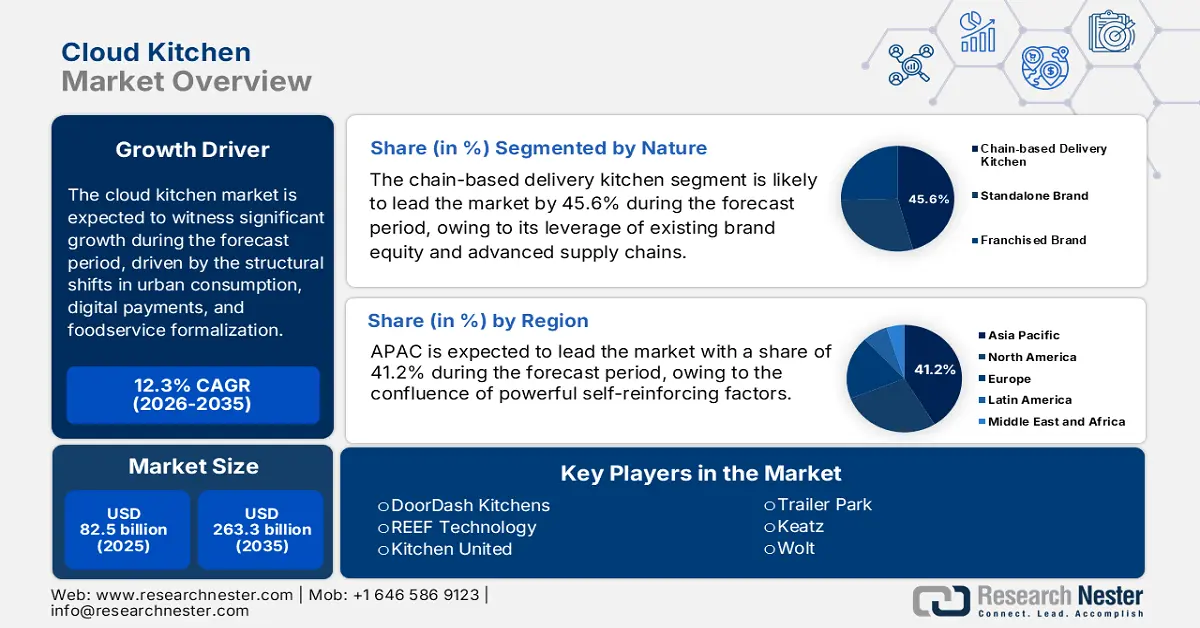
Cloud Kitchen Market size was valued at USD 82.5 billion in 2025 and is projected to reach USD 263.3 billion by the end of 2035, rising at a CAGR of 12.3% during the forecast period, i.e., 2026-2035. In 2026, the industry size of cloud kitchen is estimated at USD 92.6 billion.
The cloud kitchen market is being shaped by the structural shifts in urban consumption, digital payments, and foodservice formalization, as evidenced by the public sector data rather than private company disclosures. The rapid urbanization is a core demand driver, as the WHO data in November 2024 indicates that 55% of the world population lives in urban areas, and this percentage is expected to rise in the coming years. This data directly increases the reliance on off-premise food consumption in dense cities where the commercial real estate costs remain high. The government data also indicates sustained growth in the food delivery and takeaway industry. The USDA August 2024 report shows that spending on food away from home has increased by 12% and grew to USD 4,485 per capita in 2023. This reflects the long-term shift towards externally prepared meals.
From a supply-side perspective, the cloud kitchen market growth is supported by the government-backed MSME digitization and food safety compliance programs. The report from the PIB in June 2025 depicts that over 5.70 crore MSMEs were registered on the Udyam portal till 2025, many operating in food processing and services, supported by the credit-linked subsidy and digital onboarding schemes. Food safety authorities are also formalizing operations; the Food Safety and Standards Authority of India reported a rise in licensed food businesses, improving the regulatory clarity for delivery-only operators. In Europe, the European Commission highlights that online food services are a growing component of the digital economy, with many consumers ordering food online at least once a year. Collectively, the trends such as the urban density, rising food-away-from-home expenditure, MSME digitalization, and regulatory formalization are creating a scalable operating environment for cloud kitchens without reliance on dine-in infrastructure.