Child Resistant Packaging Market Outlook:
Child Resistant Packaging Market size was valued at USD 28.7 billion in 2025 and is projected to reach USD 51.8 billion by the end of 2035, registering around 6.1% CAGR during the forecast period, i.e., 2026-2035. In 2026, the industry size of child resistant packaging is assessed at USD 30.4 billion.
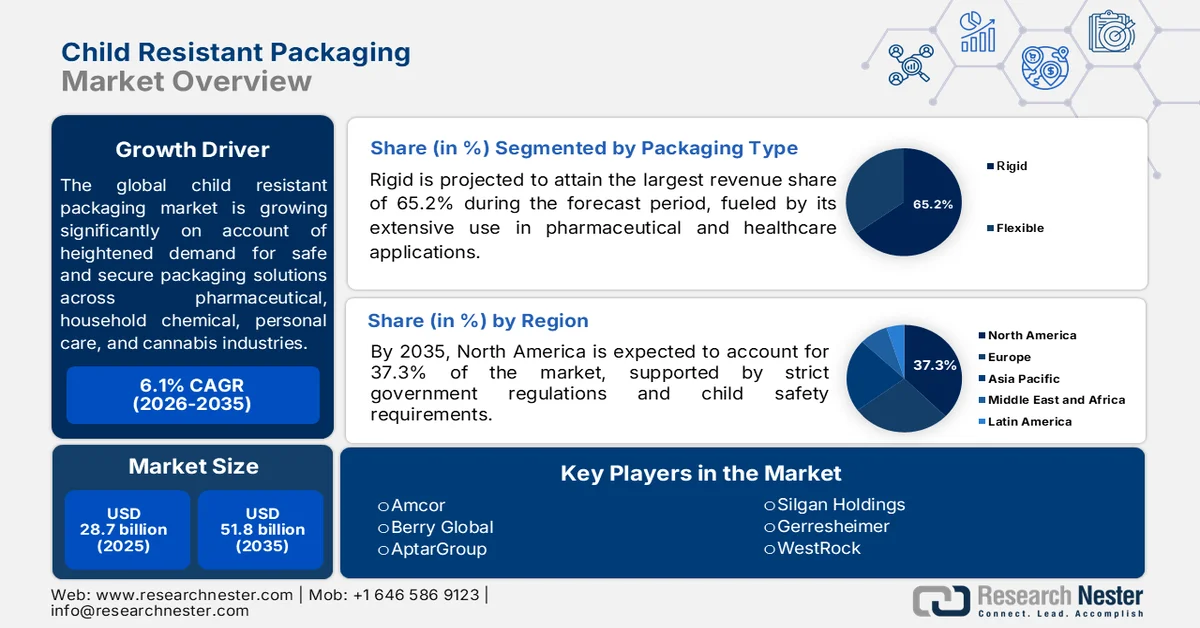
The child resistant packaging market is growing at a notable pace owing to the heightened demand for safe and secure packaging solutions across pharmaceutical, household chemical, personal care, and cannabis industries. In addition, the rising emphasis on consumer safety, regulatory compliance, and the prevention of accidental access by children is providing lucrative opportunities for manufacturers to adopt advanced packaging designs. As of February 2025 data, the U.S. Food & Drug Administration urged nicotine pouch manufacturers to adopt child-resistant packaging, as accidental exposure among young children has been increasing. These nicotine pouches contain highly concentrated nicotine; therefore, even small amounts can cause serious poisoning, especially in children under five years old, thus encouraging the use of child-resistant packaging.
Furthermore, technological advancements in packaging materials and sustainable design are supporting market development, wherein companies are focusing on solutions that combine child resistance with ease of use for adults and senior citizens. For instance, SnapSlide in April 2025 received the People’s Choice Award for Sustainability Innovation from the Plastics Industry Association for its SnapSlide Rx child-resistant prescription bottle closure. This particular design improves medication access for people with limited hand strength or dexterity while using over 25% less plastic and increasing shipping efficiency by 30% when compared to traditional packaging, thus creating a positive outlook for child resistant packaging market.
Key Child Resistant Packaging Market Insights Summary:
Regional Highlights:
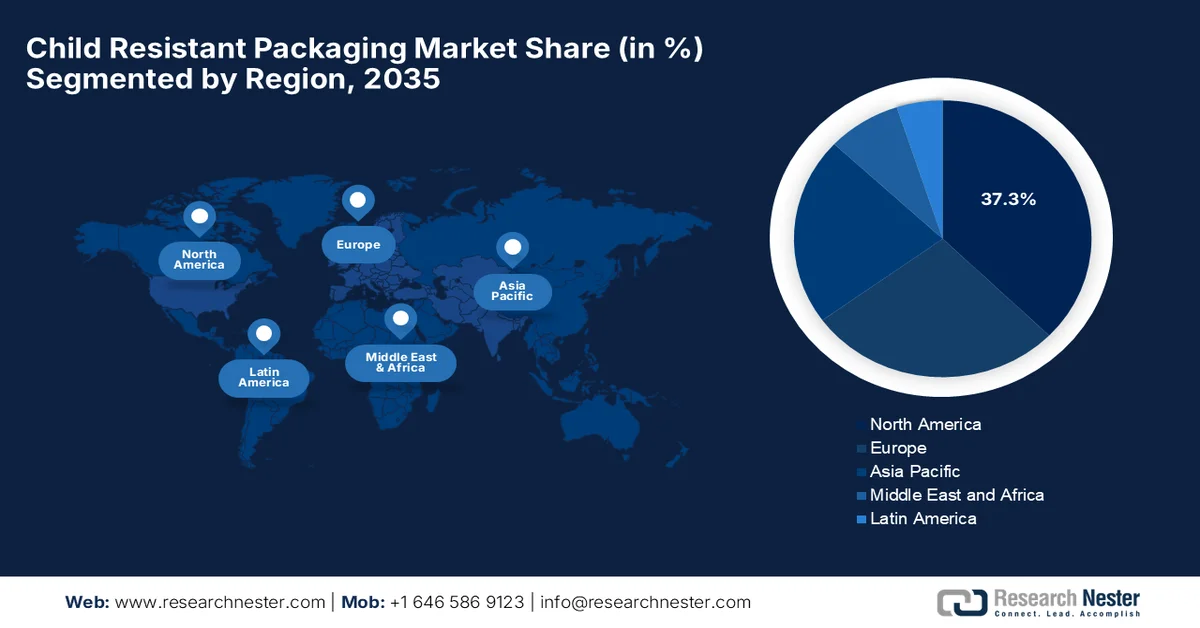
- The child resistant packaging market is anticipated to have North America capture a 37.3% market share by 2035, supported by stringent child-safety regulations and accelerated by continuous innovation in eco-friendly and sustainable child-resistant packaging materials
- Asia Pacific is forecast to register the fastest growth during 2026-2035, buoyed by a rising middle-class population, improving health literacy, and increasing consumer awareness of accidental poisoning prevention
Segment Insights:
- The child resistant packaging market is expected to see the rigid segment account for a 65.2% revenue share by 2035, reinforced by its widespread adoption in pharmaceutical and healthcare applications requiring durable, regulation-compliant, and secure child-resistant packaging solutions
- Plastic is poised to witness lucrative growth opportunities throughout 2026-2035, stimulated by its lightweight properties, cost-effectiveness, and adaptability for manufacturing diverse child-resistant packaging formats that comply with evolving safety standards
Key Growth Trends:
- Expanding cannabis and nicotine sectors
- Booming pharmaceutical and healthcare demand
Major Challenges:
- Balancing child safety with consumer convenience
- Limited adoption in emerging markets
Key Players: Amcor, Berry Global, AptarGroup, Silgan Holdings, Gerresheimer, WestRock, Comar, Graphic Packaging International, Origin Pharma Packaging.
Global Child Resistant Packaging Market Forecast and Regional Outlook:
Market Size & Growth Projections:
- 2025 Market Size: USD 28.7 billion
- 2026 Market Size: USD 30.4 billion
- Projected Market Size: USD 51.8 billion by 2035
- Growth Forecasts: 6.1% CAGR (2026-2035)
Key Regional Dynamics:
- Largest Region: North America (37.3% Share by 2035)
- Fastest Growing Region: Asia Pacific
- Dominating Countries: United States, Germany, China, Japan, Canada
- Emerging Countries: India, South Korea, Brazil, Mexico, Vietnam
Last updated on : 6 August, 2026
Child Resistant Packaging Market - Growth Drivers and Challenges
Growth Drivers
- Expanding cannabis and nicotine sectors: The legalization of medicinal and recreational cannabis, alongside the booming e-cigarette sector, is creating a massive new revenue stream. These products consist of the most appealing flavors or look like candy, due to which strict state and national laws mandate safe packaging, driving extensive growth of child resistant packaging market. In July 2026, LIFE-ND Graduate Community stated that the industry for cannabis packaging is growing on account of expanding legalization, increasing consumer demand, and stricter packaging regulations across the globe. It also mentioned that companies are choosing child-resistant, tamper-evident, and sustainable packaging solutions, thereby integrating smart technologies such as QR codes and tracking systems with a collective goal to improve safety, compliance, and product transparency.
- Booming pharmaceutical and healthcare demand: The worldwide demographic shifts, especially the aging population, catalyze the volume of dispensed medications. Also, this surge requires packaging that balances child security with senior-friendly accessibility. In this context, the National Institutes of Health (NIH) in June 2023 stated that pharmaceutical packaging plays an important role in protecting medications, maintaining stability, preventing tampering, and providing essential safety information through inserts and labels. In addition, it also mentions that the Poison Prevention Packaging Act helped reduce child deaths from accidental drug ingestion by around 45%, requiring packaging that prevents at least 80% of children from opening it within a specified time, thus contributing to child resistant packaging market expansion.
Challenges
- Balancing child safety with consumer convenience: Manufacturers in the child resistant packaging market face intense challenges in developing packaging that effectively prevents access by children. Excessively complex mechanisms may improve child resistance but can create usability issues for senior users or individuals with limited hand strength and dexterity. In this context, pharmaceutical packaging manufacturers need to achieve a balance between regulatory safety requirements and patient accessibility. Apart from this, designing packaging solutions that meet child-resistant standards while maintaining convenience requires extensive product development knowledge, consumer testing, and compliance validation. This challenge has encouraged companies to make investments in senior-friendly child-resistant designs.
- Limited adoption in emerging markets: The demand for child resistant packaging is surging, but adoption is still limited in some emerging markets due to cost sensitivity and reduced awareness of packaging safety standards. Most of the small manufacturers and local producers continue to use conventional packaging formats, as child-resistant alternatives can involve higher costs and additional operational requirements. In addition, this limited access to advanced packaging technologies and specialized manufacturing capabilities can restrict child resistant packaging market penetration. However, in recent times, increasing pharmaceutical consumption, urbanization, and the introduction of stricter safety regulations are gradually supporting adoption in developing regions.
Child Resistant Packaging Market Size and Forecast:
| Report Attribute | Details |
|---|---|
|
Base Year |
2025 |
|
Forecast Period |
2026-2035 |
|
CAGR |
6.1% |
|
Base Year Market Size (2025) |
USD 28.7 billion |
|
Forecast Year Market Size (2035) |
USD 51.8 billion |
|
Regional Scope |
|
Child Resistant Packaging Market Segmentation:
Packaging Type Segment Analysis
In terms of packaging type, rigid is projected to attain the largest revenue share of 65.2% during the discussed timeframe. The segment’s dominant position in the child resistant packaging market is fueled by its extensive use in pharmaceutical and healthcare applications, where high durability, product protection, and compliance with stringent child-safety regulations are essential. Its ability to accommodate secure child-resistant closures, thereby ensuring product integrity, also supports its strong market position. In addition, rigid formats such as bottles, containers, and blister packs provide enhanced barrier protection against moisture, contamination, and accidental damage. Apart from this, increasing demand for prescription medicines, over-the-counter drugs, and regulated consumer products is deliberately accelerating the adoption of rigid child-resistant packaging solutions.
Material Segment Analysis
Plastic is anticipated to grow with lucrative growth opportunities in the child resistant packaging market by the end of 2035. The segment’s growth is effectively propelled by its lightweight nature, cost-effectiveness, and suitability in manufacturing various child-resistant formats such as bottles, closures, containers, and blister components. Plastic packaging offers excellent design flexibility, allowing manufacturers to develop secure yet user-friendly solutions that comply with regulatory safety standards. In February 2023, the Press Information Bureau (PIB) stated that India’s Ministry of Environment, Forest and Climate Change has taken significant steps to reduce plastic pollution through the ban on identified single-use plastic items and the implementation of extended producer responsibility for plastic packaging. Besides, it also mentioned that in 2022–23, around 2.26 million tons of plastic packaging were brought under EPR, with more than 5,400 producers, importers, and brand owners registered on the CPCB portal.
Product Type Segment Analysis
The caps & closures, categorized under product type, are anticipated to account for a significant portion of child resistant packaging market revenue by the end of the forecast period. The segment’s growth is largely driven by increasing demand for secure dispensing solutions in pharmaceutical, healthcare, and household chemical applications. In addition, the emergence of advanced closure designs, including push-and-turn, squeeze-and-turn, and multi-step locking mechanisms, is gaining adoption due to their ability to enhance product safety. In March 2023, Berry Global developed an intelligent child-resistant closure that uses digital technology to support better medication management and adherence. This system efficiently captures information such as package openings and storage conditions, which in turn allows data to be shared with healthcare professionals for analysis and treatment improvement, thus denoting a wider segment scope.
Our in-depth analysis of the child resistant packaging market includes the following segments:
|
Segment |
Subsegments |
|
Packaging Type |
|
|
Material Type |
|
|
Product Type |
|
|
Distribution Channel |
|
|
Mechanism |
|
|
End use Industry |
|

Vishnu Nair
Head - Global Business DevelopmentCustomize this report to your requirements — connect with our consultant for personalized insights and options.
Child Resistant Packaging Market - Regional Analysis
North America Market Insights
North America child resistant packaging market is projected to lead with a total share of 37.3% over the forecasted years. The region benefits from strict government regulations and safety mandates, which are aimed at preventing accidental poisoning among children. North America’s market growth is further propelled by continuous innovations in eco-friendly and sustainable child-safe materials. In March 2024, Aptar Pharma reported the expansion of its manufacturing capacity at its Congers, New York facility to meet the rising demand for advanced drug delivery systems in North America. This expansion will increase production capabilities for nasal delivery platforms, bag-on-valve technology, and child-resistant, senior-friendly solutions, hence denoting a positive market outlook.
Continuous product innovations, including the development of sustainable, eco-friendly child-safe materials that meet modern environmental expectations, are driving growth of the U.S. child resistant packaging market. Also, to be competitive, domestic manufacturers are highly focused on creating dual-purpose designs that effectively restrict access for young children. As of May 2026, data, the U.S. Environmental Protection Agency requires certain residential pesticide products to use child-resistant packaging in order to reduce the risk of accidental poisoning among children. It also mentioned that products that meet specific toxicity criteria need to undergo strict testing to ensure the packaging is difficult for children under five to open while being accessible for adults, thus contributing to the market’s expansion.
In Canada, the child resistant packaging market is gaining strong exposure, which is due to federal safety mandates enforced by Health Canada. The market is highly supported by a strong shift toward sustainable and recyclable child-safe materials with a main goal to align with national environmental goals. Based on the government data published in June 2024, biocide packaging needs to ensure safe containment, prevent leaks, minimize product degradation, and maintain effectiveness during storage and use. Besides, it also stated that packaging should not resemble food or drink containers to avoid accidental ingestion. Also, child-resistant packaging is highly recommended for products that are accessible to children to improve safety and reduce exposure risks.
APAC Market Insights
Asia Pacific child resistant packaging market is projected to expand at the quickest rate from 2026 to 2035. The region’s market is highly driven by a rising middle-class population, increasing health literacy, and growing consumer awareness regarding accidental poisoning at home. To meet both local and export demands, regional manufacturers are concentrated on integrating automated production lines. In March 2026, for instance, South Korea proposed updates to food contact material regulations that allow recycled polypropylene in food packaging and introduce stricter limits for chemicals in PVC, rubber, and silicone products. These changes aim to improve food safety by controlling chemical migration and ensuring safer materials, especially for products that are used by infants and children.
A primary focus on securing household chemicals, pharmaceuticals, and agricultural products through localized manufacturing developments such as snap-tops and secure blister sheets is driving the China child resistant packaging market. In addition, the surge in terms of domestic e-commerce delivery requires these protective containers to feature enhanced structural integrity to be strong in shipping transit without compromising safety mechanisms. In July 2024, Xinfuda Medical Packaging introduced a multifunctional 28mm cap that combines child-resistant closure technology with an integrated desiccant system for improved product safety and protection. The company also stated that this design helps prevent accidental access by children and controls moisture to maintain the quality and stability of sensitive products.
In India child resistant packaging market is growing exponentially with a strong focus on securing pediatric medicines, liquid pesticides, and hazardous household cleaners through domestic manufacturing designs. Also, the expansion of rural retail networks, export growth and the rise of online pharmacy deliveries require these protective containers to maintain their structural integrity in rough transit. In December 2025, PIB stated that the strengthening of the Pharmaceuticals Industry (SPI) Scheme supports pharmaceutical sector growth through initiatives such as common facilities development and technology upgradation. In addition, the government has also implemented regulatory measures, including risk-based inspections, revised manufacturing standards, QR code-based traceability, and stricter quality controls, thus elevating the growth potential of the market.
India Pharmaceutical Sector: Export Growth & Packaging Demand Outlook Analysis 2020 - 2025
|
Financial Year |
Pharmaceutical Export Volume (Metric Tons) |
|
2020–21 |
6,42,718 |
|
2021–22 |
10,72,475 |
|
2022–23 |
10,55,352 |
|
2023–24 |
12,24,616 |
|
2024–25 |
12,40,537 |
Source: PIB
Europe Market Insights
The Europe child resistant packaging market is expanding at a considerable rate during the discussed timeframe. The region’s leadership in this field is largely driven by high consumer demand for ergonomic accessibility, which has led to the adoption of dexterity-independent mechanisms such as slide-and-lock cartons that remain elder-friendly. In addition, cross-border retail logistics require these packages to feature tamper-evident elements along with child-deterrent features to ensure product security. In May 2024, Amcor announced the launch of its European Innovation Center in Ghent, Belgium, with a main goal to help brands develop advanced, sustainable, and consumer-friendly packaging solutions through material research, design testing, and collaboration. This center combines laboratories, consumer testing facilities, e-commerce validation, and future recycling trials to create packaging that improves performance, usability, and environmental impact.
Priority for precision-engineered safety mechanisms that strictly comply with DIN and ISO certification standards is driving growth of child resistant packaging market in Germany. Market evolution is also being propelled by strict circular economy laws encouraging manufacturers to develop monomaterial designs and bio-based plastics that ensure child deterrence. In May 2026, Mondi and Dreco announced the development of a more sustainable powder detergent package by incorporating 50% post-consumer recycled plastic while maintaining product protection and visual appeal. This redesigned packaging addresses key challenges such as moisture resistance, reduced dependence on virgin plastic, durability, and thus a positive opportunity for market growth.
The UK child resistant packaging market is being reshaped by booming adoption of advanced safety formats in pharmaceutical, healthcare, and consumer product applications. Companies in this country are developing solutions such as certified child-resistant closures, pouches, and dispensing systems that include tamper evidence and senior-friendly opening mechanisms with a main focus on improving household safety. As of January 2024, Origin continues its partnership with the Child Accident Prevention Trust to support child safety initiatives and promote awareness of preventing accidental injuries. Also, through its safety-focused packaging innovations and charitable support, the company deliberately contributes to reducing accidental medicine-related harm and improving everyday child protection.
Key Child Resistant Packaging Market Players:
- Amcor (Australia)
- Berry Global (U.S.)
- AptarGroup (U.S.)
- Silgan Holdings (U.S.)
- Gerresheimer (Germany)
- WestRock (U.S.)
- Comar (U.S.)
- Graphic Packaging International (U.S.)
- Origin Pharma Packaging (UK)
- Company Overview
- Business Strategy
- Key Product Offerings
- Financial Performance
- Key Performance Indicators
- Risk Analysis
- Recent Development
- Regional Presence
- SWOT Analysis
- Amcor is identified as a leading provider of child-resistant pharmaceutical packaging which is offering innovative blister packaging solutions that comply with global safety regulations. The company’s PushSmart™ technology combines child resistance with senior-friendly access, which makes it a preferred partner for pharmaceutical companies.
- Berry Global Inc. develops child-resistant plastic packaging and closures for healthcare applications. In addition, the firm is highly focused on regulatory compliance, sustainable materials, and customized packaging solutions which is for pharmaceutical and consumer healthcare products.
- Aptar Pharma is yet another prominent player that specializes in child-resistant, senior-friendly dispensing systems for nasal sprays, topical drugs, and multidose pharmaceutical products. Besides, its innovative push-and-turn technologies enhance safety, thereby ensuring ease of use for adult patients.
- Silgan Holdings Inc. manufactures child-resistant bottles and closures for pharmaceutical and healthcare products. Apart from this, the firm offers customizable, high-quality plastic packaging solutions that meet regulatory standards and support product safety.
- Gerresheimer AG provides child-resistant caps, pharmaceutical bottles, and glass packaging for the healthcare industry. Also, the company’s broad product portfolio, global manufacturing network, and focus on quality make it a central player in this industry.
Here is a list of key players operating in the global market:
The global child resistant packaging market consists of leading manufacturers holding strong positions through broad product portfolios, regulatory compliance expertise, and global production capabilities. Companies in this sector compete primarily in terms of child safety performance, certification compliance, sustainable designs, customization capabilities, and application-specific solutions. On the other hand, North America and Europe represent key manufacturing hubs due to stringent packaging safety regulations, whereas several regional players strengthen competition through specialized closure systems and blister packaging. In June 2024, Neopac received the ETMA Tube of the Year Award for its innovative 10mm Polyfoil® tube, which consists of a child-resistant closure, recognized as the world’s smallest tube of its kind. It is designed for pharmaceutical and sensitive product applications, and the compact tube offers secure protection, precise dispensing, and high-barrier performance using certified materials.
Corporate Landscape of the Child Resistant Packaging Market:
Recent Developments
- In August 2025, Graphic Packaging International introduced CleanClose™ with ChildBlock™, which is a recyclable paperboard laundry detergent pod package designed to improve child safety while reducing reliance on plastic packaging. It is certified under U.S. child-resistance standards and provides strong protection for children.
- In July 2025, Amcor introduced the Hector child-resistant closure, which is a lightweight polypropylene solution designed for household products that combines attractive design, improved functionality, and sustainability benefits. The closure weighs only 7.25g, and it helps reduce plastic usage and carbon emissions.
- Report ID: 8729
- Published Date: Aug 06, 2026
- Report Format: PDF, PPT
- Explore a preview of key market trends and insights
- Review sample data tables and segment breakdowns
- Experience the quality of our visual data representations
- Evaluate our report structure and research methodology
- Get a glimpse of competitive landscape analysis
- Understand how regional forecasts are presented
- Assess the depth of company profiling and benchmarking
- Preview how actionable insights can support your strategy
Explore real data and analysis
Frequently Asked Questions (FAQ)
About this Report
Connect with our Expert


Report, 2026-2035



Copyright @ 2026 Research Nester. All Rights Reserved.
