Cement Additives Market Outlook:
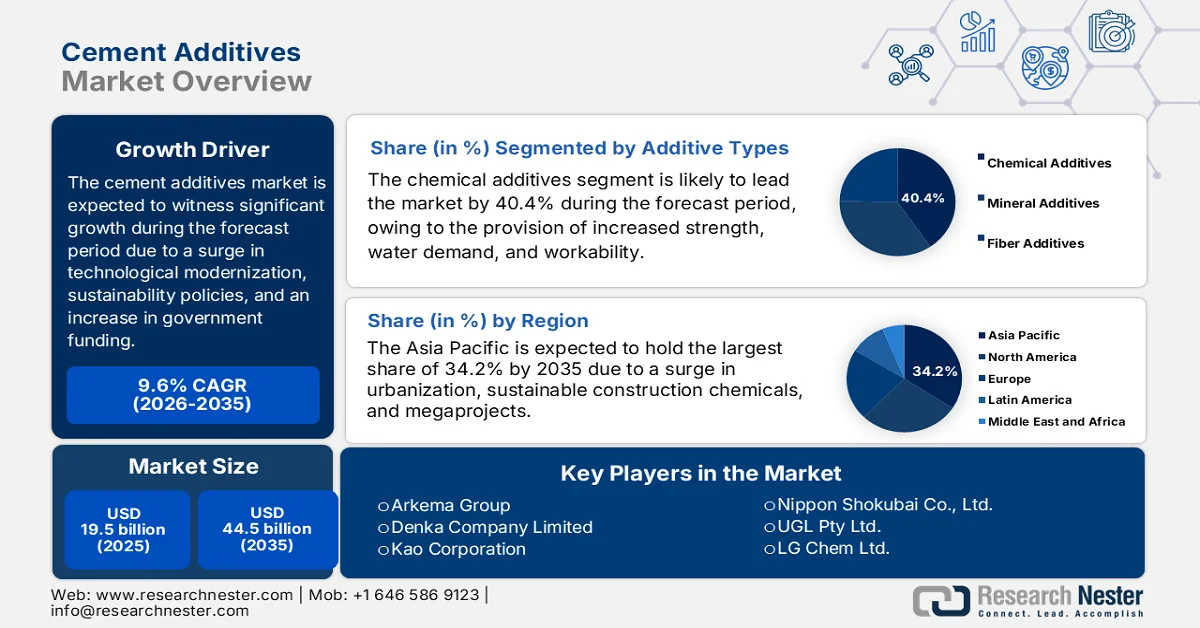
Cement Additives Market size was over USD 19.5 billion in 2025 and is expected to reach USD 44.5 billion by the end of 2035, growing at a CAGR of 9.6% during the forecast timeline, i.e., 2026-2035. In 2026, the industry size of cement additives is assessed at USD 21.3 billion.
The worldwide cement additives market is rapidly evolving, readily shaped by a complex interplay of international economic forces, strict environmental mandates, and technological breakthroughs. According to official statistics published by the Global Alliance for Buildings and Construction in 2025, in terms of carbon of construction materials, the building and construction industry’s emissions and the energy consumption, both significantly stood at 34% of the international demand. Besides, carbon dioxide emissions from the industry have readily risen by 5%, and are further expected to meet the 28% reduction objective by the end of 2030, in line with the Paris Agreement. Moreover, green building certifications significantly grew, with 20% of the newest commercial buildings in the Organization for Economic Cooperation and achieved certification as of 2023.
Furthermore, the rise of bio-based and low-carbon additives, integration of automated dosing systems and digitalization, as well as the proliferation of fiber reinforcement for complex construction, are a few trends that are bolstering the cement additives market globally. As per the February 2024 Journal of Environmental Sciences, carbon dioxide emissions from the cement industry account for 26% of the overall industrial emissions, and the requirement for developing low-carbon techniques within the industry is extremely crucial. Besides, the U.S., Europe, India, and China are considered the major cement producers, with proportions catering to 2.2%, 4.4%,7.8%. and 56.1%, respectively. The production of 1 ton of cement on average effectively emits 0.5 ton to 0.6-ton carbon dioxide, while the actual carbon emission depends upon different factors, including raw materials and fuels, heat recovery, manufacturing process, and the clinker ratio to cement. Thereby making it suitable for uplifting the cement additives market.
Key Cement Additives Market Insights Summary:
Regional Highlights:
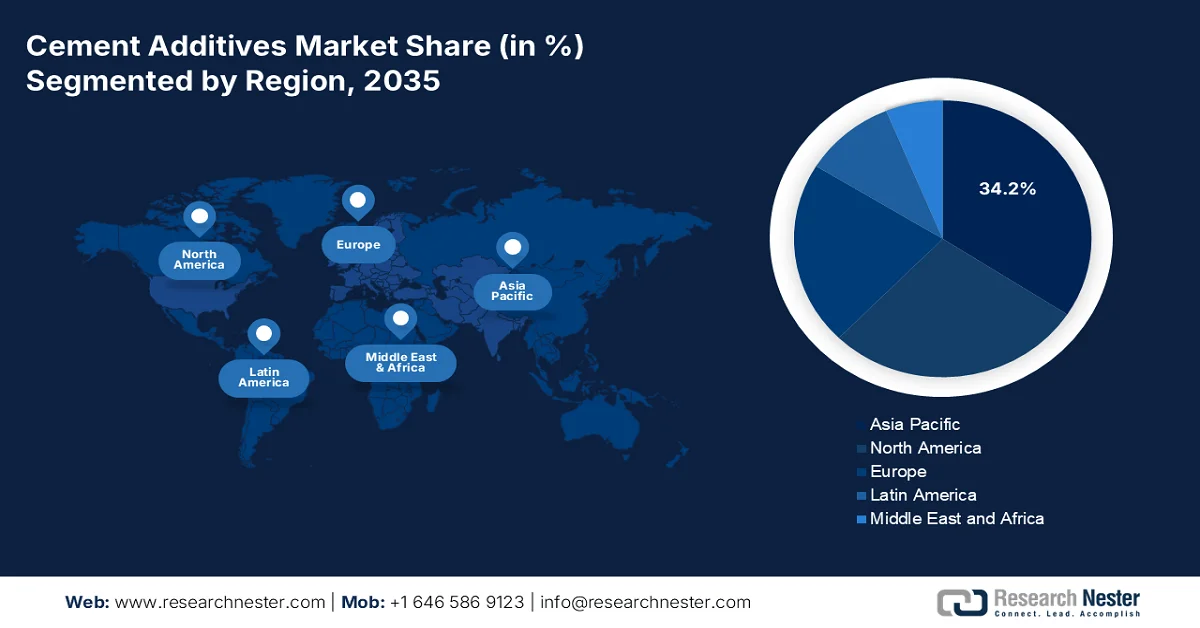
- Asia Pacific is projected to secure a dominant 34.2% share of the cement additives market by 2035, propelled by government-funded sustainability programs, mega infrastructure projects, rapid urbanization, and the presence of eco-friendly construction chemicals.
- Europe is expected to be the fastest-growing region over 2026–2035, propelled by large-scale infrastructure modernization, sustainability mandates, and strict environmental regulations.
Segment Insights:
- The chemical additives segment is expected to capture a leading 40.4% share of the cement additives market by 2035, driven by increasing strength, diminishing water demand, controlling settling times, and enhancing workability.
- The strength enhancers sub-segment is expected to hold the second-largest share during 2026–2035, fueled by optimizing hydration reactions, reducing porosity, and enhancing bonding between cement particles.
Key Growth Trends:
- The pace of global infrastructure megaprojects
- Surged demand in the oil and gas industry
Major Challenges:
- Regulatory compliance and environmental mandates
- Limited awareness and adoption in emerging markets
Key Players: BASF SE (Germany), Sika AG (Switzerland), GCP Applied Technologies Inc. (U.S.), Fosroc International Ltd. (UK), Mapei S.p.A. (Italy), CHRYSO SAS (France), Holcim Group (Switzerland), Cemex S.A.B. de C.V. (Mexico), Dow Chemical Company (U.S.), Ashland Global Holdings Inc. (U.S.), Arkema Group (France), Denka Company Limited (Japan), Kao Corporation (Japan), Nippon Shokubai Co., Ltd. (Japan), UGL Pty Ltd. (Australia), LG Chem Ltd. (South Korea), SK Chemicals Co., Ltd. (South Korea), Pidilite Industries Ltd. (India), Thermax Limited (India), Petronas Chemicals Group Berhad (Malaysia), TACC Limited (India).
Global Cement Additives Market Forecast and Regional Outlook:
Market Size & Growth Projections:
- 2025 Market Size: USD 19.5 Billion
- 2026 Market Size: USD 21.3 Billion
- Projected Market Size: USD 44.5 Billion by 2035
- Growth Forecasts: 9.6% CAGR (2026-2035)
Key Regional Dynamics:
- Largest Region: Asia Pacific (34.2% Share by 2035)
- Fastest Growing Region: Europe
- Dominating Countries: China, United States, Germany, India, Japan
- Emerging Countries: Vietnam, Malaysia, Brazil, Indonesia, South Korea
Last updated on : 2 March, 2026
Cement Additives Market - Growth Drivers and Challenges
Growth Drivers
- The pace of global infrastructure megaprojects: This goes beyond general constructional activities, including capital-based and complex projects that demand high-performance materials in the cement additives market globally. According to official statistics published by the PMI Organization in July 2025, it has been estimated that 9 out of 10 megaprojects have cost overruns, frequently more than 50% in real terms. Besides, megaprojects are conventionally defined as massive and complex investments that usually exceed USD 1 billion in expenses and take years to complete, and involve different stakeholders. The international infrastructure investment requirements are predicted to reach USD 57 trillion by the end of 2030, fueled by the transition to sustainable energy, urbanization, and population growth.
- Surged demand in the oil and gas industry: The oil and gas industry offers a strong and distinct secondary driver as it depends on the cement additives market not only for building structure, but also for technical integrity. As per the 2025 IEA Organization article, there has been growth in worldwide oil demand with a rise in consumption by 0.8% to 193 EJ as of 2023. Moreover, aviation and chemical feedstocks accounted for only 5% of the growth in global oil demand. Besides, there has been an increase in the gas demand by 2.7%, which is 115 billion cubic meters as of 2024. This has been above the 2% yearly average and also well above 1% growth rate in 2023. Therefore, with a continuous increase in both oil and gas demand, there is a huge growth opportunity for the market across different nations.
- Rise in raw material expenses: Different advanced chemical additives originate from petrochemicals, and increases as well as fluctuations in oil prices directly impact the cost of raw materials for additive manufacturers. Based on government estimates published by the ITA in January 2026, there has been an increase in the material price index by 3% as of November 2025 in comparison to 2024. Likewise, it has also increased by 2.7% in October 2025 in comparison to 2024, and finally, 0.1% increase as of November 2025 compared to October 2025. Besides, the construction material price indices deliberately vary from new housing, repair and maintenance, as well as other new work, thereby making it suitable for bolstering the cement additives market growth globally.
Challenges
- Regulatory compliance and environmental mandates: The cement additives market is subject to stringent environmental and safety regulations across regions, particularly in Europe and North America. Governments are pushing for low-carbon construction materials, requiring manufacturers to meet strict standards on emissions, waste disposal, and chemical safety. Besides, compliance often involves costly testing, certification, and process modifications, which can slow product launches and increase operational expenses. For instance, Europe’s Green Deal mandates significant reductions in carbon emissions, compelling additive producers to innovate rapidly. Similarly, OSHA and EPA regulations in the U.S. enforce strict workplace safety and environmental disposal practices, thus limiting the cement additives market expansion.
- Limited awareness and adoption in emerging markets: Despite the proven benefits of cement additives, awareness and adoption remain limited in emerging markets such as parts of Africa, Southeast Asia, and Latin America. Different construction firms in these regions prioritize cost savings over performance enhancements, relying on traditional cement mixes. The lack of technical expertise and insufficient training among contractors further restricts additive usage. Additionally, fragmented distribution networks make it difficult for manufacturers to penetrate rural and semi-urban markets. Besides, government initiatives promoting sustainable construction are often concentrated in urban centers, leaving smaller projects underserved.
Cement Additives Market Size and Forecast:
| Report Attribute | Details |
|---|---|
|
Base Year |
2025 |
|
Forecast Year |
2026-2035 |
|
CAGR |
9.6% |
|
Base Year Market Size (2025) |
USD 19.5 billion |
|
Forecast Year Market Size (2035) |
USD 44.5 billion |
|
Regional Scope |
|
Cement Additives Market Segmentation:
Additive Types Segment Analysis
The chemical additives segment, which is part of the additive types, is anticipated to garner the largest share of 40.4% in the cement additives market by the end of 2035. The segment’s upliftment is highly driven by increasing strength, diminishing water demand, controlling settling times, and enhancing workability. According to official statistics published by NLM in February 2025, based on the United Nations (UN) Department of Economic and Social Affairs, it is estimated that a majority, which is 70% of the worldwide population, is expected to reside in urban areas by the end of 2050. Therefore, it has become crucial to readily focus on the sustainability of chemical-based concrete infrastructure in the present scenario. This results in maintaining and optimizing sustainability, thus proliferating the segment’s growth within the overall cement additives market.
Functional Additives Segment Analysis
Based on the function additives segment, the strength enhancers sub-segment in the cement additives market is projected to hold the second-largest share during the forecast period. The sub-segment’s growth is highly fueled by optimizing hydration reactions, reducing porosity, and enhancing bonding between cement particles. Its importance has grown significantly as construction projects increasingly demand high-performance concrete capable of withstanding heavy loads, seismic activity, and extreme weather conditions. In infrastructure development, particularly bridges, tunnels, and high-rise buildings, strength enhancers ensure durability and safety, reducing maintenance costs over time. The segment is also driven by sustainability mandates, as stronger concrete allows for reduced cement usage, thereby lowering carbon emissions.
Application Segment Analysis
By the end of the stipulated timeline, the ready-mix concrete segment, part of the application, is expected to account for the third-largest share in the cement additives market. The segment’s development is highly attributed to its widespread use in residential, commercial, and infrastructure projects. Cement additives in RMC improve workability, setting time, and durability, making it the preferred choice for large-scale construction where consistency and efficiency are paramount. The segment benefits from urbanization trends, with rapid growth in housing, office complexes, and transportation infrastructure fueling demand. Additives such as superplasticizers, retarders, and strength enhancers are integral to RMC, ensuring uniform quality and reducing the risk of structural defects. Government initiatives promoting sustainable construction further boost this segment, as RMC with eco-friendly additives reduces cement consumption and carbon emissions.
Our in-depth analysis of the cement additives market includes the following segments:
|
Segment |
Subsegments |
|
Additive Types |
|
|
Functional Additives |
|
|
Application |
|
|
End user |
|
|
Product Form |
|
|
Distribution Channel |
|

Vishnu Nair
Head - Global Business DevelopmentCustomize this report to your requirements — connect with our consultant for personalized insights and options.
Cement Additives Market - Regional Analysis
APAC Market Insights
The Asia Pacific cement additives market is anticipated to garner the highest share of 34.2% by the end of 2035. The market’s upliftment is highly uplifted by government-funded sustainability programs, mega infrastructure projects, rapid urbanization, and the presence of eco-friendly construction chemicals. According to official statistics published by the America Coatings Association in 2026, construction-based investment in the region amounted to an estimated USD 8 trillion, with China readily accounting for the world’s largest construction industry, with 20% of international demand. Besides, in terms of construction chemicals sales in value terms, the overall region accounted for over 45%, with India and China jointly accounting for more than 50% of the demand. Meanwhile, Vietnam and Malaysia also experienced suitable growth in the need for construction chemicals, thus boosting the cement additives market’s exposure.
The cement additives market in China is growing significantly, owing to the existence of huge infrastructure projects, sustainability programs, stringent emission standards, eco-friendly admixtures, smart city projects, and the expansion of ready-to-mix concrete additives. As stated in an article published by the Climate Analytics Organization in August 2025, the country produces more than half of other nations’ cement, generating 13% to 15% of its national carbon dioxide emissions. Therefore, the cement industrial activity is essential to cater to the country’s objective of peaking national emissions by 2030 and also reach carbon neutrality by the end of 2060. Besides, as per the June 2024 Lawrence Berkeley National Laboratory June 2024 data report, the country produced an overall 2.1 billion tons of cement, accounting for 52% of worldwide production, thus proliferating the market’s growth.
The aspects of increased housing demand, government-backed sustainability strategies, an upsurge in investment for sustainable construction technologies, and infrastructure projects are certain factors that are responsible for boosting the cement additives market in India. As stated in an article published by the IBEF Organization in November 2025, the cement demand in the country is projected to account for a growth rate ranging between 7% to 8% by the end of 2027. Besides, the nation’s REITs readily deliver 6% to 7.5% of yields, which have successfully reached USD 18 billion as of August 2025, further projected to surpass USD 25 billion by the end of 2029. Moreover, in March 2024, the government inaugurated connectivity projects worth USD 1.8 billion, particularly in Kolkata. Meanwhile, road construction is continuously growing, which is also responsible for positively impacting the market in the overall country.
Road Construction Per Day Growth Analysis in India (2015-2047)
|
Year |
Per Day Growth (Kilometers) |
|
2015 |
12 |
|
2016 |
17 |
|
2017 |
23 |
|
2018 |
27 |
|
2019 |
30 |
|
2020 |
28 |
|
2021 |
37 |
|
2022 |
29 |
|
2023 |
28 |
|
2024 |
34 |
|
2025 |
29 |
|
2047 |
100 |
Source: IEBF Organization
Europe Market Insights
Europe in the cement additives market is expected to emerge as the fastest-growing region during the forecast period. The market’s development is highly propelled by large-scale infrastructure modernization, sustainability mandates, strict environmental regulations, and the enforcement of critical compliance on manufacturing safety. According to official statistics published by the Europe Commission in November 2023, the manufacturing industry in the region significantly employs 29.7 million people, which represents 19% of overall regional business economy employment. Additionally, it generates USD 260 billion in value added, which is equivalent to 23.7% of the regional business economy. Meanwhile, the Made in Europe (MiE) is the region’s private and public co-programmed partnership, which supports the transformation of the manufacturing industry. This is readily co-programmed under Horizon Europe, with an overall budget of USD 2.1 billion, thus supporting the market’s expansion.
The cement additives market in Germany is gaining increasing traction, owing to industrial advancement, robust government support, increased focus on sustainable manufacturing, a surge in funding for green construction solutions, and the presence of eco-friendly admixtures. As per an article published by Deutschland in July 2025, the construction industry in the country comprises 360,000 organizations and employs 2.6 million people, based on which it has successfully generated a yearly turnover of nearly USD 50.8 billion. In addition, companies of engineers and architects readily employed 540,000 people, and there are suitable planners behind building projects. Besides, the 1.2% of SMEs have over 100 employees in this particular industry, with Hochtief comprising 37,000 employees, along with a turnover amounting to USD 33 billion, thus denoting an optimistic outlook for the market’s growth.
The rapid implementation of sustainable construction practices, government-backed strategies, and infrastructure modernization programs, such as transportation upgradation and urban development are responsible for bolstering the cement additives market in Italy. According to official statistics published by OECD in June 2025, the country’s total official development assistance (ODA) readily increased as of 2024, amounting to USD 6.7 billion, demonstrating 0.28% of gross national income (GNI). Additionally, between 2022 and 2023, the country committed 22.9% of its overall bilateral allocable ODA to supporting the surrounding environment. Moreover, Italy has an extended length of nearly 1,300 km from north to south, along with an outstanding coastline of about 8,300 km along the Mediterranean Sea, thus proliferating the cement additives market expansion.
North America Market Insights
North America in the cement additives market is projected to witness considerable growth by the end of the stipulated timeline. The market’s growth is highly driven by government-funded infrastructure programs, sustainable construction materials, lowered carbon emissions, and the presence of administrative programs. Based on government estimates published by the Census Government in January 2026, the overall construction expenditure in the U.S. has been estimated at a yearly rate of USD 2,175.2 billion in October 2025, which is 0.5% above the September estimate of USD 2,164.3 billion. Moreover, the expenditure on private construction amounts to a seasonal adjusted yearly rate of USD 1,651.3 billion, which is 0.6% above the September estimate of USD 1,640.8 billion. Therefore, based on all these spending facilities, there is a huge growth opportunity for the market in the region.
The cement additives market in the U.S. is gaining increased exposure, owing to infrastructure investment, sustainability mandates, advanced manufacturing initiatives, and an increase in smart cities and urbanization. According to official statistics published by the U.S. Department of the Treasury in November 2023, the Bipartisan Infrastructure Law (BIL) has significantly directed USD 1.2 trillion of federal investment towards climate infrastructure, energy, and transportation, the majority of which is readily distributed through local and state governments. Besides, more than USD 350 billion has been announced through BIL funding throughout October 2023. Moreover, the majority of the BIL project is focused on bridges, roads, and other projects that are positively impacting the market’s growth in the country.
BIL Project Declaration on Bridges, Roads, and Other Projects in the U.S. (2023)
|
Components |
Project Fund (USD Billion) |
|
Roads, Bridges, and Major Projects |
174.7 |
|
Broadband |
46.5 |
|
Public Transportation |
34.1 |
|
Water |
22.2 |
|
Clean Energy and Power |
17.9 |
|
Resilience |
16.4 |
|
Safety |
12.4 |
|
Passenger and Freight Rail |
9.8 |
|
Airports/FAA |
7.8 |
|
Ports and Waterways |
5.9 |
Source: U.S. Department of the Treasury
The aspects of green building programs, infrastructure expansion, government funding, and cold climate construction demands are certain factors that are proliferating the cement additives market in Canada. As per an article published by the Canada Newswire in December 2022, the Member of Parliament for Mississauga, significantly responsible for the Federal Economic Development Agency for Southern Ontario notified a generous investment of nearly USD 4 million for the Yves Landry Foundation (YLF). The purpose has been to effectively deliver the Achieving Innovation and Manufacturing Excellence Green Initiative (AIME Green). Additionally, through the AIME Green strategy, South Ontario-based SMEs, particularly in the manufacturing industry, tend to receive almost USD 100,000 to train and upskill their workforce to implement green manufacturing solutions, thereby making it suitable for bolstering the market in the country.
Key Cement Additives Market Players:
- BASF SE (Germany)
- Sika AG (Switzerland)
- GCP Applied Technologies Inc. (U.S.)
- Fosroc International Ltd. (UK)
- Mapei S.p.A. (Italy)
- CHRYSO SAS (France)
- Holcim Group (Switzerland)
- Cemex S.A.B. de C.V. (Mexico)
- Dow Chemical Company (U.S.)
- Ashland Global Holdings Inc. (U.S.)
- Arkema Group (France)
- Denka Company Limited (Japan)
- Kao Corporation (Japan)
- Nippon Shokubai Co., Ltd. (Japan)
- UGL Pty Ltd. (Australia)
- LG Chem Ltd. (South Korea)
- SK Chemicals Co., Ltd. (South Korea)
- Pidilite Industries Ltd. (India)
- Thermax Limited (India)
- Petronas Chemicals Group Berhad (Malaysia)
- TACC Limited (India)
- Company Overview
- Business Strategy
- Key Product Offerings
- Financial Performance
- Key Performance Indicators
- Risk Analysis
- Recent Development
- Regional Presence
- BASF SE is a global leader in chemical solutions, with a strong portfolio of cement additives that enhance durability and sustainability. The company invests heavily in R&D to develop low‑carbon admixtures aligned with Europe-based climate goals. BASF’s strategic partnerships with construction firms strengthen its market presence in infrastructure projects worldwide.
- Sika AG specializes in construction chemicals, with cement additives that improve workability and performance. The company focuses on eco‑friendly admixtures, supporting Europe’s push toward sustainable building practices. Sika’s acquisitions of regional players expand its footprint in the Asia Pacific and North America.
- GCP Applied Technologies Inc. is recognized for its innovative admixtures that enhance concrete strength and reduce environmental impact. The company leverages U.S. infrastructure spending programs to boost demand for advanced cement additives. GCP’s digital solutions for construction monitoring provide added value to contractors and developers.
- Fosroc International Ltd. offers a wide range of cement additives tailored for infrastructure and industrial construction. The company emphasizes sustainability, with admixtures that reduce cement usage and carbon emissions. Fosroc’s strong presence in the Middle East supports large‑scale infrastructure projects in the region.
- Mapei S.p.A. is a leading manufacturer of construction chemicals, including high‑performance cement additives. The company invests in sustainable technologies, aligning with EU directives on green construction. Mapei’s global distribution network ensures strong penetration in both mature and emerging markets.
Here is a list of key players operating in the global market:
The worldwide cement additives market is highly competitive, with leading players such as BASF, Sika, and GCP Applied Technologies driving innovation through sustainable admixtures and low-carbon solutions. Besides, Europe-based firms, including Mapei and CHRYSO, focus on eco-friendly additives aligned with regional regulations, while Asia-specific companies such as Nippon Shokubai and LG Chem leverage advanced chemical technologies to expand regional presence. Moreover, strategic initiatives include R&D investments, mergers and acquisitions, and partnerships with construction firms to strengthen supply chains. For instance, in July 2025, TACC Limited has effectively signed a Memorandum of Understanding (MoU) with the National Council for Cement and Building Materials (NCB) to jointly explore the creation of next-generation cement concrete by utilizing graphene-based additives, thereby bolstering the cement additives industry globally.
Corporate Landscape of the Cement Additives Market:
Recent Developments
- In October 2025, UltraTech Cement declared an investment of USD 1.1 million for expanding its cement production capacity by 22.8 mtpa, which includes its subsidiary, India Cements Limited, and has been executed through a combination of greenfield and brownfield projects.
- In August 2025, CureAssure introduced CureAssure, which is the world’s first-ever internal curing concrete additive that has been significantly engineered to diminish the demand for conventional external curing and provide suitable water savings of almost 8 billion liters.
- In June 2025, Cemex EMEA launched the prime family of innovative admixtures solutions, which significantly marks the newest stage in a wide-ranging evolution of its admixture’s portfolio, readily available across global and regional markets.
- Report ID: 8406
- Published Date: Mar 02, 2026
- Report Format: PDF, PPT
- Explore a preview of key market trends and insights
- Review sample data tables and segment breakdowns
- Experience the quality of our visual data representations
- Evaluate our report structure and research methodology
- Get a glimpse of competitive landscape analysis
- Understand how regional forecasts are presented
- Assess the depth of company profiling and benchmarking
- Preview how actionable insights can support your strategy
Explore real data and analysis
Frequently Asked Questions (FAQ)
About this Report
Connect with our Expert


Report, 2026-2035



Copyright @ 2026 Research Nester. All Rights Reserved.
