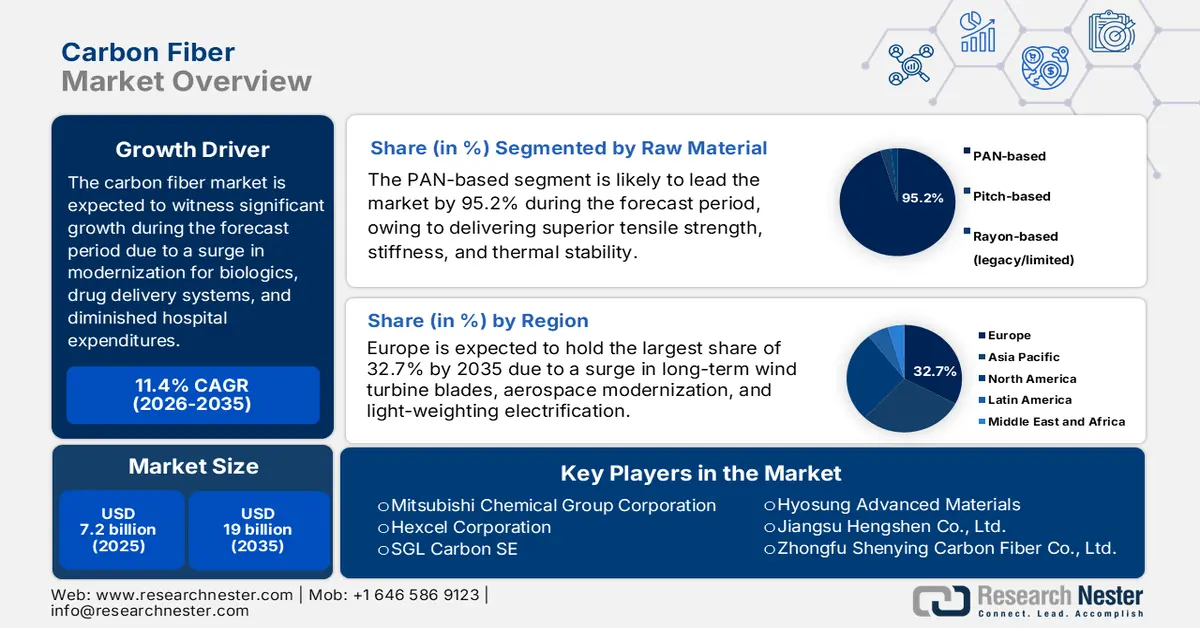
Carbon Fiber Market Outlook:
Carbon Fiber Market size was over USD 7.2 billion in 2025 and is estimated to reach USD 19 billion by the end of 2035, expanding at a CAGR of 11.4% during the forecast timeline, i.e., 2026-2035. In 2026, the industry size of carbon fiber is assessed at USD 8 billion.
The international carbon fiber market is considered a standard cornerstone for innovative materials, providing high strength-to-weight ratios, along with durability that makes it readily indispensable across industrial, wind energy, automotive, and aerospace applications. According to an article published by the U.S. Department of Energy in 2025, almost a 10% reduction in vehicle weight tends to result in a 6% to 8% fuel economy optimization, since it generally takes less energy to accelerate a light object. Thereby, by utilizing lightweight components, along with high-efficiency engines can enable innovative materials within a quarter, especially in the U.S., and successfully save over 5 billion gallons of fuel every year by the end of 2030. Besides, replacing heavy steel components with materials, including high-strength steel, glass fiber, and aluminum composites, can readily decrease component weight by 10% to 60%, thus denoting an optimistic approach for the carbon fiber market’s growth.
List of Light-Weight Materials Ensuring Mass Reduction (2025)
|
Material Type |
Mass Reduction (%) |
|
Magnesium |
30 to 70 |
|
Carbon Fiber Composites |
50 to 70 |
|
Aluminum and AI Matrix Composites |
30 to 60 |
|
Titanium |
40 to 55 |
|
Glass Fiber Composites |
25 to 35 |
|
Advanced High-Strength Steel |
15 to 25 |
|
High Strength Steel |
10 to 28 |
Source: U.S. Department of Energy
Furthermore, the recycled carbon fiber adoption, increased automation in manufacturing, integration into electric vehicle platforms, expansion in wind energy, diversification into new applications, and the aspect of regional leadership are other factors driving the carbon fiber market internationally. As per an article published by the WWEA Organization in April 2025, the overall wind capacity exceeded by 1,174 GW, with 121 GW readily added in 2024. In addition, China has significantly installed 87 GW, which accounts for 72% of the newest international capacity. Moreover, countries with the largest carbon fiber market volume for new wind turbines include 5.4 GW in Brazil, 4.2 GW in the U.S., 3.4 GW in India, 3.3 GW in Australia, 3.2 GW in Germany, and 2.2 GW in the UK, thereby driving the market’s demand across every nation.
Yearly Overall Cumulative Installed Wind Capacity (2016-2024)
|
Year |
Capacity (MW) |
|
2016 |
485,549 |
|
2017 |
537,732 |
|
2018 |
589,511 |
|
2019 |
650,951 |
|
2020 |
744,695 |
|
2021 |
844,740 |
|
2022 |
930,743 |
|
2023 |
1,051,335 |
|
2024 |
1,173,580 |
Source: WWEA Organization