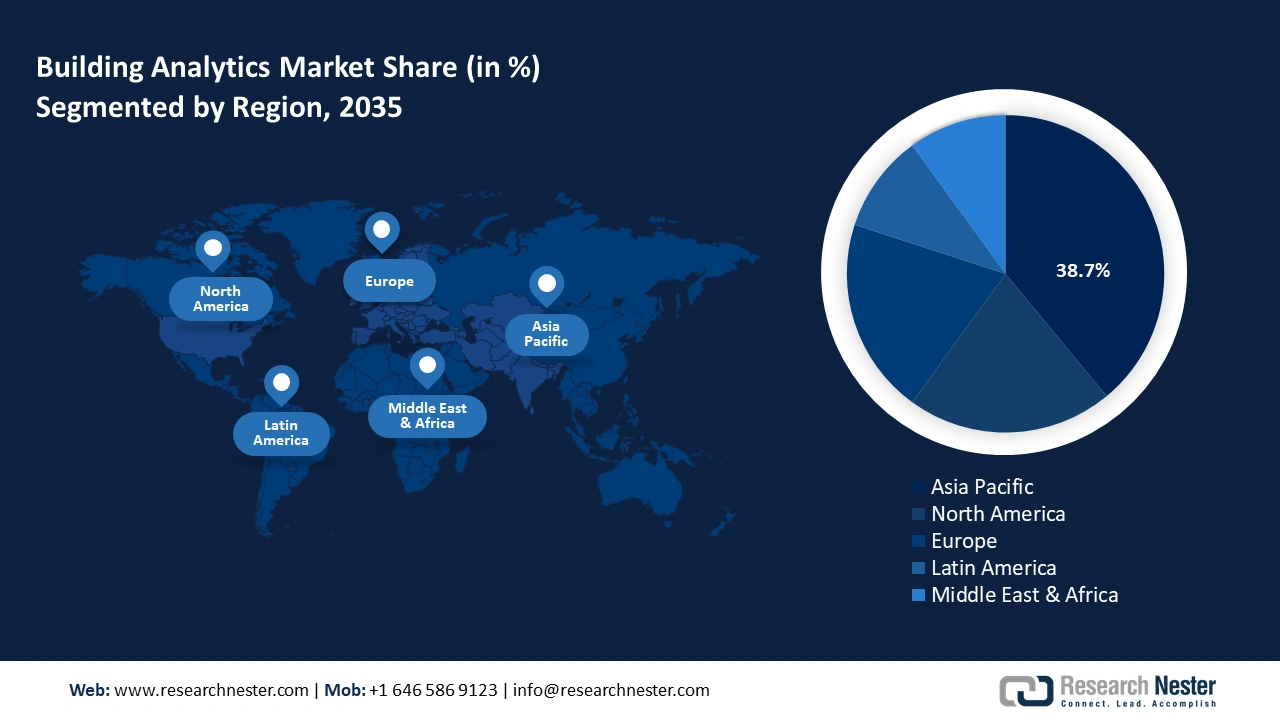
Building Analytics Market - Regional Analysis
North America Market Insights
North America market is poised to account for a leading revenue share of 38.7% by the end of 2035. The market's growth is favorably impacted by a higher degree of economic integration, which is mapped by the intra-continental flows of building tech components in the region. Moreover, this creates a well-established value chain in the region. The market is supported by a favorable regulatory ecosystem, such as the North American Energy Standards Board, implementing homogenous energy efficiency policies. Additionally, in terms of demographic trends, the urban population has expanded massively across the major metros, correlating with the surging deployment of smart buildings. These trends, converging together, are poised to ensure that the market maintains its dominant revenue share during the forecast timeline.
U.S. building analytics market is poised to maintain its leading share in North America. The market is characterized by state-level differentiation, with the most lucrative opportunities for vendors concentrated in Texas, California, and New York. Federal policies, such as the Inflation Reduction Act (IRA), impact sub-markets, resulting in high improvements in fault detection adoption in commercial real estate. Strategic intelligence highlights that firms that are leveraging localized regulatory knowledge also capture premium pricing whilst expanding service portfolios.
The Canada market is anticipated to expand steadily throughout the forecast period. The stringent energy efficiency regulations are accelerating the trade of building analytics. The green building certifications and government-backed sustainability programs are also boosting the demand for building analytics solutions. The Canada Green Building Council projects that the green building sector of the country is estimated to create 1.5 million direct green building jobs and around USD 150 billion in GDP by 2030. Thus, this industry is likely to be the key booster of building analytics solutions.
APAC Market Insights
The APAC market is slated to increase at a CAGR of 12.9% throughout the forecast timeline. A driving force behind APAC’s growth is the improvement in trade flow across the economies of APAC and a greater proliferation of smart city initiatives. Additionally, Petri and Plummer's research shows that the RCEP trade agreement is set to boost global incomes by 2030. China, Japan, and South Korea are expected to gain the most from it. Additionally, bilateral agreements between Vietnam and South Korea, Indonesia, and Japan have spurred the technology transfer. The market also benefits from sovereign wealth funds such as the GIC of Singapore and Khazanah of Malaysia through the proactive investments in regional green building infrastructure. By the end of 2035, the surging urbanization across APAC has the potential to ensure a sustained market growth.
China building analytics market is expected to register rapid growth owing to the Dual Circulation strategy. The domestic consumption has risen in tier 1 cities, including Shanghai. The tier 2 cities in Wuhan and Chengdu are where large-scale infrastructure modernization is driving the deployment of building analytics. In terms of trends, consumers and businesses in China have exhibited a high responsiveness to green building certification, which bolsters the intent among end users to adopt building analytics tools, serving as a key bottom-of-the-funnel indication.
India building analytics market is projected to be driven by the rising urbanization and increasing smart city initiatives. The government-backed energy efficiency programs are accelerating the trade of building analytics. According to the Press Information Bureau (PIB), 94% of the 8,067 projects in the Smart Cities Mission are finished, with around USD 1.98 trillion spent on them. Smart city projects are creating large-scale opportunities for building management system and analytics platform producers.
Europe Market Insights
The Europe market is estimated to hold a significant revenue share through 2035, owing to the stringent environmental regulations and energy efficiency mandates. The rapid digital transformation and increasing expansion of smart cities are further opening high-earning opportunities for building analytics companies. The green building trend is also accelerating the adoption of HVAC and lighting systems
Germany leads the sales of building analytics, owing to its strict energy regulations such as the Energy Saving Ordinance (EnEV) and the Renewable Energy Heat Act (EEWärmeG). The commercial and industrial buildings are prime end users of building analytics. The country’s strong industrial base and high penetration of smart buildings further accelerate the deployment of IoT-enabled sensors and cloud analytics.
The U.K. market is projected to be driven by the expanding government initiatives promoting energy efficiency and carbon neutrality. Programs such as the UK Green Building Council (UKGBC) initiatives and mandatory energy reporting for large commercial buildings are significantly boosting the trade of building analytics platforms. The commercial offices, retail spaces, and healthcare facilities are prime adopters of building analytics platforms.