Blow-Fill-Seal Technology Market Outlook:
Blow-Fill-Seal Technology Market size was valued at USD 394.6 million in 2025 and is projected to reach USD 756.5 million by the end of 2035, expanding at a CAGR of 7.5% during the forecast period, i.e., 2026-2035. In 2026, the industry size of blow-fill-seal technology is assessed at USD 424.2 million.
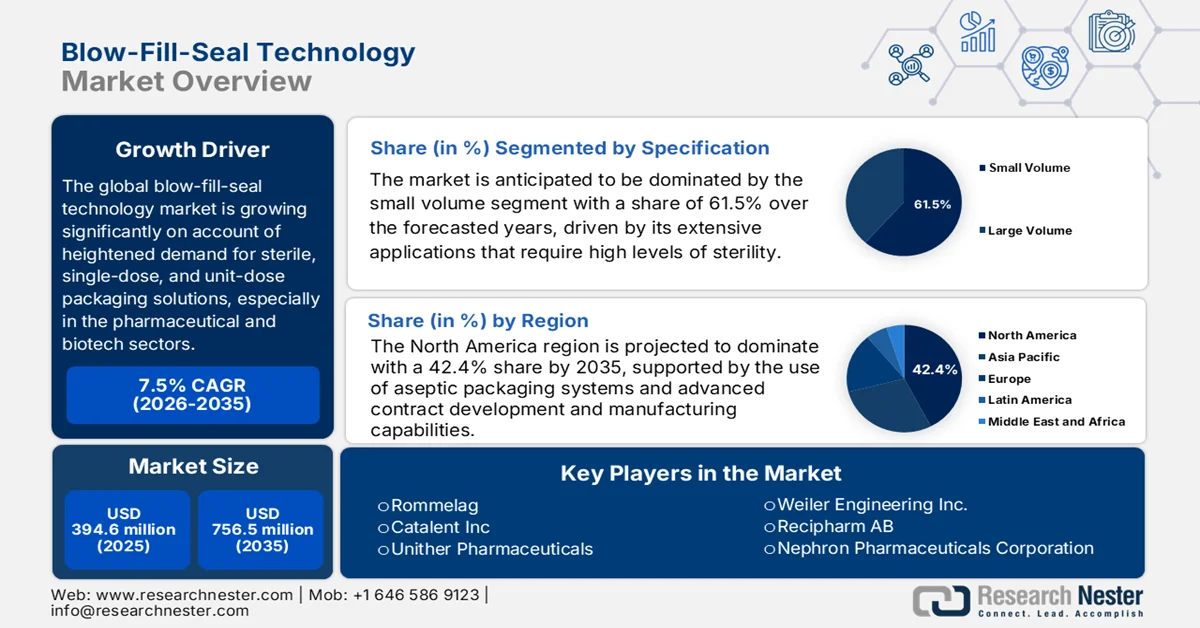
The global blow-fill-seal technology market is poised for noteworthy growth in the years ahead, owing to the heightened demand for sterile, single-dose, and unit-dose packaging solutions, especially in the pharmaceutical and biotech sectors. As per an article published by the World Health Organization (WHO) in March 2025, it guides on the transport of infectious substances and forms updated requirements by covering classification, packaging, labeling, and documentation across all transport modes. In addition, it mandates the use of validated sterile primary receptacles and compliant secondary, outer packaging systems to ensure containment and integrity during transit. Also, the guideline emphasizes temperature control, traceability, and risk-based handling procedures with the main goal of preventing contamination or exposure across the supply chain. Moreover, it requires formal training and competency for all personnel involved, encouraging standardized practices for shippers, carriers, and receiving facilities.
Furthermore, as the regulatory standards keep tightening across most of the nations, and the pharmaceutical manufacturing is making a shift towards biologics, parenteral drugs, and complex eye drop formulations, stimulating growth in the blow-fill-seal technology market. BFS is highly used over conventional packaging for its ability to combine bottle forming, filling, and sealing into one sterile, high-speed automated process. In October 2022, Recipharm announced the expansion of its sterile filling capabilities by introducing Lab+ technology for low-volume blow-fill-seal at its Kaysersberg, France, facility. This particular system enables flexible, small-batch production with a throughput of 2,000 doses per hour, supporting clinical phase I and II projects without dedicating entire filling lines, thus positively impacting the market’s growth and exposure.
Key Blow-Fill-Seal Technology Market Insights Summary:
Regional Highlights:
- North America is projected to command a 42.4% share of the blow-fill-seal technology market by 2035, propelled by strong pharmaceutical manufacturing, high adoption of aseptic packaging, and advanced CDMO infrastructure
- Asia Pacific is expected to register the fastest growth in the forecast period 2026–2035, fueled by rising healthcare expenditure, expanding pharmaceutical manufacturing capacities, and increasing demand for contamination-free packaging solutions
Segment Insights:
- In the blow-fill-seal technology market, the small volume segment is anticipated to account for a 61.5% share by 2035, driven by its extensive application in sterile single-dose packaging requiring precise dosing and contamination-free handling
- Polypropylene under the material segment is projected to capture a considerable revenue share by 2035, owing to its superior chemical resistance, thermal stability, and strong barrier properties for pharmaceutical packaging
Key Growth Trends:
- Growth of the pharmaceutical and healthcare industry
- Rising demand for unit-dose packaging
Major Challenges:
- Technical complexity and skilled workforce requirement
- Regulatory compliance and validation challenges
Key Players: Rommelag (Germany), Catalent Inc. (U.S.), Unither Pharmaceuticals (France), Weiler Engineering Inc. (U.S.), Recipharm AB (Sweden), Nephron Pharmaceuticals Corporation (U.S.), The Ritedose Corporation (U.S.), Curida AS (Norway), Brevetti Angela S.R.L. (Italy), Unicep Packaging LLC (U.S.), Asept Pak, Inc. (U.S.), Pharmapack Co., Ltd. (China), Apiject Holdings (U.S.), Vanguard Utility (U.S.), Amneal Pharmaceuticals (U.S.).
Global Blow-Fill-Seal Technology Market Forecast and Regional Outlook:
Market Size & Growth Projections:
- 2025 Market Size: USD 394.6 million
- 2026 Market Size: USD 424.2 million
- Projected Market Size: USD 756.5 million by 2035
- Growth Forecasts: 7.5% CAGR (2026-2035)
Key Regional Dynamics:
- Largest Region: North America (42.4% Share by 2035)
- Fastest Growing Region: Asia Pacific
- Dominating Countries: United States, Germany, China, Japan, India
- Emerging Countries: China, India, Brazil, South Korea, Mexico
Last updated on : 28 April, 2026
Blow-Fill-Seal Technology Market - Growth Drivers and Challenges
Growth Drivers
- Growth of the pharmaceutical and healthcare industry: The progression of worldwide pharmaceutical manufacturing, especially injectables, biosimilars, and vaccines, is an important growth engine for the blow-fill-seal technology market. These products require controlled, sterile environments during packaging to maintain stability and effectiveness. As per the WHO article published in December 2025, the global vaccine market reached about 7.2 billion doses in 2024, which is 7% higher when compared to 2023, with a financial value of around USD 66.5 billion. The blow-fill-seal technology market remains highly concentrated, with the top 10 manufacturers controlling nearly 78% of volume and 84% of value. At the same time, procurement is split mainly between MIC self-procuring countries and UNICEF pooled procurement, together covering over 80% of global volumes, thus denoting a lucrative opportunity for blow-fill-seal technologies.
- Rising demand for unit-dose packaging: The structural shift towards unit-dose packaging, i.e., single-use vials, ampoules, and prefilled syringes for patient convenience, in medical and home facilities, drives the market growth. BFS helps in producing small, disposable containers such as vials and ampoules. As per an article published by the National Institute of Health (NIH) in October 2025, a study on a unit-dose dispensing system incorporated with digital health IT, 4.7 million doses were prescribed in 2023, wherein 64% being UDDS-compatible, showing strong potential to reduce nursing workload and improve medication safety through automated dispensing. It also mentioned that a large proportion of prescriptions were solid dosage forms, enabling more efficient hospital medication workflows at scale. The system showed clear efficiency gains, thus suitable for bolstering the blow-fill-seal technology market.
- Expansion in food, beverage, and cosmetics applications: Apart from pharmaceuticals, BFS is highly used in food & beverages and personal care products, where hygienic and tamper-proof packaging is important, e.g., single-serve drinks, lotions, eye drops. Consumers are showcasing an increased preference for safe, portable, and contamination-free packaging formats. India Brand Equity Foundation (IBEF) in December 2023 reported that India’s cosmetic industry has grown at a rapid pace of progress with a CAGR of almost 25%. The report also stated that rising disposable incomes, urbanization, and demand for organic, herbal, and ayurvedic products are driving this expansion. At the same time, the digital revolution and Gen Z’s preference for customized, high-quality products are reshaping competition, denoting a huge opportunity for the blow-fill-seal technology market over the upcoming years.
Challenges
- Technical complexity and skilled workforce requirement: The BFS technology requires higher technical knowledge for operation, maintenance, and validation. This process integrates molding, filling, and sealing in a single automated system, which in turn demands precise control in terms of temperature, airflow, and sterility conditions. Any type of deviation can lead to contamination risks, thereby negatively impacting the growth of the blow-fill-seal technology market. Apart from this, the shortfall of skilled professionals trained specifically in BFS systems creates major operational challenges for manufacturers. Continued training and dependence on equipment vendors for technical support raise the dependency costs. Additionally, troubleshooting complex BFS machinery can lead to production downtime.
- Regulatory compliance and validation challenges: The blow fill seal technology market needs to operate under strict regulatory concerns, which necessitate continued validation of sterile processes. Each of the BFS production lines needs to undergo huge qualification, including installation, operational, and performance validation, i.e., IQ, OQ, PQ. At the same time, maintaining consistent sterility assurance across continuous production adds additional complexity. Regulatory expectations also evolve frequently, which necessitates manufacturers to continuously upgrade systems and documentation processes. Therefore, any type of deviation or contamination event can result in costly recalls or production shutdowns. These stringent compliance requirements increase the time for the product to enter the blow-fill-seal technology market and create barriers for smaller manufacturers entering highly regulated pharmaceutical markets.
Blow-Fill-Seal Technology Market Size and Forecast:
| Report Attribute | Details |
|---|---|
|
Base Year |
2025 |
|
Forecast Year |
2026-2035 |
|
CAGR |
7.5% |
|
Base Year Market Size (2025) |
USD 394.6 million |
|
Forecast Year Market Size (2035) |
USD 756.5 million |
|
Regional Scope |
|
Blow-Fill-Seal Technology Market Segmentation:
Specification Segment Analysis
On the basis of specification, the global blow-fill-seal technology market is anticipated to be dominated by the small volume segment with a share of 61.5% over the forecasted years. The segment’s dominance is effectively driven by its extensive application in single-dose vials, ampoules, and unit-dose bottles that require high levels of sterility, precise dosing, and contamination-free handling. The segment plays a critical role in the pharmaceutical industry, particularly in the packaging of vaccines, biologics, ophthalmic solutions, and injectable drugs, in which product safety and accuracy are highly essential. Growing demand for patient-centric care, increasing prevalence of chronic diseases, and expansion of biologics deliberately strengthen its position. In addition, stringent regulatory requirements for aseptic packaging and the rising adoption of automated BFS systems support the continued dominance of the small volume segment across global healthcare sectors.
Material Segment Analysis
By the end of 2035, polypropylene, which is under the material segment, is expected to grow with a considerable revenue share in the blow-fill-seal technology market. The segment’s growth is largely attributable to PP’s superior chemical resistance, excellent thermal stability, and strong barrier properties, making it highly suitable for pharmaceutical and biotechnology packaging applications. It helps maintain product integrity, sterility, and shelf life, especially for sensitive formulations such as injectables, vaccines, and biologics. As per an article published by NIH in January 2024, polypropylene is a versatile thermoplastic that is used across packaging and biomedical sectors, with properties such as low density, good chemical resistance, and mechanical strength. Besides, other modifications include iron nanoparticles improving tensile strength by 24% and reducing air permeability by 33%, silver nanoparticles enhancing antimicrobial activity from 0.44% to 2.60%, and Cu-PP textiles eliminating 99.8% of S. aureus in 60 minutes.
Product Segment Analysis
In terms of product vials is predicted to showcase noteworthy growth in the blow-fill-seal technology market during the discussed timeframe. The segment’s growth is mainly attributed to the widespread use of vials in injectable pharmaceuticals, vaccines, and biologics that require strict aseptic conditions and precise dosing. Their strong adoption is also supported by the growing demand for biologics and immunization programs worldwide, where safety, sterility, and product integrity are highly essential. In addition, BFS-based vial production ensures a closed, automated process that minimizes human intervention and significantly reduces contamination risks, making it highly suitable for sensitive drug formulations. The increasing prevalence of chronic diseases and the growing need for efficient parenteral drug delivery systems further solidify demand for sterile vial packaging.
Our in-depth analysis of the blow-fill-seal technology market includes the following segments:
|
Segment |
Subsegments |
|
Specification |
|
|
Material |
|
|
Product |
|
|
End user Industry |
|
|
Container Type |
|
|
Packaging Type |
|
|
Drug Type |
|

Vishnu Nair
Head - Global Business DevelopmentCustomize this report to your requirements — connect with our consultant for personalized insights and options.
Blow-Fill-Seal Technology Market - Regional Analysis
North America Market Insights
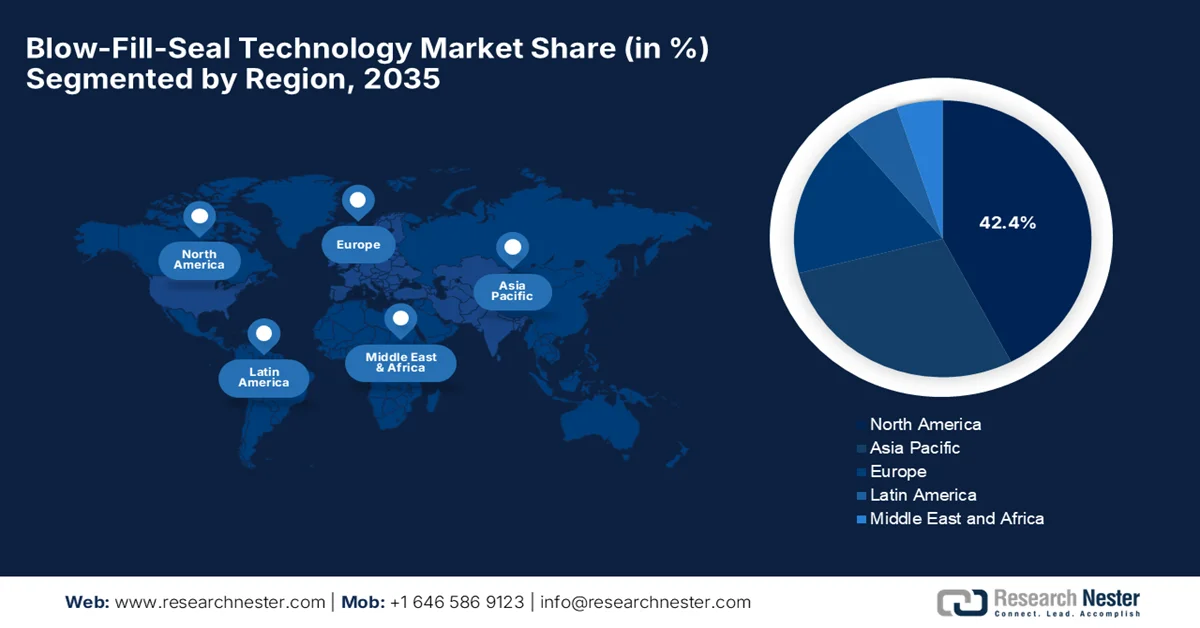
North America blow-fill-seal technology market is anticipated to lead with the largest share of 42.4% by the end of the discussed timeframe. The region’s dominance is largely propelled by strong pharmaceutical manufacturing, high adoption of aseptic packaging, and advanced CDMO infrastructure. Expansion is primarily driven by sterile injectable demand, vaccine production, and automation upgrades in BFS lines across contract manufacturing facilities. For instance, in March 2024, Holland & Knight advised DifGen Pharmaceuticals on its acquisition of New Vision Pharmaceuticals’ U.S. FDA-registered manufacturing facility in Tamarac, Florida. This particular site supports blow-fill-seal, form-fill-seal, and traditional filling for various liquid and semi-solid dosage forms. Therefore, the presence of such moves strengthens the region’s focus on complex generics and specialty pharmaceuticals, enhancing access to high-quality medicines for global communities.
The adoption of aseptic pharmaceutical packaging, particularly within the biopharmaceutical, injectables, and ophthalmic sectors, is responsibly driving the blow-fill-seal technology market in the U.S. Some of the key trends witnessed by the country’s market include widespread replacement of traditional glass vial systems with automated plastic BFS technology, boosting production efficiency, and strategic expansion into specialized drug delivery. As of the November 2025 article published by the U.S. Food & Drug Administration for products packaged using blow-fill-seal technology, stability testing for exhibit batches may be conducted in a single orientation, provided it ensures maximum contact between the drug product and the container closure system components, including the seal and neck. This approach allows either horizontal or upright positioning, depending on the product design and contact assessment.
The escalating demand for advanced aseptic packaging solutions within the pharmaceutical and biotechnology sectors is the main driver that is efficiently boosting the blow-fill-seal technology market in Canada. This market is showcasing a strong emphasis on sterility assurance, compliance with stringent regulatory standards for medication safety, and a growing adoption of unit-dose formats for liquid pharmaceuticals. The major drivers boosting the country’s market are the increasing production of injectable drugs, vaccines, and specialized ophthalmic products, which require contamination-free, high-speed manufacturing processes. Apart from this, the country’s market is making a shift towards automation, robotics, and the use of sustainable, recyclable materials, whereas contract manufacturing organizations are expanding their capacity to make it suitable for the rising demand from domestic and international clients.
APAC Market Insights
The Asia Pacific blow-fill-seal technology market is predicted to grow at the fastest rate from 2026 to 2035. The region’s progress in this field is mainly propelled by rising healthcare expenditure, medical coverage, technological advancements, enhanced automation, and the need for secure, contamination-free packaging solutions. Expanding pharmaceutical manufacturing capacities in countries such as China and India are major contributors. The blow-fill-seal technology market is also witnessing increased adoption in the cosmetics and food sectors. As per the article published by NIH in November 2025, the study shows that South Asia is projected to make significant progress toward universal health coverage, wherein the regional primary healthcare service coverage is expected to rise to 81.5% by 2030, surpassing the 80% SDG target. Countries such as Sri Lanka and Bhutan are leading this progress, whereas Bangladesh, India, and Nepal are also expected to achieve strong improvements in service coverage. This denotes a huge opportunity for pharmaceutical and packaging solutions in the region.
The advancements in the pharmaceutical sector and strong government support for vaccine and biologic production are some of the factors driving the blow-fill-seal technology market in China. Growth is also propelled by the widespread adoption of BFS in contract manufacturing, boosting efficiency in the production of complex pharmaceutical products. According to the article published by NIH in April 2023, the country’s pharmaceutical industry showcased a clear shift from rapid expansion to a consolidation phase, as regulatory reforms and policy support have matured and market pressures have increased. It stated that innovation capacity continues to strengthen, especially in terms of biologics, cell therapies, and antibody drug conjugates. The number of IND filings, clinical trials, and new drug approvals declined due to tighter financing conditions and post-pandemic adjustments. Overall, the sector is transitioning toward more structured, high-quality innovation suitable for bolstering the blow-fill-seal technology industry.
In India, the blow-fill-seal technology market is growing at a considerable rate, mainly propelled by government initiatives boosting domestic manufacturing. The industry is making a shift toward automated, high-output machinery to produce bottles, ampoules, and vials with enhanced sterility. As stated by Press Information Bureau (PIB) in June 2023, India’s pharmaceutical exports rose from USD 10.9 billion in 2013-14 to almost USD 24.6 billion in 2022-23, which marks a 125% growth and accounts for 5.71% of total exports. The country leads globally with 60% of vaccine production and a 20% share in generics by volume, supplying over 298 million COVID-19 doses worldwide. The report also stated that government PLI schemes attracted investments worth USD 2.6 billion, thereby boosting self-reliance in bulk drugs, medical devices, and pharmaceuticals, thus denoting an optimistic market opportunity.
Europe Market Insights
Europe blow-fill-seal technology market is gaining enhanced traction owing to the existence of increased automation in the pharmaceutical category. This advanced aseptic manufacturing process, which integrates container formation, filling, and sealing into a single, continuous, and contamination-free operation, is becoming highly suitable for producing unit-dose containers for ophthalmics, respiratory drugs, and injectables. In August 2024, Open Access Government stated that Unither Pharmaceuticals is readily advancing equitable vaccine access in developing countries with its Euroject device, which integrates blow-fill-seal technology into a cost-effective, scalable, and user-friendly injection system. It also stated that BFS reduces reliance on glass vials and supports sensitive biologics, thereby enabling mass production up to one billion doses annually by the end of 2027 at its Amiens facility. This Euroject strengthens global health preparedness and offers a practical solution for large-scale vaccination campaigns in resource-limited settings.
The presence of established companies and innovators and a shift toward efficient, specialized, and flexible packaging solutions are fueling growth in the blow-fill-seal technology market in Germany. The country’s market also benefits from increasing demand for on-the-go formats, such as lightweight bottles, while focusing on improving container design stability. In February 2025, Recipharm announced the expansion of its aseptic filling capabilities with a new modular sterile filling system at its Wasserburg, Germany, facility. It is operating under GMP-compliant Grade A isolator conditions, and the system supports syringes and vials, with batch sizes ranging from 500 to 50,000 units. Therefore, such instances in the market denote that Germany is actively strengthening its aseptic manufacturing infrastructure and advancing scalable, high-precision blow-fill-seal and sterile filling capabilities.
The blow-fill-seal technology market in the UK is undergoing significant transformations owing to a huge emphasis on engineering precision and the integration of advanced manufacturing systems within pharmaceutical production environments. One of the most notable features of the country’s landscape is the increasing alignment between packaging design and automated fill-finish platforms, where manufacturers are prioritizing process consistency, closed-system operations, and reduced human intervention to support high-quality sterile production. Apart from this, the presence of established pharmaceutical innovators and contract manufacturing organizations is also encouraging the adoption of modular and scalable solutions. In addition, there is a growing focus on integrating BFS systems with digital monitoring and validation tools to enhance batch traceability and operational control across production cycles.
Key Blow-Fill-Seal Technology Market Players:
- Rommelag (Germany)
- Catalent Inc. (U.S.)
- Unither Pharmaceuticals (France)
- Weiler Engineering Inc. (U.S.)
- Recipharm AB (Sweden)
- Nephron Pharmaceuticals Corporation (U.S.)
- The Ritedose Corporation (U.S.)
- Curida AS (Norway)
- Brevetti Angela S.R.L. (Italy)
- Unicep Packaging LLC (U.S.)
- Asept Pak, Inc. (U.S.)
- Pharmapack Co., Ltd. (China)
- Apiject Holdings (U.S.)
- Vanguard Utility (U.S.)
- Amneal Pharmaceuticals (U.S.)
- Apiject Systems (U.S.)
- Takeda Pharmaceutical Company Limited (Japan)
- GlaxoSmithKline plc (UK)
- Johnson & Johnson (U.S.)
- Pfizer Inc. (U.S.)
- Sanofi S.A. (France)
- SIFI S.p.A. (Italy)
- Amanta Healthcare Ltd. (India)
- Wockhardt Ltd. (India)
- Company Overview
- Business Strategy
- Key Product Offerings
- Financial Performance
- Key Performance Indicators
- Risk Analysis
- Recent Development
- Regional Presence
- SWOT Analysis
- Rommelag is identified as the global pioneer and technology leader in terms of blow-fill-seal systems, particularly through its Bottelpack machinery platform. The company is highly focused on high-precision aseptic BFS equipment, which is extensively used for pharmaceutical liquids, injectables, and ophthalmic products.
- Catalent Inc. is one of the largest global CDMOs, which is proactively using BFS technology for sterile drug manufacturing and packaging. The firm applies BFS primarily in injectables, respiratory therapies, and ophthalmic solutions.
- Unither Pharmaceuticals is one of the most specialized BFS-focused CDMOs globally, which has a strong leadership position in unit-dose sterile manufacturing. The company primarily serves ophthalmic, respiratory, and liquid pharmaceutical markets by using BFS single-dose technology.
- Weiler Engineering Inc. has established itself as a major BFS machinery manufacturer and one of the key technology providers in the global market. Besides, the company designs and supplies advanced BFS equipment that is used by pharmaceutical manufacturers across the globe.
- Nephron Pharmaceuticals Corporation is a leading CDMO based in the U.S. that has strong BFS manufacturing capabilities, especially in terms of respiratory and sterile liquid drug products. The company operates one of the largest BFS facilities in North America by focusing on inhalation solutions, ophthalmic, and generic sterile medications.
Below is the list of some prominent players operating in the global blow-fill-seal technology market:
The blow-fill-seal technology market is a moderately consolidated landscape that is being dominated by Europe-based pioneers such as Rommelag, Unither Pharmaceuticals, and Recipharm, along with U.S. CDMOs like Catalent, Nephron, and Ritedose. These firms lead through large-scale aseptic manufacturing, automation, and strong injectable portfolios. At the same time, machine manufacturers such as Weiler Engineering and Rommelag strengthen technological control of the value chain. Meanwhile, India, China, and Japan are expanding BFS capacity for cost-efficient sterile drug production. Strategic priorities pursued by leading players in this field include capacity expansion, biologics-ready BFS lines, digital automation, and CDMO partnerships. Furthermore, competition is intensifying as firms race to deliver high-speed, contamination-free, single-dose drug packaging solutions globally.
Corporate Landscape of the Blow-Fill-Seal Technology Market:
Recent Developments
- In January 2026, Apiject Holdings announced a new 30,000-square-foot pharmaceutical manufacturing facility in Apex, North Carolina, which will serve as both a production site and the headquarters of its subsidiary Vanguard Utility. The facility will use advanced blow-fill-seal technology to produce essential generic injectable medicines.
- In May 2025, Amneal Pharmaceuticals and Apiject Systems announced a strategic collaboration to expand sterile blow-fill-seal manufacturing at Amneal’s Brookhaven, New York, facility, boosting U.S. capacity for injectables, ophthalmic, and inhalation products.
- In August 2024, Nephron Pharmaceuticals made an investment of almost USD 10 million in a new Rommelag blow-fill-seal production line, adding IV bottles to its portfolio to help address FDA drug shortages.
- Report ID: 8533
- Published Date: Apr 28, 2026
- Report Format: PDF, PPT
- Explore a preview of key market trends and insights
- Review sample data tables and segment breakdowns
- Experience the quality of our visual data representations
- Evaluate our report structure and research methodology
- Get a glimpse of competitive landscape analysis
- Understand how regional forecasts are presented
- Assess the depth of company profiling and benchmarking
- Preview how actionable insights can support your strategy
Explore real data and analysis
Frequently Asked Questions (FAQ)
About this Report
Connect with our Expert


Report, 2026-2035



Copyright @ 2026 Research Nester. All Rights Reserved.
