Auto-injectors Market Outlook:
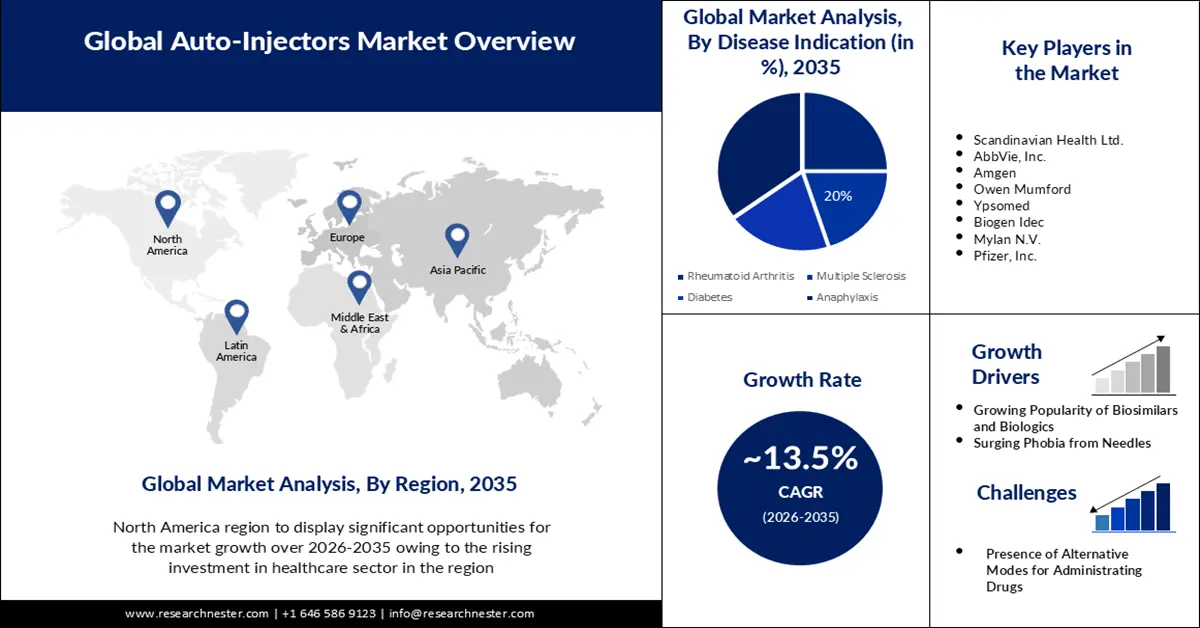
Auto-injectors Market size was over USD 10.53 billion in 2025 and is anticipated to cross USD 37.36 billion by 2035, witnessing more than 13.5% CAGR during the forecast period i.e., between 2026-2035. In the year 2026, the industry size of auto-injectors is assessed at USD 11.81 billion.
The growth in the market is impelled by the rising cases of rheumatoid arthritis (RA), multiple sclerosis (MS), and diabetes. In 2020, the number of people living with RA was 17.6 million, which is further expected to reach 31.7 million by 2050, as per NLM. Similarly, the count of MS was predicted at 2.8 million in 2020, as per the MS International Foundation. On the other hand, the International Diabetes Federation projected the volume of diabetes patients worldwide to surpass 853.0 million by 2050. Most of the treatment of these chronic conditions incorporate regular injections and self-administrations, where patient convenience and safety often get compromised due to accidental piercing or allergic reactions. This indicates an enlarging patient pool for this sector.
Advanced solutions available in the market are specifically engineered to make this process safer and comfortable while delivering the right amount of medication. Despite the higher payers’ pricing, this drug delivery approach becomes highly cost-effective for certain health conditions. For instance, in February 2020, an NLM study concluded that contextualized self-injectable epinephrine (SIE) for allergen immunotherapy (AIT) was found to be USD 3421.0 less expensive than the universal SIE prescriptions. It also mentioned that the universal SIE may also deliver value for money when the pricing per twinpack is USD 24.0, offering 1000x protection against fatality and the 2.7 per 10,000 AIT fatality rate. Moreover, advanced technologies such as 3D printing are proven to reduce the retail pricing of these products.