Anxiety Disorder Treatment Market Outlook:
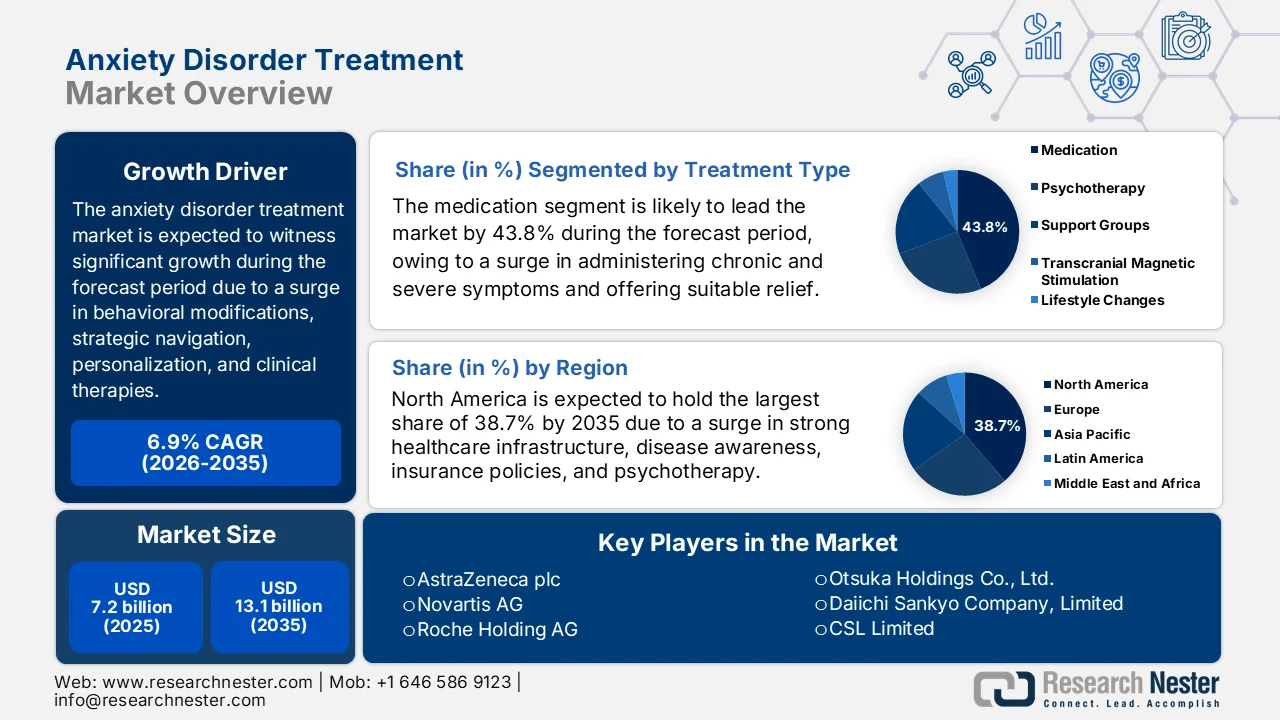
Anxiety Disorder Treatment Market size was valued at over USD 7.2 billion in 2025 and is expected to reach USD 13.1 billion by the end of 2035, growing at a CAGR of 6.9% during the forecast period, i.e., 2026-2035. In 2026, the industry size of anxiety disorder treatment is evaluated at USD 7.7 billion.
The worldwide anxiety disorder treatment market is being readily shaped by a confluence of external factors that are modifying the architecture of value capture and care delivery. These factors include generational behavioral changes and macroeconomic transitions that have created headwinds and tailwinds that demand nuanced tactical navigation. According to official statistics published by the CDC Government in June 2025, 23% of almost 1 in 5 adults residing in the U.S. are heavily impacted by a mental health condition. Additionally, 6% of nearly 1 in 8 adults live with a severe mental health condition, including major depression, bipolar disorder, and schizophrenia, that affects the ability to carry out regular activities. Moreover, 20% or 1 in 5 adolescents aged from 12 to 17 years have a diagnosed behavioral or mental health condition, thereby enhancing the market demand globally.
Furthermore, the rise in psychedelic-assisted therapy, the workplace mental health integration, along with the aspect of AI-based personalization and predictive analytics, are a few trends that are bolstering the anxiety disorder treatment market globally. As stated in an article published by NLM in December 2022, mental health disorders are considered the 5th notable cause of disability-adjusted life years (DALYs), affecting 10.7% of the global population. Besides, depression accounts for 1/3rd of this burden, which is further followed by 13.1% of alcohol disorders and 8.4% of drug use disorders. Meanwhile, the remaining 10% constitutes eating disorders, schizophrenia, and bipolar disorders. Therefore, there is a huge demand for the mobility of psychedelic compounds from research laboratories into clinical consideration, which is positively impacting the anxiety disorder treatment market upliftment.
Key Anxiety Disorder Treatment Market Insights Summary:
Regional Highlights:
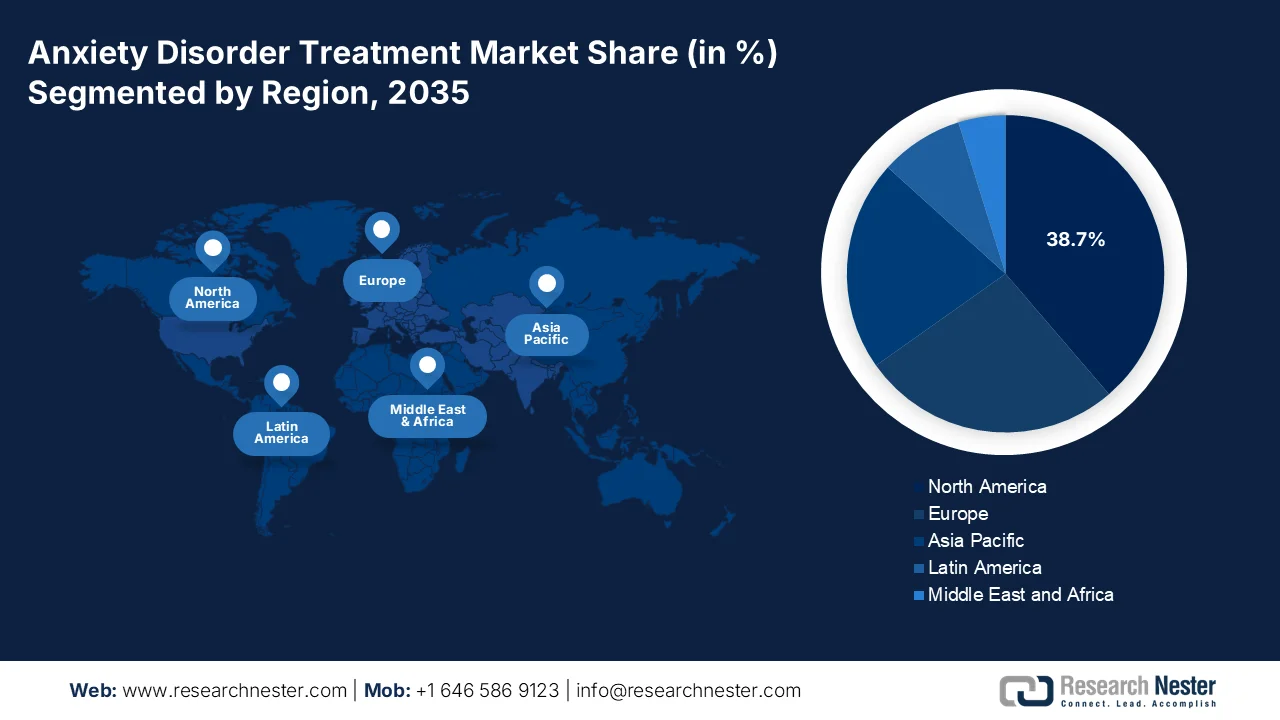
- North America in the anxiety disorder treatment market is anticipated to hold a 38.7% share by 2035, attributed to strong healthcare infrastructure, rising awareness, and expanding demand for psychotherapy and pharmacological interventions
- Asia Pacific is expected to witness the fastest growth during 2026–2035, impelled by increasing mental health awareness, rapid socioeconomic changes, and a large underserved patient population
Segment Insights:
- The medication segment of the anxiety disorder treatment market is projected to account for a 43.8% share by 2035, propelled by its critical role in managing severe symptoms and supporting long-term therapeutic recovery
- The antidepressants sub-segment is expected to secure the second-highest share during the forecast period 2026–2035, fueled by its effectiveness in regulating neurotransmitters and enhancing neuroplasticity to alleviate anxiety symptoms
Key Growth Trends:
- Fast-track approvals and regulatory modernization
- Intergenerational transitions in help-seeking behavior
Major Challenges:
- The commercialization of digital therapeutics’ payer resistance
- Workforce shortages and diagnosis gaps
Key Players: Pfizer Inc., Eli Lilly and Company, Johnson & Johnson, AbbVie Inc., Bristol Myers Squibb, Merck & Co., Inc., GlaxoSmithKline plc, AstraZeneca plc, Novartis AG, Roche Holding AG, Sanofi S.A., Bayer AG, Takeda Pharmaceutical Company Limited, Otsuka Holdings Co., Ltd., Daiichi Sankyo Company, Limited, CSL Limited, Samsung Biologics, Sun Pharmaceutical Industries Ltd., Dr. Reddy’s Laboratories Ltd., Pharmaniaga Berhad, Mind Medicine Inc., Viatris Inc., Alembic Pharmaceuticals Limited, Eisai Co., Ltd., Biogen Inc.
Global Anxiety Disorder Treatment Market Forecast and Regional Outlook:
Market Size & Growth Projections:
- 2025 Market Size: USD 7.2 billion
- 2026 Market Size: USD 7.7 billion
- Projected Market Size: USD 13.1 billion by 2035
- Growth Forecasts: 6.9% CAGR (2026-2035)
Key Regional Dynamics:
- Largest Region: North America (38.7% Share by 2035)
- Fastest Growing Region: Asia Pacific
- Dominating Countries: United States, Germany, United Kingdom, Japan, France
- Emerging Countries: China, India, South Korea, Brazil, Mexico
Last updated on : 1 April, 2026
Anxiety Disorder Treatment Market - Growth Drivers and Challenges
Growth Drivers
- Fast-track approvals and regulatory modernization: This is one of the critical growth drivers for the anxiety disorder treatment market, which is considered the systematic evolution of regulatory policies to escalate the acceptance of notable anxiety treatments. For instance, in September 2025, Alembic Pharmaceuticals Limited declared the USFDA finalized approval for its paroxetine extended-release of 25 mg and 37.5 mg tablets. These particular tablets are extremely suitable for aiding major depressive disorder, social anxiety disorder, premenstrual dysphoric disorder, and panic disorder. Besides, in November 2024, Eisai Co., Ltd. and Biogen Inc. successfully received the Medicinal Products for Human Use (CHMP) of the EMA approval for the amyloid-beta (Aβ) monoclonal antibody lecanemab. This is suitable for adding patients with mild dementia and mild cognitive impairment, thus enhancing the market exposure.
- Intergenerational transitions in help-seeking behavior: This is the profound driver for the anxiety disorder treatment market, which is fundamentally modifying attitudes towards mental health across young demographics. As stated in an article published by NLM in May 2023, anxiety and depressive disorders account for over 970 million prevalent cases globally. In addition, opioid use disorder is one of the most prevalent drug use disorders, catering to more than 22% of drug use disorder incidences. Simultaneously, over 13% of adolescents have a mental disorder, with depression and anxiety constituting almost 40% of mental health issues. Therefore, to overcome these, there has been the implementation of task-shifting that readily utilizes abbreviated training of healthcare professionals to ensure task redistribution through human resources utilization, which is suitable for uplifting the market demand.
- Public health emergency preparedness funding: This is one of the structural drivers for the anxiety disorder treatment market, with increased focus on public health funding allocation across designated mental health facilities. According to official statistics published by the NIH in June 2025, there has been the provision of generous federal funds, amounting to USD 2.7 billion for mental health and USD 1.8 billion for substance use disorders prevention. Besides, the overall U.S.-based expenditure across the private and public healthcare industry for behavioral health treatment effectively tripled from USD 40 billion to USD 140 billion. Moreover, the 2023 drug control budget planned by the White House Office of National Drug Control Policy (ONDCP) indicated the allocation of USD 21.6 billion and USD 2.7 billion for substance use disorder treatment and prevention, thus denoting an optimistic outlook for the market growth.
Challenges
- The commercialization of digital therapeutics’ payer resistance: Despite technological promise, the integration of digitalized therapeutics into mainstream care is facing a severe commercialization chasm, which is negatively impacting the anxiety disorder treatment market. The bankruptcy of Pear Therapeutics has served as a market correction, exposing the critical flaw that FDA clearance does not equal payer coverage. Besides, U.S. pharmacy and medical directors revealed that the infrastructure to establish specific therapeutic formularies is still 3 to 5 years away, primarily due to a lack of comparative effectiveness data against active controls. Payers are demanding real-world evidence that these tools reduce total hospitalization costs and medication spend, not just short-term symptom improvement in controlled trials.
- Workforce shortages and diagnosis gaps: A significant supply-side roadblock of the anxiety disorder treatment market is the acute shortage of qualified mental health professionals capable of delivering the standardized treatment. Even though awareness reduces stigma, the healthcare logistics fail to keep pace with recent developments. In regions such as the UK, there has been the emergence of new referrals to mental health services per month, and despite this, the capacity is static, leading to massive waiting lists. Furthermore, diagnosis remains highly subjective due to the lack of specific biomarkers or laboratory tests for GAD or Social Anxiety Disorder. This leads to frequent misdiagnosis or delayed treatment, particularly in primary care settings where physicians are overburdened, thereby causing a hindrance in the market expansion.
Anxiety Disorder Treatment Market Size and Forecast:
| Report Attribute | Details |
|---|---|
|
Base Year |
2025 |
|
Forecast Year |
2026-2035 |
|
CAGR |
6.9% |
|
Base Year Market Size (2025) |
USD 7.2 billion |
|
Forecast Year Market Size (2035) |
USD 13.1 billion |
|
Regional Scope |
|
Anxiety Disorder Treatment Market Segmentation:
Treatment Type Segment Analysis
The medication segment, part of the treatment type, is anticipated to grab the highest share of 43.8% in the anxiety disorder treatment market by the end of 2035. The segment’s upliftment is primarily attributed to its importance for effectively managing chronic and critical symptoms, offering increased relief from acute panic, and ensuring individuals to engage in long-lasting and therapeutic recovery strategies. Besides, according to official statistics published by the World Health Organization (WHO) in January 2026, the proportion of health infrastructure with crucial medicines cost-effectiveness and availability across low- and middle-income nations ranges between 8% and 41%. Moreover, medicines usually account from 20% to 60% of total healthcare expenditures across developing countries, with nearly 90% of the population purchasing medicines through out-of-pocket expenses, thus driving the segment’s growth.
Medication Class Segment Analysis
During the forecast period, the antidepressants sub-segment, which is part of the medication class segment, is projected to account for the second-highest share in the anxiety disorder treatment market. The sub-segment’s growth is highly driven by its highly effective capability to reduce symptoms by balancing out brain neurotransmitters, including norepinephrine and serotonin, and also increasing neuroplasticity to optimize mood and diminish fear. As stated in an article published by NLM in March 2025, there has been an increase in the mean defined daily dose of antidepressants from 5.4 to 69.5 across the majority of countries. Besides, to analyze the dose consumption, a linear model is usually utilized to evaluate quadratic trends and country-wise specific linear variations per 1,000 inhabitants, thereby making it suitable for boosting the sub-segment’s demand globally.
Psychotherapy Approaches Segment Analysis
The cognitive behavioral therapy (CBT) segment in the anxiety disorder treatment market is expected to hold the third-highest share by the end of the stipulated timeline. The segment’s development is highly propelled by its goal-oriented, structured, and effective approach for equipping patients with skills to restructure and identify negative behaviors and thought patterns. Unlike conventional talk therapies, CBT emphasizes practical coping strategies, exposure techniques, and cognitive restructuring, which deliver measurable improvements in symptom reduction and functional recovery. Its adaptability across diverse patient demographics, including children, adolescents, adults, and the elderly, further strengthens its market position.
Our in-depth analysis of the anxiety disorder treatment market includes the following segments:
|
Segment |
Subsegments |
|
Treatment Type |
|
|
Medication Class |
|
|
Psychotherapy Approaches |
|
|
Patient Demographics |
|
|
Supportive Interventions |
|
|
Advanced Therapies |
|

Vishnu Nair
Head - Global Business DevelopmentCustomize this report to your requirements — connect with our consultant for personalized insights and options.
Anxiety Disorder Treatment Market - Regional Analysis
North America Market Insights
North America in the anxiety disorder treatment market is anticipated to garner the largest share of 38.7% by the end of 2035. The market’s upliftment in the region is highly attributed to the presence of strong health and medical facilities, a rise in disorder awareness, robust insurance coverage, federal strategies, and an increase in the demand for psychotherapy and pharmacological interventions. According to official statistics published by the CDC Government in November 2024, nearly 6% of adults in the U.S. experienced severe or moderate symptoms of anxiety, and 7% witnessed moderate or severe symptoms of depression. Besides, as of 2022, almost 1 in 5 adults aged more than 18 years, which is 18.2%, experienced anxiety symptoms, and 21.4% witnessed depression symptoms. Therefore, the disorder is present among different age groups, which is positively driving the market demand in the overall region.
Age-Wise Analysis of Anxiety and Depression Symptoms in the U.S. (2022)
|
Symptom Type |
18 to 29 years |
30 to 44 years |
45 to 64 years |
Over 65 years |
|
Any Symptoms |
26.6% |
20.7% |
15.8% |
11.2% |
|
Mild Symptom |
16.9% |
12.8% |
9.7% |
7.7% |
|
Moderate Symptoms |
5.3% |
4.6% |
3.6% |
2.4% |
|
Severe Symptoms |
4.5% |
3.3% |
2.5% |
1.1% |
Source: CDC Government
The anxiety disorder treatment market in the U.S. is growing significantly, owing to an increase in mental health expenditure, increased priority on behavioral health, expansion in Medicaid reimbursements, introduction of telehealth and digital mental health tools, and Medicare coverage for digitalized therapy devices. As per an article published by the Campaign for Trauma-Informed Policy and Practice Organization in February 2025, the mental health epidemic in the country accounts for more than 1 in 5 people experiencing diagnosed difficulties. Besides, mental health risk expenses in the domestic economy amount to over USD 280 billion every year. Moreover, premature deaths due to mental health issues led to USD 278 billion in expenses, and this particular disorder can produce almost USD 14 trillion in high costs by the end of 2040, thus denoting market expansion in the nation.
The increased focus on provincial and federal healthcare spending, suitable governmental funding and investment for anxiety treatment, industrial associations, suitable innovation in digital health adoption and drug development, along with administrative strategies for target accessibility, are factors responsible for bolstering the anxiety disorder treatment market in Canada. As stated in an article published by Nova Scotia in February 2025, the provincial intake line in the country has successfully resulted in registering over 13,000 people in Nova Scotia for addiction and mental health services after previously assisting more than 17,000 patients between 2023 and 2024. Besides, due to the ongoing support, the Province has effectively made an initial USD 10 million investment in the mental health and addictions publicly funded insured services program to help people overcome disorders, which is suitable for market upliftment in the nation.
APAC Market Insights
The Asia Pacific in the anxiety disorder treatment market is expected to emerge as the fastest-growing region during the forecast period. The market’s development in the region is highly propelled by rapid socioeconomic transformation, an increase in mental health awareness, and the presence of an underserved and massive patient population. According to official statistics published by OECD in November 2024, mental, neurological and substance use disorders and self-harm (MNSS) conditions, as well as mental disabilities, account for 21.5% to 30% across 38 regional countries. Besides, depression, along with schizophrenia, anxiety disorders, and migraine, altogether cater to more than 60% disability in the region. Moreover, Alzheimer’s disease, dementia, and epilepsy also constitute 90% of the mental health burden, thus enhancing the market development and demand in the overall region.
The anxiety disorder treatment market in China is gaining increased traction, owing to a surge in the approval process for the latest psychiatric drugs and digitalized therapeutics to cater to immense treatment barriers, generous governmental spending on mental health, and focus on integrated mental health services into tiered healthcare systems. As per an article published by SSM- Mental Health in December 2023, the lifetime prevalence of mental disorders among people aged over 18 years was 16.5%, and meanwhile, with the increased social economy development, domestic people readily suffered from common mental disorders as well as psycho-behavioral issues. Simultaneously, the burden of substance use, psychiatric, and neurological disorders also account for 16.8% globally, and these disorders combinedly cater to 11.3% of overall disease burden in the country, thus denoting a huge growth opportunity for the market.
An upsurge in suicide rates, the formation of national mental health policy, the provision of vouchers for psychological counselling services, generous budget allocation for treatment purposes, the demand for domestic distribution of resources, and the government’s ability to effectively address accessibility barriers are responsible for fueling the anxiety disorder treatment market in South Korea. As stated in an article published by NLM in December 2023, the suicide death rate for women in the country was 4,159, which is 16.2 per 100,000 population, denoting a surge by 1.4% in comparison to previous years. Besides, overall deaths in the country reached 317,680, demonstrating a 4.2% increase and reaching the highest level. Additionally, the suicide rate accounted for 26.0 per 100,000 population, indicated 1.2% upsurge from previous decades, thus ensuring the market development.
Europe Market Insights
Europe in the anxiety disorder treatment market is projected to experience considerable growth by the end of the stipulated duration. The market’s growth in the region is highly driven by the support provision from government initiatives, regional funding programs, increased emphasis on mental health accessibility and resilience, cross-border collaborations, and an escalation in adopting standard therapies. According to official statistics published by the WHO in January 2026, 1 in 6 people, which is almost 140 million of the population, live with a mental health condition. This condition usually ranges from mild to severe in terms of its regular impacts, which is positively fueling the market demand in the region. In addition, over 120,000 people lose their lives by suicide annually, which is more than 300 suicides per day, thus denoting an optimistic outlook for the market demand in the overall region.
The anxiety disorder treatment market in Germany is gaining increased exposure, owing to the existence of reimbursement policies, a surge in drug approvals through increased clinical trials, the suitable integration of CBT platforms, expansion in telehealth services, and the adoption of neuromodulation therapies. As per an article published by Europe Investment Bank Organization in October 2025, the administrative organization has offered PRECISIS GmbH a generous venture loan, amounting to USD 22.9 million. This particular loan is utilized to make advancements in clinical development and readily ensure industrial expansion, as well as being suitable for upscaling production and ensuring huge industrial accessibility across the total region. Moreover, this loan has delivered advanced breakthroughs in the PRECISIS therapy, which is suitable for catering to the disorder treatment in the country.
The allocation of generous resources to mental health, an increase in reimbursement for pharmacological therapies, telehealth adoption, the rising disorder prevalence among the working-age and youth population, and collaborations for optimizing cost-effectiveness and accessibility are factors driving the anxiety disorder treatment market in the UK. As stated in an article published by the Mental Health Foundation in 2026, 28% of young people in the country aged from 16 to 29 years account for anxiety disorders, and 5% of people aged 70 years or older are also affected with the disorder. Besides, between 2022 and 2023, 29.9% of men and 37.1% of women had increased levels of anxiety, in comparison to 18.3% of men and 21.8% of women in previous years. Therefore, with this prevalence among both genders and the differently aged population, the market is expanding in the country.
Key Anxiety Disorder Treatment Market Players:
- Pfizer Inc. (U.S.)
- Eli Lilly and Company (U.S.)
- Johnson & Johnson (U.S.)
- AbbVie Inc. (U.S.)
- Bristol Myers Squibb (U.S.)
- Merck & Co., Inc. (U.S.)
- GlaxoSmithKline plc (UK)
- AstraZeneca plc (UK)
- Novartis AG (Switzerland)
- Roche Holding AG (Switzerland)
- Sanofi S.A. (France)
- Bayer AG (Germany)
- Takeda Pharmaceutical Company Limited (Japan)
- Otsuka Holdings Co., Ltd. (Japan)
- Daiichi Sankyo Company, Limited (Japan)
- CSL Limited (Australia)
- Samsung Biologics (South Korea)
- Sun Pharmaceutical Industries Ltd. (India)
- Dr. Reddy’s Laboratories Ltd. (India)
- Pharmaniaga Berhad (Malaysia)
- Mind Medicine Inc. (U.S.)
- Viatris Inc. (U.S.)
- Alembic Pharmaceuticals Limited (India)
- Eisai Co., Ltd. (Japan)
- Biogen Inc. (U.S.)
- Company Overview
- Business Strategy
- Key Product Offerings
- Financial Performance
- Key Performance Indicators
- Risk Analysis
- Recent Development
- Regional Presence
- Pfizer Inc. has established a strong presence in the anxiety disorder treatment market through its portfolio of widely prescribed medications. The company continues to invest in research collaborations to expand therapeutic options and improve patient outcomes.
- Eli Lilly and Company is recognized for its innovative pipeline in psychiatric and neurological treatments. The firm emphasizes long-term strategies in digital health integration and partnerships to enhance accessibility.
- Johnson & Johnson leverages its global healthcare network to deliver both pharmacological and supportive therapies for anxiety disorders. The company focuses on advancing patient-centric solutions through clinical innovation and outreach programs.
- AbbVie Inc. has strengthened its position in mental health care by expanding its therapeutic portfolio for anxiety-related conditions. Additionally, strategic acquisitions and collaborations support its growth in advanced treatment modalities.
- Bristol Myers Squibb emphasizes neuroscience research as a key driver in its anxiety disorder treatment initiatives. The company pursues partnerships with academic institutions to accelerate the development of novel therapies.
Here is a list of key players operating in the global anxiety disorder treatment market:
The global anxiety disorder treatment market is highly competitive, with multinational pharmaceutical companies leading through innovation, mergers, and strategic collaborations. Besides, U.S. firms dominate due to strong R&D pipelines and government-backed healthcare initiatives, while Europe-based players leverage advanced biologics and generics. Likewise, Japan and South Korea-specific companies focus on novel therapies and biosimilars, enhancing regional competitiveness. Moreover, in March 2024, Mind Medicine Inc. achieved the U.S. FDA approvals for its MM120 program for the suitable treatment of generalized anxiety disorder. In addition, the company also declared that its Phase 2b evaluation of MM120 for anxiety disorder to cater to its notable secondary endpoint, thereby making it suitable for boosting the anxiety disorder treatment industry worldwide.
Corporate Landscape of the Anxiety Disorder Treatment Market:
Recent Developments
- In March 2026, Viatris Inc. achieved Japan’s Ministry of Health, Labour and Welfare (MHLW) approval for its Effexor SR 37.5 mg/75 mg capsules, also known as a serotonin-noradrenaline reuptake inhibitor, suitable for aiding adults with generalized anxiety disorder.
- In January 2025, Johnson & Johnson notified the U.S. FDA acceptance for a supplemental New Drug Application (sNDA) for SPRAVATO CIII nasal spray, which is extremely suitable for adults residing with major depressive disorder and constituting an inadequate response to almost 2 oral antidepressants.
- In December 2024, Eli Lilly and Company received the U.S. FDA approval for its very own Zepbound, which is the first-ever prescription medicine for adults suffering from moderate-to-severe obstructive sleep apnea (OSA) as well as obesity.
- Report ID: 8496
- Published Date: Apr 01, 2026
- Report Format: PDF, PPT
- Explore a preview of key market trends and insights
- Review sample data tables and segment breakdowns
- Experience the quality of our visual data representations
- Evaluate our report structure and research methodology
- Get a glimpse of competitive landscape analysis
- Understand how regional forecasts are presented
- Assess the depth of company profiling and benchmarking
- Preview how actionable insights can support your strategy
Explore real data and analysis
Frequently Asked Questions (FAQ)
About this Report
Connect with our Expert


Report, 2026-2035


Copyright @ 2026 Research Nester. All Rights Reserved.
