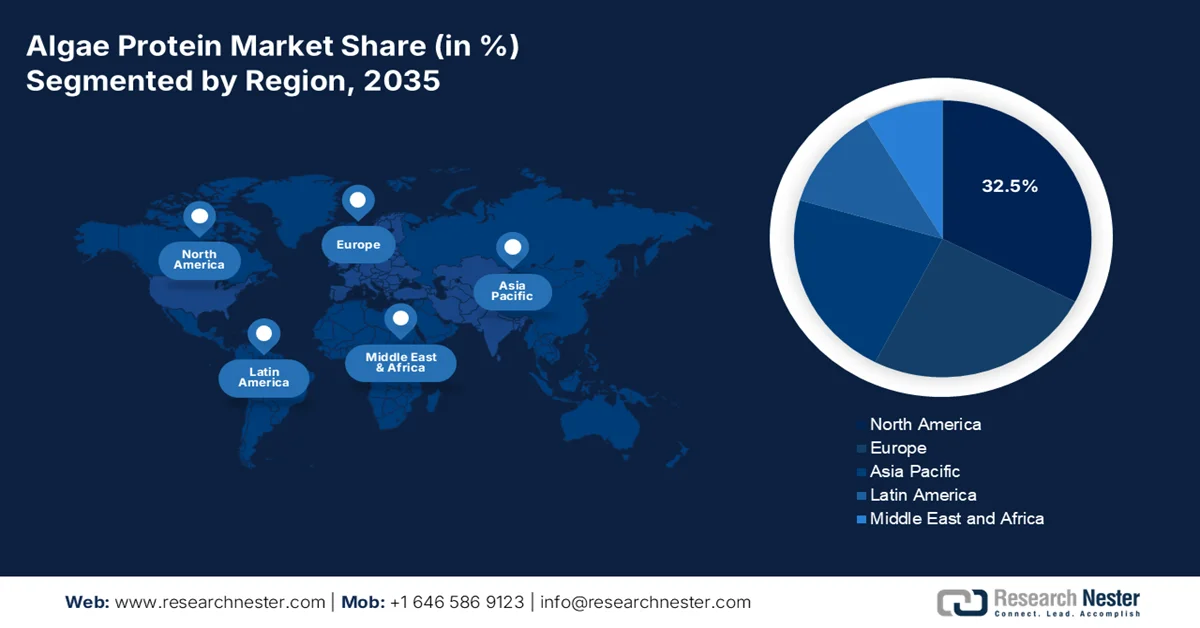
Algae Protein Market - Regional Analysis
North America Market Insights
North America is dominating the algae protein market and is expected to hold the regional revenue share of 32.5% by 2035. The market is characterized by a mature dietary supplements channel and accelerating interest from food and feed manufacturers. In the U.S., the demand is driven by the sports nutrition brands seeking complete protein sources and clean-label color solutions using phycocyanin. Canada distinguishes itself via cold water strain cultivation and strategic blending of algae with pulse proteins to improve amino acid profiles. Government-funded research initiatives focus on reducing the harvesting and extraction costs, while the public procurement programs in the schools and federal institutions are emerging as stable demand channels. B2B contracting remains the dominant distribution model, with long-term agreements between the cultivators and finished goods manufacturers ensuring supply chain predictability.
The strong federal investment in algae biomanufacturing, carbon utilization, and sustainable fuel co-production programs is driving the algae protein market in the U.S. According to the U.S. Department of Energy, the July 2024 national microalgae biomass production potential is at 152 million tons annually, representing nearly 268 million tons of CO2 utilization capacity across 1,000 viable algae farm sites. DOE analysis also showed that algal fuel and protein co-production could reduce emissions by up to 90% compared with conventional fuel and whey protein systems when supported by low-emission electricity sources. In addition, DOE 2026 announced USD 20.2 million in funding for algae conversion and bioproduct development projects to strengthen low-carbon fuel, agricultural, and animal feed supply chains, directly supporting commercial expansion opportunities for algae protein producers in the U.S.
The supportive regulatory approvals and expanding commercialization of algae-derived food ingredients are shaping the algae protein market in Canada. According to the Government of Canada, February 2023 data, Health Canada approved high oleic algal oils developed by Corbion Biotech using genetically modified Prototheca moriformis strains, confirming that the products are as safe and nutritious as conventional edible oils. The oils contain more than 80% oleic acid and are intended for use across multiple food categories in Canada. Health Canada’s assessment also noted that algae-derived products, including algal flour and protein ingredients, have already received prior approvals supporting broader acceptance of algae-based nutrition products. Commercial-scale production under current Good Manufacturing Practices, combined with growing regulatory confidence in algae-derived food ingredients, is strengthening investment opportunities for algae protein manufacturers targeting Canada’s plant-based food nutrition and specialty ingredient sectors.
APAC Market Insights
The Asia Pacific is projected to emerge rapidly during the assessed period, 2026 to 2035, in the algae protein market. The region is driven by the established cultivation infrastructure, lower production costs, and proximity to high-demand end markets. Japan and South Korea lead in phycocyanin extraction for functional beverages, while China and India scale spirulina biomass for both domestic feed applications and export. Southeast Asia nations, mainly Malaysia and Indonesia, leverage year-round tropical conditions for open pond cultivation, achieving higher annual yields than temperate regions. Government-backed farmer cooperatives in India and Thailand aggregate small-scale algae production for B2B ingredient supply. The region also serves as a manufacturing hub for algae-enriched noodles, baked goods, and meat analogs destined for local and Western markets.
The increasing pressure on livestock feed resources and rising demand for sustainable alternative proteins are driving the algae protein market in India. As per the Invest India September 2022 data, India supports 17.5% of the global population and nearly 20% of the world’s livestock on only 2.3% of global land area, creating severe feed shortages, including a 35.6% deficit in green fodder and a 44% shortage in concentrate feed ingredients. This imbalance is accelerating interest in non-conventional feed resources such as algae-based feed ingredients. Microalgae, including Chlorella, Scenedesmus, and Arthrospira, contain approximately 40% to 60% protein and are increasingly recognized for improving livestock growth and feed efficiency. Government-backed initiatives under the National Livestock Mission, including 50% capital subsidies for feed and fodder infrastructure, are further supporting investment opportunities for algae-derived protein and feed manufacturers in India.
The Japan algae protein market is expected to expand from USD 47.83 million in 2025 and reach USD 77 million by the end of 2035 at a CAGR of 4.86% during the assessed period. In 2026, the market is set to reach USD 50.17 million. The nation is driven by the rising demand for plant-based protein ingredients, driven by increasing health and environmental awareness. According to the USDA August 2023 data, the vegan and vegetarian population remains relatively small. The country’s plant-based protein ingredient market reached approximately USD 323 million in 2021, reflecting a 14.2% increase. Demand for meat alternatives is also expanding, with Japan’s plant-based meat market projected to grow from nearly USD 18 million in 2022 to USD 29 million by 2025. The rapid increase in plant-based products available in supermarkets and food-service channels is creating new opportunities for algae-derived proteins used in nutritional foods, beverages, and alternative meat formulations.
Production of Isolated Soy Protein in Japan, 2023
|
Year |
Volume (MT) |
|
2010 |
23, 560 |
|
2020 |
36, 046 |
|
2021 |
36, 054 |
|
2022 |
36, 703 |
Source: USDA August 2023
Europe Market Insights
The algae protein market in Europe is shaped by the stringent novel food regulations, strong sustainability mandates, and active government funding for alternative proteins. The European Commission's Farm to Fork Strategy supports algae as a strategic protein source, while the EU Algae Initiative facilitates B2B matchmaking and consumer acceptance campaigns. Germany, France, and the Netherlands lead in algae-enriched bakery pasta and dairy alternatives, with formulators prioritizing neutral-tasting isolates from Tetraselmis and Nannochloropsis strains. Nordic countries focus on cold water photobioreactor cultivation, reducing energy costs compared to heated systems. Direct B2B contracting via retail channels is expanding through certified organic and non-GMO algae products. Horizon Europe grants continue to fund the harvesting efficiency and protein extraction research, lowering technology risk for commercial entrants.
The algae protein market in Germany is driving due to the rising plant-based food demand, sustainability targets, and government-supported bioeconomy initiatives. According to FEED Magazine, May 2025 data show that nearly 126,500 tons of vegan and vegetarian meat substitutes were produced in Germany, reflecting continued demand growth for alternative proteins. The German Federal Ministry of Food and Agriculture also reported that Germany’s organic farming area share grew to 9.8%, supporting broader consumer preference for sustainable food ingredients. The Federal Ministry of Education and Research continues to invest in Germany’s National Bioeconomy Strategy, which supports algae biotechnology and sustainable protein innovation. Rising industrial focus on low-emission food production and traceable protein sourcing is creating commercial opportunities for algae protein suppliers in Germany’s food, nutraceutical, and animal nutrition sectors.
The increasing demand for sustainable protein, alternative nutrition products, and low-carbon food systems is shaping the algae protein market in the UK. According to the Government of the UK, July 2025 data, the agri-food sector contributed 6.2% of national GVA, supporting investment in innovative food ingredients and alternative proteins. The UK Office for National Statistics reported that vegetarian and vegan product sales continued to expand across retail channels as consumers increasingly adopted plant-based diets. In addition, Innovate UK and UK Research and Innovation have continued funding sustainable biotechnology and alternative protein projects, including algae-based food innovations. These developments are strengthening commercial opportunities for algae protein suppliers targeting food manufacturing, nutraceutical, aquafeed, and functional nutrition applications across the UK.