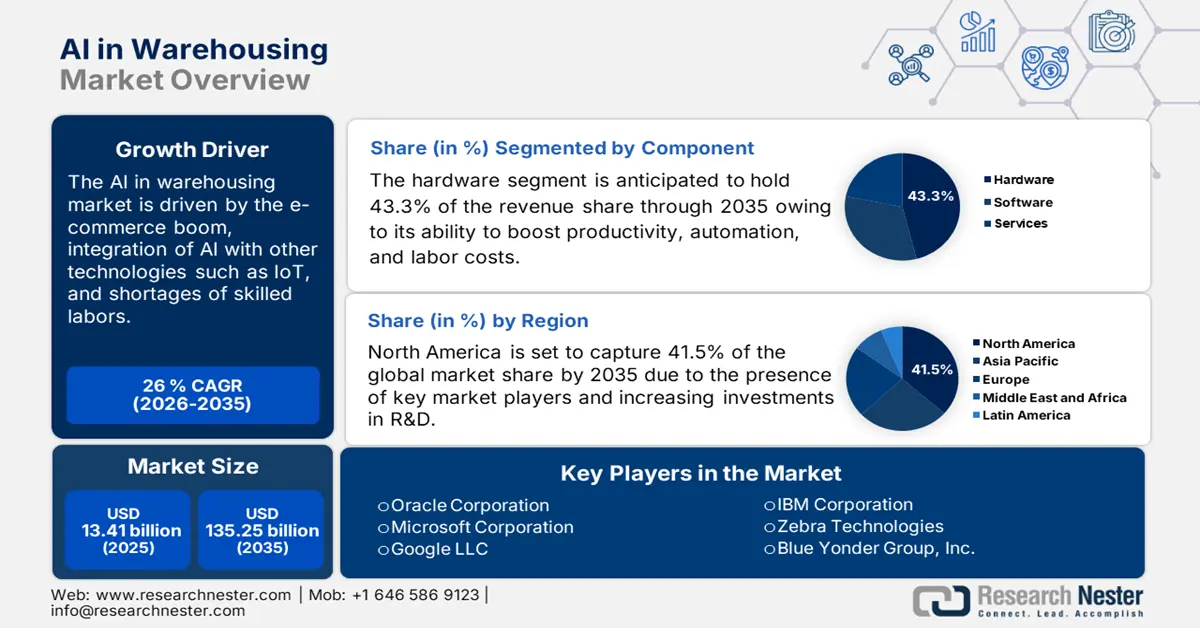
Artificial Intelligence in Warehousing Market Outlook:
Artificial Intelligence in Warehousing Market size was valued at USD 13.41 billion in 2025 and is likely to cross USD 135.25 billion by 2035, registering more than 26% CAGR during the forecast period i.e., between 2026-2035. In the year 2026, the industry size of artificial intelligence in warehousing is estimated at USD 16.55 billion.
The gradual digital shift is primarily fuelling the adoption of artificial intelligence (AI) and other digital technologies such as machine learning, big data analytics, cloud computing, edge computing, and the Internet of Things in warehousing applications. Warehouse operators across the globe are widely adopting AI to streamline workflow, reduce operational costs, and increase automation. AI also reduces the need for labor as it increases the working speed level, mitigates errors, maximizes resource utilization, boosts order processing, and improves inventory management by effectively coordinating with logistics.
According to McKinsey and DHL industry studies, about one-third of logistics and transportation companies are already using AI to enhance operations, while more than half of warehouses employ robotics and nearly half are adopting drones to boost efficiency. Thus, to move from process automation to smarter automation many companies are investing in AI technologies.