Agricultural Films Market Outlook:
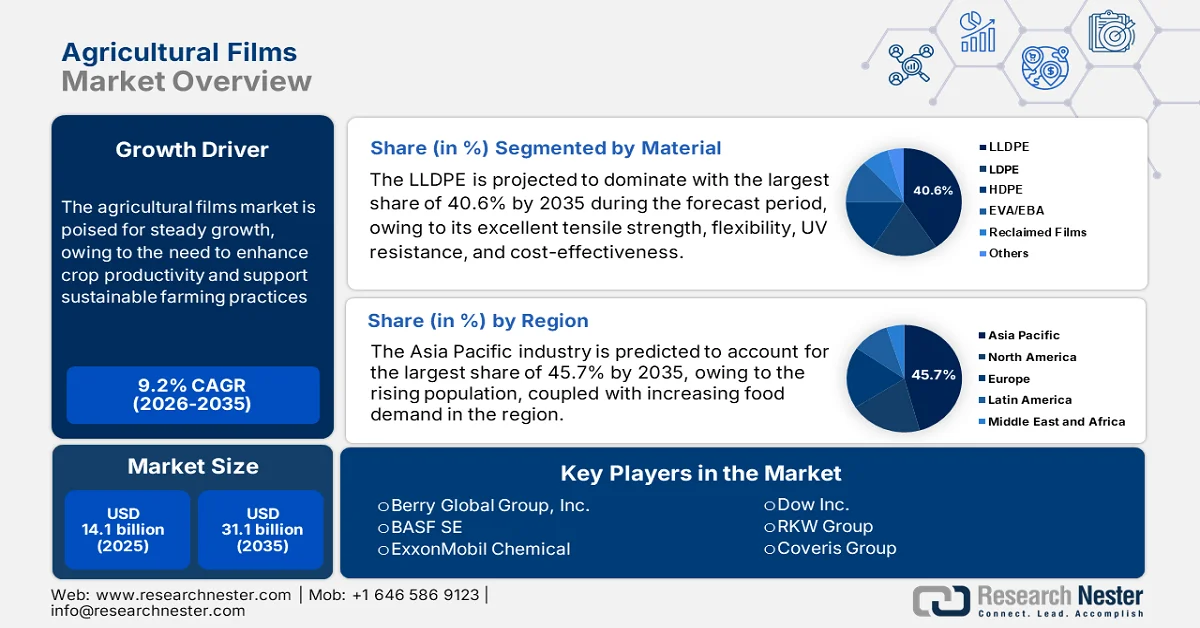
Agricultural Films Market size was valued at USD 14.1 billion in 2025 and is projected to reach USD 31.1 billion by 2035, growing at a CAGR of 9.2% during the forecast period, i.e., 2026-2035. In 2026, the industry size of agricultural films is assessed at USD 15.4 billion.
The market is poised for steady growth owing to the need to enhance crop productivity and support sustainable farming practices. Films such as mulch, greenhouse covers, and silage wraps help regulate temperature and extend growing seasons, making them highly essential for modern and protected cultivation. In this context, based on the government data from the U.S. Department of Agriculture, the University of Wisconsin, funded by the USDA’s National Institute of Food and Agriculture through an AFRI allocation of USD 1,000,000, is conducting a project from 2023 to 2026 to develop 100% biobased and fully soil-biodegradable mulch films from renewable woody biomass such as poplar wood and forest residues. It also stated that the project is mainly focused on optimizing film fabrication, characterizing their mechanical and mulching performance, and evaluating their environmental and economic feasibility through techno-economic analysis and life cycle assessment.
Furthermore, the international agricultural films market is embracing biodegradable, compostable, and eco-friendly materials, allowing the firms to comply with evolving environmental regulations. In this context, the European Bioplastics in October 2024 officially reported that the European Union included soil-biodegradable mulch films, coating agents, and water retention polymers in the Fertilising Products Regulation (FPR 1009/2019). So, these products must meet strict biodegradability criteria as outlined in the Delegated Acts to make sure they meet environmental safety standards and promote healthier soils. Moreover, the soil-biodegradable mulch films, proven for more than 20 years to match the agronomical efficiency of conventional plastics, eliminate the need for post-harvest retrieval, recycling, or disposal. Their inclusion in the FPR supports sustainable agriculture, encourages innovation, and addresses the issue of microplastic accumulation in soils, hence positively impacting market growth.