5G Virtual Reality Market Outlook:
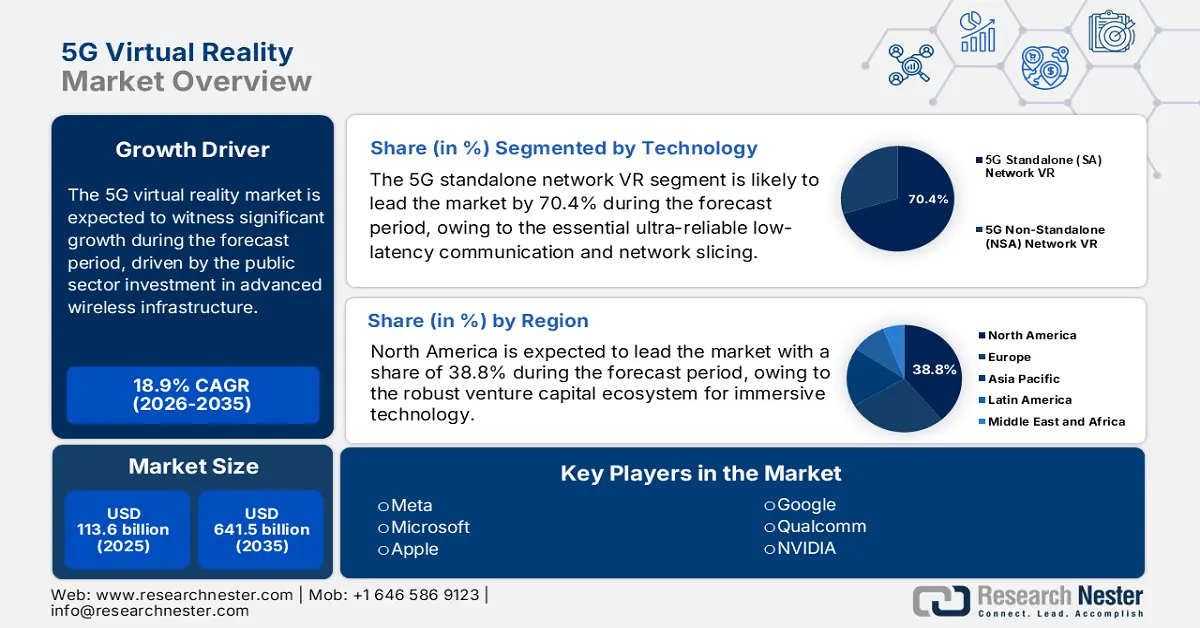
5G Virtual Reality Market size was valued at USD 113.6 billion in 2025 and is projected to reach USD 641.5 billion by the end of 2035, rising at a CAGR of 18.9% during the forecast period, i.e., 2026-2035. In 2026, the industry size of 5G virtual reality is assessed at USD 135.1 billion.
The 5G virtual reality market is being shaped by public sector investment in advanced wireless infrastructure and by enterprise-led adoption across training, healthcare, manufacturing, and defense use cases. The government data confirms the rapid expansion of the 5G capacity that underpins the VR deployment at scale. The report from CITA 2024 has depicted that 330 million people in the U.S. have access to 5G services with mid-band spectrum deployment delivering significantly higher capacity and lower latency than earlier networks, directly supporting immersive applications in industrial and institutional settings. The data from Congress.gov in November 2023 reported that the FCC has allocated USD 9 billion for 5G funding, prioritizing low-latency use cases such as advanced simulation, telemedicine, and workforce training and environments.
From a demand perspective, the government and non-profit organizations highlight VR as a strategic digital capability rather than a consumer novelty. The U.S. Department of Defense has disclosed expanding use of immersive simulation for pilot training, battlefield rehearsal, and equipment maintenance with networked VR environments, reducing training costs and physical asset usage while increasing the repetition frequency. In healthcare, the National Institutes of Health report growing federally funded research into VR-assisted surgery planning, pain management, and clinical skills training aided by the high-speed wireless connectivity in the hospital campuses. Further, the 5G virtual reality market is being driven by institutional spending, regulated network expansion, and measurable productivity outcomes rather than short-cycle consumer demand.