5-HT3 Receptor Antagonists Market - Regional Analysis
North America Market Insights
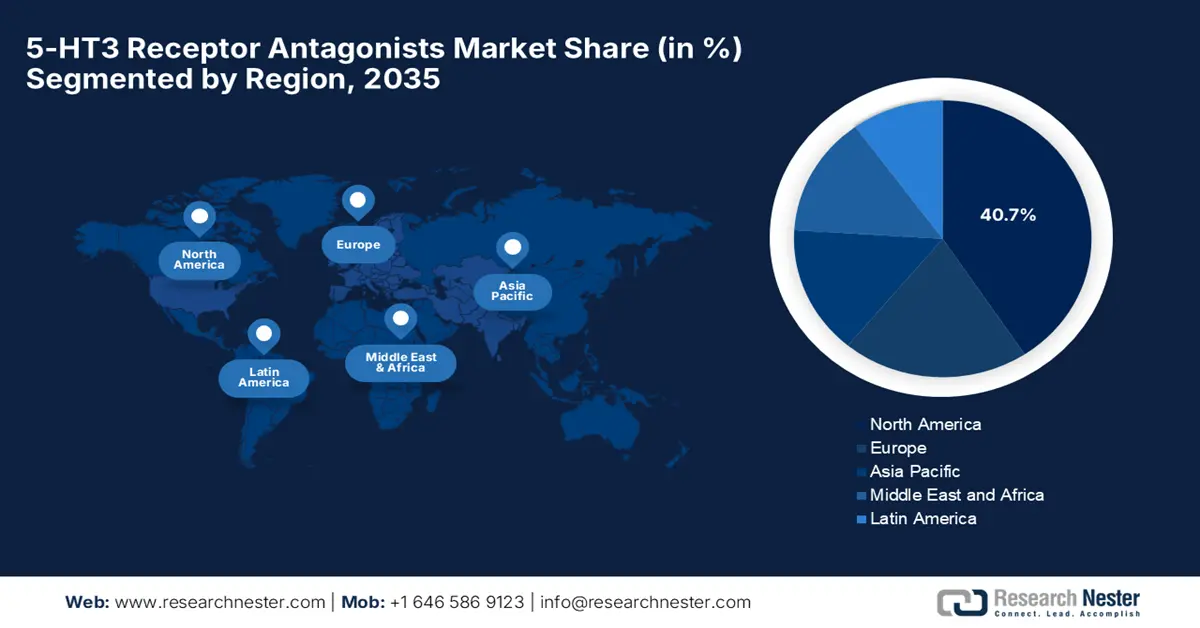
North America in the 5-HT3 receptor antagonists market is expected to capture the largest revenue share of 40.7% by the end of 2035. The growth in the region is effectively attributed to a surge in federal budget allocation and an increase in cancer treatment admissions. Testifying to the same, NCI states that as of May 2025, there are approximately 18.6 million cancer survivors in the U.S., making up about 5.4% of the population. Also, this number is projected to rise significantly, reaching 26 million by the end of 2040; therefore, this growing survivor population highlights the expanding need for long-term care.
In the U.S., the market is driven by increasing Medicare spending and various state-level initiatives, especially in Texas and California. For instance, as of October 2024, CMS reports Medicare processed over USD 1.1 billion fee-for-service claims and made payments totaling more than USD 424 billion, making it the largest healthcare payer in the U.S. These payments cover a wide range of services and settings, including inpatient care, outpatient departments, and physician offices, denoting a positive market outlook.
The 5-HT3 receptor antagonists market in Canada is driven by the increasing demand for chemotherapy, wherein Health Canada has also streamlined the regulatory approvals for the combination therapies, enabling faster access to the product across major provinces. In October 2024, Health Canada reported that it has committed USD 12.29 million over five years, along with USD 220,000 annually ongoing, to support the prevention and treatment of cancers linked to firefighting, providing an encouraging opportunity for pioneers in the country.
Financial Burden of Cancer Care in the U.S.
|
Year |
National Cancer Care Costs |
Notes |
|
2015 |
USD 190.2 billion |
Baseline estimate including medical services and oral prescription drugs costs |
|
2020 |
USD 208.9 billion |
10% increase from 2015 due to aging and growth of the U.S. population (in 2020 dollars) |
|
2030 |
USD 245+ billion (projection) |
Projected to exceed USD 245 billion by 2030, a 34% increase from 2015, mainly driven by population aging. |
Source: NIH
APAC Market Insights
The 5-HT3 receptor antagonists market in the Asia Pacific is poised to register the fastest growth by the end of the forecast duration, driven by expanding oncology infrastructure and a surge in the prevalence of cancer. There has been an increased spending on getting high-efficiency antiemetics for treating CINV in the Asia Pacific. On the other hand, countries such as China, India, Japan, and South Korea are investing heavily in healthcare infrastructure, leading to increased demand for effective antiemetic treatments, thereby fostering a favorable business environment.
The market in China is reinforcing its dominance over the regional landscape, driven by increased healthcare access, rising cancer rates, and a higher number of chemotherapy and surgical procedures. For instance, in May 2025, Jiangsu Hengrui Pharmaceuticals' subsidiary reported that it had received approval from the National Medical Products Administration for its Class 1 innovative drug called Fosrolapitant and Palonosetron Hydrochloride for Injection (HR20013), which is a combination of a 5-HT3 antagonist (palonosetron) with an NK-1 antagonist for preventing nausea and vomiting caused by highly emetogenic chemotherapy in adults.
In India, the market growth is driven by the launch of public health programs such as Ayushman Bharat, which involves surgery, oncology, and chemotherapy, which is generally used as a frontline treatment. In August 2025, MoHFW reported that under the Rashtriya Arogya Nidhi (RAN) scheme, financial assistance of up to ₹15 lakh is provided to poor cancer patients through the HMCPF for treatment at Regional Cancer Centres, Tertiary Care Cancer Centres, State Cancer Institutes, and government hospitals.
Financial Assistance under Rashtriya Arogya Nidhi (RAN) for Cancer Patients
|
Description |
Amount (₹) |
Amount (USD approx.) |
|
Maximum one-time financial assistance per patient |
15,00,000 (₹15 lakh) |
18,070 |
|
Total amount disbursed in 2024-25 |
27,06,00,000 (₹27.06 crore) |
3,258,000 |
|
Amount disbursed in 2025-26 (till 16 July 2025) |
9,14,00,000 (₹9.14 crore) |
1,101,200 |
Source: MoHFW
Europe Market Insights
The 5-HT3 receptor antagonists market in Europe is anticipated to garner significant traction on the back of robust regional expansion for the treatment of CINV and constant efforts from both domestic and international players. In April 2025, Helsinn Group announced the submission of a new formulation of AKYNZEO to the European Medicines Agency (EMA), which is used to prevent acute and delayed nausea and vomiting caused by highly and moderately emetogenic cancer chemotherapy, including cisplatin-based treatments.
In Germany, the market is gaining immense exposure owing to the robust investment in oncology and leading digital health infrastructure. The country also benefits from a robust pharmaceutical sector, wherein the increasing awareness of supportive care therapies in oncology supports steady growth in this market. Furthermore, the government initiatives to improve cancer care and an aging population contribute to the increasing use of 5-HT3 receptor antagonists across hospitals and outpatient settings.
The market in the UK is also witnessing significant growth owing to increased demand to handle chemotherapy-induced nausea and vomiting. In June 2025, the NHS highlighted that 5-HT₃ receptor antagonists such as ondansetron and granisetron are a cornerstone of anti-emetic therapy, specifically recommended for the prophylaxis of acute chemotherapy-induced nausea and vomiting. Besides, they are considered equally efficacious and are to be administered orally, typically only on the days of chemotherapy administration.