Virtual Reality in Healthcare Market - Regional Analysis
North America Market Insights
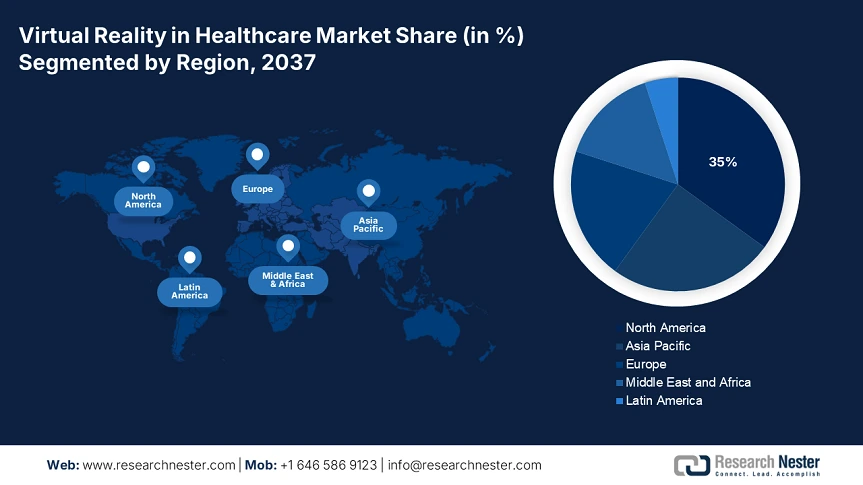
North America is expected to dominate the global virtual reality in healthcare market with a share of 35% by the end of 2037. The growth is led by the strong Medicare/Medicaid pilot reimbursement and digital health funding. An increasing number of clinics and hospitals are using VR for pain relief, rehabilitation, surgery, and some varieties of behavioral therapy. In Canada, Health Canada and PHAC support digital health frameworks with bilateral agreements. Major hospitals are implementing programs under VR pain and rehab, under interoperability initiatives in Federal funding. North America is well-positioned as a leader in the global VR healthcare market due to a basis of government funding, regulatory clarity, and acceptance from payers.
The U.S. market demand for VR in health care is growing rapidly, sustained by federal and payer support. Medicare funding--CMS has issued HCPCS codes, including G0455 VR CBT pain therapy, and is evaluating devices like RelieVRx, which treats chronic low back pain. Medicaid programs are increasingly covering VR therapy as an outpatient therapy biofeedback program. VR products that have been cleared by the FDA are moving into home use, rehabilitation, and behavioral/mental health. Pilot funding is supporting the use of VR in rural areas and demonstrating successful early adopter studies. The CMS interoperability programs support EHR-linked VR health care. The large volume of money and continuing codes from federal and state entities continues to expand the potential for new business opportunities for VR health applications.
Canada’s market for VR healthcare continues as a sustained growth trajectory through federal-provincial levers and digital health strategies. The Chief Data Office will offer data support for the improvement of the VR analytical infrastructure. Expansion of tele-rehabilitation implementation is being carried out in rural and Indigenous communities to improve access to treatment. Federal-provincial bilateral investment agreements caused federal investment in infrastructure and advanced mental-health VR tools. Overall, the development of Canada’s market related to VR in healthcare is the result of collaborative efforts, more funding, evolving policy and frameworks, maturation of digital proficiency.
APAC Market Insights
By 2037, the Asia Pacific region is projected to grow at the fastest rate in the global virtual reality in healthcare market. Such growth is primarily due to government investments in digital health services, growing chronic disease load, and aging populations in developed countries. Japan is a leader in the region with sizeable public spending via AMED and MHLW on developing digital-medical devices and decentralized clinical trial applications. China's Healthy China 2030 agenda is also moving virtual reality forward. India has targeted more virtual reality use through its tele-rehabilitation programs in government hospitals and even policy reform through its Ayushman Bharat health care reform. South Korea and Malaysia are also scaling out onboard digital care pilots. All governments in the region also have some rural outreach and elderly care commitments, and are trialing some projects across borders.
|
Country/Region |
Investment & Government Support |
Recent Developments |
|
China |
Strong government influence: “Health China 2030” |
Leading hospitals in Beijing/Shanghai integrate AR-assisted surgery |
|
Japan |
MHLW funding VR medical-training pilots |
VR is used in elderly rehabilitation, cognitive therapy, and surgical simulation |
|
India |
Invest India: USD 370 billion investment in health in 2022 |
5G rollout supports immersive tele‑health |
|
Australia |
Private and public investments in VR pain management and remote therapy |
Rapid deployment in rural tele-therapy and rehabilitation programs |
Europe Market Insights
The Europe virtual reality in healthcare market is estimated to garner a notable industry value from 2025 to 2037. The European Health Data Space projects support telemedicine, remote monitoring, and interoperable VR experiences. For instance, National budgets also demonstrate their commitment. Germany’s Digital Healthcare Act drives recommended VR apps for prescriptions. The aging populations and rising chronic diseases also create a greater and growing demand. The outstanding challenges are evolving, specifically fragmented reimbursement and heterogeneous digital maturity across member states. All in all, Europe is developing into a dynamic and better-funded VR health sector by the time we hit 2037.
The UK is now leading Europe’s VR health market as a result of notable NHS digital investment. The UK is demonstrating best practices for NICE evaluation on a number of digital therapeutic references, including CBT and VR, that create similar routes for payer reimbursement. The drivers for this development include NHS centralised procurement, major testbeds, and previous health IT infrastructure expenditure. This is enabling rapid scaling of VR solutions into clinical pathways.
Germany's VR healthcare growth is backed by a high healthcare spend. The German VR healthcare market is developing in the context of the historical social-insurance-based reimbursement in the healthcare system. Germany is in an advantageous position to be a leader in advancing VR for healthcare.