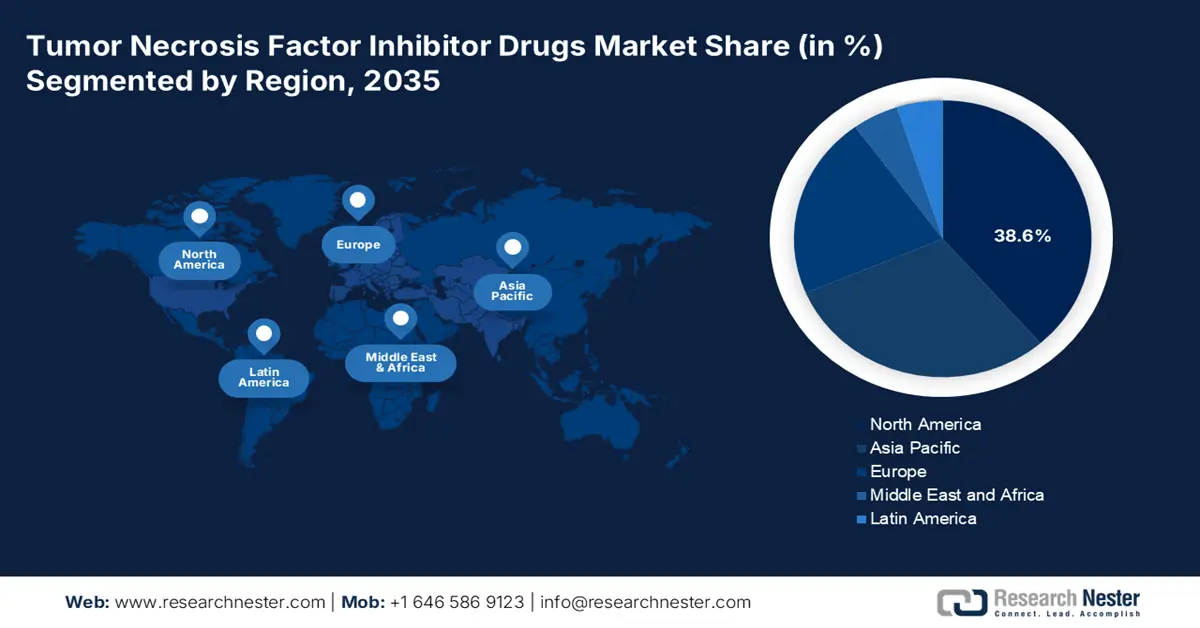
Tumor Necrosis Factor Inhibitor Drugs Market Regional Analysis:
North America Market Analysis
North America industry is predicted to dominate majority revenue share of 38.6% by 2035. This growth can be attributed to the presence of top pharmaceutical businesses and biopharmaceutical companies focused on developing cutting-edge TNF inhibitor drugs. Furthermore, the developed healthcare system and regulatory framework in North America make it easier for novel treatments to enter the market quickly and be adopted.
The region's dominant position in the global tumor necrosis factor inhibitor drugs market is further attributed to its high patient awareness and availability of cutting-edge therapy choices. For example, in February 2022, the United States Food and Drug Administration (FDA) accepted Pfizer Inc.'s request to examine the Prior Approval Supplement (PAS) to the Biologics License Application (BLA) for ABRILADA (adalimumab-AFB), a biosimilar of Humira (adalimumab).
The U.S. holds a significant position due to its highly developed healthcare system, high incidence of autoimmune illnesses, and a strong focus on research and development. The country’s well-established healthcare reimbursement system additionally makes these treatments more accessible, which increases their use. In May 2024, Teva Pharmaceuticals partnered with Alvotech to launch SIMLANDI, the first interchangeable high-concertation injection for the treatment of Crohn’s disease, adult plaque psoriasis, adult psoriatic arthritis, and adult rheumatoid arthritis.
Asia Pacific Market Analysis
Asia Pacific in tumor necrosis factor inhibitor drugs market is expected to experience a stable CAGR during the forecast period owing to the high prevalence of autoimmune diseases such as rheumatoid arthritis, Crohn’s disease, and psoriasis, rising adoption of advanced solutions to manage these diseases, and improving healthcare infrastructure. India, South Korea, Japan, and China are some of the largest revenue-generating countries in the Asia Pacific.
Prominent producers, strong government initiatives, and an aging population are driving the China market for TNF inhibitor drugs. The overall market expansion in China is expected to be stimulated by increasing rheumatic disease occurrences, high awareness of the availability and efficacy of TNF inhibitors, increased investments made by various industrial companies in biosimilars, and increased support from regulatory boards for biosimilar approval.
In India, the market is expected to rise as a result of the rising elderly population, the high prevalence of autoimmune diseases, and increasing investments in developing cost-effective TNF inhibitor drugs.