Transparent Plastics Market Outlook:
Transparent Plastics Market size was valued at over USD 156.8 billion in 2025 and is expected to reach USD 302.3 billion by the end of 2035, growing at a CAGR of 7.6% during the forecast period, i.e., 2026-2035. In 2026, the industry size of transparent plastics is assessed at USD 168.2 billion.
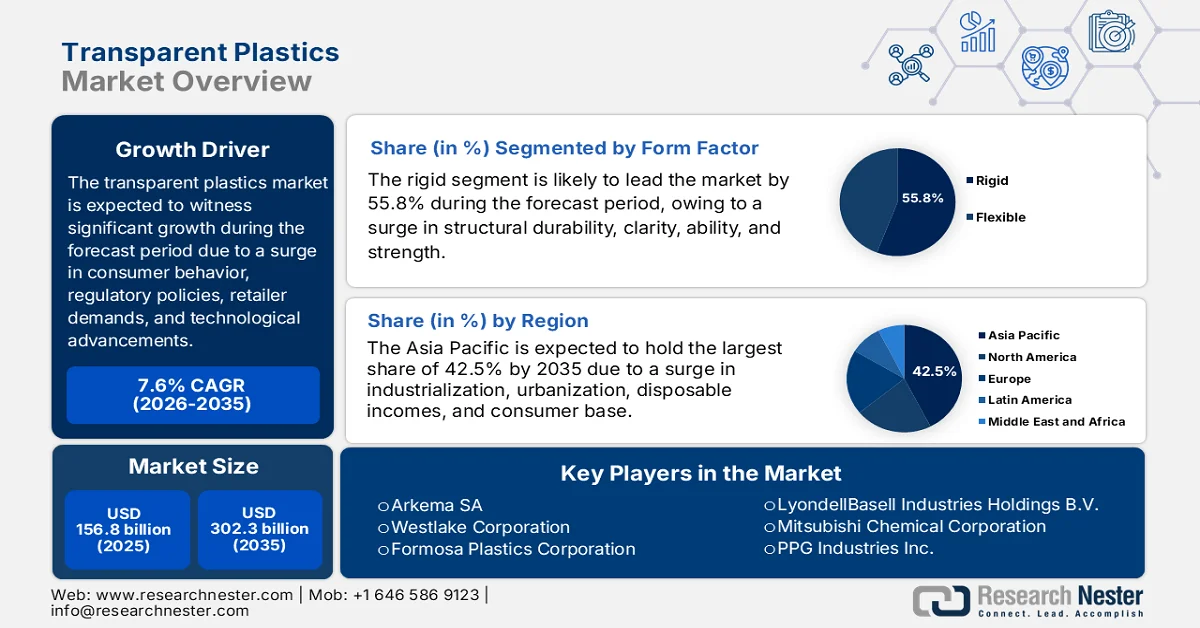
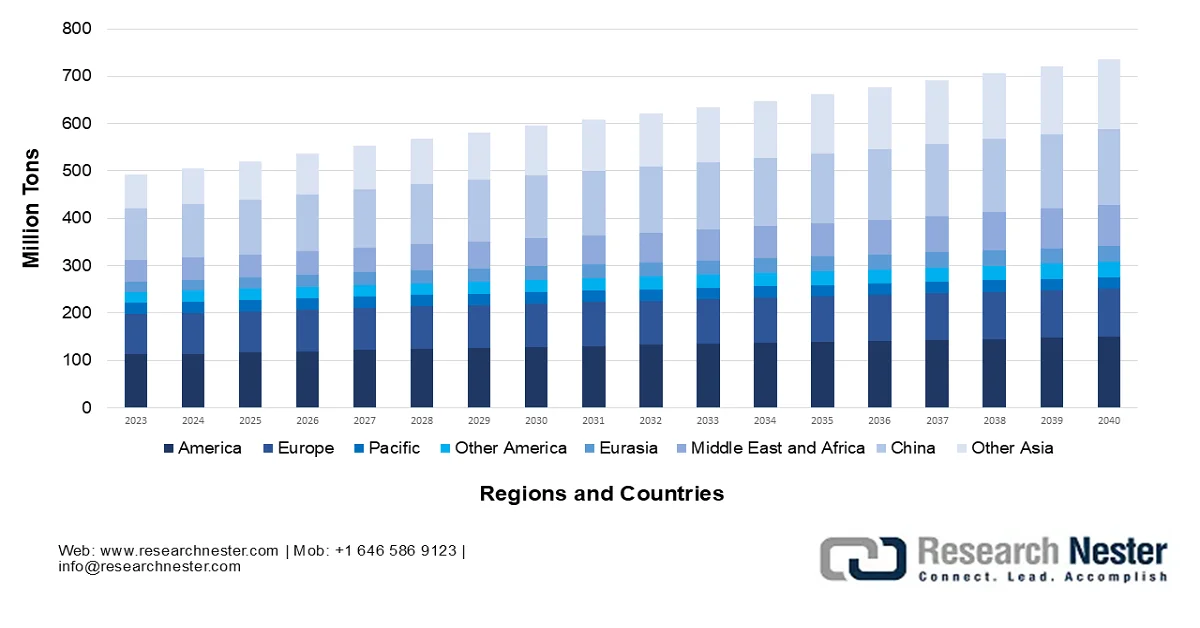
The worldwide transparent plastics market is gradually evolving with several foundational factors, such as the regulatory landscape, raw material price volatility, shift in consumer behavior, retailer requirements, and technological advancements in barrier coatings. According to official statistics published by Our World in Data in November 2024, packaging readily accounts for 37% of overall plastic wastage in the U.S., which is followed by 38% in Europe and 45% in China. Therefore, altogether these regions cater for 60% of global packaging waste generation. Besides, as per the 2026 OECD article, plastic production has successfully reached 35 million tons, and it is further expected that the yearly production, utilization, and waste generation will increase by 70% by the end of 2040. In this regard, there has been a continuous increase in plastic utilization across different regions, which is positively impacting the transparent plastics market growth.
Global Plastic Current and Future Utilization Analysis (2023-2040)
|
Year |
America (Million Tons) |
Europe (Million Tons) |
Pacific (Million Tons) |
Other America (Million Tons) |
Eurasia (Million Tons) |
Middle East and Africa (Million Tons) |
China (Million Tons) |
Other Asia (Million Tons) |
|
2023 |
112.6 |
85.2 |
23.4 |
23.1 |
22.4 |
46.3 |
107.9 |
72.3 |
|
2024 |
113.7 |
86.6 |
23.6 |
23.4 |
22.8 |
48.2 |
110.8 |
77.1 |
|
2025 |
116.4 |
87.3 |
23.5 |
23.7 |
23.9 |
48.7 |
115.3 |
82.3 |
|
2026 |
119.2 |
88.2 |
23.4 |
24.0 |
25.5 |
50.4 |
119.8 |
87.2 |
|
2027 |
121.9 |
89.2 |
23.4 |
24.4 |
26.8 |
52.3 |
124.0 |
91.9 |
|
2028 |
124.3 |
90.1 |
23.6 |
24.8 |
27.6 |
54.3 |
127.2 |
96.2 |
|
2029 |
126.5 |
90.8 |
23.6 |
25.3 |
28.3 |
56.5 |
130.2 |
100.5 |
|
2030 |
128.6 |
91.6 |
23.7 |
25.8 |
28.9 |
58.9 |
133.1 |
104.8 |
|
2031 |
130.7 |
92.5 |
23.8 |
26.4 |
29.4 |
60.9 |
135.9 |
108.7 |
|
2032 |
132.7 |
93.4 |
23.9 |
27.0 |
29.9 |
63.2 |
138.7 |
112.5 |
|
2033 |
134.8 |
94.3 |
24.1 |
27.6 |
30.3 |
65.5 |
141.5 |
116.4 |
|
2034 |
136.9 |
95.2 |
24.2 |
28.2 |
30.7 |
67.9 |
144.3 |
120.3 |
|
2035 |
138.9 |
96.2 |
24.4 |
28.8 |
31.1 |
70.5 |
147.0 |
124.3 |
|
2036 |
141.0 |
97.2 |
24.5 |
29.5 |
31.6 |
73.5 |
149.6 |
129.0 |
|
2037 |
143.1 |
98.2 |
24.6 |
30.2 |
32.0 |
76.7 |
152.2 |
133.8 |
|
2038 |
145.2 |
99.2 |
24.8 |
30.9 |
32.4 |
80.0 |
154.7 |
138.6 |
|
2039 |
147.4 |
100.2 |
24.9 |
31.6 |
32.8 |
83.5 |
157.0 |
143.6 |
|
2040 |
149.6 |
101.2 |
25.1 |
32.3 |
33.2 |
87.1 |
159.3 |
148.6 |
Source: OECD
Global Plastic Utilization Graphical Representation (2023-2040)
Source: OECD
Furthermore, the aspect of intelligent and active transparent packaging, the presence of mono-material transparent structures for recyclability, focus on post-consumer recycled (PCR), and light-weighting through structural design, are a few trends that are responsible for bolstering the transparent plastics market worldwide. As stated in an article published by the Journal of Environmental Management in December 2023, 8.6% of municipal solid waste plastic was recycled in the U.S., along with 7.8% of landfilled plastics. This practice of recycling has increased, owing to the total plastic production, accounting for 311 million tons, which is further projected to triple by the end of 2050. Besides, in terms of landfill disposal expense, the collected household plastic waste in the U.S. amounted to USD 177. Meanwhile, the implementation of a recycling system increased the handling cost to USD 218, thus proliferating the transparent plastics market expansion.
Key Transparent Plastics Market Insights Summary:
Regional Highlights:
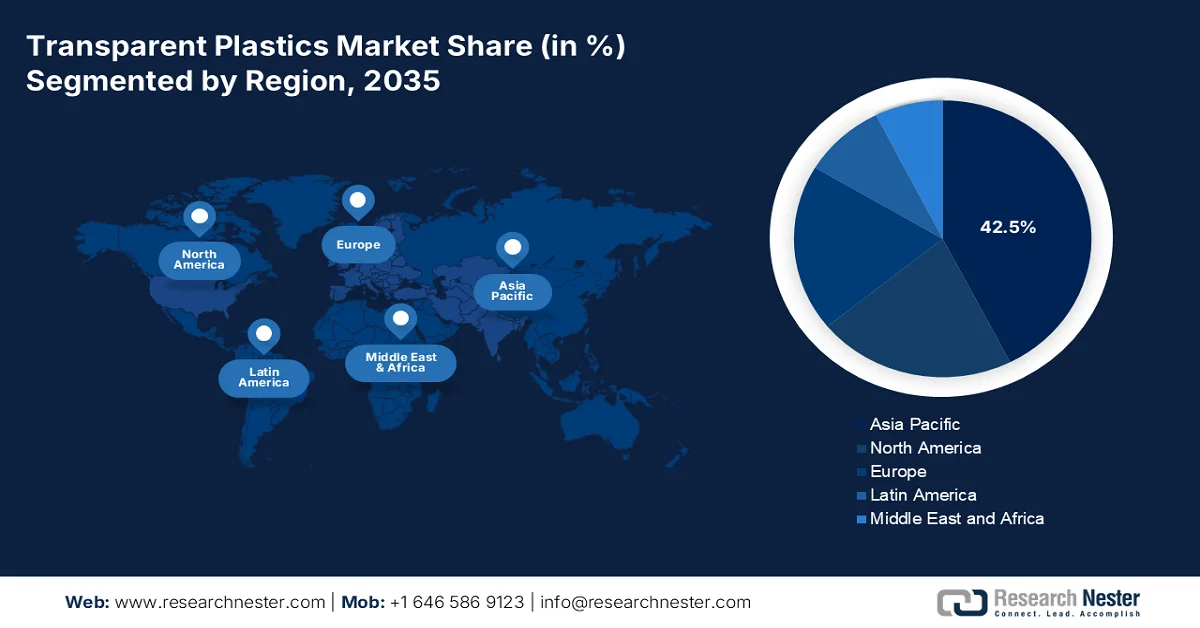
- Asia Pacific transparent plastics market is anticipated to hold a 42.5% share by 2035, impelled by rising urbanization, expanding e-commerce penetration, and increasing demand for packaged food and beverages
- Europe is projected to witness the fastest growth during 2026–2035, fueled by stringent environmental regulations and advancements in recyclable and bio-based polymer technologies
Segment Insights:
- The rigid segment of the transparent plastics market is projected to account for a 55.8% share by 2035, propelled by its critical role in ensuring structural strength, clarity, and food protection across supply chains
- The injection molding segment is expected to secure the second-highest share during 2026–2035, driven by its capability to enable precise, repeatable production of complex plastic components
Key Growth Trends:
- Increase in global e-commerce grocery penetration
- Rise in the middle class across emerging economies
Major Challenges:
- Inconsistent global recycling infrastructure
- Higher production costs for barrier and clarity performance
Key Players: BASF SE (Germany), Covestro AG (Germany), Dow Chemical Company (U.S.), DuPont de Nemours Inc. (U.S.), Eastman Chemical Company (U.S.), Evonik Industries AG (Germany), INEOS Group (UK), LANXESS AG (Germany), LG Chem (South Korea), LyondellBasell Industries Holdings B.V. (Netherlands), Mitsubishi Chemical Corporation (Japan), PPG Industries Inc. (U.S.), SABIC (Saudi Arabia), Shin-Etsu Chemical Co. Ltd. (Japan), Teijin Limited (Japan), Trinseo PLC (U.S.), Asahi Kasei Corporation (Japan), Arkema SA (France), Westlake Corporation (U.S.), Formosa Plastics Corporation (Taiwan), Aduro Clean Technologies Inc. (Canada), Borealis (Austria).
Global Transparent Plastics Market Forecast and Regional Outlook:
Market Size & Growth Projections:
- 2025 Market Size: USD 156.8 billion
- 2026 Market Size: USD 168.2 billion
- Projected Market Size: USD 302.3 billion by 2035
- Growth Forecasts: 7.6% CAGR (2026-2035)
Key Regional Dynamics:
- Largest Region: Asia Pacific (42.5% Share by 2035)
- Fastest Growing Region: Europe
- Dominating Countries: United States, China, Germany, Japan, India
- Emerging Countries: Brazil, South Korea, Mexico, Indonesia, Vietnam
Last updated on : 17 April, 2026
Transparent Plastics Market - Growth Drivers and Challenges
Growth Drivers
- Increase in global e-commerce grocery penetration: The online grocery sales are continuously rising and accounting for the total grocery retail industry, which is positively impacting the transparent plastics market growth. According to official statistics published by NLM in January 2022, 34% of shoppers in the U.S. deliberately reported purchasing groceries online almost majority of the times. Additionally, of this, 30% belonged to low-income households, comprising less than USD 40,000 yearly household income, and 64% of the population were parents with children. However, later on, there was a further increase in online retail sales by 39% in the country, especially for families residing across low-income areas, thus positively fueling the market exposure in the country.
- Rise in the middle class across emerging economies: Based on an increase in disposable income, households are gradually shifting from unpacked and bulk staples to packaged, portion-controlled, and branded foods. As stated in a data report published by the Asia Development Bank in June 2022, there has been an increase in the worldwide middle class from 1.8 billion to 3.5 billion, with 40% effectively located in Asia, particularly in India and China. Besides, there has been a surge in the GDO per capita by 66% in China, followed by 53% in India. However, between 2030 and 2035, India is projected to overtake China in terms of middle-class population. Therefore, with this continuous increase in this population category, there is an increase in transparent plastic packaging, owing to the cost-effective aspect to ensure product visibility, which is driving the transparent plastics market.
- Expanded shelf life demands among retailers: The transparent plastics market, with enhanced barrier properties, is expanding shelf life in comparison to uncoated or paperboard, which acts as yet another growth driver. As stated in an article published by Cleaner Materials in March 2024, an estimated 2/3rd of global plastics have a short-term life cycle, which is usually less than a month. In addition, the approximate worldwide plastic waste generation was nearly 6.3 billion tons, which is almost 80% of the plastic accumulation in the natural environment. Besides, the plastic waste generation is estimated to be nearly 242 million tons, with degradation rates usually ranging from 100 to 1,000 years. Therefore, with such an increase in production and degradation, the shelf-life aspect of plastics is extremely crucial for retailers.
Challenges
- Inconsistent global recycling infrastructure: A transparent plastic package is only as sustainable as the system that collects and processes it after use, and that system varies wildly between geographies. In regions with advanced deposit return schemes and single-stream sorting equipped with near-infrared optical scanners, clear PET bottles achieve high recovery rates and are efficiently recycled back into food-grade material. However, in most of the world, collection is haphazard, sorting facilities cannot distinguish between different transparent resin types, and recycling economics favor opaque or colored plastics, which hide contamination better. Besides, transparent trays, cups, and films often end up incinerated or landfilled because local recyclers lack the technology to clean and process them profitably, thereby negatively impacting the transparent plastics market.
- Higher production costs for barrier and clarity performance: The aspect of achieving both high transparency and sufficient barrier properties against oxygen, moisture, and ultraviolet light requires sophisticated multilayer structures, specialized additives, or advanced coatings, all of which increase production costs significantly compared to opaque plastics. For instance, transparent EVOH-layered films that keep coffee fresh or prevent potato chip staleness cost substantially more than standard polyethylene pouches. Similarly, crystal-clear polypropylene containers demand higher-grade molds, slower cycle times, and more precise temperature control than standard white or tinted versions. These cost premiums are difficult to pass on to price-sensitive consumers in competitive food retail categories where margins are already thin, thus causing a hindrance to the transparent plastics market growth.
Transparent Plastics Market Size and Forecast:
| Report Attribute | Details |
|---|---|
|
Base Year |
2025 |
|
Forecast Year |
2026-2035 |
|
CAGR |
7.6% |
|
Base Year Market Size (2025) |
USD 156.8 billion |
|
Forecast Year Market Size (2035) |
USD 302.3 billion |
|
Regional Scope |
|
Transparent Plastics Market Segmentation:
Form Factor Segment Analysis
The rigid segment, part of the form factor, is anticipated to garner the highest share of 55.8% in the transparent plastics market by the end of 2035. The segment’s upliftment is primarily attributed to its importance for structural strength, clarity, and ability to protect food throughout the supply chain. However, its very rigidity requires a certain material thickness, which translates to higher plastic consumption per unit compared to flexible alternatives. This makes them a prime target for lightweighting regulations and environmental scrutiny. Furthermore, achieving crystal clarity in rigid formats often necessitates virgin resin or specialized clarifying agents, as recycled content can introduce haze or discoloration. The mechanical recycling of rigid transparent items is also hampered by label adhesives, closures made of different polymers, and food residue, all of which complicate processing.
Manufacturing Process Segment Analysis
Based on the manufacturing process, the injection molding segment is projected to grab the second-highest share in the transparent plastics market during the forecast period. The segment’s growth is highly driven by the aspect of deliberately making it possible to achieve products of specially designed size and shape. In addition, these developed injection molds permit repeatable and repeated production of selective plastic parts. According to official statistics published by NLM in January 2024, the overall model for injection mold filling is usually meshed with 1,887,778 3D solid mesh elements, such as hexa, prism, pyramid, and tetra. Besides, mold filling and cooling simulation effectively lasts for almost 8.5 hours by utilizing Lenovo’s ThinkPad P15 Gen 2i computer, which is further equipped with a 2,5 GHz processor, along with 32 GD of RAM, thus bolstering the segment growth.
Polymer Type Segment Analysis
By the end of the stipulated timeline, the polyethylene segment, which is part of the polymer type, is expected to account for the third-highest share in the transparent plastics market. The segment’s development is highly propelled by its benefits, including cost-effective properties, chemical resistance, durability, and light-weight. As per a data report published by the NPE Organization in May 2024, there has been a continuous increase in the demand for polyethylene across various segments, including 3.5% for film and sheet, which is followed by 3.8% for pipe and profile, and 3.4% for blow molding. In addition, rotomolding accounts for 4.2% of polyethylene demand, 3.5% for Raffia, 3.1% for injection molding, 2.5% for extrusion coating. 2.7% for wire and cable, 2.9% for fiber, and 1.8% for other segments. Therefore, with the increased demand in these different categories, there is a huge growth opportunity for the segment.
Our in-depth analysis of the transparent plastics market includes the following segments:
|
Segment |
Subsegments |
|
Form Factor |
|
|
Manufacturing Process |
|
|
Polymer Type |
|
|
End use Industry |
|
|
Product Type |
|
|
Material Type |
|

Vishnu Nair
Head - Global Business DevelopmentCustomize this report to your requirements — connect with our consultant for personalized insights and options.
Transparent Plastics Market - Regional Analysis
APAC Market Insights
The Asia Pacific in the transparent plastics market is anticipated to garner the highest share of 42.5% by the end of 2035. The market’s upliftment in the region is primarily attributed to increased urbanization, industrialization, a rise in disposable incomes, expansion in consumer base, a surge in e-commerce penetration, and the growing demand for packaged beverages and food. According to official statistics published by NLM in April 2023, China has the highest e-commerce trade, which is worth USD 370 billion, while India demonstrated the lowest with USD 136 billion. Based on this, there has been an increase in Internet users, accounting for 99.7% percent users, especially in West Asia, and the lowest, catering to 0.25% in Myanmar. Besides, there has also been a continuous upsurge in B2B e-commerce services in the region, which is also uplifting the transparent plastics market.
B2B E-Commerce Growth in the Asia Pacific (2017-2026)
|
Year |
Growth % |
|
2017 |
77.9 |
|
2018 |
78.0 |
|
2019 |
78.0 |
|
2020 |
78.1 |
|
2021 |
78.3 |
|
2022 |
78.6 |
|
2023 |
78.9 |
|
2024 |
79.3 |
|
2025 |
78.7 |
|
2026 |
80.0 |
Source: ITA
The transparent plastics market in China is growing significantly, owing to the presence of the massive manufacturing capacity, robust domestic demand across consumer goods, automotive, and packaging industries, supportive governmental reforms promoting circular economy development, and an increase in the volume of transparent PP and PET materials. Based on government estimates published by the ITA in September 2025, the overall retail sales of consumer goods approximately reached USD 6.8 trillion, indicating a 3.5% year-on-year increase as of 2024. Besides, the overall retail sales significantly hit almost USD 1.9 trillion, effectively reflecting a 6.5% surge. Moreover, the country’s imports of goods resumed a suitable momentum in the same year after a slight 5.5% YoY decrease in 2023, thereby denoting an optimistic outlook for the transparent plastics market growth.
The aspects of rapid economic expansion, a rise in consumer spending power, an increase in the adoption of packaged goods, an upsurge in pharmaceuticals and beverage industries, growth in the automotive sectors, and the continuous development of industrial infrastructure, along with a surge in the middle-class population, are certain factors for driving the transparent plastics market in India. As per an article published by the PIAI Organization in 2026, the packaging industry in the country was valued at USD 50.5 billion and successfully reached USD 204.8 billion by the end of 2025, indicating a 26.7% growth rate. In addition, the packaging is one of the growth industries in the nation and has developed a 22% to 25% per year, effectively emerging as the most preferred facility for the packaging industry, thus positively impacting the transparent plastics market development.
Europe Market Insights
Europe in the transparent plastics market is expected to emerge as the fastest-growing region during the forecast period. The market’s development in the region is highly propelled by the presence of strict environmental reforms, robust demand from the automotive and packaging industries, a well-established industrial base for polymer manufacturing, and an escalation in innovative recyclable technologies and bio-based polymers. According to official statistics published by the Open Access Government Organization in April 2026, each of the population in the region generated an average of 178 kilograms of packaging waste as of 2023. In addition, the total waste levels are expected to increase by 19% by the end of 2030, and the plastic waste is further predicted to rise by 46% in the region. This denotes increased packaging applications, which are gradually developing the market exposure in the region.
The transparent plastics market in Germany is gaining increased traction, owing to the existence of the notable automotive sector, strong chemical manufacturing base, the presence of high-quality transparent polymer materials, including PET, polycarbonates, and acrylics, lightweighting strategies, and the increased focus on policy framework and recycling infrastructure. Based on government estimates published by the ITA in August 2025, there has been a rise in exports of automation in the country from USD 955 billion as of 2022 to more than USD 1 trillion in 2023, which further slightly contracted to nearly USD 991 billion in 2024. Besides, the 2024 U.S. advanced manufacturing exports to the country amounted to USD 37 billion, thereby making it suitable for fueling the market’s expansion and development in the overall country.
German Advanced Manufacturing Industry Analysis (2022-2024)
|
Components |
2022 (USD Million) |
2023 (USD Million) |
2024 (USD Million) |
|
Overall Exports |
955,316 |
1,026,836 |
991,050 |
|
Overall Imports |
753,557 |
764,300 |
721,621 |
|
Imports from the U.S. |
35,978 |
38,998 |
36,753 |
|
Trade Surplus/Deficit |
201,759 |
262,536 |
269,429 |
|
EUR-USD Exchange Rate |
1.05 |
1.08 |
1.08 |
Source: OEC
The low production expenses, an increase in foreign direct investment in automotive and packaging component manufacturing, a significant production location for plastic packaging, and the focus on optimizing recycling infrastructure and waste management are a few trends that are responsible for driving the transparent plastics market in Poland. As per an article published by the Environment Protection in December 2023, 174 installations for mechanical and biological processing of non-segregated municipal waste were operated in the country. In addition, the biological part of the MBP is almost 5,300,000Mg per year, leading to processing the 0 to 80 mm fraction stream from mixed wastage. Besides, of the total installations, 8 are currently in operation for co-financing under regional operational programs, thus proliferating the transparent plastics market development in the country.
North America Market Insights
North America in the transparent plastics market is projected to experience considerable growth by the end of the stipulated timeline. The market’s growth in the region is highly driven by the robust demand across consumer goods, automotive, and packaging industries, along with leadership in material advancement, the preference for high-performance plastic solutions, and innovative manufacturing capabilities. According to official statistics published by the PMMI Organization in 2025, the packaging machinery industry, particularly in the U.S., significantly reached USD 11.3 billion in sales as of 2024, with a 2.2% growth rate in 2025. Besides, the industry in Canada accounted for USD 1.2 billion in sales in 2024, along with a 0.8% growth rate. Therefore, with this continuous growth in industries across both countries, the market is expanding in the overall region.
Regional Packaging Machinery Analysis in the U.S. and Canada (2025)
|
Components |
U.S. |
Canada |
|
Sales Growth Rate |
2.7% |
3.1% |
|
Domestic Value |
USD 11.3 billion |
USD 1.2 billion |
|
Imports Value |
USD 3.7 billion |
USD 515 million |
|
Exports Value |
USD 703 million |
USD 613 million |
|
Food |
44% |
43% |
|
Beverage |
15% |
12% |
|
Household, Industrial, and Agricultural Chemicals |
13% |
15% |
|
Other End user Sectors |
12% |
14% |
|
Pharmaceuticals |
11% |
5% |
|
Personal Care, Toiletries, and Cosmetics |
5% |
11% |
Source: PMMI Organization
The transparent plastics market in the U.S. is gaining increased exposure, owing to the dominance of the packaging industry, growth in consumer electronics, innovations in automotive applications, expansion in the healthcare industry, and an increase in regulatory and sustainability support. As stated in an article published by the U.S. Environmental Protection Agency in February 2026, 34% of the newest vehicles in the country were cars, and 66% of the overall latest vehicles were trucks under NHTSA regulations as of 2024. Besides, in terms of fuel economy, there has been an increase in truck-based SUVs from 1.0 mpg to the newest 25.7 mpg. Moreover, regarding electric vehicles, 30% of car SUVs were battery electric vehicles, and an addition 35 were plug-in hybrid electric vehicles (PHEV). Therefore, with developments in automotive applications, there is a huge demand for the market in the country.
The increased demand for high-performance materials across different industries, regulatory pressure and sustainability mandates, an increase in the consumer preference for eco-friendly packaging, innovations in cost competitiveness and material performance, as well as growth in healthcare and medical applications, are certain factors for bolstering the transparent plastics market in Canada. As per an article published by the Government of Canada in October 2025, Environment and Climate Change Canada readily supported 55 projects with more than USD 10 million in funding for the Zero Plastic Waste Initiative and the Advancing a Circular Plastics Economy. This particular fund was further leveraged by more than USD 7 million in private and public funds to diminish plastic pollution and waste, thus positively fueling the transparent plastics market growth.
Key Transparent Plastics Market Players:
- BASF SE (Germany)
- Covestro AG (Germany)
- Dow Chemical Company (U.S.)
- DuPont de Nemours Inc. (U.S.)
- Eastman Chemical Company (U.S.)
- Evonik Industries AG (Germany)
- INEOS Group (UK)
- LANXESS AG (Germany)
- LG Chem (South Korea)
- LyondellBasell Industries Holdings B.V. (Netherlands)
- Mitsubishi Chemical Corporation (Japan)
- PPG Industries Inc. (U.S.)
- SABIC (Saudi Arabia)
- Shin-Etsu Chemical Co. Ltd. (Japan)
- Teijin Limited (Japan)
- Trinseo PLC (U.S.)
- Asahi Kasei Corporation (Japan)
- Arkema SA (France)
- Westlake Corporation (U.S.)
- Formosa Plastics Corporation (Taiwan)
- Aduro Clean Technologies Inc. (Canada)
- Borealis (Austria)
- Company Overview
- Business Strategy
- Key Product Offerings
- Financial Performance
- Key Performance Indicators
- Risk Analysis
- Recent Development
- Regional Presence
- BASF SE offers a broad portfolio of transparent plastics solutions, including high-clarity polystyrene and polypropylene grades specifically designed for food packaging applications. The company focuses on developing certified compostable and bio-based transparent polymers to help food brands meet circular economy targets.
- Covestro AG is recognized for its high-performance polycarbonate transparent plastics, which are used in durable and reusable food containers and beverage dispensing systems. The company actively pursues recycling innovations, including advanced chemical recycling processes to recover clear polymers from post-consumer food packaging waste.
- Dow Chemical Company manufactures transparent polyethylene and polyolefin elastomers that are widely used in flexible food packaging films and clear lidding solutions. The company has committed to making its entire transparent packaging portfolio recyclable or reusable by a specified target year, driving design-for-recycling initiatives.
- DuPont de Nemours Inc. specializes in transparent ionomer and ethylene copolymer resins that provide exceptional seal integrity and optical clarity for modified atmosphere food packaging. The company focuses on lightweighting technologies that reduce material usage in rigid transparent containers without compromising strength or transparency.
- Eastman Chemical Company produces a family of advanced copolyester transparent plastics that offer glass-like clarity with superior toughness and chemical resistance for reusable food storage products. The company has launched a circular recycling initiative specifically targeting difficult-to-recycle transparent food trays and clamshells, converting them back into virgin-quality materials.
Here is a list of key players operating in the global transparent plastics market:
The worldwide transparent plastics market is highly competitive, with leading players pursuing product diversification and technological innovation to strengthen their positions. Major manufacturers are increasingly investing in sustainable solutions, including blockchain-based recycling platforms and bio-based transparent polymers. Moreover, strategic initiatives focus on expanding applications in the packaging, automotive, and consumer electronics sectors. Simultaneously, companies are also forming partnerships and making acquisitions to enhance manufacturing capabilities, particularly in injection molding and specialty transparent materials. For instance, in December 2024, Arkema S.A. successfully acquired Dow’s flexible packaging lamination-based adhesives portfolio, which is one of the most notable global producers of adhesives for the flexible packaging industry. The USD 250 million yearly sales portfolio offers high-quality solutions in medical and food applications, thus positively fueling the transparent plastics industry globally.
Corporate Landscape of the Transparent Plastics Market:
Recent Developments
- In December 2025, Aduro Clean Technologies Inc. entered into a multi-year framework collaboration agreement with ECOCE, A.C., and jointly evaluated Hydrochemolytic™ Technology (HCT) as a potential chemical recycling solution for flexible and mixed plastic packaging in Mexico.
- In April 2024, Eastman and deSter significantly collaborated to ensure advancement to the airline sector by unveiling reusable in-flight drinkware made with Tritan™ Renew, constituting the highest potential to meet operational and design challenges.
- In May 2023, Borealis launched Stelora, which is the latest class of sustainable engineering polymer that provides increased durability, strength, and a step modification in heat-resistance capability.
- Report ID: 8518
- Published Date: Apr 17, 2026
- Report Format: PDF, PPT
- Explore a preview of key market trends and insights
- Review sample data tables and segment breakdowns
- Experience the quality of our visual data representations
- Evaluate our report structure and research methodology
- Get a glimpse of competitive landscape analysis
- Understand how regional forecasts are presented
- Assess the depth of company profiling and benchmarking
- Preview how actionable insights can support your strategy
Explore real data and analysis
Frequently Asked Questions (FAQ)
About this Report
Connect with our Expert


Report, 2026-2035



Copyright @ 2026 Research Nester. All Rights Reserved.
