Transcatheter Aortic Valve Replacement Market Outlook:
Transcatheter Aortic Valve Replacement Market size was valued at USD 5.3 billion in 2025 and is expected to reach USD 16.2 billion by the end of 2035, growing at around 11.7% CAGR during the forecast period, i.e., 2026-2035. In 2026, the industry size of transcatheter aortic valve replacement is assessed at USD 5.9 billion.
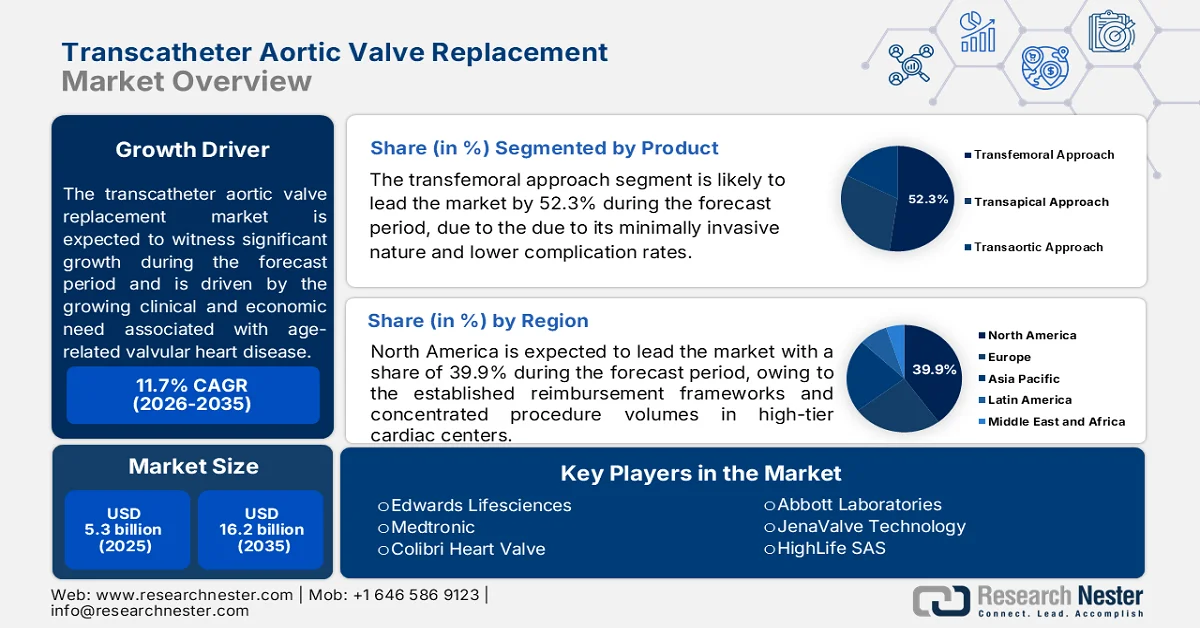
The transcatheter aortic valve replacement market is being supported by a growing clinical and economic need associated with age-related valvular heart disease, particularly aortic stenosis. According to the CDC January 2026 data, valvular heart disease affects more than 2.5% of the U.S. population, with prevalence increasing substantially among older adults. The Population Reference Bureau January 2024 data notes that the U.S. population aged 65 years and above reached approximately 58 million people and is projected to continue expanding, creating a larger patient pool requiring structural heart interventions. Clinical adoption has accelerated as long-term registry and real-world evidence continue to demonstrate favorable outcomes across broader patient risk categories.
Key Transcatheter Aortic Valve Replacement Market Insights Summary:
Regional Insights:
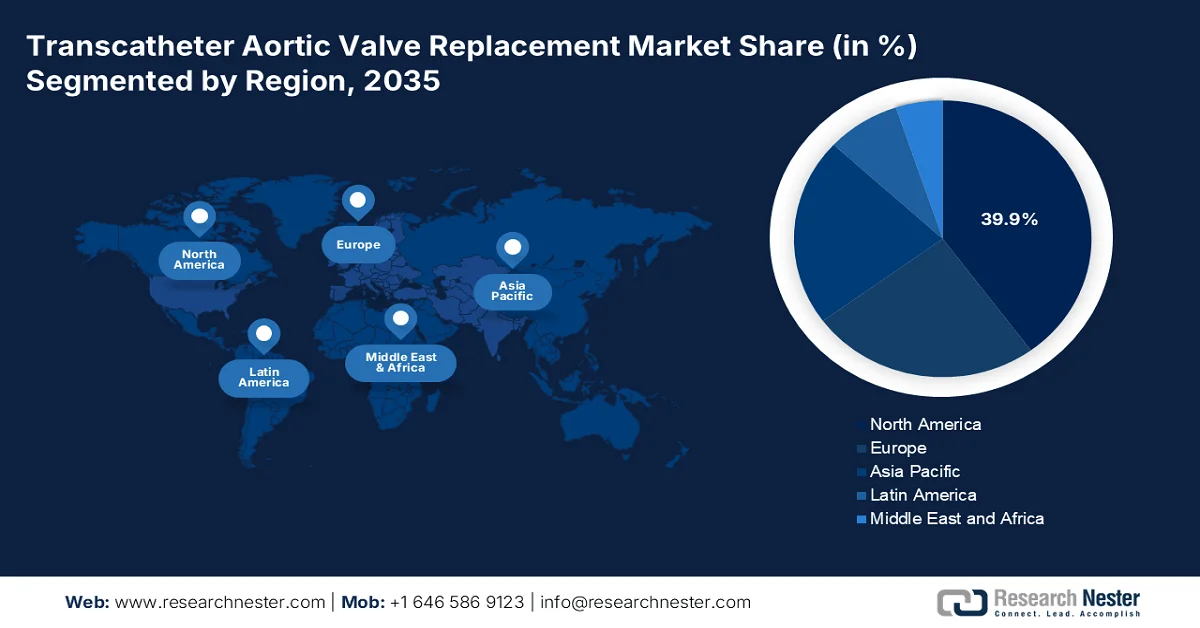
- North America transcatheter aortic valve replacement market is anticipated to secure 39.9% of regional revenue share by 2035, supported by mature adoption, established reimbursement frameworks, and concentrated procedure volumes in high-tier cardiac centers
- Asia Pacific is set to witness the fastest expansion in the forecast period of 2026–2035, bolstered by increasing adoption across emerging healthcare systems and evolving reimbursement pathways
Segment Insights:
- The transfemoral approach segment in the transcatheter aortic valve replacement market is projected to account for 52.3% of procedures by 2035, propelled by its minimally invasive nature and lower complication rates
- The nitinol segment is expected to maintain its leading position through 2035, underpinned by exceptional superelasticity, shape memory, and biocompatibility essential for transcatheter valve frames
Key Growth Trends:
- Rising government spending on cardiovascular disease management
- Growing severe aortic stenosis burden
Major Challenges:
- High regulatory hurdles
- Physician training and adoption resistance
Key Players: Edwards Lifesciences (U.S.),Medtronic (U.S.),Abbott Laboratories (U.S.),JenaValve Technology (Germany),Colibri Heart Valve (U.S.),HighLife SAS (France).
Global Transcatheter Aortic Valve Replacement Market Forecast and Regional Outlook:
Market Size & Growth Projections:
- 2025 Market Size: USD 5.3 billion
- 2026 Market Size: USD 5.9 billion
- Projected Market Size: USD 16.2 billion by 2035
- Growth Forecasts: 11.7% CAGR (2026-2035)
Key Regional Dynamics:
- Largest Region: North America (39.9% Share by 2035)
- Fastest Growing Region: Asia Pacific
- Dominating Countries: United States, Germany, Japan, Canada, France
- Emerging Countries: China, India, Australia, South Korea, Singapore
Last updated on : 22 June, 2026
Transcatheter Aortic Valve Replacement Market - Growth Drivers and Challenges
Growth Drivers
- Rising government spending on cardiovascular disease management: Government healthcare budgets are increasingly prioritizing cardiovascular disease (CVD) treatment, creating a favorable environment for TAVR adoption. According to the Health Affairs December 2024 data, national health expenditures reached USD 4.9 trillion in 2023, representing 17.6% of GDP, with a significant portion allocated to Medicare beneficiaries who constitute the primary TAVR patient population. The U.S. National Heart, Lung, and Blood Institute (NHLBI) estimates that heart valve disease affects millions of Americans, requiring advanced intervention capacity. These investments are enabling hospitals to expand structural heart programs, acquire advanced imaging systems, and increase procedural capacity.
- Growing severe aortic stenosis burden: Population aging is a major demand driver for TAVR procedures because severe aortic stenosis prevalence rises significantly among older adults. Clinical evidence published by the American Heart Association (AHA) indicates that aortic stenosis prevalence increases substantially after age 75. Governments are therefore increasing spending on elderly care programs and cardiovascular services. For example, the PGPF March 2026 data indicates that the Medicare spending surpassed USD 1 trillion annually, reflecting growing healthcare utilization among older populations. As healthcare systems face increasing numbers of elderly patients with valve disease, hospitals are expanding TAVR capabilities to reduce surgical burden and improve outcomes. This demographic shift creates a sustained long-term procedure pipeline for manufacturers and healthcare providers.
- Expansion of national screening and early diagnosis programs: Governments and public health organizations are promoting earlier diagnosis of cardiovascular disease through screening and awareness initiatives. The World Health Organization 2026 data identifies cardiovascular diseases as the leading cause of death globally, responsible for approximately 17.9 million deaths annually. Public health campaigns and improved access to echocardiography are increasing identification of previously undiagnosed valve disease patients. Earlier detection enables referral before severe clinical deterioration, increasing eligibility for TAVR. As diagnosis rates increase, healthcare systems are expected to experience higher referral volumes for structural heart interventions, creating sustained demand for TAVR devices and related procedural services.
Challenges
- High regulatory hurdles: Entering the transcatheter aortic valve replacement market requires navigating complex, lengthy approvals from bodies like the FDA and CE Mark. Clinical trial requirements for safety and efficacy demand millions in investment and years of patient follow-up. Small manufacturers lack internal regulatory expertise, delaying market access and increasing costs significantly.
- Physician training and adoption resistance: Interventional cardiologists require hands-on proctoring and simulator training to master a new valve’s deployment nuances. Incumbent companies have embedded their techniques into fellowship curricula. New entrants struggle to secure proctors, cadaver labs, and simulation facilities, slowing adoption curves significantly.
Transcatheter Aortic Valve Replacement Market Size and Forecast:
| Report Attribute | Details |
|---|---|
|
Base Year |
2025 |
|
Forecast Year |
2026-2035 |
|
CAGR |
11.7% |
|
Base Year Market Size (2025) |
USD 5.3 billion |
|
Forecast Year Market Size (2035) |
USD 16.2 billion |
|
Regional Scope |
|
Transcatheter Aortic Valve Replacement Market Segmentation:
Procedure Segment Analysis
The transfemoral approach is the dominant sub-segment in the transcatheter aortic valve replacement market, accounting for over 52.3% of all TAVR procedures in the U.S. The segment is driven due to its minimally invasive nature and lower complication rates. This entry route involves accessing the femoral artery percutaneously, avoiding thoracotomy and cardiopulmonary bypass, which reduces intensive care unit stays and 30-day mortality. According to the NLM study released in August 2024, more than 94.5% of patients receiving approved TAVR devices were treated via the transfemoral route, reflecting its clinical preference. Advancements in low-profile sheaths have enabled safe deployment even in patients with peripheral artery disease, ensuring the transfemoral approach remains the leading procedural sub-segment through 2035.
Material Segment Analysis
The nitinol segment has consistently dominated due to the alloy's exceptional superelasticity, shape memory, and biocompatibility, which are critical for transcatheter valve frames. Nitinol allows self-expanding valve systems to be compressed into low-profile delivery sheaths and then reliably expand to conform to native aortic annulus geometry upon deployment. Unlike stainless steel or cobalt-chromium alloys, nitinol tolerates significant flexural and torsional stresses without permanent deformation, reducing the risk of frame fracture over millions of cardiac cycles. Furthermore, nitinol's lower radial force compared to balloon-expandable frames minimizes the risk of annular rupture and conduction disturbances. This combination of deliverability, conformability, and fatigue resistance has made nitinol the material of choice for leading self-expanding TAVR platforms, ensuring its continued leadership across the market.
End use Segment Analysis
Hospitals and specialized cardiac centers are leading the end users in the transcatheter aortic valve replacement market, due to the need for hybrid operating rooms, multidisciplinary heart teams, and intensive care infrastructure. These settings offer real-time fluoroscopy, echocardiography, and surgical backup for complications, which ambulatory surgical centers currently cannot match. According to the NLM study published in July 2023, over 280,000 TAVR procedures were performed in U.S. hospitals, with less percentage occurring in outpatient settings. The concentration of volume in high-tier hospitals ensures cost-efficient outcomes, making hospitals the dominant end-use segment for the foreseeable future.
Our in-depth analysis of the transcatheter aortic valve replacement market includes the following segments:
|
Segment |
Subsegments |
|
Procedure |
|
|
Material |
|
|
Valve Type |
|
|
Product |
|
|
Indication |
|
|
End use |
|

Vishnu Nair
Head - Global Business DevelopmentCustomize this report to your requirements — connect with our consultant for personalized insights and options.
Transcatheter Aortic Valve Replacement Market - Regional Analysis
North America Market Insights
The North America is dominating the transcatheter aortic valve replacement market and is expected to hold the regional revenue share of 39.9% by the end of 2035. The region is characterized by mature adoption, established reimbursement frameworks, and concentrated procedure volumes in high-tier cardiac centers. The United States leads with a well-defined Medicare coverage infrastructure, while Canada operates through provincial health authority tenders and centralized procurement. Private payer policies in the U.S. increasingly mirror public coverage determinations, creating a unified demand signal. In Canada, waitlist pressures for surgical replacement continue to drive provincial expansion of TAVR capacity. Both countries face margin compression as procurement models evolve from fee-for-device to episode-based bundled payments.
The rising procedure volumes and increasing treatment adoption for severe aortic stenosis is shaping the transcatheter aortic valve replacement market in the U.S. According to the SEC 2024 data, approximately 73,000 patients underwent TAVR procedures in the U.S., reflecting substantial year-over-year growth since the procedure was first introduced. The increasing number of eligible patients, combined with broader physician acceptance and expanding hospital capabilities, is strengthening demand for TAVR systems. Furthermore, industry estimates cited by FMI project that the global market opportunity associated with severe aortic stenosis and valve-in-valve (ViV) procedures could reach USD 12.4 billion by 2028, indicating significant long-term growth potential for the U.S. market.
The expanding utilization of the publicly funded healthcare system is driving the transcatheter aortic valve replacement market in Canada. According to the NLM study published in December 2022, nearly 4,145 Ontario patients underwent TAVR, reflecting the increasing role of TAVR as the standard treatment for severe aortic stenosis across multiple risk categories. The study also noted that TAVR has been publicly funded in Ontario and is available at all 11 cardiac surgery hospitals in the province. Researchers highlighted that rising demand for TAVR has been accompanied by policy discussions focused on improving equitable access and reducing post-procedure readmissions, factors expected to support continued market expansion in Canada.
APAC Market Insights
The Asia Pacific is projected to emerge rapidly during the assessed period, 2026 to 2035 in the transcatheter aortic valve replacement market. The region is highly heterogeneous, with Japan and Australia representing mature, regulated markets, while China, India, and Southeast Asian nations exhibit rapid but fragmented adoption. Reimbursement structures vary widely: Japan operates under a national fee schedule, India relies on mixed public-private insurance, and most of Southeast Asia remains out-of-pocket dominant. Key drivers include aging populations, rising prevalence of bicuspid aortic valve disease, and government initiatives to establish structural heart programs in tier-two cities. Local manufacturing partnerships and cost-engineered valve platforms are emerging as necessary strategies for volume penetration.
The transcatheter aortic valve replacement market in India is gaining momentum as clinical evidence demonstrates favorable outcomes in patients with severe aortic stenosis, a condition whose prevalence rises from 2.8% among individuals aged 60–74 years to 13.1% in those older than 75 years. Data published in the NLM study in February 2022 reported that 84 intermediate- and high-risk patients underwent TAVR between 2017 and 2021 at two Armed Forces cardiac centers, highlighting the gradual expansion of advanced structural heart interventions in the country. The study showed a procedural success rate exceeding 90%, with procedural mortality of only 2.3%, reinforcing physician confidence in catheter-based valve replacement. As India’s elderly population grows and specialized cardiac centers increase capacity, demand for TAVR procedures is expected to strengthen further.
The rising aging population and increasing prevalence of aortic stenosis (AS) is shaping the transcatheter aortic valve replacement market in China. According to a NLM study published in July 2024, AS affects more than 1% of the Chinese population aged 65 years and older, creating a substantial patient pool for valve replacement therapies. The study reported that the number of TAVR procedures in China increased from 293 in 2017 to 7,357 in 2021, demonstrating strong adoption of minimally invasive valve interventions. China’s growing structural heart market is further supported by the availability of multiple domestically developed transcatheter valves alongside internationally recognized devices. With approximately 16% of China’s population aged 60 years or older, demand for TAVR is expected to continue rising as healthcare providers expand access to advanced cardiac treatments.
Europe Market Insights
The Europe transcatheter aortic valve replacement market is characterized by cross-country reimbursement diversity, with Germany, France, and Italy leading in procedure volumes, while Eastern European nations remain underpenetrated. The European Medicines Agency provides centralized device approval, but national health technology assessment bodies independently determine pricing and coverage. Key dynamics include volume-based procurement in France, DRG tariff modernization in Germany, and NHS waiting list reduction targets in the United Kingdom. Manufacturers face pressure to demonstrate long-term durability data (10+ years) to secure favorable pricing. Consolidation among hospital heart teams is accelerating, with regional referral networks concentrating TAVR volumes in high-volume centers. Cost containment initiatives across Southern Europe are driving demand for second-generation, lower-cost valve platforms.
The adoption of innovative valve technologies and expansion into new patient populations is shaping the transcatheter aortic valve replacement market in Germany. A multicenter registry involving 58 consecutive patients across six German cardiac centers evaluated the commercial use of the CE-marked JenaValve Trilogy system for severe symptomatic aortic regurgitation. The NLM August 2023 study reported a 98% device success rate and a low 30-day mortality rate of 1.7%, demonstrating strong procedural outcomes in patients considered unsuitable for surgery. Additionally, 92% of patients achieved NYHA Class I or II status within 30 days, indicating significant functional improvement. These favorable results support broader utilization of transcatheter valve therapies in Germany and reinforce the country’s position as a leading European market for structural heart interventions and advanced TAVR technologies.
The transcatheter aortic valve replacement market in the UK is benefiting from strong clinical evidence and government-backed research supporting wider adoption of minimally invasive valve replacement procedures. The National Institute for Health and Care Research (NIHR)-funded UK-TAVI trial included all 34 TAVI centers across the United Kingdom and enrolled 890 patients aged 70 years and older with a median age of 81 years. The NLM September 2022 study found that 1-year all-cause mortality was 4.6% in the TAVI group compared with 6.6% following surgical aortic valve replacement (SAVR), confirming TAVI as a non-inferior treatment option. Additionally, the median hospital stay was significantly shorter with TAVI (3 days versus 8 days for SAVR), supporting healthcare efficiency objectives and encouraging continued expansion of TAVI services across the UK healthcare system.
Key Transcatheter Aortic Valve Replacement Market Players:
- Edwards Lifesciences (U.S.)
- Medtronic (U.S.)
- Abbott Laboratories (U.S.)
- JenaValve Technology (Germany)
- Colibri Heart Valve (U.S.)
- HighLife SAS (France)
- Company Overview
- Business Strategy
- Key Product Offerings
- Financial Performance
- Key Performance Indicators
- Risk Analysis
- Recent Development
- Regional Presence
- SWOT Analysis
- Edwards Lifesciences is the dominant player in the transcatheter aortic valve replacement market. The company has strategically advanced the TAVR market by expanding indications to low-risk patients and developing technologies like SAPIEN 3 Ultra with COMMENCE software. In 2025, the company has invested USD 1 billion to advance transcatheter aortic valve replacement.
- Medtronic is the second-largest force in the transcatheter aortic valve replacement market, competing aggressively with its Evolut platform (Pro+, FX). Key strategic initiatives in the TAVR market include the introduction of a retrievable, self-expanding valve design that enables optimized implantation depth. In 2025, the company has invested USD 2.7 billion in R&D.
- Boston Scientific has carved a differentiated niche in the market via its ACURATE neo2 and the Acurate platform. Despite slower commercial uptake, the company has focused on the TAVR market by emphasizing low-profile sheaths, intuitive positioning, and minimalist procedural workflows.
- Abbott Laboratories is a calculated player in the transcatheter aortic valve replacement market, leveraging its core strength in structural heart and electrophysiology. Unlike rivals, Abbott has prioritized the TAVR market through its Portico (now Navitor) platform with FlexNav delivery system, featuring a unique intra-annular leaflet design to reduce coronary obstruction risk.
- JenaValve Technology is a specialized European innovator in the transcatheter aortic valve replacement market, known for its differentiated JenaValve Trilogy system. The company has targeted an underserved segment of the TAVR market: patients with pure aortic regurgitation (AR) and severe aortic stenosis.
Here is a list of key players operating in the global transcatheter aortic valve replacement market:
The global transcatheter aortic valve replacement market remains highly consolidated, with top players, though new entrants from Asia and Europe are gaining traction. Key strategic initiatives include next-generation valve development, expansion into low-risk patient populations, and aggressive geographic penetration via local manufacturing partnerships. Europe players focus on cost-effective, minimalist-design systems, while Japan and South Korea firms leverage precision engineering. India and Malaysia manufacturers are targeting emerging economies with budget-friendly devices. Clinical trial differentiation and direct-to-consumer awareness campaigns are intensifying rivalry.
Corporate Landscape of the Market:
Recent Developments
- In April 2026, JenaValve Technology, Inc. has announced the successful first cases and official U.S. commercial launch of the Trilogy THV System, following the U.S. FDA recent premarket approval (PMA) for the treatment of patients with symptomatic and severe aortic regurgitation (ssAR).
- In October 2025, Medtronic plc announced it has launched the Avalus Ultra™ Bioprosthesis valve, which is a next-generation surgical aortic heart valve, in India. The Avalus Ultra valve was specifically designed to offer ease of use at implant and provides a durable circular foundation and reliable performance for future transcatheter aortic valve in surgical aortic valves.
- In January 2025, Abbott announced the launch of Navitor Vision in India for treating patients with symptomatic severe aortic stenosis at high or extreme surgical risk. The device is the latest iteration of the company’s Navitor transcatheter aortic valve implantation/replacement (TAVI/TAVR) system.
- Report ID: 1400
- Published Date: Jun 22, 2026
- Report Format: PDF, PPT
- Explore a preview of key market trends and insights
- Review sample data tables and segment breakdowns
- Experience the quality of our visual data representations
- Evaluate our report structure and research methodology
- Get a glimpse of competitive landscape analysis
- Understand how regional forecasts are presented
- Assess the depth of company profiling and benchmarking
- Preview how actionable insights can support your strategy
Explore real data and analysis
Frequently Asked Questions (FAQ)
About this Report
Connect with our Expert


Report, 2026-2035



Copyright @ 2026 Research Nester. All Rights Reserved.
