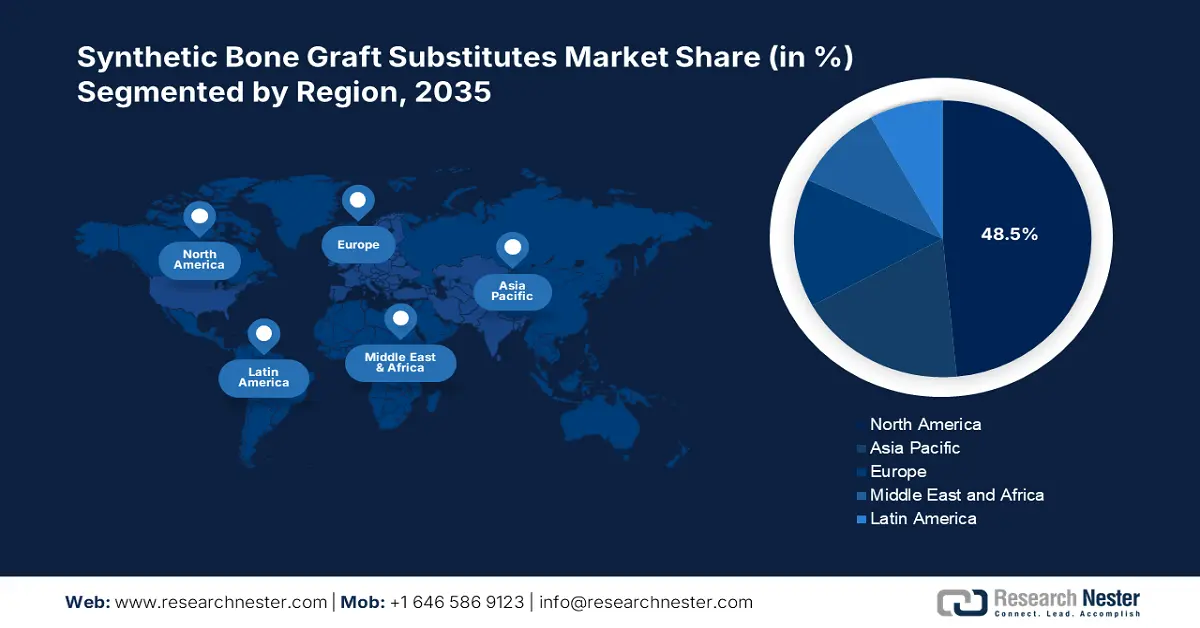
Synthetic Bone Graft Substitutes Market - Regional Analysis
North America Market Insights
The North America synthetic bone graft substitutes market is set to account for more than 48.5% of the global market share by the end of 2035. The key hallmark of the regional market’s dominance is the high osteoporosis prevalence, coupled with the Medicare expansion. The number of aging individuals who face degenerative bone diseases is growing exponentially. This has increased the demand for and urgency to develop safe and effective solutions for bone regeneration. As reported by the National Osteoporosis Foundation, about 54 million Americans suffer from osteoporosis or low bone mass. Besides this, the risk of fractures increases with worsening bone health, often requiring surgical treatment and bone grafting. This clinical demand is supported by an increasing healthcare infrastructure and easy access to orthopaedic and dental services.
The North American market is dominated by the U.S. in terms of volume, population and the prevalence of osteoporosis and related orthopaedic conditions. This level of demand is supported by the introduction of advanced surgical technologies and the presence of prominent medical device companies. The upside with synthetic grafts is the benefits associated with the expansion of Medicare and improving reimbursement from insurance companies; patients' access to a myriad of synthetic grafts has made them the 'standard of care' in many procedures. The landscape of medication and technology investment in R&D, as well as swift enrollment in product approvals from the FDA, and a diligent surgical workforce, also contribute to growth alongside promotional education throughout the country.
Canada is a major player in the North America synthetic bone graft substitutes market, owing to an estimated 7.1% CAGR influenced by public and private healthcare systems. Further, the growth is buoyed by an increasing elderly population and respective increases in osteoporosis fractures. In Canada, funding for health insurance is predominantly provided to citizens and permanent residents by the government, radically improving patient access to orthopaedic care. Patient access for procedures involving bone grafting is assured as provincial health insurance plans increasingly cover various iterations of the procedure. Due to an environment with advanced research and collaboration, there are more opportunities for early adoption of innovative products. The importance of public health education and stronger investments in population health prevention and education strategies are promoting increased awareness and active treatment.
APAC Market Insights
Asia Pacific synthetic bone graft substitutes market is anticipated to witness the fastest growth with a share of 18.4%, growing at a CAGR of 9.3% during the forecast timeline. The regional development is facilitated by the presence of key countries and their developmental tendency. Japan offers its support with the rising number of aging populations. Besides, South Korea is contributing with 3D-printed grafts, utilizing bioresorbable materials. Urbanization, increased access to healthcare, and rising disposable incomes are allowing even more patients the option to select modern surgical treatment as an option. The overall market is also being amplified with government investments to improve healthcare infrastructure and improve orthopaedic care in rural areas and underserved communities. Additionally, the Asia-Pacific is becoming a hotbed for innovation and affordable manufacturing for synthetic graft materials. Local companies connected and international medtech companies are further progressing research and development and setting up manufacturing bases in China and India to keep pace with the regional demand.
The synthetic bone graft substitutes market in India is poised for rapid growth because of the increasing rates of osteoporosis, growing number of road traffic incidents, and an increase in orthopaedic and dental surgeries. The forecast by SaveLIFE Foundation predicts that India saw 4,61,312 traffic accidents in 2022, resulting in 1,68,491 fatalities and 4,43,366 injuries. The government's emphasis on improving overall access to healthcare is feeding the increased usage of synthetic grafts, both in public and private hospitals. The rise of new minimally invasive surgical techniques is supporting strong demand for injectable and mouldable synthetic grafts.
The country of China holds a significant position in the Asia-Pacific market thanks to its aging population and high incidence of osteoporosis and joint-related illnesses. The use of synthetic bone grafts is expected to gradually increase in the public hospital sector. Many local biotech and medical device companies are working with prominent, well-respected research institutions to develop the next generation of bone graft materials and are looking at the challenge of combining bioactivity with a low-cost structure. The National Medical Products Administration (NMPA), through its efforts to streamline regulations and processes for product approvals, is also helping to grow the market potential for synthetic grafts.
Europe Market Insights
The synthetic bone graft substitutes market in Europe is steadily expanding as the population ages and the prevalence of osteoporosis and other bone-related disorders remains high. Germany and France lead the market with advanced healthcare systems and comprehensive reimbursement policies. Innovation is advancing in the sector, as there is an increased number of partnerships between medtech companies, research institutions, and regulatory bodies that are aimed specifically at developing bioactive/biocompatible or minimally invasive grafts. Healthcare infrastructure is solid and growing in Europe, while physician awareness of grafts as part of the Procedure increases.
The synthetic bone graft substitutes market in France is a slowly growing market. This is due to an increasing aging population, a strong public health care system that covers advanced orthopaedic procedures, and the impact of government reimbursement policy to support the common use of bone graft materials. France, like many countries, is reporting a high rate of osteoporosis and functional impairments from other bone-related traumas in the aging population who require orthopaedic solutions and or graft biomaterials. The number of hospitals and or surgical centres in hospitals in France, adopting bioactive and or injectable synthetic grafts, is growing.
Germany is one of the largest and most developed synthetic bone graft substitute markets in Europe, due to its highly developed healthcare system and high volume of orthopaedic and spinal procedures. With an aging population and an increasing number of osteoporosis cases, the demand for ample bone regeneration materials is growing rapidly. In Germany, statutory health insurance covers a large number of orthopaedic procedures using synthetic graft materials, creating incentives for clinical use. Germany is heavily active in medical technology, with many global medtech leaders and numerous research entities active in synthetic bone graft innovation, particularly bio ceramics and nanotechnology. The very high level of surgeon knowledge, stringent quality control measures in place, and pursuit of regulatory recognition help drive the market to prefer synthetic over natural graft types.