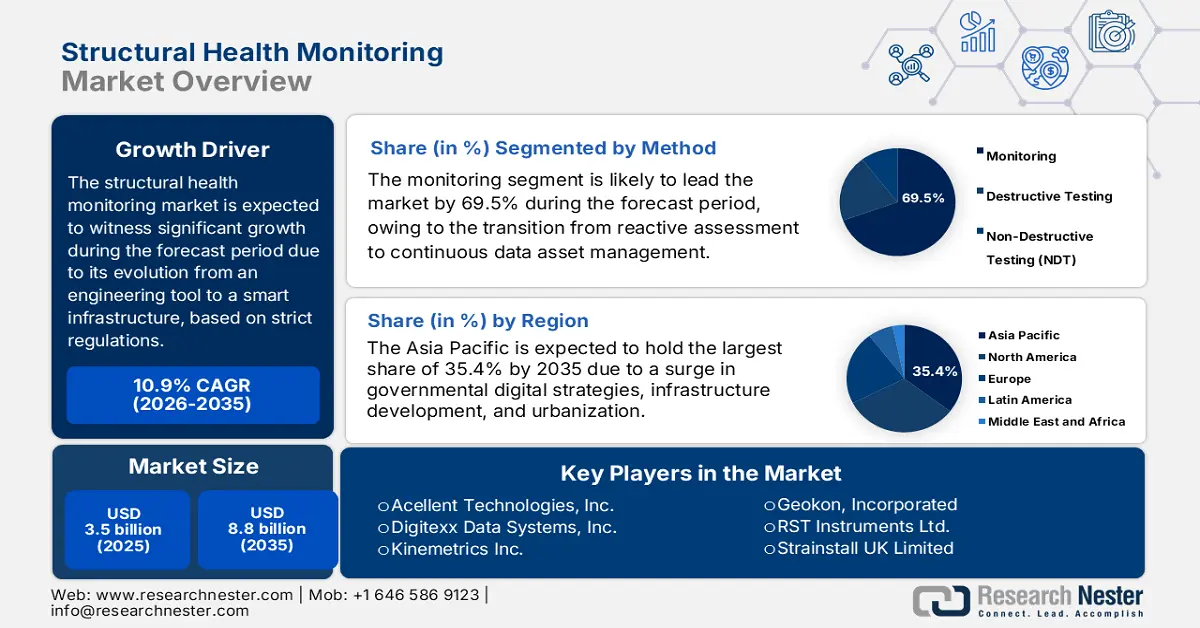
Structural Health Monitoring Market Outlook:
Structural Health Monitoring Market size was over USD 3.5 billion in 2025 and is estimated to reach USD 8.8 billion by the end of 2035, expanding at a CAGR of 10.9% during the forecast timeline, i.e., 2026-2035. In 2026, the industry size of structural health monitoring is estimated at USD 3.8 billion.
The international structural health monitoring market is currently undergoing a crucial transformation, evolving from a specialized engineering tool to a standard component of smart infrastructure and Industry 4.0 strategies. This particular shift is readily driven by the effective convergence of rapid maturation of digital technologies, strict regulations, and aging global infrastructure. According to an article published by the United Nations Organization in 2025, digitalized technologies have progressed rapidly than any other advancement and successfully reached 50% of the developing world’s population within 20 years. Besides, there has been increased focus on shifting to a green economy that is projected to create 24 million new employment opportunities by the end of 2030, thereby denoting an optimistic outlook for the overall market.
Furthermore, the convergence of digital twins, sudden shift to the Internet of Things (IoT)-driven and wireless systems, predictive insights and artificial intelligence-based analytics, integrated multimodal sensing, and growth in platform-specific and SaaS models are also uplifting the structural health monitoring market globally. As per an article published by the NIELIT Government in May 2022, there has been a surge in internet-connected devices by 12.5 billion, which has surpassed the number of human beings, accounting for 7 billion. In addition, the number is gradually increasing by 26 billion to 50 billion, which is creating a positive impact on the market’s continuous growth. Besides, as stated in an article published by the OECD Organization in September 2025, 70% of nations utilize AI to optimize internal governmental processes, while 33% use it to improve policy implementation and design, thereby making it suitable for the market’s development.