Stainless Steel Kirschner Wires Market Outlook:
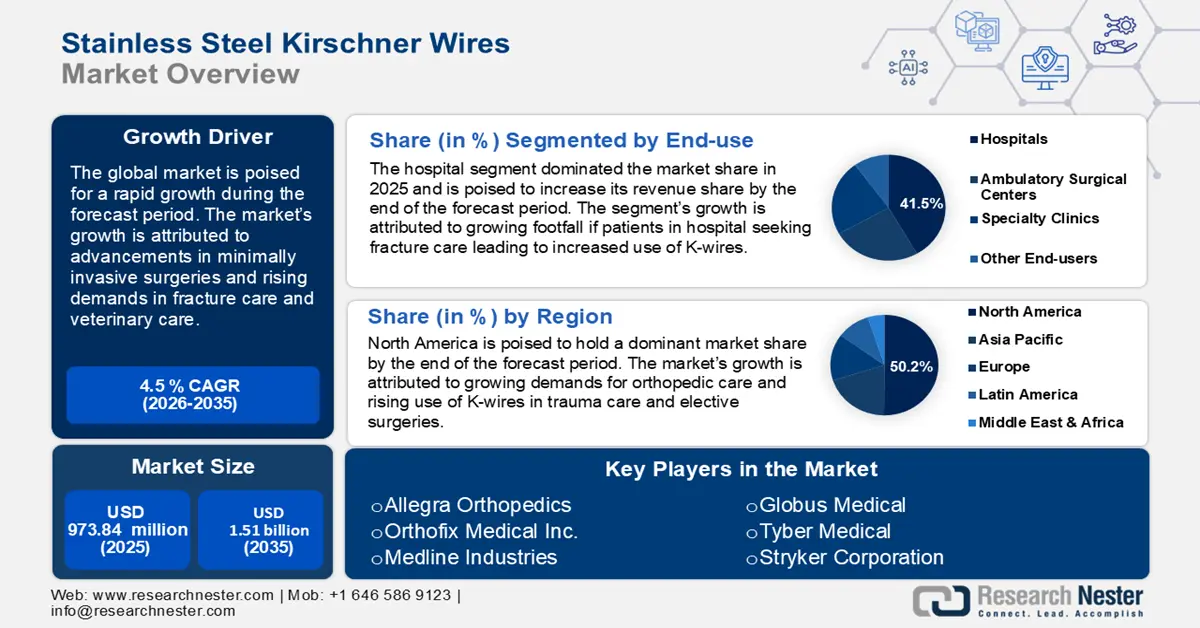
Stainless Steel Kirschner Wires Market size was over USD 973.84 million in 2025 and is anticipated to cross USD 1.51 billion by 2035, witnessing more than 4.5% CAGR during the forecast period i.e., between 2026-2035. In the year 2026, the industry size of stainless steel kirschner wires is assessed at USD 1.01 billion.
The robust stainless steel kirschner wires market growth is attributed to rising prevalence of bone-related disorders and growing demand for orthopedic surgeries. The increase in aging population globally is projected to exponentially increase the demand for fracture care in the next decade. For instance, the United Nations reported 1 in 10 people were aged 65 or above in 2021 and due to decreasing fertility levels, the share of older people has eventually risen up.
In September 2024, the World Health Organization (WHO) released figures of fracture rate comparisons from 1990 to 2019 that indicated a 33.4% increase in new fractures. WHO estimated 455 million prevalent cases of acute or long-term symptoms of fracture, a 70.1% increase since 1990. The rising cases of fractures drastically increase demands for K-wire solutions owing to improved biocompatibility and corrosion resistance. K-wires provide an anchor to hold bone fragments. Additionally, there is a rising awareness of minimally invasive surgery, which is poised to increase demands for K-wires of various diameters. Improvements in the healthcare sector for robust distribution channels also ensure the availability of K-wires in remote areas with clinics. The increased usage and accessibility to healthcare professionals are projected to continue boosting the stainless steel kirschner wires market’s growth by the end of 2037.
The opportunities for various segments within the global stainless steel kirschner wires market are vast. Key market players can take advantage of the rising emphasis on developing advanced surgical tools and materials. For instance, in September 2023, Tyber Medical gained Food and Drug Administration (FDA) clearance on implantable K-wires on stainless steel and titanium alloy. Additionally, the rising prevalence of sports-related injuries is a driving factor for the global market. The market trends estimate a profitable future during the forecast period, with rising investments in the healthcare sector in emerging economies leading to a surge in demand for K-wires.