Spirulina Market Outlook:
Spirulina Market size was over USD 249.3 million in 2025 and is projected to cross USD 563.6 million by the end of 2035, growing at more than 8.5% CAGR during the forecast period, i.e., 2026-2035. In 2026, the industry size of spirulina is evaluated at USD 270.4 million.
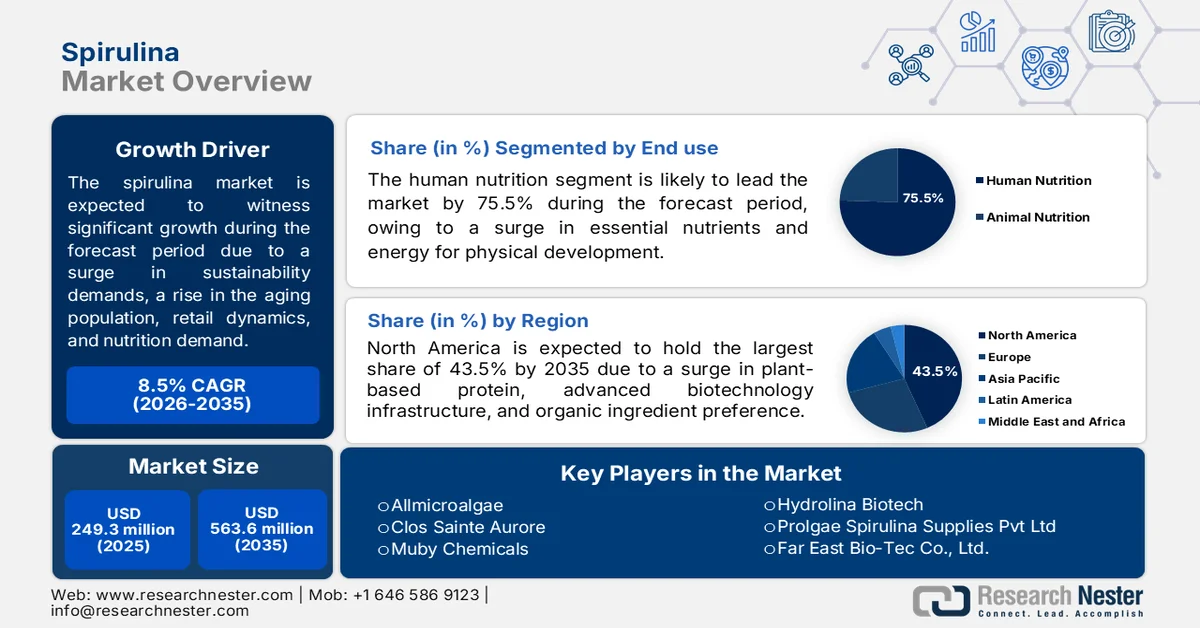
The worldwide spirulina market is positively influenced by shifting consumer demographics, evolving retail dynamics, environmental sustainability mandates, an aging population, an increase in the demand for nutrition, and the rise of personalized nutrition platforms. According to official statistics published by NLM in September 2025, over 650 million adults are overweight, and almost 20% of the global population is projected to be affected by the end of 2030. Besides, 537 million adults are impacted by diabetes, which is further poised to rise to 783 million by the end of 2045. Therefore, based on these health issues, traditional dietary recommendations have always been wide-ranging. However, to consider inter-individual variation in diet responses, there is a huge growth and demand for personalized nutrition platforms, thus driving the spirulina market exposure.
Overweight and Obesity Incidence Among People Globally, 2022-2024
|
Overweight |
Obesity |
||
|
Component |
Incidence |
Component |
Incidence |
|
|
|
People living with the incidence |
1 in 8 (2022) |
|
Adults aged more than 18 years |
2.5 billion (2022) |
Overweight population |
890 million |
|
Adult % |
43.0% |
Adult % |
16.0% |
|
Children under 5 years |
35 million (2024) |
- |
- |
|
Children between 5 to 19 years |
390 million (2022) |
Overweight child population |
160 million |
Source: WHO
Furthermore, the blue color-label movement in beverages and confectionery, along with regular wellness and athleisure consumer segmentation, and an increase in symbiotic and fermented products, are a few trends that are responsible for fueling the spirulina market globally. As stated in an article published by NLM in November 2024, protein is considered the most abundant component of spirulina, readily accounting for 50% to 70% of its dry weight. This protein content is extremely notable, owing to the presence of 38.8% of essential amino acids, including 7.6% of leucine, 4.3% of lysine, 2.3% of methionine, 4.4% of phenylalanine, 4.8% of threonine, 1.95 of tryptophan, and 6.3% of valine. Likewise, it also comprises 61.1% of non-essential amino acids, such as 7.5% of alanine, 7.6% of arginine, 5.2% of glycine, and 4.1% of serine, thus making spirulina an attractive dietary protein source, especially for the beverage and confectionary sectors.
Key Spirulina Market Insights Summary:
Regional Highlights:
- North America is anticipated to capture a 43.5% share of the spirulina market by 2035, owing to surging consumer preference for plant-based protein supplements and organic non-GMO ingredients
- Asia Pacific is poised to register the fastest growth in the market throughout 2026-2035, impelled by expanding supplement manufacturing facilities and rising demand for functional foods
Segment Insights:
- The human nutrition segment is projected to command a 75.5% share of the spirulina market by 2035, propelled by rising demand for nutrient-rich dietary intake supporting mental and physical development
- By 2035, the Arthrospira platensis sub-segment is expected to secure the second-largest share in the market, fueled by its growing utilization as a nutrient-dense superfood and iron-rich dietary supplement
Key Growth Trends:
- Pet humanization in premium food formulations
- Government-backed algae agriculture
Major Challenges:
- Supply chain vulnerabilities and contamination risks
- Regulatory fragmentation and labeling compliance obstacles
Key Players: DIC Corporation, Cyanotech Corporation, Parry Nutraceuticals, Earthrise Nutritionals LLC, Sensient Technologies Corporation, Chr. Hansen Holding AS, Fuqing King Dnarmsa Spirulina Co., Ltd., Inner Mongolia Rejuve Biotech Co., Ltd., Chenghai Baoer, Wudi Luqi Biological Engineering Co., Ltd., Lvxian Biotech, Green-A, CBN, Hydrolina Biotech, Prolgae Spirulina Supplies Pvt Ltd, Far East Bio-Tec Co., Ltd., Elken, Allmicroalgae, Clos Sainte Aurore, Muby Chemicals, NielsenIQ, FoodHealth Co., Mars Petcare, Zinzino.
Global Spirulina Market Forecast and Regional Outlook:
Market Size & Growth Projections:
- 2025 Market Size: USD 249.3 million
- 2026 Market Size: USD 270.4 million
- Projected Market Size: USD 563.6 million by 2035
- Growth Forecasts: 8.5% CAGR (2026-2035)
Key Regional Dynamics:
- Largest Region: North America (43.5% Share by 2035)
- Fastest Growing Region: Asia Pacific
- Dominating Countries: United States, China, India, Japan, Germany
- Emerging Countries: Brazil, South Korea, Indonesia, Vietnam, Mexico
Last updated on : 15 May, 2026
Spirulina Market - Growth Drivers and Challenges
Growth Drivers
- Pet humanization in premium food formulations: Pet owners are increasingly applying their respective dietary standards to animal nutrition, which is driving the spirulina market demand globally. According to official statistics published by NLM in February 2026, there exists a massive industry for cat and dog food, since the global pet food industry was significantly valued at USD 132.4 billion as of 2025, with dog and cat food accounting for 95% of sales. Besides, there were roughly 528 million companion dogs and 476 million cats globally, based on which pet nutrition is in huge demand. Meanwhile, the international pet food sector is predicted to almost double to USD 247.7 billion by the end of 2035, with animal-based ingredients comprising approximately 53% of dog and cat food.
- Government-backed algae agriculture: Different national governments are proactively subsidizing spirulina cultivation as a tactical tool for food security and agricultural diversification. As stated in an article published by NLM in November 2022, the yearly commercial output of spirulina around the world surged from 3,000 to 5,500 tons. Meanwhile, based on the cultivation aspect, environmental factors, such as 4 Klux lightning, along with 30 degrees Celsius temperature, stirring speed, inoculation volume, 10 to 60 g/L dissolved solids, 8.5 to 10.5 pH, and total water quality, as well as micronutrient presence, play a crucial role in the overall agricultural process. Besides, the spirulina biomass production on a large scale is based on different elements, including temperature, light, algal strain, and nutrients, thereby bolstering the spirulina market growth.
- Increase in medical nutrition: Clinical nutrition providers and hospitals are continuously adding spirulina to malnutrition and post-surgical recovery protocols, especially across emerging economic public health systems. As per an article published by NLM in November 2023, 69% of reproductive-aged women and 56% of pre-school-aged children are found to be deficient in more than 1 essential micronutrient. Therefore, unlike general sports or wellness nutrition, this particular driver is physician-prescribed and readily operates through medical supply chains in comparison to retail. Moreover, the green algae’s complete amino acid profile, room-temperature stability, and digestibility for patients with gut function make the spirulina market suitable, particularly for humanitarian rations and safety food kits.
Challenges
- Supply chain vulnerabilities and contamination risks: The aspect of cultivation in the spirulina market is inherently susceptible to environmental contaminants, thus posing a persistent risk for consumer goods manufacturers, facing severe brand risk from product recalls. Besides, open ponds, while cost-effective, are exposed to heavy metals, airborne pollutants, and microcystins from cross-contamination with toxic blue-green algae strains. Likewise, closed systems tend to witness batch failures owing to temperature fluctuations, pH imbalances, or microbial invasions. Moreover, when a contaminated batch enters the supply chain, the consequences for a consumer goods brand are catastrophic, usually ranging from expensive product recalls and regulatory fines to permanent reputational damage, particularly in the health-conscious consumer segment.
- Regulatory fragmentation and labeling compliance obstacles: The spirulina market operates across diversified international regulatory landscapes, pressuring consumer goods organizations to navigate a fragmented and often contradictory compliance environment. In Europe, spirulina is recognized as a notable food ingredient, demanding specific pre-market authorization for certain health claims and utilization levels. Simultaneously, in the U.S., the Food and Drug Administration (FDA) generally recognizes spirulina as safe, but individual states may impose additional labeling requirements regarding heavy metal testing or organic certification. Meanwhile, Asia-based markets such as Japan and India have their respective frameworks under FSSAI and the Ministry of Health, respectively, often mandating country-specific shelf-life studies and ingredient origin disclosures.
Spirulina Market Size and Forecast:
| Report Attribute | Details |
|---|---|
|
Base Year |
2025 |
|
Forecast Year |
2026-2035 |
|
CAGR |
8.5% |
|
Base Year Market Size (2025) |
USD 249.3 million |
|
Forecast Year Market Size (2035) |
USD 563.6 million |
|
Regional Scope |
|
Spirulina Market Segmentation:
End user Segment Analysis
Based on the end user, the human nutrition segment is anticipated to capture the largest share, at 75.5%, in the spirulina market by the end of 2035. The segment’s upliftment is primarily attributed to the provision of crucial energy and nutrients required for mental and physical development, the regulation of bodily processes, and tissue repair. According to official statistics published by the World Health Organization (WHO) in January 2026, carbohydrates, as an essential nutrient, constitute a suitable portion of the human diet, accounting for an estimated 75% of total energy intake. Besides, people aged more than 10 years are expected to aim for almost 400 grams of vegetables and fruits every day. Likewise, children under 10 years need to consume 250 to 350 grams of carbohydrates, thereby making it suitable for boosting the segment’s growth.
Type Segment Analysis
During the forecast period, the Arthrospira platensis sub-segment, part of the type segment, is projected to account for the second-largest share in the spirulina market. The sub-segment’s growth is effectively driven by its importance as a nutrient-dense superfood, industrial source of bioactive compounds, and dietary supplement. As stated in an article published by NLM in November 2025, in terms of iron deficiency, anemia readily affects 40% of children aged between 6 and 59 months, along with 37% of pregnant women and 30% of non-pregnant women aged from 15 to 49 years. Therefore, Arthrospira platensis stands as an outstanding and valuable source of iron and other essential nutrients. In addition, it offers 133.5 mg of iron per 100 grams and is rich in high-temperature and acidic environments, thus driving the sub-segment’s demand globally.
Nature Segment Analysis
The conventional spirulina sub-segment, which is part of the nature segment, is expected to garner the third-largest share in the spirulina market by the end of the stipulated timeline. The sub-segment’s development is highly propelled by its necessity as a commercially cultivated and highly nutritious blue-green algae, considered for its intense nutrient density, high protein content, and antioxidant properties. As per an article published by NLM in November 2024, spirulina is considered a valuable source of protein, accounting for between 55% and 70%, and also comprising all crucial amino acids. Besides, spirulina is commercially available in different forms, such as capsules, tablets, and dry powder, with a suggested dose range from 0.2 grams to 5 grams, thereby denoting a huge growth opportunity and an optimistic outlook for the sub-segment’s exposure.
Our in-depth analysis of the spirulina market includes the following segments:
|
Segment |
Subsegments |
|
End user |
|
|
Type |
|
|
Nature |
|
|
Distribution Channel |
|
|
Form |
|
|
Application |
|

Vishnu Nair
Head - Global Business DevelopmentCustomize this report to your requirements — connect with our consultant for personalized insights and options.
Spirulina Market - Regional Analysis
North America Market Insights
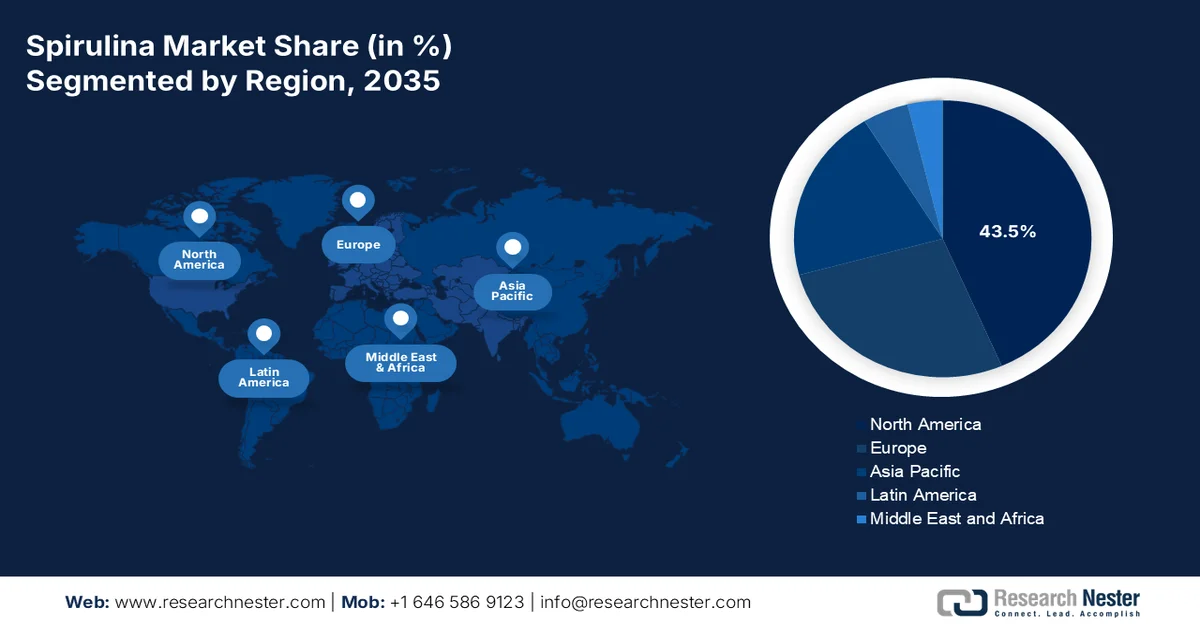
North America in the spirulina market is anticipated to garner the highest share of 43.5% by the end of 2035. The market’s upliftment in the region is primarily attributed to an increase in health consciousness, robust demand for plant-based protein supplements, innovative biotechnology infrastructure, and the consumer preference for organic, natural, and non-GMO ingredients. According to official statistics published by the Good Food Institute (GFI) Organization in 2026, plant-based food sales in the U.S. retail industry were worth USD 3.9 billion, which later doubled to USD 7.9 billion as of 2025. In addition, 60% or 6 in 10 households in the country purchase plant-based foods, while these food products make 1.1% of overall retail food and beverage sales, and 96% of households purchased plant-based seafood and meat, thus enhancing the spirulina market exposure in the region.
Regional Plant-Based Foods Sales Metrics and Purchase Dynamics, 2025
|
Sales Dynamics |
Total Plant-Based Foods |
|
Dollar sales |
USD 7.9 billion |
|
1-year dollar growth |
-2.0% |
|
Dollar share |
1.1% |
|
Unit sales |
1.7 billion |
|
1-year unit growth |
-3.0% |
|
Unit share |
0.9% |
|
Household penetration |
60.0% |
|
Repeat rate |
78.0% |
Source: GFI Organization
The spirulina market in the U.S. is growing significantly, owing to NASA and military research funding for algae-based life support systems, the presence of the USDA specialty crop block grant program for algae agriculture, and state-based carbon capture tax credits. Besides, as stated in an article published by the CDC Government in January 2024, the parent population in the country, especially mothers, commences breastfeeding, but almost 6 in 10 stop earlier than planned. In this regard, lower rates of breastfeeding add over USD 3 billion every year to medical expenses for both women and children in the country. Meanwhile, fewer than 1 in 10 adults and children consume the recommended amount of vegetables, thus increasing the focus on nutrition. However, as of 2023, over 6,100 schools in the nation provided salad bars, which boosted healthy fruit and vegetable products for more than 3.5 million school staff and children, thereby positively impacting the spirulina market growth.
The tactical innovation fund for algae biorefinery stream, the indigenous economic development of partnerships for the north civilization, and a surge in cross-border algae supply chains through the Pacific economic development agency are certain factors that are enhancing the spirulina market in Canada. As per an article published by the Observatory of Economic Complexity (OEC) in April 2026, the country is the largest exporter of seaweeds and other algae products, with a valuation worth USD 25.2 million. In addition, the country also imports these products, amounting to USD 17.8 million. Besides, there is a huge focus on strategies emphasizing bioeconomy principles, wherein every spirulina biomass component generates suitable revenue, thereby denoting an optimistic outlook for the market upliftment.
APAC Market Insights
The Asia Pacific in the spirulina market is expected to emerge as the fastest-growing region during the forecast period. The market’s development in the region is highly propelled by a rise in health consciousness, an increase in disposable incomes, an expansion in supplement manufacturing facilities, a surge in the demand for functional foods, low-cost production benefits, and the presence of government bioeconomy strategies. According to official statistics published by NLM in February 2025, the health and wellness food industry in China was valued at an estimated USD 45.5 billion as of 2023, which is further predicted to expand to USD 58.2 billion by the end of 2032. Based on this growth, 70% of individuals in the country aged between 50 and 65-years experienced interest in dietary supplements that are tailored to senior citizens, thus driving the market demand.
The spirulina market in China is gaining increased traction, owing to effectively prioritizing microalgae cultivation for feed, industrial applications and food, generous infrastructure investment, offering policy certainty, an increase in middle-class consumers, and a transition towards preventive healthcare. As stated in an article published by NLM in February 2025, an estimated 47.3% of the middle-aged and older adult population in the country are impacted with almost 1 health checkup. Besides, the proportion of older adult individuals in the country is expected to surpass 30% of its overall population by the end of 2035. Moreover, the total health spending catered to 6.4% of the nation’s gross domestic product (GDP), which is also anticipated to increase by 10% by the end of 2030, thus creating a huge growth opportunity for the market.
The aspects of an increase in the prevalence of lifestyle-based diseases, an upsurge in the demand for preventive nutrition and supplements, growth in the need for clean-label protein alternatives, expansion in the supply chain, and suitable healthcare development are a few factors that are responsible for fueling the spirulina market in Japan. As per a data report published by OECD in November 2025, preventable mortality in the country was 86 per 100,000, with treatable mortality at 49 per 100,000. Besides, the spirulina industry in the country was valued at USD 18.3 million as of 2025, which is further forecasted to be worth USD 19.7 million by the end of 2026, as well as USD 51.4 million, along with a 10.5% growth rate by the end of 2035. Therefore, with the increased health awareness and continuous expansion in the product, the market is expanding in the country.
Europe Market Insights
Europe in the spirulina market is projected to witness considerable growth by the end of the stipulated timeline. The market’s growth in the region is effectively driven by a rise in health consciousness, supportive government strategies, growth in the e-commerce industry, advanced product development, and the strong requirement for industrial appeal, enhancing product credibility, and organic certification. According to official statistics published by the ITA in 2025, the region is considered the third-largest retail e-commerce industry globally, with an overall revenue worth USD 631.9 billion. This is further subject to a yearly growth rate of 9.3% for revenues, which is projected to result in USD 902.3 billion in regional retail e-commerce sales by the end of 2027. Additionally, the e-commerce expenditure across different countries is also fueling the spirulina market growth in the region.
Regional E-commerce Spending Across Different Countries, 2025
|
Countries |
Spending % |
|
UK |
9.3% |
|
Denmark |
7.3% |
|
Greece |
5.9% |
|
Sweden |
5.8% |
|
Spain |
5.7% |
|
France |
5.2% |
|
Finland |
5.2% |
|
Portugal |
4.8% |
|
Czech Republic |
4.7% |
|
Norway |
4.6% |
|
Poland |
4.4% |
|
Netherlands |
3.6% |
|
Germany |
3.0% |
Source: ITA
The spirulina market in Germany is gaining increased exposure, owing to regulatory policies for favoring organic-certified superfoods, a boost in the advanced industrial infrastructure, strong research and development capabilities, promoting sustainable chemical innovation, and the integration of the bio-based chemical value chain. Based on the 2030 Organic Strategy data report, the aspect of 30% organic approach is considered a suitable opportunity for enabling the environment, enterprises, and climate to be fit for the future. Besides, the Europe Commission ensures great importance to organic farming, with the intention of accounting for 25% of regional agricultural land, which is nearly 40 million hectares by the end of 2030. Moreover, the administrative organization introduced an action plan for developing organic production, thus enhancing the market in the country.
The increase in consumer awareness of health benefits, a significant transition to vegan and plant-based diets, robust demand in Manchester and London for healthy food trends, a regulatory environment, and barrier reduction for new brand entry, along with enabling direct-to-consumer sales models, are certain trends that are driving the spirulina market in the UK. As per an article published by the Vegetarian Society Organization in 2026, 4.5% of the domestic population follows a vegetarian or vegan diet, accounting for more than 3 million adults and children aged more than 18 years. Besides, the population consumed 17% less meat, and also spent nearly USD 811.5 million on meat-free food products. Furthermore, the plant-specific alternative industry in the country grew from USD 5.2 billion to USD 8.9 billion by the end of 2025, thus boosting the market exposure.
Key Spirulina Market Players:
- DIC Corporation (Japan)
- Cyanotech Corporation (U.S.)
- Parry Nutraceuticals (India)
- Earthrise Nutritionals LLC (U.S.)
- Sensient Technologies Corporation (U.S.)
- Chr. Hansen Holding AS (Denmark)
- Fuqing King Dnarmsa Spirulina Co., Ltd. (China)
- Inner Mongolia Rejuve Biotech Co., Ltd. (China)
- Chenghai Baoer (China)
- Wudi Luqi Biological Engineering Co., Ltd. (China)
- Lvxian Biotech (China)
- Green-A (China)
- CBN (China)
- Hydrolina Biotech (China)
- Prolgae Spirulina Supplies Pvt Ltd (India)
- Far East Bio-Tec Co., Ltd. (FEBICO) (Taiwan)
- Elken (Malaysia)
- Allmicroalgae (Portugal)
- Clos Sainte Aurore (France)
- Muby Chemicals (India)
- NielsenIQ (NIQ) (U.S.)
- FoodHealth Co. (U.S.)
- Mars Petcare (U.S.)
- Zinzino (Sweden)
- Company Overview
- Business Strategy
- Key Product Offerings
- Financial Performance
- Key Performance Indicators
- Risk Analysis
- Recent Development
- DIC Corporation, as a conglomerate, owns a leading U.S.-based spirulina subsidiary. The company leverages its extensive distribution network to supply pharmaceutical-grade spirulina extracts globally.
- Cyanotech Corporation, a Hawaii-based producer, specializes in cultivating high-quality spirulina using natural sunlight and deep ocean water. The company focuses on the nutraceutical and functional food segments.
- Parry Nutraceuticals, a subsidiary of a large India-based conglomerate, operates one of Asia's largest spirulina cultivation facilities. The company emphasizes sustainable and traceable production for dietary supplement manufacturers worldwide.
- Earthrise Nutritionals LLC., a California-based company, pioneered commercial spirulina farming in the U.S. several decades ago. The brand is strongly associated with organic, non-GMO spirulina sold through health food retailers.
- Sensient Technologies Corporation, a specialty color and flavor company, incorporates spirulina-derived phycocyanin into its natural food coloring portfolio. The company serves major food and beverage brands seeking plant-based blue and green color alternatives.
Here is a list of key players operating in the global market:
The global spirulina market is moderately consolidated, with a mix of long-established Japan, U.S., and India-based producers alongside emerging China and Taiwan-specific manufacturers. Meanwhile, DIC Corporation leads the market, leveraging its ownership of Cyanotech Corporation to dominate both spirulina powder and phycocyanin extract segments. Key strategic initiatives include vertical integration, with companies, such as Parry Nutraceuticals and FEBICO, controlling cultivation through extraction processes to ensure quality and cost efficiency. Besides, in June 2025, NielsenIQ (NIQ) and FoodHealth Co. declared a groundbreaking collaboration for integrating the FoodHealth Score, which is a cutting-edge nutrition intelligence tool, into NIQ’s worldwide data ecosystem. Therefore, with such collaborations, there is a huge focus on human nutrition, which is enhancing the spirulina industry demand.
Corporate Landscape of the Spirulina Market:
Recent Developments
- In May 2026, Mars Petcare and Big Idea Ventures launched the next-generation Pet Food Program by collaborating with industrial leaders, such as Ingredion, Givaudan, AAK, and Bühler, thus making advancements in sustainable solutions in pet nutrition.
- In November 2025, Zinzino acquired 35% of Xion International Group, with the intention of developing a joint venture for producing algae by utilizing bioreactors, and further secured a future sustainable supply of omega-3, particularly for BalanceOil+, which is a polyphenol-rich, omega-balancing dietary supplement.
- In April 2025, DIC Corporation proclaimed that Earthrise Nutritionals, LLC, its U.S. subsidiary, commenced operations at its newest edible algae cultivation infrastructure, intending to realize sustainable smart farming.
- Report ID: 8569
- Published Date: May 15, 2026
- Report Format: PDF, PPT
- Explore a preview of key market trends and insights
- Review sample data tables and segment breakdowns
- Experience the quality of our visual data representations
- Evaluate our report structure and research methodology
- Get a glimpse of competitive landscape analysis
- Understand how regional forecasts are presented
- Assess the depth of company profiling and benchmarking
- Preview how actionable insights can support your strategy
Explore real data and analysis
Frequently Asked Questions (FAQ)
About this Report
Connect with our Expert


Report, 2026-2035



Copyright @ 2026 Research Nester. All Rights Reserved.
