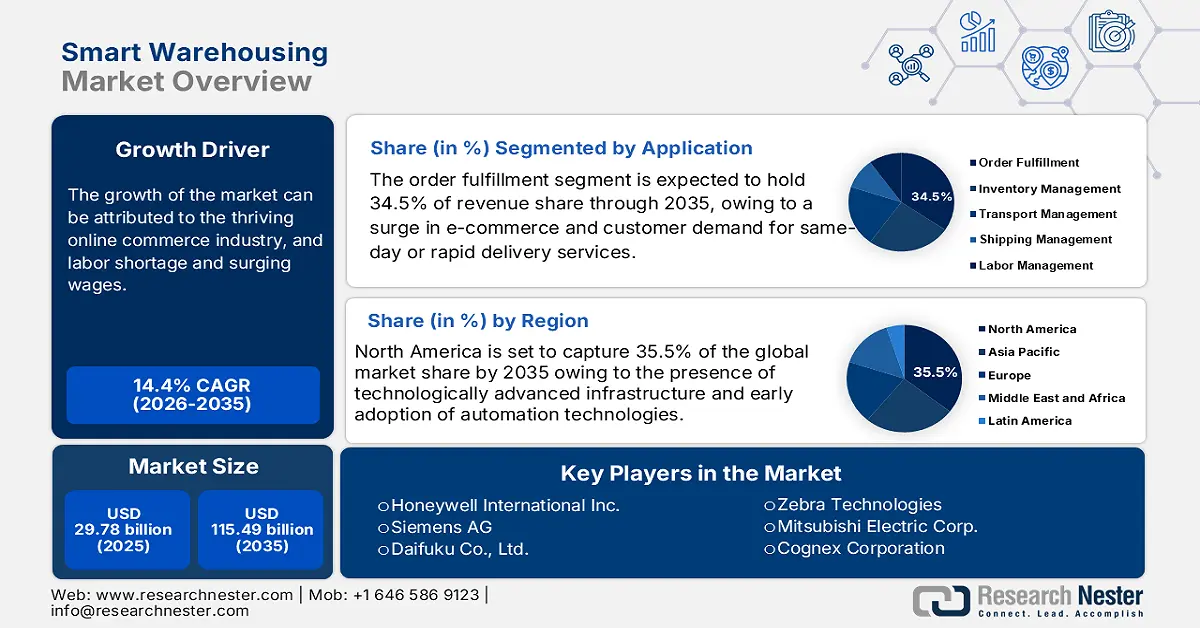
Smart Warehousing Market Outlook:
Smart Warehousing Market was valued at USD 29.78 billion in 2025 and is projected to reach USD 115.49 billion by the end of 2035, rising at a CAGR of 14.4% during the forecast period, i.e., 2026-2035. In 2026, the industry size of smart warehousing is evaluated at USD 33.96 billion.
The market is undergoing a remarkable transition fueled by shifts in trade dynamics and technological advancements. The warehouse operations are directly dependent upon the export and import of raw materials and goods. Technological advancements such as the inclusion of blockchain, AI, and ML. Additionally, a study showcased that unmanned aerial vehicle systems have also automated the inventory tasks management and upgraded the traceability of products in the supply chain. These concoctions are pivotal for facilitating warehouse processing and ensuring transparency in the supply chain. The smart warehousing industry is transforming itself to adapt to the technologically advancing landscape. Companies are embracing novel technologies and responding positively, even to the highly volatile trade patterns. Smart warehousing holds the capability to address key challenges of the traditional warehousing systems, such as labor shortage, exhaustive logistics, and managing an intricate supply chain.
One of the key trends is a growing reliance on artificial intelligence (AI) and generative AI technologies to help support inventory planning, forecast demand, and drive automation of routine decisions in warehouse operations. Warehouses are also increasingly implementing robotics, and in most cases, the robotics are being used to work collaboratively with people. Another significant trend involves the use of Internet of Things (IoT) devices and digital twin technology providing visibility into what is happening in the warehouse. Cloud-based Warehouse Management Systems (WMS) are gaining in prominence, with companies seeing new ways to expand scalability, gain remote access, and connect to commerce systems.