Shortwave Infrared (SWIR) Market Outlook:
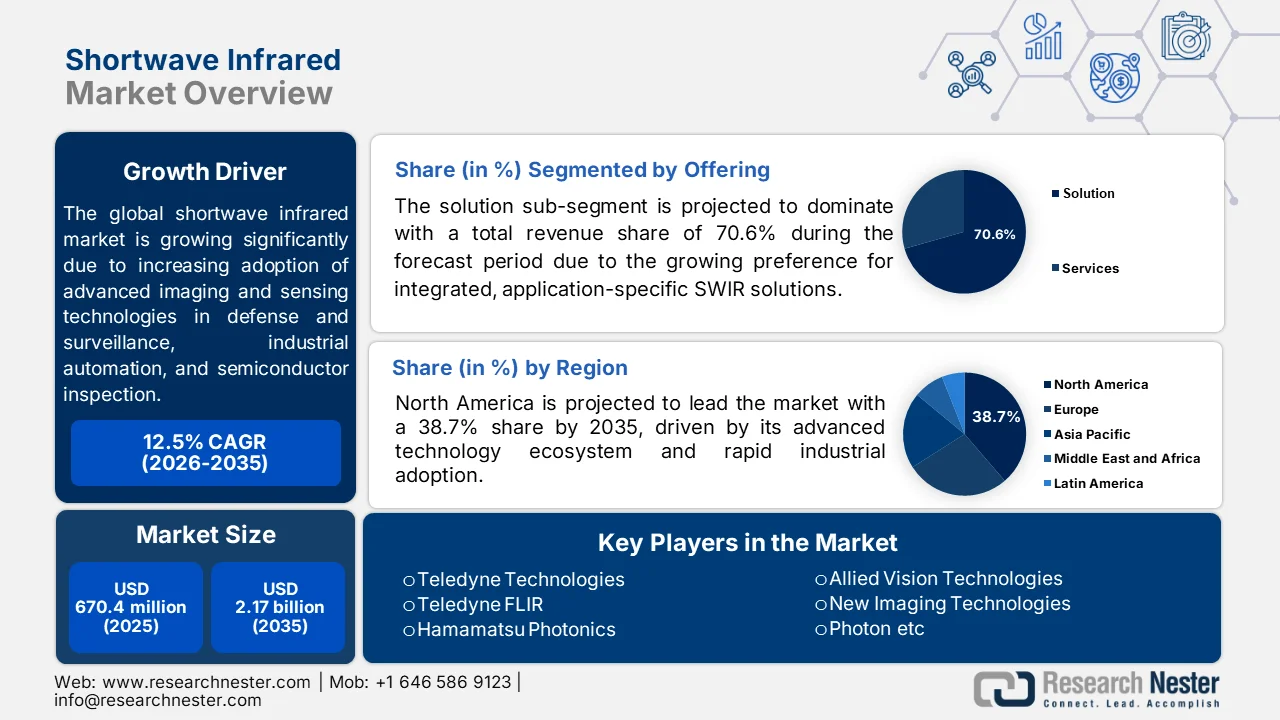
Shortwave Infrared (SWIR) Market size was valued at USD 670.4 million in 2025 and is anticipated to reach USD 2.17 billion by the end of 2035, expanding at around 12.5% CAGR during the forecast period, i.e., 2026-2035. In 2026, the industry size of shortwave infrared is estimated at USD 754.2 million.
The global shortwave infrared market is positioned for solid growth, which is driven by increasing adoption of advanced imaging and sensing technologies in defense and surveillance, industrial automation, semiconductor inspection, machine vision, agriculture, food sorting, recycling, healthcare, and scientific research. This technology is transitioning from a niche defense tool into a mainstream commercial solution, effectively fueled by advancements in manufacturing techniques that improve sensor yield and affordability. As per an article published by the National Institutes of Health (NIH) in December 2025, SWIR imaging 1000 - 2000 nm offers greater sensitivity to tissue water and lipids, with reduced scattering and hemoglobin/melanin absorption enabling deeper tissue assessment. It also stated that recent advances have applied SWIR to skin hydration, lipid mapping, burn-depth diagnosis, diabetic neuropathy, and ocular imaging.
Furthermore, in terms of industrial automation, SWIR imaging is becoming indispensable for machine vision applications, such as non-destructive quality control, semiconductor wafer inspection, and food sorting. This is because it can see through opaque materials and detect moisture, prompting a profitable business environment for the shortwave infrared market. In this context, Sony Semiconductor Solutions showcased advanced imaging technologies at APCS 2025 in Tokyo in January 2026, including high-speed global-shutter sensors and the SWIR IMX992. This IMX992 demonstrated silicon-wafer penetration for reverse-side inspection, highlighting SWIR’s potential for advanced semiconductor manufacturing, and it can support next-generation industrial inspection and packaging applications.
Key Shortwave Infrared Market Insights Summary:
Regional Highlights:
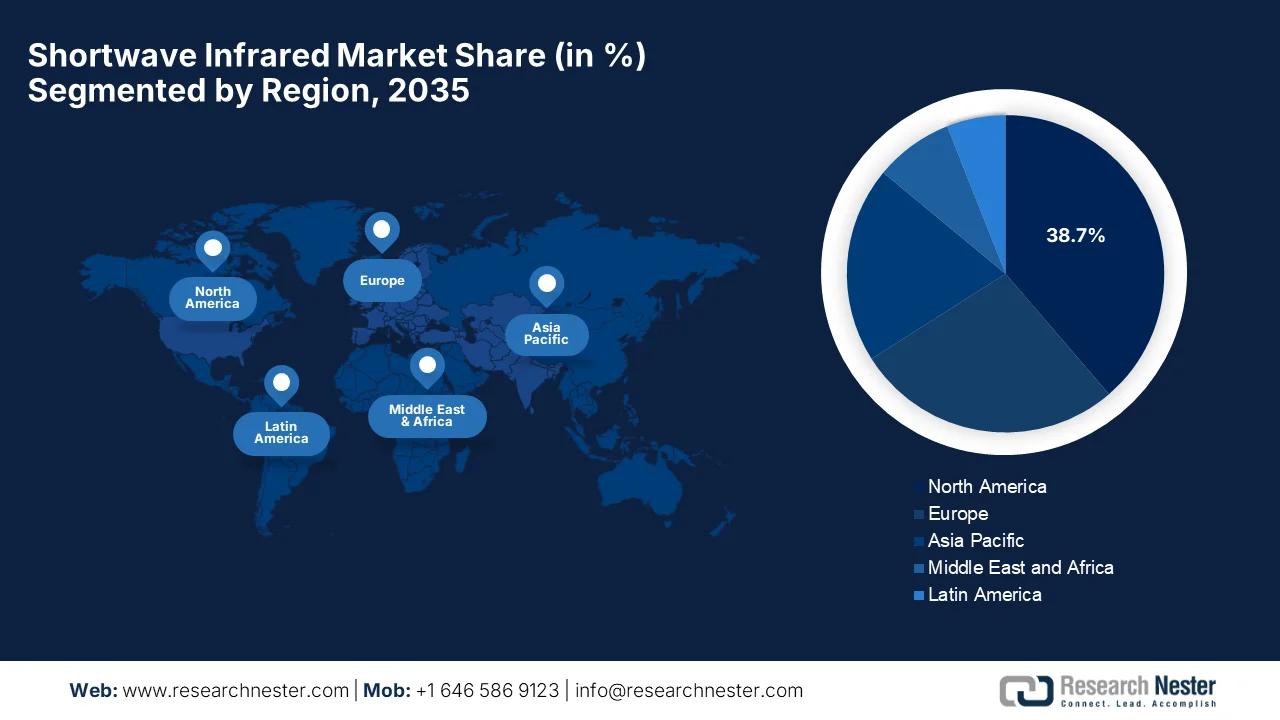
- North America is projected to command the highest 38.7% share during 2026-2035 in the shortwave infrared market, reflecting substantial investments in military modernization and homeland security.
- Asia Pacific is forecast to register the fastest growth during 2026-2035, fueled by massive electronics manufacturing hubs and accelerating industrial automation.
Segment Insights:
- The solution sub-segment is projected to command a 70.6% revenue share during 2026-2035 in the shortwave infrared market, supported by the growing preference for integrated, application-specific SWIR solutions.
- The spectral imaging sub-segment is anticipated to secure a substantial share during 2026-2035, reflecting rising demand for precise material identification and non-destructive analysis.
Key Growth Trends:
- Autonomous vehicle safety
- Emerging quantum technologies
Major Challenges:
- Severe technical complexities
- Strict export regulations
Key Players: Teledyne Technologies (Canada), Teledyne FLIR (U.S.), Hamamatsu Photonics (Japan), Allied Vision Technologies (Germany), New Imaging Technologies (NIT) (France), Photon etc. (Canada), Raptor Photonics (UK), Imperx (U.S.)
Global Shortwave Infrared Market Forecast and Regional Outlook:
Market Size & Growth Projections:
- 2025 Market Size: USD 670.4 million
- 2026 Market Size: USD 754.2 million
- Projected Market Size: USD 2.17 billion by 2035
- Growth Forecasts: 12.5% CAGR (2026-2035)
Key Regional Dynamics:
- Largest Region: North America (38.7% Share by 2035)
- Fastest Growing Region: Asia Pacific
- Dominating Countries: United States, China, Japan, Germany, South Korea
- Emerging Countries: Taiwan, United Kingdom, Canada, France, Netherlands
Last updated on : 20 August, 2026
Shortwave Infrared (SWIR) Market - Growth Drivers and Challenges
Growth Drivers
- Autonomous vehicle safety: Advanced driver-assistance systems responsibly accelerate shortwave infrared market growth. Autonomous vehicles need reliable environmental perception in hazardous conditions in which SWIR radiation penetrates thick fog, heavy rain, dense smoke, as well as blinding glare. This capability provides critical long-range night vision, maximizing passenger safety during severe weather. In September 2024, NIH stated that ADAS technologies improve driving safety and comfort by combining cameras, radar, LiDAR, and ultrasonic sensors to detect vehicles, pedestrians, lanes, and obstacles. Systems such as adaptive cruise control, blind-spot detection, lane keeping, and emergency braking assist drivers by deliberately reducing collision risks and workload, thus increasing the growth avenues for the industry.
- Emerging quantum technologies: The rise of colloidal quantum dot technology revolutionizes the entire market outlook. Traditional SWIR sensors depend on expensive materials, but CQD integration utilizes standard silicon CMOS fabrication. This manufacturing aspect raises production costs. Therefore, SWIR technology becomes highly accessible for mass-market consumer electronics, smartphones, and some of the affordable medical devices. In December 2025, Imec demonstrated CMOS-compatible integration of colloidal quantum-dot photodiodes with metasurfaces on 300 mm wafers, enabling compact multispectral SWIR sensors. It also mentioned that this technology uses wavelength-tunable quantum dots and metasurfaces to provide high-resolution spectral detection while reducing the cost and size of conventional SWIR sensors.
Challenges
- Severe technical complexities: Manufacturing SWIR sensors represents severe technical complexities that limit production scaling and yield optimization. The lattice mismatch between InGaAs epitaxial layers and standard silicon substrates leads to crystal defects, which directly degrade sensor performance. In this context, achieving high-resolution arrays needs reducing pixel pitches, but smaller pixels complicate the delicate hybridization bonding process. The presence of this technical hurdle in the shortwave infrared market results in dead pixels, non-uniformity across the sensor array, and high rejection rates during quality control. Apart from this, standard InGaAs sensors require effective thermal management in order to minimize dark current and thermal noise, especially in terms of extended-wavelength applications.
- Strict export regulations: The shortwave infrared market is witnessing strict regulatory compliance frameworks and export control mechanisms that restrict international trade and distribution. SWIR imaging offers exceptional capabilities for night vision, laser tracking, camouflage detection, and long-range surveillance, due to which it is heavily classified as a dual-use technology. Therefore, these legal bodies enforce lengthy licensing processes and strict penalties for unauthorized foreign transfers, which in turn is bottlenecking global supply chains. Manufacturers in this sector face restricted access to lucrative international markets, whereas global customers witness severe delivery delays. This fragmented regulatory landscape discourages commercial vendors from making investments in large-scale R&D, as they cannot freely monetize their innovations across the globe.
Shortwave Infrared (SWIR) Market Size and Forecast:
| Report Attribute | Details |
|---|---|
|
Base Year |
2025 |
|
Forecast Period |
2026-2035 |
|
CAGR |
12.5% |
|
Base Year Market Size (2025) |
USD 670.4 million |
|
Forecast Year Market Size (2035) |
USD 2.17 billion |
|
Regional Scope |
|
Shortwave Infrared (SWIR) Market Segmentation:
Offering Segment Analysis
The solution sub-segment is projected to lead the offering segment with a total revenue share of 70.6% during the forecast period. The sub-segment’s dominating position in the shortwave infrared market is effectively propelled by the growing preference for integrated, application-specific SWIR solutions that combine imaging hardware, sensors, optics, software, and processing capabilities. Apart from this, increasing deployment across defense and surveillance, industrial inspection, semiconductor manufacturing, machine vision, and scientific applications is strengthening demand for complete systems that are capable of delivering actionable data under low-light and visually challenging conditions. Moreover, advancements in terms of sensor performance, miniaturization, automation, and AI-enabled image processing are broadening the applicability of SWIR solutions, and thus solidifying the segment’s revenue leadership.
Imaging Type Segment Analysis
The spectral imaging segment, which is a part of the imaging type category, is anticipated to capture a substantial share value from 2026 to 2035. The sub-segment is growing in the shortwave infrared market on account of the increasing demand for precise material identification and non-destructive analysis across various applications. In addition, SWIR spectral imaging captures both spatial and spectral information, enabling users to distinguish materials and detect chemical or compositional differences. Association for Advancing Automation, in June 2026, stated that SWIR imaging provides efficient visibility beyond the visible spectrum, which enables inspection of silicon wafers, laser beams, industrial materials, solar cells, and biological samples. Other than its ability to improve material contrast, detect hidden defects, and image specific infrared wavelengths, it is highly valuable for machine vision, semiconductor inspection, and scientific research, thus denoting a wider scope.
Technology Segment Analysis
The uncooled sub-segment is expected to hold a lucrative share in the shortwave infrared market throughout the forecast period. Its lower system complexity, reduced power consumption, and greater suitability for compact and mobile imaging platforms drive the sub-segment’s leadership. Eliminating thermoelectric cooling enables manufacturers to develop smaller, lighter, and more easily deployable SWIR cameras, which makes the technology attractive for applications where size, weight, power, and operating simplicity are critical. In addition, advances in terms of InGaAs detector design and readout architectures are improving the performance of uncooled configurations, supporting their adoption across surveillance, industrial inspection, machine vision, and portable sensing applications.
Our in-depth analysis of the shortwave infrared (SWIR) market includes the following segments:
|
Segment |
Subsegments |
|
Offering |
|
|
Imaging Type |
|
|
Technology |
|
|
Vertical |
|

Vishnu Nair
Head - Global Business DevelopmentCustomize this report to your requirements — connect with our consultant for personalized insights and options.
Shortwave Infrared (SWIR) Market - Regional Analysis
North America Market Insights
North America shortwave infrared market is anticipated to capture the highest share of 38.7% during the stipulated timeframe. The region’s progress in this sector is largely driven by a mature ecosystem of advanced technological research and rapid industrial adoption. North America is witnessing substantial investments in military modernization and homeland security, where SWIR imaging systems are extensively deployed for long-range covert surveillance, tactical night vision, and border monitoring. In 2023, NOAA stated that CrIS shortwave infrared channels can provide atmospheric temperature profiles comparable in accuracy to conventional longwave channels. This study found that SWIR channels contain valuable information for atmospheric sounding, whereas higher instrument noise can reduce performance under some conditions.
The country’s well-established defense sector and an automated manufacturing sector are responsibly driving progress in the U.S. shortwave infrared market. The domestic market is majorly sustained by the defense sector's continuous upgrades to night vision goggles, unmanned aerial vehicles, and laser target designators, which depend on SWIR's superior atmospheric penetration. In this context, in March 2024, the U.S. Army finalized a total amount of USD 118 million with Raytheon to produce Common Sensor Payload v3 systems for the MQ-1C Gray Eagle. In addition, this CSP v3 upgrades imaging capabilities and adds target location accuracy, enabling faster and more precise target-coordinate generation, thus making it suitable for standard market growth.
The country's primary industries, i.e., mining, oil and gas, agriculture, forestry, and advanced scientific research sectors, are positioning Canada shortwave infrared market for solid growth. A major driver for this market is the country’s massive agricultural and forestry industries, which utilize SWIR imaging mounted on drones and satellites for precision farming, crop health monitoring, and early forest fire detection through dense smoke. In August 2024, Teledyne FLIR IIS introduced the Forge 1GigE SWIR camera, which consists of Sony’s 1.3 MP IMX990 InGaAs sensor with sensitivity from 400 to 1700 nm, covering both visible and SWIR wavelengths. This compact camera is especially designed for applications including industrial inspection, quality control, recycling, environmental monitoring, security, and precision agriculture.
APAC Market Insights
Asia Pacific shortwave infrared market is forecasted to grow at the fastest rate over the assessed timeframe. The region’s prominence in this sector is largely propelled by massive electronics manufacturing hubs and accelerating industrial automation. Major manufacturing nations such as Japan, South Korea, China, and Taiwan are integrating SWIR imaging into high-volume production lines for automated semiconductor wafer inspection, solar cell quality control, and advanced consumer electronics packaging. In July 2025, SWIRSAT is a planned three-satellite Earth-observation constellation by LatConnect60, which is designed to provide high-resolution monitoring of atmospheric methane and carbon dioxide. Its Chameleon SWIR imagers cover 1000–1750 nm across four bands, whereas complementary VNIR imaging provides detailed surface maps for environmental monitoring.
The nation's aggressive industrial modernization policies and its position as a global manufacturing powerhouse are driving growth of the shortwave infrared market in China. A primary catalyst is the domestic semiconductor and electronics fabrication sector, which deploys SWIR cameras for high-throughput wafer inspection, solar panel quality assessment, and consumer electronics defect detection. In addition, China's massive automotive industry is accelerating the integration of SWIR sensors into autonomous vehicles and advanced driver-assistance systems to ensure safe navigation through severe urban smog, heavy rainfall, and low-visibility conditions. On the other hand, the defense sector drives demand for high-performance SWIR systems in border surveillance, night vision, and aerospace tracking.
Japan shortwave infrared market is growing rapidly, primarily driven by world-class robotics, industrial automation, and machine vision sectors. The country’s market is supported by a robust domestic network of well-known imaging corporations and research institutions, and it is also at the forefront of pioneering next-generation, low-cost sensor architectures such as integrating colloidal quantum dots with standard CMOS readouts. In November 2023, Sony Semiconductor Solutions announced the IMX992 and IMX993, which are next-generation SWIR image sensors designed for industrial equipment, with the IMX992 delivering 5.32 effective megapixels and a 3.45 μm pixel size. These sensors use Sony’s proprietary Cu-Cu connection between the InGaAs photodiode layer and silicon readout circuit, enabling high-resolution imaging across the 0.4–1.7 μm spectrum.
Europe Market Insights
The Europe shortwave infrared market is progressing at a steady pace owing to its stringent quality standards, high-tech industrial base, and robust automotive engineering sector. In addition, the region’s focus on sustainable agriculture and space-based earth observation accelerates the deployment of SWIR cameras on airborne and satellite platforms for precision farming, environmental monitoring, and soil moisture analysis. In this context, ESA stated in November 2024 that the CHIME mission is being developed to use hyperspectral imaging to provide valuable information for sustainable agriculture, biodiversity management, and soil health. The satellite will collect detailed data across visible and shortwave-infrared wavelengths to support better environmental monitoring.
Germany shortwave infrared market is developing at a noteworthy rate through the country’s strong ecosystem of industrial imaging, semiconductor manufacturing, automation, and advanced optical research. Institutions, such as Fraunhofer, are advancing SWIR and hyperspectral imaging for semiconductor wafer inspection, automated production, precision agriculture, autonomous driving, and unmanned aerial monitoring. In January 2024, the HyperImage project, which is led by Fraunhofer IWS, is developing a universal hyperspectral imaging platform using advanced photonic technologies and AI. The project includes twelve partners, and it focuses on converting high-resolution spectral data into useful information for industrial, agricultural, and autonomous applications.
The UK shortwave infrared market is being reshaped by the country’s strong capabilities in space-based Earth observation, advanced sensing, and environmental intelligence, in which SWIR technology is moving into applications beyond conventional industrial imaging. The country is also developing SWIR-enabled space surveillance capabilities. In November 2024, SSTL and LatConnect 60 signed a letter of intent to collaborate on space-based SWIR payloads, building on the HERCHI project supported by the UK Space Agency. This partnership aims to develop SWIR imaging systems that meet the needs of users requiring detailed Earth-observation data, thus contributing to the market’s expansion.
Key Shortwave Infrared (SWIR) Market Players:
- Teledyne Technologies (Canada)
- Teledyne FLIR (U.S.)
- Hamamatsu Photonics (Japan)
- Allied Vision Technologies (Germany)
- New Imaging Technologies (NIT) (France)
- Photon etc. (Canada)
- Raptor Photonics (UK)
- Imperx (U.S.)
- Company Overview
- Business Strategy
- Key Product Offerings
- Financial Performance
- Key Performance Indicators
- Risk Analysis
- Recent Development
- Regional Presence
- SWOT Analysis
- Teledyne DALSA holds a strong position in SWIR imaging, which is propelled through its Linea SWIR cameras, offering InGaAs-based line-scan solutions with high sensitivity, 40 kHz line rates, and 950- 1700 nm coverage. The company primarily focuses on providing products for optical sorting, solar inspection, recycling applications, and machine vision systems.
- Teledyne FLIR competes in this sector with SWIR cameras such as the A6260 that are designed for R&D and high-performance imaging. Its InGaAs technology covers 0.9 - 1.7 μm and provides high sensitivity, flexible integration times, and synchronization capabilities for the most demanding scientific applications.
- Hamamatsu Photonics is also a prominent player in this sector, which offers InGaAs SWIR cameras for industrial inspection, including its C15333-10E04-02 line-scan camera. The firm’s solutions include 950–1700 nm sensitivity and up to 40 kHz line rates, and they address semiconductor, food, agriculture, solar-cell, and manufacturing inspection.
- Allied Vision provides a broad Goldeye SWIR camera portfolio by using InGaAs sensors, with resolutions up to 1.3 MP and frame rates reaching 344 fps. Besides, its range includes standard and extended-SWIR models, cooling options, and configurations for industrial and scientific imaging.
- New Imaging Technologies specializes in terms of high-performance SWIR cameras, including the LiSaSWIR 2048 v2. In addition, the camera provides 2048 × 1 resolution, 0.9- 1.7 μm spectral coverage, and line rates above 110 kHz, with targets in semiconductor, photovoltaic, food sorting, recycling, and process-control applications.
Here is a list of key players operating in the global market:
The global shortwave infrared (SWIR) market is witnessing intense competition, which is concentrated among established infrared imaging and machine-vision manufacturers along with specialized SWIR camera producers. Leading companies in this sector differentiate themselves through detector sensitivity, spectral range, cooling technologies, frame rates, resolution, hyperspectral capabilities, and application-specific integration. Competitive intensity in this market is rising as SWIR adoption expands in semiconductor inspection, industrial sorting, recycling, defense, scientific imaging, and hyperspectral applications. In February 2026, Hamamatsu Photonics introduced the G17242/G17243-0808T InGaAs area image sensors, which are designed for high-speed near-infrared hyperspectral imaging in scientific and industrial applications.
Corporate Landscape of the Shortwave Infrared (SWIR) Market:
Recent Developments
- In May 2026, Hamamatsu Photonics introduced upgraded MEMS-FPI SWIR spectroscopic modules which are especially designed to deliver higher signal-to-noise ratios and better stray-light suppression for reliable material analysis. These compact modules offer USB plug-and-play operation, optional fiber connectivity, and simplified integration.
- In January 2026, New Imaging Technologies announced the LiSa SWIR 2048R M-STE2, which is a rectangular-pixel SWIR camera designed for hyperspectral imaging, spectroscopy, and optical coherence tomography applications.
- Report ID: 8741
- Published Date: Aug 20, 2026
- Report Format: PDF, PPT
- Explore a preview of key market trends and insights
- Review sample data tables and segment breakdowns
- Experience the quality of our visual data representations
- Evaluate our report structure and research methodology
- Get a glimpse of competitive landscape analysis
- Understand how regional forecasts are presented
- Assess the depth of company profiling and benchmarking
- Preview how actionable insights can support your strategy
Explore real data and analysis
Frequently Asked Questions (FAQ)
About this Report
Connect with our Expert


Report, 2026-2035



Copyright @ 2026 Research Nester. All Rights Reserved.
