Search and Rescue Robots Market Outlook:
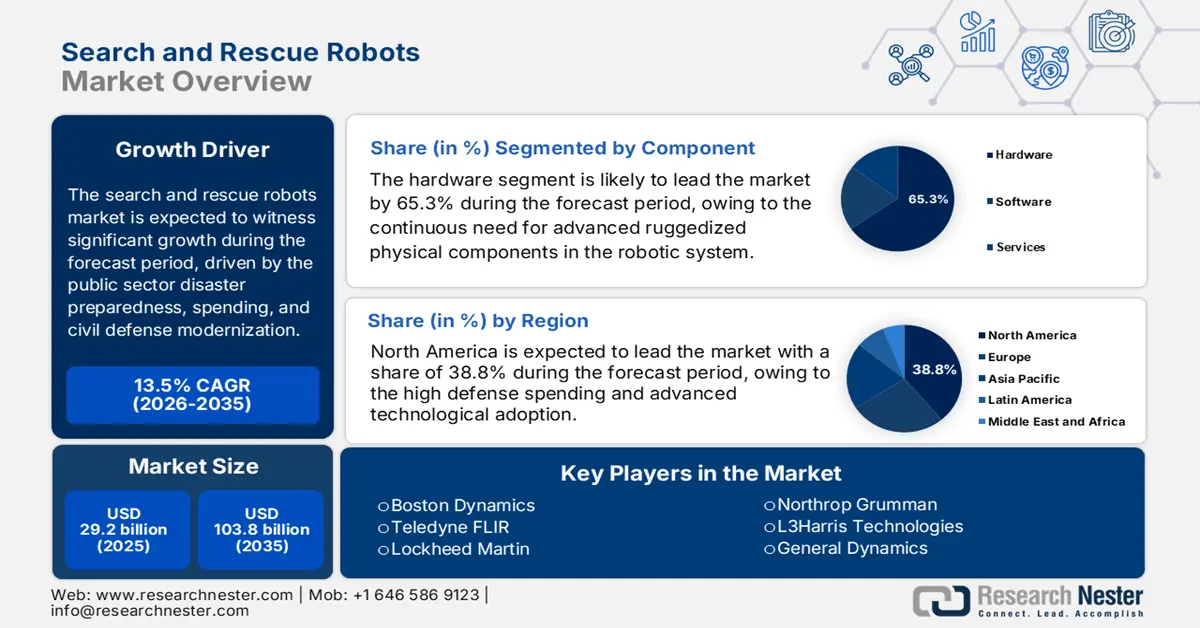
Search and Rescue Robots Market size was valued at USD 29.2 billion in 2025 and is projected to reach USD 103.8 billion by the end of 2035, rising at a CAGR of 13.5% during the forecast period, i.e., 2026-2035. In 2026, the industry size of search and rescue robots is estimated at USD 33.2 billion.
The global demand for the search and rescue robots market is closely tied to the public sector disaster preparedness, spending, civil defense modernization, and urban resilience programs. Government continue to increase allocations for disaster response due to the rising frequency and cost of natural hazards. The report from the U.S. National Centers for Environmental Information in January 2025 has indicated that 27 weather and climate disasters were confirmed, with the losses exceeding USD 1 billion, creating a sustained pressure on federal and state agencies to improve the response speed and responder safety via automation support systems. Further, the Federal Emergency Management Agency received a significant amount in 2024 discretionary budget authority, with a growing share directed toward urban search and rescue emergency logistics and responder capability upgrades, where robotic platforms are increasingly piloted for hazardous environment assessment and victim location tasks.
Besides, the search and rescue robots market expansion is also supported by the defense and homeland security programs that prioritize unmanned systems for operations in collapsed structures, contaminated zones, and conflict-affected urban environments. The U.S. Department of War in March 2023 funded autonomous systems under the Research, Development, Test & Evaluation budget, which exceeded USD 145 billion in 2024, with robotics and autonomous platforms cited as core capability areas. Further, the public safety agencies are integrating robotics into standardized response frameworks. The National Institute of Standards and Technology has expanded its Disaster Response Robot Evaluation Exercises, enabling agencies to validate robotic performance against real-world rescue scenarios, stimulating institutional acceptance and procurement readiness.