Recombinant Proteins Market - Regional Analysis
North America Market Insights
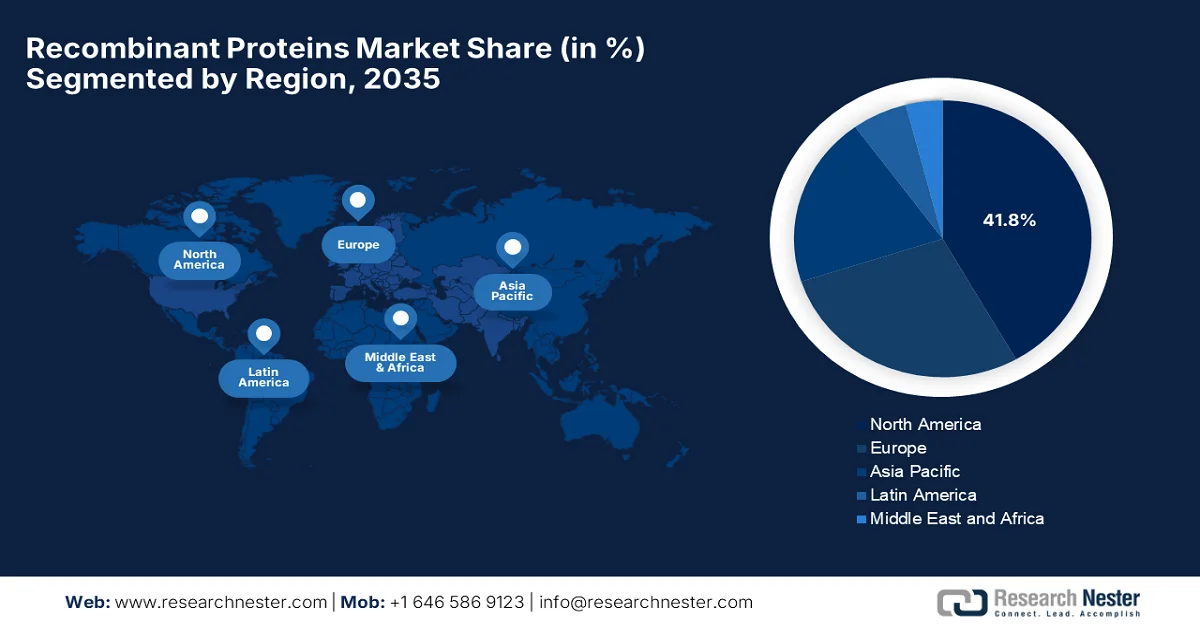
The North America recombinant proteins market is anticipated to lead, commanding the highest share of 41.8% during the discussed timeframe. The region’s dominance in this sector is largely propelled by a sophisticated healthcare infrastructure, high healthcare spending, and a surging prevalence of chronic and infectious illnesses. Market growth is also propelled by substantial venture capital inflows, increased investment in R&D, and the growing clinical adoption of precision-based bioprocess automation. In this context, Amgen in December 2024 announced a total investment of USD 1 billion to establish a second drug-substance manufacturing facility in Holly Springs, North Carolina, raising its total planned investment in the area to more than USD 1.5 billion. This new facility will use advanced manufacturing technologies and sustainable practices and support the growing demand for its medicines.
A widespread clinical adoption of advanced therapeutics and collaboration among pioneering pharmaceutical firms, academic laboratories, and contract development organizations is propelling growth of the U.S. market. This landscape is supported by a highly progressive regulatory environment under the U.S. FDA that actively shortens approval pathways for novel biologics and low-cost biosimilars, and a mature intellectual property framework. In July 2024, the FDA and U.S. Army DEVCOM Chemical Biological Center established an MOU with the main goal of developing cell-free protein synthesis platforms for producing acetylcholinesterase fusion proteins for biosensor research. It also mentions that this collaboration focuses on optimizing recombinant protein production in order to evaluate stability and critical quality attributes, and develop suitable formulation and lyophilization processes.
The Canada recombinant proteins market has a huge opportunity to grow in the upcoming years owing to the presence of a public healthcare infrastructure and a collaborative domestic research ecosystem. Apart from this, targeted provincial and federal funding programs, coupled with sustained corporate investment in R&D, are accelerating the advancement of innovative biotherapeutics and cell-based vaccines. Based on government data which was published in August 2023, a cumate-inducible CHO expression system can temporarily reduce recombinant protein production during stable pool selection, which helps cells avoid excessive metabolic and endoplasmic reticulum stress. The study found that pools selected under suppressed expression were more productive for most of the tested proteins, including cytokines, receptor proteins, monoclonal antibodies, as well as bispecific antibodies.
APAC Market Insights
The Asia Pacific market is expected to grow at the fastest rate during the forecast period from 2026 to 2035. The region’s leadership is mainly propelled by expanding healthcare access, a rising burden of age-related chronic illnesses, and a significant surge in biomanufacturing investments. The region has emerged as a premier global hub for contract CDMOs, wherein countries such as China, India, South Korea, and Japan are establishing massive production facilities to support international supply chains. In March 2026, PIB stated that BRIC-RGCB in Thiruvananthapuram inaugurated a central facility for recombinant cells and sensors, which was developed with an investment of approximately USD 6.27 million to support drug discovery, medical research, and agricultural genomics. This facility provides engineered recombinant cells and advanced screening platforms with the main goal of helping researchers and biotechnology companies accelerate target-based drug development and related applications.
An aging population and a powerful state-driven push toward biopharmaceutical self-reliance are driving growth of the market in China. The country market growth is intensely fueled by proactive government initiatives, including the Made in China strategic frameworks, which channel massive state funds, tax incentives, and corporate investments into domestic therapeutic innovation. In December 2025, Frontiers stated that researchers in China established the country’s first national standard for recombinant nuclease, which is an enzyme used to remove residual nucleic acids during biopharmaceutical, cell, and gene therapy manufacturing. This study developed and validated a standardized activity assay using herring sperm DNA, demonstrating strong precision, accuracy, stability, and consistency in participating laboratories.
The Japan recombinant proteins market is one of the largest and most influential which is driven by high consumer spending power and a long-standing tradition of excellence in fermentation and bioprocessing technologies. Market expansion is supported by strong government backing, including strategic funding, along with corporate R&D investments from established domestic pharmaceutical giants. On the other hand, growth is accelerated by an industry-wide transition toward automated mammalian expression systems for precise protein folding, a highly rigorous yet clarifying regulatory framework that actively champions biosimilar substitution.
Europe Market Insights
The Europe recombinant proteins market is anticipated to grow at a notable rate during the discussed timeframe. The region’s progression in this sector is highly driven by a high burden of chronic conditions and a strong regional commitment to advanced therapeutic options. The market is firmly catalyzed by major biopharmaceutical hubs across Germany, the UK, France, and Switzerland, which foster intense collaboration between academic research networks, biotechnology firms, and CMOs. In October 2025, Lonza expanded its TheraPEAK portfolio with AmpliCell Cytokines and 293-GT Medium to offer GMP-ready solutions designed to support cell and gene therapy development and manufacturing. It also mentioned that AmpliCell Cytokines enable consistent immune-cell expansion, activation, and differentiation, whereas the 293-GT medium system supports scalable AAV production in suspension HEK293 cells.
A robust life science strategy and a growing elderly population are uplifting the UK market. The industry’s commercial landscape is accelerated by an increasingly agile and independent regulatory environment that streamlines approval pathways for innovative biologics, while rapid laboratory integration of high-throughput automated bioprocessing technologies ensures a steady supply of high-purity research reagents. Based on the government data published in November 2024, the UK is relaunching the innovative licensing and access pathway in order to accelerate patient access to transformative medicines that address significant NHS unmet needs. The article also outlined that this refreshed pathway will provide coordinated support from the MHRA, health technology assessment bodies, and the NHS from early clinical development through patient access.
The France recombinant proteins market is effectively driven by a universal healthcare framework and a powerful state-driven mandate to bolster domestic health sovereignty. The market is further supported by significant corporate spending on research and development, attractive tax incentives, and targeted funding from government-backed investment programs. Apart from this, the commercial landscape is reshaped by the adoption of localized single-use bioreactor systems, the presence of biochemical and bioprocess engineers, and a progressive regulatory climate. These regulatory authorities work in lockstep with regional standards to streamline approval, production, and public reimbursement pathways for high-purity therapeutic proteins, research reagents, and advanced biosimilars.