Personal Care Ingredients Market Outlook:
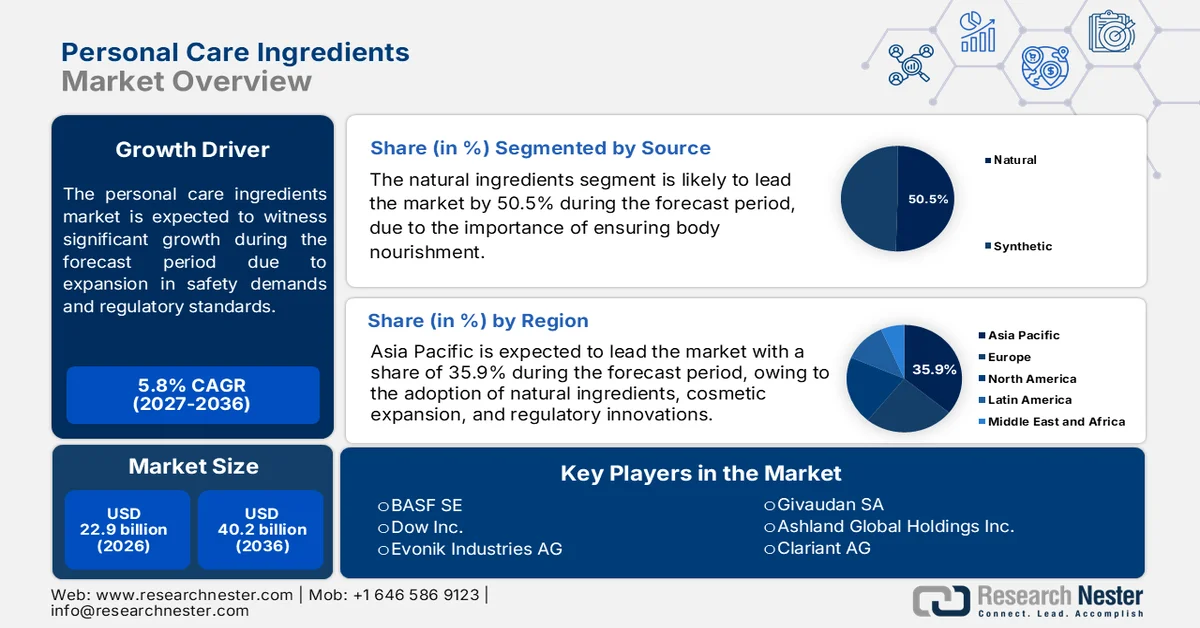
Personal Care Ingredients Market size was valued at USD 22.9 billion in 2026 and is expected to reach USD 40.2 billion by the end of 2036, registering around 5.8% CAGR during the forecast period, i.e., 2027-2036. In 2027, the industry size of personal care ingredients is estimated at USD 24.2 billion.
The global personal care ingredients market is continuously witnessing expansion, owing to modernization in regulations, manufacturing compliance standards, and ingredient safety requirements. Based on these factors, the adoption of the Modernization of Cosmetics Regulation Act (MoCRA) in the U.S. is strengthening across cosmetic ingredient supply chains and encouraging greater investment in documentation, testing, and quality management systems. Besides, as per the U.S. BLS December 2023 data report, personal consumption expenditures on personal care products and services gradually rose by 12.3% between 2021 and 2022. Therefore, this eventually reflected the continued spending on beauty, hygiene, and wellness products, thus creating an optimistic outlook for the market’s growth and exposure.
Average Yearly Expenditures for Personal Care Services and Products, 2019-2022
|
Year |
Expenditure (USD in Thousands) |
|
2019 |
786 |
|
2020 |
646 |
|
2021 |
771 |
|
2022 |
866 |
|
Percent Change (%) |
|
|
2019-2020 |
-17.8 |
|
2020-2021 |
19.3 |
|
2021-2022 |
12.3 |
Source: U.S. BLS
Moreover, the aspect of renewable and sustainability feedstock implementation is also positively contributing to growth and development opportunities for the personal care ingredients market globally. As stated in an article published by USDA in 2023, the U.S. bio-based products industry effectively contributed an estimated USD 489 billion every year to the U.S. economy, which eventually highlighted the expanded industrial base for renewable raw materials. This particular trend has encouraged ingredient manufacturers to increase the production of plant-derived and bio-based alternatives that meet both performance and environmental objectives. Besides, in Europe, suitable regulatory initiatives supporting safer chemical utilization and sustainable product development continue to influence ingredient selection and sourcing practices, thus proliferating the market’s exposure.
Key Personal Care Ingredients Market Insights Summary:
Regional Highlights:
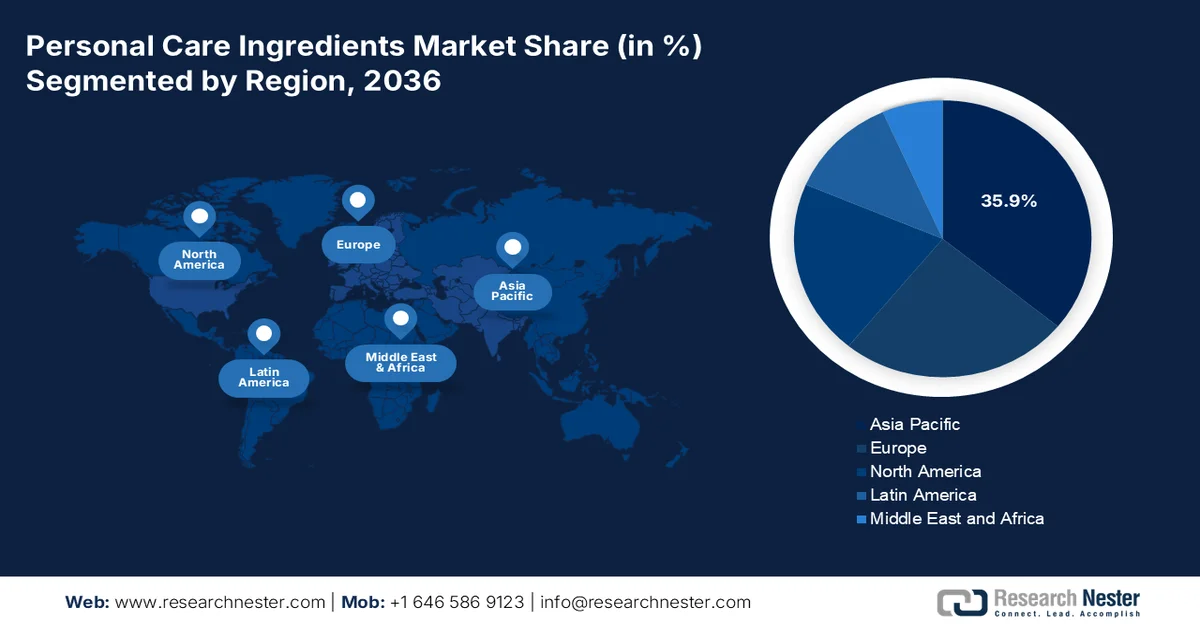
- Asia Pacific is projected to hold the largest share of 35.9% in the personal care ingredients market by 2036, underpinned by rising demand for multifunctional, organic, and natural ingredients alongside supportive regulatory developments
- North America is poised to be the fastest-growing region during the forecast period, driven by increasing demand for microbiome-based, organic, and natural formulations, robust industrial infrastructure, and access to bio-specific feedstocks
Segment Insights:
- Natural ingredients sub-segment is projected to command a 50.5% share of the personal care ingredients market by 2036, supported by growing preference for plant-based, safe formulations that minimize environmental exposure to harsh chemicals
- Skin care sub-segment is anticipated to secure a 45.8% share during the 2027-2036 forecast period, fueled by the skin’s vital protective role against ultraviolet rays, bacteria, and pollution
Key Growth Trends:
- Convergence of beauty with nutrition
- Digitalization and personalization
Major Challenges:
- Regulatory risks and compliance complexity
- Rising consumer demand for clean and natural formulations
Key Players: BASF SE, Dow Inc., Evonik Industries AG, Givaudan SA, Syensqo SA/NV, Clariant AG, Ashland Global Holdings Inc., Symrise AG, Croda International Plc, The Lubrizol Corporation, Novaphene, Sytheon Ltd.
Global Personal Care Ingredients Market Forecast and Regional Outlook:
Market Size & Growth Projections:
- 2026 Market Size: USD 22.9 billion
- 2027 Market Size: USD 24.2 billion
- Projected Market Size: USD 40.2 billion by 2036
- Growth Forecasts: 5.8% CAGR (2027-2036)
Key Regional Dynamics:
- Largest Region: Asia Pacific (35.9% Share by 2036)
- Fastest Growing Region: North America
- Dominating Countries: United States, China, Japan, Germany, France
- Emerging Countries: India, South Korea, Brazil, Australia, Canada
Last updated on : 7 September, 2026
Personal Care Ingredients Market - Growth Drivers and Challenges
Growth Drivers
- Convergence of beauty with nutrition: The aspect of cross-industry convergence is continuously developing new growth for the personal care ingredients market. Likewise, the nutrition-beauty convergence is equally expanding into dual-utilization and ingestible ingredients that ensure inside-out beauty solutions and services. This is possible with the continuous shipment of beauty, skincare, and make-up products globally. According to the 2023 WITS data report, the European Union accounted for the largest exports of such products, amounting to USD 12,886,419.7 thousand for 518,831,000 kilograms. This is followed by USD 9,882,031.5 thousand for 291,418,000 kilogram in France, USD 6,527,465.8 thousand for 220,593,000 kilogram in Korea, USD 4,776,366.3 thousand for 44,786,000 kilogram in Singapore, and USD 4,697,580.2 thousand for 143,760,000 kilogram in the U.S.
- Digitalization and personalization: The rapid growth of e-commerce, social media platforms, artificial intelligence (AI), and augmented reality (AR) has enabled brands to deliver highly customized shopping experiences. According to an article published by NLM in December 2023, a clinical study was conducted on 1,174 females, of which 51% of female respondents reported discovering skincare products through social media platforms. In addition, 91.3% of females expressed confidence in skincare and cosmetic products. This particular trend reflects the growing importance of digital-first consumer engagement and encourages brands to strengthen direct-to-consumer channels, thus boosting the market development.
Challenges
- Regulatory risks and compliance complexity: Manufacturers in the personal care ingredient market face an increasingly intricate web of global regulations. Besides, different regions enforce varying standards on safety, labeling, and approved substances, making cross-border market entry costly and time-consuming. Constantly evolving rules, particularly around preservatives and UV filters, require ongoing reformulation and retesting. Smaller players struggle to keep pace with legal demands, while even large firms experience delays in product launches. The lack of harmonized international guidelines forces companies to maintain multiple formulations for different markets, inflating operational expenses and straining research and development resources.
- Rising consumer demand for clean and natural formulations: Consumers are increasingly scrutinizing ingredient lists, pushing brands to phase out synthetic chemicals in favor of natural, biodegradable, and ethically sourced alternatives. However, natural ingredients often have shorter shelf lives, variable efficacy, and higher procurement costs. They also require different processing techniques, which disrupt established manufacturing lines. Besides, meeting performance expectations such as preservation, texture, and sensory appeal without synthetic additives remains technically difficult. This shift forces suppliers to reinvent portfolios, invest heavily in novel extraction methods, and validate new combinations, all while maintaining product safety and stability under real-world usage conditions, thus restricting the market growth.
Personal Care Ingredients Market Size and Forecast:
| Report Attribute | Details |
|---|---|
|
Base Year |
2026 |
|
Forecast Period |
2027-2036 |
|
CAGR |
5.8% |
|
Base Year Market Size (2026) |
USD 22.9 billion |
|
Forecast Year Market Size (2036) |
USD 40.2 billion |
|
Regional Scope |
|
Personal Care Ingredients Market Segmentation:
Source Segment Analysis
The natural ingredients sub-segment, part of the source segment, is anticipated to capture the largest share, at 50.5%, in the personal care ingredients market by the end of 2036. The sub-segment’s upliftment is primarily driven by its importance for nourishing the body with plant-based and safe ingredients, while effectively protecting the environment from harsh chemicals. According to an article published by NLM in March 2022, the worldwide natural and organic personal care products industry was valued at USD 11 billion, which further increased to USD 22 billion as of 2022. Based on this growth, North America is considered the major sector for organic and natural personal care products, which is followed by the Asia Pacific and Europe. Besides, organic and natural care readily maintains suitable billing in the worldwide organic beauty industry and further accounted for a 30.9% share as of 2024, thus proliferating the sub-segment.
Application Segment Analysis
Based on the application segment, the skin care sub-segment is expected to account for the second-largest share of 45.8% in the personal care ingredients market during the forecast period. The sub-segment’s growth is highly driven by its importance for acting as the body’s largest defense organ that shields from harsh ultraviolet rays, bacteria, and pollution. As per an article published by NLM in August 2025, skin is not only the largest organ in the human body since skeletal muscles also readily weigh 40% of the mucosal area and body weight of the digestive tract. Besides, the skin increasingly suffers from more than one disorder compared to any other organ, and a few skin diseases are associated with extracutaneous conditions, thus enhancing the sub-segment demand in the market globally.
Ingredients Segment Analysis
By the end of the stipulated timeline, the surfactants sub-segment under the ingredients segment is predicted to garner the third-largest share of 25.9% in the market. The sub-segment’s development is effectively fueled by the mounting pressure to balance performance with environmental responsibility. Besides, conventional petrochemical-based surfactants are increasingly scrutinized for their ecological footprint, yet bio-based alternatives often fall short on foam quality, cleansing power, or cost-effectiveness. Manufacturers must reformulate without compromising sensory appeal or shelf stability, a technically demanding process. Meanwhile, consumer preference for mild, skin-friendly products adds another layer of formulation complexity, stretching R&D capabilities and delaying time-to-market.
Our in-depth analysis of the personal care ingredients includes the following segments:
|
Segment |
Subsegments |
|
Source |
|
|
Application |
|
|
Ingredients |
|
|
Delivery Format/Form |
|
|
Function in Formulation |
|
|
Distribution Channel |
|

Vishnu Nair
Head - Global Business DevelopmentCustomize this report to your requirements — connect with our consultant for personalized insights and options.
Personal Care Ingredients Market - Regional Analysis
APAC Market Insights
The Asia Pacific personal care ingredients market is anticipated to grab the highest share of 35.9% by the end of 2036. The market’s upliftment in the region is primarily attributed to a shift toward multifunctional, organic, and natural ingredients, support provision by regulatory developments, and an expansion in the cosmetic ingredient directory. According to an article published by NLM in November 2022, the cosmetics sector in China was worth USD 60 billion. Additionally, this indicated a 14% increase, which is further projected to increase to USD 450 billion by the end of 2050. Besides, a series of regulatory policies have been effectively issued in the country, which have proposed to optimize the legal system as well as technical standards and expand the construction of the inspection system. Therefore, based on the cosmetics sector growth and regulations, the market is expanding in the region.
The personal care ingredients market in China is growing significantly, owing to strong manufacturing capabilities, an increase in the demand for premium haircare and skincare products, along with continuous investment in the chemical sector. Meanwhile, the nation is strengthening its cosmetic industry, which is positively encouraging advancements in ingredient development and production. In this regard, and as stated in the March 2025 Zenithra Care article, the retail sales of cosmetics for facilities above a designated size in the country amounted to USD 64.8 billion (435.7 billion yuan), indicating a year-on-year reduction of 1.1%. Simultaneously, the overall export and import volume of cosmetics in the country has also reached USD 23.5 billion, thereby making the country the second-largest cosmetics consumer sector globally.
The aspects of expansion in the personal care and beauty sector, especially through digitalized retail channels, are positively shaping the personal care ingredients market in India. As per an article published by the IBEF Organization in February 2025, the country has readily emerged as the fastest-growing online sector for beauty products, with beauty quick commerce and e-commerce sales rising by 39% in valuation between June and November 2024 in comparison to last year and outpacing by 3% growth. Besides, the shift towards online shopping significantly reflects a structural modification in consumer behavior, with 17% of domestic consumers increasingly purchasing beauty products from online platforms. Besides, the personal and beauty care sector in the country was worth USD 28 billion and is further expected to reach USD 34 billion by the end of 2028, along with a 10% to 11% growth rate, thus positively impacting the market exposure.
North America Market Insights
North America market is expected to emerge as the fastest-growing region during the forecast. The market’s development is highly propelled by the demand for microbiome-based, organic, and natural formulations, along with strong industrial infrastructure, chemical processing facilities, and accessibility to bio-specific feedstocks. According to a data report published by the American Academy of Dermatology in February 2025, acne is considered the most common skin condition in the U.S., which affects almost 50 million people every year. In addition, this particular skin condition occurs at a particular stage and impacts people aged 30 to 40, impacting almost 15% of the female population in the country. Moreover, an estimated 85% of people aged between 12 and 24 years suffer from minor acne, thereby proliferating the market’s growth in the region.
The personal care ingredients market in the U.S. is gaining increased traction, owing to robust consumer demand, modernization in regulatory policies, and an increase in the integration of standard wellness and skincare products. Besides, ingredient suppliers are continuously benefiting from the need for bio-specific actives, formulation components, and multifunctional ingredients that are readily linked with FDA requirements. Moreover, digital commerce is also strengthening and creating growth opportunities for formulators and brands. As stated in the August 2026 Census Government article, the retail e-commerce sales for the second quarter of 2026 amounted to USD 340.2 billion, demonstrating a surge of 3.8% from the first quarter. In addition, the overall sales for the second quarter were roughly USD 1,986.5 billion, indicating an increase of 2.9%, thus fueling market growth.
The rising need for skincare, hygiene, and haircare products, along with the increasing interest in sustainable and naturally derived formulations, is bolstering the market in Canada. Besides, manufacturers are generously investing in ingredients that are associated with Health Canada’s safety requirements and evolving consumer preferences for transparency and environmental responsibility. Moreover, the nation’s robust research ecosystem and innovative manufacturing capabilities support advancements in specialty ingredients. Based on the February 2026 Government of Canada data report, the retail expenditure in the country gradually increased from 3.0% to USD 865.2 billion as of 2024, of which USD 73.7 billion has been allocated for e-commerce revenue, thereby demonstrating a huge growth opportunity for the market.
Europe Market Insights
Europe market is predicted to account for a considerable share by the end of the stipulated timeline. The market’s growth in the region is effectively fueled by a strict regulatory framework, growing consumer preference for sustainable products, and generous governmental funding for green chemistry. According to the March 2026 European Parliament article, the 2025 Clean Industrial Deal constitutes the objective of ensuring competitiveness and climate action under a suitable growth strategy. This is notably focused on achieving a complete regional economy by the end of 2050 by targeting a 90% net reduction in greenhouse gas emissions by 2040 and eventually mobilizing more than USD 116.5 billion (EUR 100 billion) to support clean manufacturing. Therefore, based on this deal and its objectives, there is a huge growth opportunity for the market.
The personal care ingredients market in Germany is gaining increased exposure, owing to the presence of the cosmetics and beauty sector, which significantly drives the continuous demand for high-value formulation ingredients. Besides, manufacturers are readily focusing on performance-enhancing, bio-based, and sustainable ingredients to meet regulatory and consumer requirements. Meanwhile, the country also serves as one of the major production and trade centers for beauty products to support procurement and innovation activities. Based on the 2024 OEC data report, France is considered the top exporter of beauty products, amounting to USD 12.3 billion, and its import value is worth USD 2.4 billion. Likewise, the import and export of beauty products across other countries in Europe is also responsible for boosting the market growth.
Beauty Products Export and Import in Europe, 2024
|
Country |
Export (USD) |
Import (USD) |
|
Germany |
4.4 billion |
3.3 billion |
|
Italy |
3.7 billion |
1.5 billion |
|
Poland |
2.4 billion |
1.6 billion |
|
Spain |
1.9 billion |
1.6 billion |
|
UK |
1.9 billion |
2.9 billion |
|
Switzerland |
1.3 billion |
779 million |
|
Czechia |
800 million |
941 million |
|
Belgium |
1.4 billion |
1.44 billion |
Source: OEC
An increase in consumer demand, a rise in disposable incomes, and the growing demand for organic and natural cosmetic ingredients are a few factors that are responsible for uplifting the market in Spain. As per a data report published by Nature Organization in 2026, the natural beauty industry in the country is expected to expand by 8.6% by the end of 2029. This expansion is highly driven by selecting localized natural and cosmetic ingredients for multi-purpose and biotechnology solutions. In addition, the aspect of sustainability is continuously and increasingly shaping consumer preferences. Besides, the national cosmetics sector also benefits from a robust supply chain facility, which is effectively supported by the Federation of Spanish Chemical Industry (FEIQUE), thus positively fueling the market’s exposure.
Key Personal Care Ingredients Market Players:
- BASF SE (Germany)
- Dow Inc. (U.S.)
- Evonik Industries AG (Germany)
- Givaudan SA (Switzerland)
- Syensqo SA/NV (Belgium)
- Clariant AG (Switzerland)
- Ashland Global Holdings Inc. (U.S.)
- Symrise AG (Germany)
- Croda International Plc (U.S.)
- The Lubrizol Corporation (U.S.)
- Novaphene (India)
- Sytheon Ltd. (U.S.)
- Company Overview
- Business Strategy
- Key Product Offerings
- Financial Performance
- Key Performance Indicators
- Risk Analysis
- Recent Development
- Regional Presence
- BASF SE is a global leader in personal care ingredients, offering a comprehensive portfolio that spans surfactants, emollients, UV filters, and rheology modifiers for skin, hair, and sun care applications. The company differentiates itself through strong R&D capabilities and a growing focus on bio-based and sustainable ingredient solutions.
- Dow Inc. holds a prominent position in the market with a broad range of silicone-based specialties, conditioning polymers, and emulsifiers used across skincare and haircare formulations. Its strength lies in integrating advanced material science with formulation expertise to address performance and sensory demands.
- Evonik Industries AG is a key player known for its specialty actives, delivery systems, and high-performance polymers tailored for premium personal care formulations. The company emphasizes innovation in sustainable ingredients and bioactive compounds for anti-aging, moisturizing, and skin barrier repair applications.
- Givaudan SA is a leading supplier of active beauty ingredients, marine-derived bioactives, and natural polymers for the personal care industry. The company focuses on sustainability and biotechnology-driven solutions to meet growing consumer demand for clean-label and naturally derived formulations.
- Syensqo SA/NV offers a specialized range of personal care ingredients including specialty surfactants, emulsifiers, and rheology modifiers derived from natural and renewable sources. The company serves formulators seeking sustainable alternatives that maintain high performance and sensory appeal.
Here is a list of key players operating in the global market:
The personal care ingredients market is moderately consolidated, with major multinational chemical manufacturers commanding significant global share through extensive R&D capabilities, broad ingredient portfolios spanning skin, hair, and oral care applications, and strong technical support for formulators. Leaders are aggressively differentiating through bio-based solutions, sustainable sourcing, and high-performance active compounds. Besides, in November 2024, BASF and Acies Bio significantly entered into a transformative partnership and developed a standard platform for fermentation technology, especially from methanol, for producing fatty alcohols, thus demonstrating a huge growth opportunity for the personal care ingredients industry globally.
Corporate Landscape of the Market:
Recent Developments
- In July 2026, Melt&Marble launched the Marble7®, the first-ever precision-fermented lipid ingredient for the personal care market, which further received the INCI name r-Saccharomyces Butter in March.
- In November 2025, Dow Inc. unveiled 4 newest personal care ingredients and introduced the Beauty in Harmony concepts collection, including DOWSIL™ FC-5012 ID Resin Gum, DEXCARE™ CD-2 Polymer, DOWSIL™ CB-2251 Fluid, and ACUDYNE™ 2000 Polymer.
- In September 2024, L’Oréal proclaimed a tri-party deal with Abolis Biotechnologies and Evonik, which enabled the discovery, development, and manufacturing of sustainable and innovative beauty ingredients.
- Report ID: 5989
- Published Date: Sep 07, 2026
- Report Format: PDF, PPT
- Explore a preview of key market trends and insights
- Review sample data tables and segment breakdowns
- Experience the quality of our visual data representations
- Evaluate our report structure and research methodology
- Get a glimpse of competitive landscape analysis
- Understand how regional forecasts are presented
- Assess the depth of company profiling and benchmarking
- Preview how actionable insights can support your strategy
Explore real data and analysis
Frequently Asked Questions (FAQ)
About this Report
Connect with our Expert


Report, 2027-2036



Copyright @ 2026 Research Nester. All Rights Reserved.
