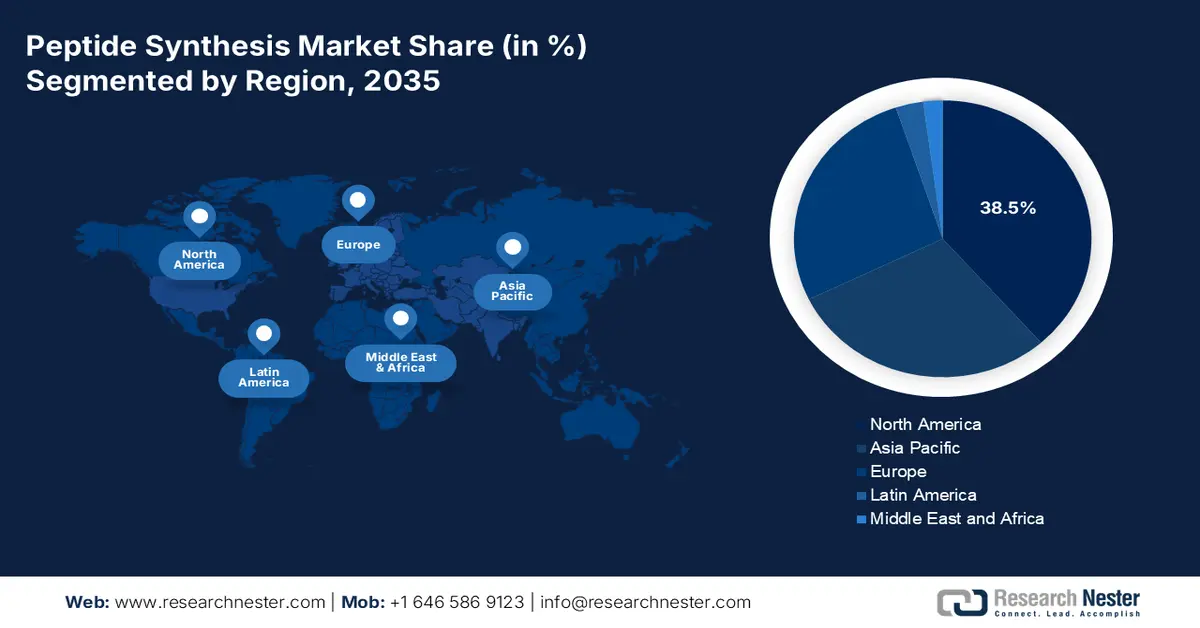
Peptide Synthesis Market - Regional Analysis
North America Market Insights
North America in the peptide synthesis market is anticipated to hold the largest share of 38.5% by the end of 2035. The market’s upliftment in the region is primarily attributed to an increase in the adoption of peptide therapeutics across metabolic disease and oncology, aggressive CDMO capacity, and the presence of mature biopharma ecosystems. According to an article published by the EPA Government in September 2025, more than 1.5 million tons of hazardous wastes have been managed by recycling solvent, metals, and other recoveries, which positively contributes to the market’s upliftment. Besides, the overall municipal solid waste has been recorded to be 292.4 million tons, which is 4.9 pounds per person per day. Of this total generation, an estimated 69 million tons have been successfully recycled, while 25 million tons have been composted, thereby denoting a reduction in hazardous chemical generation, which is uplifting the peptide synthesis market’s growth.
Total Municipal Solid Waste Generated by Material in America (2025)
|
Material Type |
Generation |
|
Paper and Paperboard |
23.0% |
|
Food |
21.5% |
|
Plastics |
12.2% |
|
Yard Trimmings |
12.1% |
|
Metals |
8.7% |
|
Wood |
6.1% |
|
Textiles |
5.8% |
|
Glass |
4.1% |
|
Rubber and Leather |
3.1% |
|
Other |
1.5% |
|
Miscellaneous Inorganic Wastes |
1.3% |
Source: EPA Government
The U.S. in the peptide synthesis market is growing significantly due to the clinical momentum, sustainability pull, the presence of industrial decarbonization, advanced manufacturing, chemical safety, along with investment and stewardship. As per an article published by the CATF in October 2025, the industrial sector in the country significantly employs more than 12 million workers and has generated USD 852 billion in the yearly payout. Simultaneously, it is also responsible for an estimated 12% of harmful air pollutants, along with 23% of greenhouse gas emissions. However, to combat this, the U.S. Department of Energy (DOE) has allocated USD 6.3 billion for the Industrial Demonstrations Program to effectively support the demonstration of emerging technologies. Moreover, USD 2.5 billion has been provided for carbon capture demonstration projects, thereby fueling the market’s growth in the country.
Canada in the peptide synthesis market is also growing, owing to government funding for clean chemical production, green chemistry and sustainability approaches, advanced biotech and manufacturing clusters, and chemical industry transformation. As per a data report published by the OECD in 2022, the country has notified a target to reduce greenhouse gas emissions by 40% to 45% by the end of 2030, along with legislating c standard commitment to reach net zero emissions by the end of 2050. Besides, the federal government has significantly proposed the country’s Strengthened Climate Plan, which comprises 64 latest measures, as well as CAD 15 billion in investments. Furthermore, the Atlantic Loop constitutes an approximate CAD 3 billion and an estimated greenhouse gas reduction potential, accounting for 2.6 million tons per year, thereby denoting a positive impact for the market’s growth.
Predicted Canada Greenhouse Gas Emissions in 2030 (2022)
|
Trajectory Plan |
Projected GHG Emissions (Million Tons) |
|
2030 Trajectory |
815 |
|
2030 Trajectory After Measures Declared in Pan-country Framework on Clean Growth and Climate Change |
588 |
|
2030 Trajectory After Measures Notified in A Healthy Environment and a Healthy Economy |
503 |
|
2030 Trajectory After Budget 2021 Measures and Additional Action, Including Continued Alignment with the U.S. |
468 |
Source: OECD
Europe Market Insights
Europe in the peptide synthesis market is expected to emerge as the fastest-growing region during the forecast period. The market’s development in the region is highly propelled by sustained research and development investment in automated solid-phase peptide synthesis, along with greener chemistries, innovative GMP manufacturing, and robust biopharma clusters. According to an article published by NLM in June 2023, the chemical industry in the region significantly depends on fossil fuels, eventually making it the source of 5.6 Gt carbon dioxide per year, in comparison to an estimated 10% of the international anthropogenic greenhouse gas emission. Besides, the Haber–Bosch process, which is considered an energy-intensive procedure, readily operates at demanding conditions, with 150 to 250 bar and 350 to 550-degree Celsius, thus suitable for bolstering the peptide synthesis market’s exposure.
Germany in the peptide synthesis market is gaining increased traction, owing to sustained investment in GMP and automation capacity, advancement in process engineering, and the presence of the integrated chemicals and pharma base. As per an article published by the ITA in August 2025, the advanced manufacturing field in the country accounts for USD 991,050 million in total exports, followed by USD 721,621 million in total imports, USD 36,753 million for imports from the U.S., USD 269,429 million for trade surplus, and 1.0 the EUR-USD exchange rate. Besides, the 2024 CEFIC Organization article stated that the chemicals, along with pharmaceutical organizations in the country, comprise research activities and research and development expenditure reaching nearly EUR 14 billion as of 2023, thereby making it suitable for fueling the market’s demand and growth.
France in the peptide synthesis market is also developing, owing to an increase in the adoption of greener processes and automated synthesizers, a surge in the CDMO capacity, and the presence of string biopharma clusters. As stated in a data report published by OECD in 2025, the health expenditure in the country accounted for 11.5% of the gross domestic product (GDP) as of 2023. In addition, the private and public compulsory health insurance funded 84.4% of the overall health spending in the country. Moreover, the out-of-pocket payments share catered to 9.3%, and meanwhile, the voluntary health insurance accounted for 6.3% of the overall spending. Besides, the overall life expectancy upsurged by 1.4 years as of 2024, based on which there is a huge demand for peptide synthesis in the country’s healthcare industry.
APAC Market Insights
The Asia Pacific in the peptide synthesis market is projected to witness considerable growth by the end of the stipulated timeline. The market’s growth in the region is highly driven by green chemistries, process intensification, and an increase in the adoption of SPPS. Besides, according to an article published by the UNICEF Organization in July 2025, 94% of infants from South Asia received the third dose of Diphtheria, Tetanus, and Pertussis (DTP) vaccine as of 2024, deliberately marking a 2% point increase since 2023. In the same year, there has been an increase in children receiving the first dose of DTP from 93% to 95%. Furthermore, there has been a reduction in zero-dose children in India by 43%, that is 23,000 as of 2023 to 11,000 in 2024. Therefore, the increased focus on vaccination is readily driving the market’s growth in the overall region.
The peptide synthesis market in China is gaining increased exposure due to policy support for advanced manufacturing and clean production processes, integrated chemicals and pharma supply chains, and scale benefits. As per an article published by the State Council in March 2024, the Ministry of Industry and Information Technology, along with the National Development and Reform Commission indicated that the output from green factories is poised to account for more than 40% of the overall country’s manufacturing sector by the end of 2030. Besides, the country has readily outlined the national target to peak its carbon dioxide emissions by the end of the same and achieve carbon neutrality by the end of 2060. Based on this objective, the nation’s manufacturing industry, which accounts for 31.7% of the country’s GDP as well as 30% of the international manufacturing, significantly contributed to 45% of the nation’s carbon emissions.
The peptide synthesis market in India is also growing due to the existence of supportive government programs in industrial and chemical research and development, CRO services, and an expansion in the pharma manufacturing. According to an article published by the IBEF in May 2025, the pharma sector in the country has been continuously growing at a 7.8% year-on-year (YoY) basis. In addition, the sector is regarded as the largest generic medicines supplier, offering 20% of the international supply, with turnover amounting to ₹4,17,345 crore at 10% yearly growth for the past 5 years. Besides, smart schemes by government is also fueling the market’s demand, with the Pradhan Mantri Bhartiya Janaushadhi Pariyojana (PMBJP) operating 15,479 Jan Aushadhi Kendras providing generic medicines at 80% lower prices in comparison to branded medicines, thus suitable for the market’s welfare.