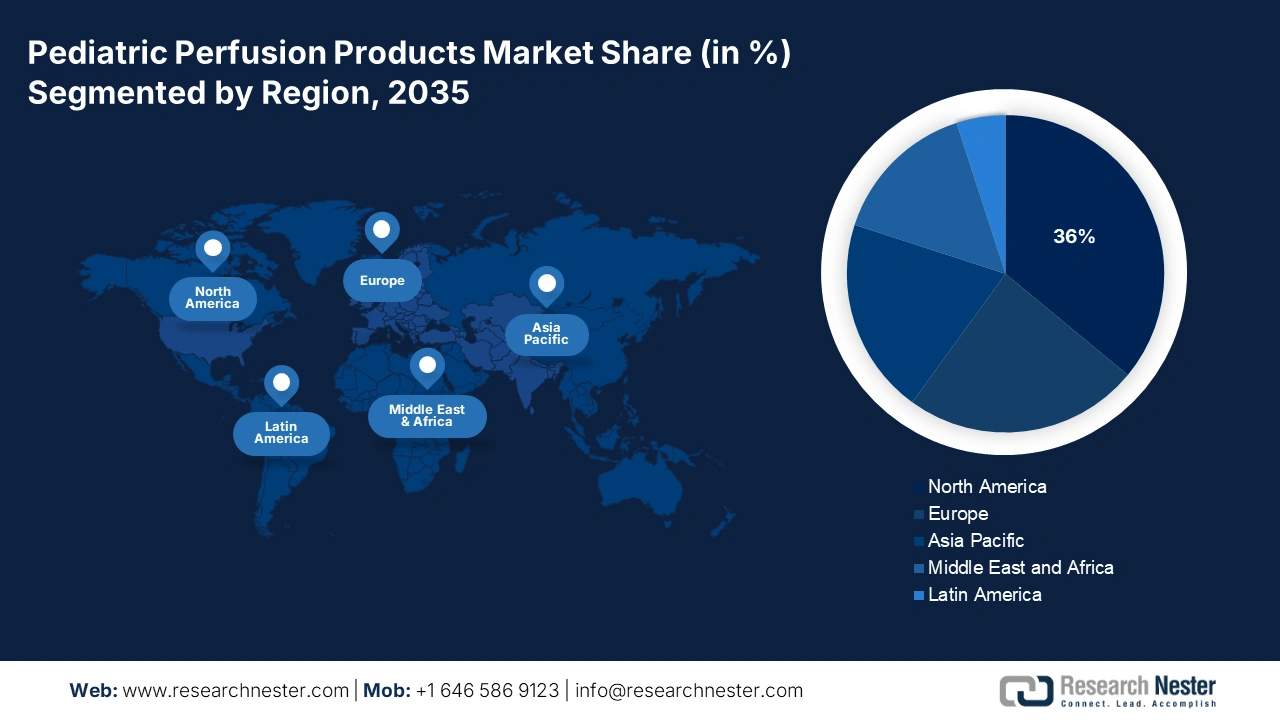
Pediatric Perfusion Products Market - Regional Analysis
North America Market Insights
North America is expected to dominate the global pediatric perfusion products market with a share of 36% by the end of 2035. The region is fueled by the rising prevalence of congenital heart defects that affect the birth rate annually in the U.S. Critical trends that improve outcomes for newborn and pediatric patients are technological developments in ECMO systems and smaller oxygenators. Active national bodies such as the American Medical Association (AMA) and the Pharmaceutical Research and Manufacturers of America (PhRMA) are committed to advocating for innovation in pediatric perfusion. Overall, federal government funding, technological innovation, and continued expansion of healthcare infrastructure are what keep North America as the number one market in the world.
The U.S. market is dominated by technological adoption and large government-funded healthcare spending. A primary trend is the rapid integration of miniaturized, low-priming-volume oxygenators, which reduce blood transfusion needs in neonates. According to the CDC, congenital heart defects are the leading birth defect, guaranteeing steady demand. The American Heart Association's September 2025 report says that almost 40,000 babies are born with congenital heart defects. Market growth is further driven by strategic hospital partnerships with manufacturers to develop next-generation ECMO systems and perfusion protocols, focusing on data integration and predictive analytics for improved patient management.
The pediatric perfusion products market in Canada is benefiting from steady growth due to increased federal and provincial investments in healthcare. As per the Canadian Congenital Heart Alliance report in 2025, nearly 1 in 80 to 100 children are born with congenital heart defects. Further, the recent funding announcements in provinces such as Ontario revealed historic funding increases in 2024. This directly benefits pediatric patients required to access cardiac services. The strength of Canada's universal coverage system provides access to healthcare that other countries do not allow. There is a demand for pediatric perfusion products due to increased awareness of congenital heart disease and developments in pediatric cardiac surgery capacities. In addition, the Government of Canada places increased emphasis on the value of pediatric specialty care centers and pediatric training across Canada to promote and strengthen the pediatric workforce.
Trade Data of Medical Devices Including Pediatric Perfusion Products
|
Country |
Import (USD billion) |
Export (USD billion) |
Year |
|
U.S. |
37.7 |
34.8 |
2023 |
|
Canada |
3.74 |
1.29 |
2023 |
Source: OEC 2023
APAC Market Insights
Asia Pacific is poised to register the highest pace of growth in the global pediatric perfusion products market by the end of 2035. The overall market is expected to continue to increase due to the rising incidences of pediatric cardiovascular disease, investments into healthcare infrastructures, and growing government initiatives to improve child health outcomes. As per the WHO report in March 2024, babies born with defects in South East Asia has increased from 4% to 11%. Further, China and India are leading the market due to their vast pediatric populations and increasing investments in specialized cardiac care infrastructure.
The pediatric perfusion products market in India is experiencing rapid growth, fueled by a high birth rate and improving healthcare access. As per Censes of India June 2025 report, the birth per 1000 rate in 2022 is 19.1. New pediatric cardiac units are being established nationwide as part of government programs like the National Health Mission, which is extending the tertiary care infrastructure. The public investment, along with skilled cardiac surgeons, is driving the demand for the essential equipment such as oxygenators and heart-lung machines, making the country dominate the Asia-Pacific region.
China's market is characterized by massive scale and strong government support. The NLM report in September 2023 states that 80.77 per 10,000 births were registered in China with congenital defects. The nation is actively promoting the domestic development and approval of cutting-edge medical devices to treat its huge patient pool with new congenital heart defect cases every year. Significant state investment in hospital upgrading directly feeds into acquiring advanced perfusion technology, making China the largest and most rapidly growing pediatric perfusion products market in the region.
Europe Market Insights
The Europe pediatric perfusion products market is estimated to garner a notable industry value from 2026 to 2035. The growth is driven by a combination of increasing instances of congenital heart disease, increasing investments in infrastructure for pediatric cardiac care. Across Europe, pediatric healthcare has been made a priority by governments, resulting in larger budgets as well as favorable policy frameworks. Germany leads in healthcare costs and is bolstered by a strong medical device manufacturing industry and favorable reimbursement policies. The United Kingdom National Health Service (NHS) continues to invest in advanced pediatric perfusion technologies. The focus by the NHS tends to be toward patient safety as well as cost-effectiveness. The European Union (EU) has recognized the challenges of innovation and investment in pediatric cardiac care.
The pediatric perfusion market in Germany is dominating the Europe market due to a strong medical device industry and high healthcare spending. The decentralized hospital system supports independent investment in cutting-edge technology. Strong quality standards by the Federal Ministry of Health (BMG) and heavy volumes of complex pediatric cardiac procedures provide steady demand for innovative perfusion systems. This blend of manufacturing power, procurement independence, and clinical demand fortifies Germany's leading status.
France's market is also known to have strong central regulation and strategic national planning of health. The market is also prompted by the increasing heart defect cases in the nation and the NLM study in April 2024 states that the incidence of such defects is around 25 per 1,000 births. The government directs investment to specialized pediatric cardiac centers through the Ministry of Solidarity and Health, prioritizing equitable access to high-tech care. This method aids in the development of advanced perfusion products across the country.