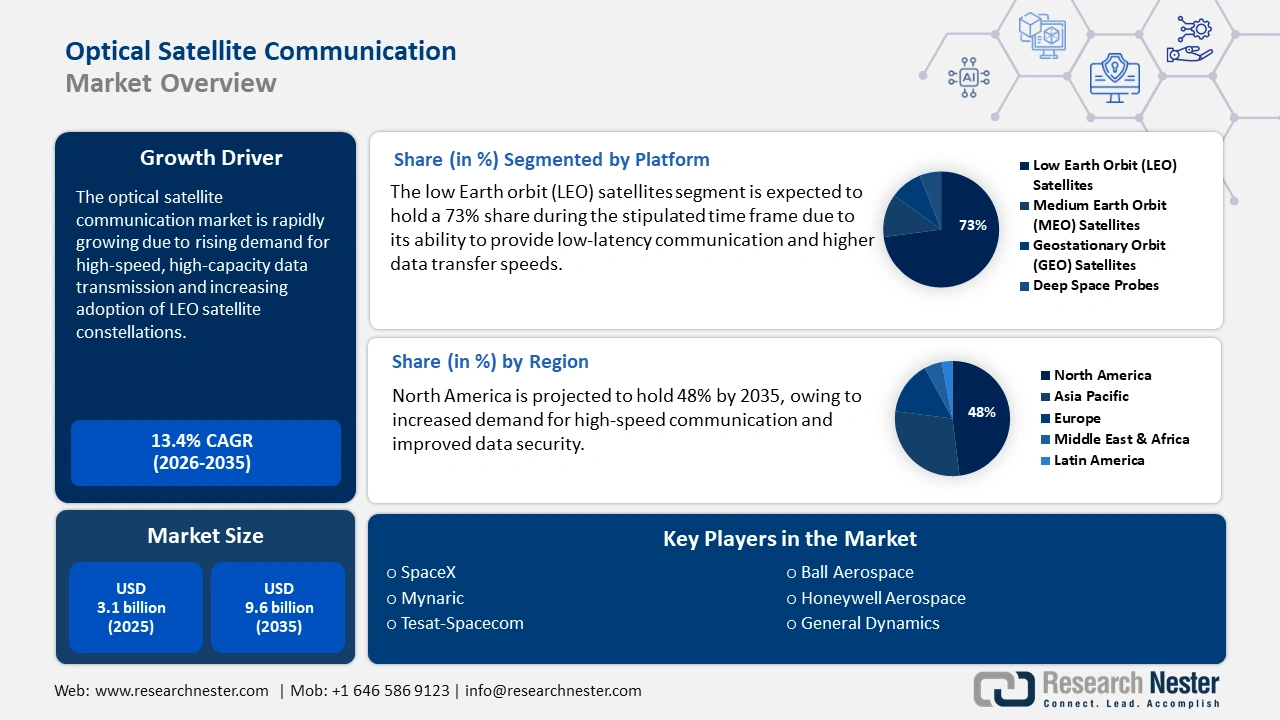
Optical Satellite Communication Market Outlook:
Optical Satellite Communication Market size was USD 3.1 billion in 2025 and is anticipated to reach USD 9.6 billion by the end of 2035, increasing at a CAGR of 13.4% during the forecast period, i.e., 2026-2035. In 2026, the industry size of optical satellite communication is estimated at USD 3.5 billion.
The worldwide optical satellite communication market is being thoroughly reshaped by different concurrent and powerful trends that are escalating its incorporation beyond usual projections. These include the vertical integration of OSC into LEO broadband constellations, standardization and commoditization, along with tactical partnerships and consolidation. According to an article published by the SHS in 2022, the latest high-resolution radar satellite, which is TerraSAR-X in Germany, as well as the U.S.-based Infrared experimental satellite NFIRE, effectively carried a two-way optical communication at a 5.625Gbit/s rate. This is considered a core operational demand for developing a space-driven internet backbone, which is suitable for the market’s growth.
Moreover, the demand for volume production, the sector’s transition from custom and one-off terminals to scalable, lower-cost, and modular designs, are also driving the market globally. In addition, strategies by the Europe-based Space Agency (ESA) under its Scylight program are proactively uplifting for standardization to reduce expenses and enhance interoperability. As per an article published by NLM in October 2022, a LEO spacecraft has the ability to ensure data transmission at an increased distance of an estimated 35,000 km. However, NASA’s Terabyte Infrared Delivery system (TBIRD) has successfully developed cubesat-suitable optical terminals, with a capability of 200 Gbps coherent LEO-to-ground downlink, thus suitable for the overall market.