Nerve Repair and Regeneration Market Outlook:
Nerve Repair and Regeneration Market size was over USD 9.4 billion in 2025 and is expected to exceed USD 21.6 billion by the end of 2035, witnessing over 8.7% CAGR during the forecast period i.e., between 2026-2035. In 2026, the industry size of nerve repair and regeneration is assessed at USD 10.2 billion.
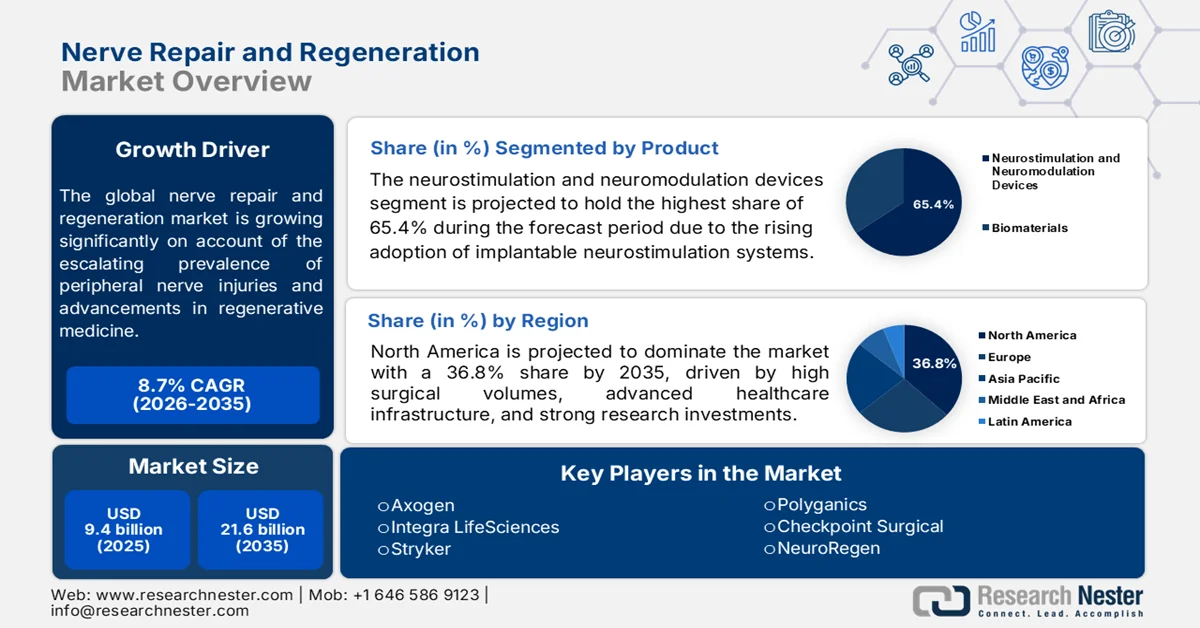
The nerve repair and regeneration market is growing at a noteworthy pace, which is being driven by the escalating prevalence of peripheral nerve injuries and advancements in regenerative medicine. In addition, the rising demand for minimally invasive treatment options and continuous innovation in biomaterials, nerve grafts, and tissue engineering technologies also position the industry for sustained growth. As per an article published by the National Institutes of Health in January 2026, around 4.13 million new nerve injury cases were reported globally in a year, with an age-standardized incidence of 53 cases per 100,000 people and 440,000 years lived with disability (YLDs). The article also highlighted that the highest incidence rates were recorded in Australasia, which was 169.16 per 100,000, and Eastern Europe being 145.61 per 100,000, thus elevating the growth potential of the market.
Furthermore, payer pricing and reimbursement policies are also influencing factors for the adoption of nerve repair and regeneration therapies by determining patient access and provider purchasing decisions. Therefore, favorable reimbursement efficiently supports the uptake of advanced nerve repair products, thus enhancing market penetration as well as commercial growth. In this context, NIH in November 2023 revealed that a U.S. payer-perspective cost-effectiveness analysis found that avance® nerve graft gained a higher meaningful recovery rate, which was 75.15% vs. 70.46%, while reducing lifetime treatment costs around USD 12,677 vs. USD 14,023 when compared with autograft repair. The study concluded that allograft use could save approximately USD 1,346 per patient, indicating a huge growth opportunity for nerve repair technologies.
Key Nerve Repair and Regeneration Market Insights Summary:
Regional Highlights:
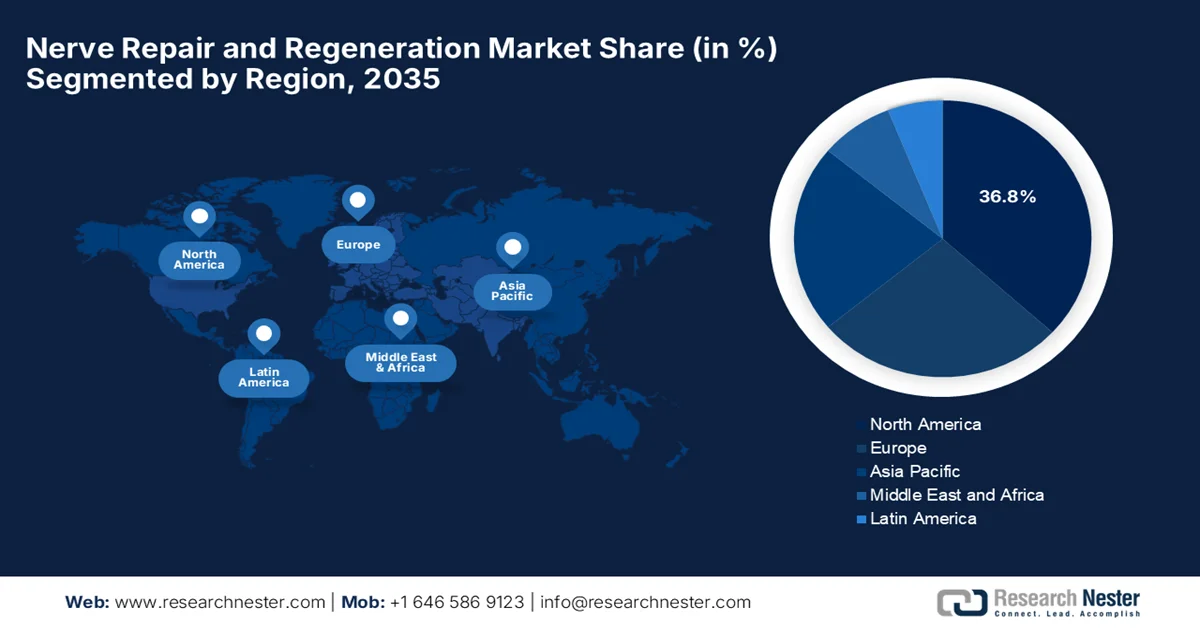
- The North America nerve repair and regeneration market is anticipated to capture a leading 36.8% revenue share by 2035, bolstered by advanced healthcare infrastructure, high surgical volumes, and substantial research funding
- Asia Pacific is poised to witness the fastest growth in the market throughout 2026-2035, stimulated by rapid healthcare modernization, expanding medical tourism, and increasing cases of neurodegenerative disorders and traumatic injuries
- The market in the U.S. accounts for 90.7% of the share in North America, which is driven by the high adoption of neurostimulation and regenerative technologies and significant R&D investments
Segment Insights:
- The neurostimulation and neuromodulation devices segment is projected to account for 65.4% of the nerve repair and regeneration market by 2035, fueled by rising adoption of implantable neurostimulation systems and continuous advancements in closed-loop and rechargeable devices
- Traditional neuro-stimulation & neuro-modulation surgeries are expected to register considerable growth during 2026–2035, aided by expanding clinical applications, increasing regulatory approvals, and rising investments in next-generation neuromodulation solutions
Key Growth Trends:
- Technological leaps in biomaterials and neuromodulation
- Rapidly aging global population
Major Challenges:
- High cost of nerve repair and regeneration therapies
- Shortage of skilled professionals
Key Players: Axogen (U.S.), Integra LifeSciences (U.S.), Stryker (U.S.), Polyganics (Netherlands), Checkpoint Surgical (U.S.), NeuroRegen (China), BioCircuit Technologies (U.S.), Renerva, Inc. (U.S.), NervGen Pharma (Canada).
Global Nerve Repair and Regeneration Market Forecast and Regional Outlook:
Market Size & Growth Projections:
- 2025 Market Size: USD 9.4 billion
- 2026 Market Size: USD 10.2 billion
- Projected Market Size: USD 21.6 billion by 2035
- Growth Forecasts: 8.7% CAGR (2026-2035)
Key Regional Dynamics:
- Largest Region: North America (36.8% Share by 2035)
- Fastest Growing Region: Asia Pacific
- Dominating Countries: United States, Germany, Japan, China, Canada
- Emerging Countries: India, Singapore, South Korea, Australia, Brazil
Last updated on : 22 July, 2026
Nerve Repair and Regeneration Market - Growth Drivers and Challenges
Growth Drivers
- Technological leaps in biomaterials and neuromodulation: The improvements in terms of bioresorbable nerve guidance conduits, stem-cell-infused biological grafts, and smart neurostimulation devices are readily transforming clinical outcomes. These systems provide superior anatomical guidance and cellular support in order to accelerate functional recovery, thus accelerating uptake in the market. In this context, the U.S. Food & Drug Administration (FDA) in December 2025 announced the approval of Axogen’s Avance® acellular nerve allograft for treating sensory nerve discontinuities, thereby recognizing it as a peripheral nerve scaffold that supports nerve function restoration. It also mentioned that Avance uses processed donor nerve tissue, thereby eliminating the need for a second surgical site.
- Rapidly aging global population: The unprecedented expansion of the elderly demographic acts as a vital catalyst for the growth of the market. Older individuals are generally more vulnerable to degenerative nerve conditions, age-related peripheral neuropathies, and falls, causing severe physical trauma. According to a United Nations article that was published in 2024, the global aging population aged 65 years and older is expected to reach 2.2 billion by the late 2070s. The report also mentioned that by the mid-2030s, the number of people aged 80 years and above will reach 265 million, whereas global life expectancy is expected to increase from 73.3 years in 2024 to 77.4 years by 2054, which reflects a growing elderly population that will require expanded healthcare services.
Challenges
- High cost of nerve repair and regeneration therapies: The substantial costs which are associated with advanced nerve repair and regeneration products are a major obstacle to market growth. These innovative solutions require sophisticated manufacturing processes, extensive clinical validation, and regulatory approvals, which in turn raise the overall development and production costs. These expenses can limit accessibility, especially for people in emerging markets in which healthcare budgets and reimbursement coverage may be constrained. In addition, the cost burden, which is associated with complex surgical procedures and long-term patient care, can influence treatment adoption. In this context, manufacturers need to focus on cost-effective production methods and scalable technologies in order to improve accessibility and expand the adoption of nerve regeneration solutions across the globe.
- Shortage of skilled professionals: Executing intricate nerve reconstruction surgeries necessitates certain specialized microsurgical skills that are currently in short supply globally. Microsurgical suturing, nerve grafting, and the precise implantation of neuromodulation devices require extensive training and several years of hands-on clinical experience. Therefore, a severe shortage of qualified neurosurgeons and orthopedic specialists, especially in rural or low-income regions, causes restrictions on patient access to modern treatments. On the other hand, without a robust workforce trained on the latest regenerative tools, newly launched products remain unused on hospital shelves, thus creating a major bottleneck and ultimately slowing down the practical adoption of market technologies.
Nerve Repair and Regeneration Market Size and Forecast:
| Report Attribute | Details |
|---|---|
|
Base Year |
2025 |
|
Forecast Period |
2026-2035 |
|
CAGR |
8.7% |
|
Base Year Market Size (2025) |
USD 9.4 billion |
|
Forecast Year Market Size (2035) |
USD 21.6 billion |
|
Regional Scope |
|
Nerve Repair and Regeneration Market Segmentation:
Product Segment Analysis
The neurostimulation and neuromodulation devices segment is projected to hold the highest share of 65.4% in the product category of the nerve repair and regeneration market during the forecast period. The segment’s dominance is highly propelled by the rising adoption of implantable neurostimulation systems for chronic pain and neurological disorders, and continuous technological advancements in closed-loop and rechargeable devices. In addition, expanding regulatory approvals and growing clinical preference for minimally invasive therapies also propel the segment’s expansion. In May 2024, the U.S. FDA approved Abbott’s spinal cord stimulation system, which includes Prodigy, Proclaim Plus, Proclaim XR, and Eterna Systems, as implantable neurostimulation devices for treating difficult-to-manage chronic pain. The system uses an implantable pulse generator and lead wires to deliver different stimulation patterns.
Application Segment Analysis
Under the application segment, traditional neuro-stimulation & neuro-modulation surgeries are anticipated to grow at a considerable rate in the nerve repair and regeneration market during the discussed timeframe. The segment’s growth is largely attributable to expanding clinical applications, regulatory approvals, and growing investments by medical device companies to commercialize next-generation neuromodulation solutions. The availability of multiple approved devices and improved treatment outcomes also strengthens the adoption of these procedures when compared with other surgical approaches. In June 2025, the U.S. FDA announced the approval of Neuspera Medical’s sacral neuromodulation system, which is an implantable electrical stimulator especially designed for treating urinary urge incontinence in patients who have failed or cannot tolerate conservative treatments. This approval highlights continued innovation in implantable neuromodulation technologies, expanding the clinical use of targeted nerve stimulation therapies.
End user Segment Analysis
By the end of 2035, the hospitals segment is expected to grow with a noteworthy share in the nerve repair and regeneration market. The increasing concentration of complex nerve reconstruction procedures and the availability of specialized surgical teams are driving the segment’s leadership. In addition, access to advanced diagnostic and rehabilitation infrastructure and rising preference for hospital-based interventions for severe traumatic nerve injuries requiring multidisciplinary care position the segment for sustained growth. In November 2025, TISSIUM announced the first commercial use of COAPTIUM® CONNECT for peripheral nerve repair at Cooper University Hospital in the U.S. The procedure utilized TISSIUM’s sutureless nerve repair technology, which is especially designed to enable atraumatic coaptation of severed peripheral nerves.
Our in-depth analysis of the nerve repair and regeneration market includes the following segments:
|
Segment |
Subsegments |
|
|
|
Application |
|
|
End user |
|

Vishnu Nair
Head - Global Business DevelopmentCustomize this report to your requirements — connect with our consultant for personalized insights and options.
Nerve Repair and Regeneration Market - Regional Analysis
North America Market Insights
North America nerve repair and regeneration market is anticipated to garner the highest share of 36.8% during the forecast period. The region’s dominance is mainly propelled by its advanced healthcare infrastructure, high surgical volumes, and substantial research funding. Market expansion is also driven by the U.S. and Canada, where a rising prevalence of neurodegenerative illnesses, stroke cases, and traumatic peripheral nerve injuries creates continuous demand. In July 2025, the U.S. FDA approved TISSIUM’s light-activated polymer-based nerve repair system, which enables suture-less repair of severed nerves. This technology uses a biocompatible polymer to create a flexible chamber that stabilizes nerve segments and supports natural reconnection, thus making it suitable for standard market growth.
A high concentration of leading medical technology companies and substantial venture capital investment are certain visible trends reshaping the growth dynamics of the U.S. market. The country’s clinical environment features rapid adoption of cutting-edge solutions, including 3D-bioprinted nerve guides, cellular therapies, and advanced closed-loop spinal cord stimulators. In December 2022, the U.S. Department of Defense generously funded a USD 2 million, four-year study led by Barrow Neurological Institute and Vanderbilt University to develop diffusion MRI methods for diagnosing peripheral nerve injuries and monitoring nerve regeneration. This technology aims to provide objective biomarkers of nerve recovery, improve surgical decision-making, and support better evaluation of nerve repair outcomes.
In Canada, the market is gaining enhanced momentum, which is facilitated by a rising elderly population vulnerable to neurodegenerative disorders, along with a significant number of occupational and industrial trauma injuries. The country’s market benefits from increasing clinical adoption of bioresorbable nerve conduits and advanced spinal cord stimulators. In March 2024, Abbott announced the first use of its Eterna™ spinal cord stimulation system at Hôpital de l'Enfant-Jésus in Quebec City for chronic pain treatment. Besides, the Health Canada-approved device uses BurstDR™ stimulation technology and is designed as a small, rechargeable implantable neurostimulator, thus positively benefiting the market’s growth.
APAC Market Insights
Asia Pacific market is forecasted to grow at the fastest rate during the stipulated timeframe. The region benefits from rapid healthcare modernization, expanding medical tourism, and a massive patient pool. Growth is primarily driven by China, India, and Japan, where surging rates of road traffic accidents, industrial trauma, and age-related neurodegenerative diseases create immense clinical demand. For instance, Orthocell in October 2024 received regulatory approval from Singapore’s Health Sciences Authority (HSA) to commercialize Remplir™, which is its nerve repair product. The company also notes that this approval marked the first major international expansion of Remplir other than Australia and New Zealand, thus supporting its strategy to increase global access to advanced nerve repair technologies.
The massive patient population and intensive state-driven healthcare modernization are driving the growth of the China market. In addition, domestic commercialization is accelerating through the government's Healthy China initiatives, which fast-track approvals for locally manufactured biomedical innovations and incentivize the production of advanced biomaterial-based nerve conduits. Based on the data published by the National Medical Products Administration in October 2025, the country aims to accelerate the innovation and commercialization of high-end medical devices, including novel biomaterial-based medical devices. The framework supports faster review pathways, technical guidance, and registration assistance for domestically developed innovative products using new materials and technologies, thus denoting a positive market outlook.
In India, the market is growing considerably on account of rising disposable incomes and the rapid expansion of corporate hospital networks. The market is primarily propelled by government initiatives such as Make in India, which incentivize domestic biomedical R&D and low-cost manufacturing of tissue-engineered scaffolds. In July 2026, the article published by the Press Information Bureau (PIB) disclosed that JIPMER performed South India’s first robotic-assisted nerve reconstruction for traumatic brachial plexus injury by using robotic-assisted thoracoscopic phrenic nerve harvest and transfer to restore elbow function. This particular robotic platform enabled precise minimally invasive nerve harvesting with reduced tissue trauma, thus reflecting the growing adoption of advanced surgical technologies in nerve repair.
Europe Market Insights
The Europe nerve repair and regeneration market is one of the largest and most influential, which is being positively influenced by advanced clinical research, well-established healthcare systems, and strict emphasis on patient safety. The market’s commercial expansion is heavily backed by public healthcare funding and extensive research grants; product launches are strictly governed by the stringent framework. The EU-funded KLISBio project, which was supported by the European Innovation Council with a total investment of USD 3.9 million, developed SILKBridge, a silk fibroin-based nerve guide for peripheral nerve repair. The project ran from July 2024 to June 2026, whereas the technology is designed to support nerve regeneration through a biocompatible scaffold that protects healing nerves while reducing risks such as immune rejection and fibrosis.
In Germany, the market is being supported by medical centers that are rapid adopters of premium medical technologies, including advanced bioresorbable nerve conduits, cell-based therapies, and high-end neuromodulation systems. The country’s market also benefits from established diagnosis-related groups reimbursement pathways that ensure that validated, high-cost nerve repair innovations achieve rapid commercial uptake and widespread clinical integration across the country's extensive hospital networks. In August 2023, Nexstim announced that a hospital in Germany had ordered its NBS 5 System, which is a CE-marked and FDA-approved navigated brain stimulation platform for presurgical mapping of speech and motor cortices. This particular system also provides therapeutic capabilities for major depression and chronic neuropathic pain, reflecting the adoption of advanced neuromodulation technologies in the country’s healthcare facilities.
The centralized healthcare procurement and prominent academic research are the main factors responsible for uplifting the UK nerve repair and regeneration market. Market growth is primarily driven by a priority towards cost-effective, off-the-shelf solutions such as bioresorbable nerve conduits and advanced spinal cord stimulators in order to reduce long-term patient rehabilitation times. In this context, the Royal National Orthopaedic Hospital in November 2024 announced the launch of the ImPRESS research trial with the main goal of evaluating epidural spinal cord stimulation for improving bladder and bowel function in people living with spinal cord injuries. This trial uses implanted stimulation technology to target specific nerves involved in bladder and bowel control, thus addressing a major unmet need in spinal cord injury rehabilitation.
Key Nerve Repair and Regeneration Market Players:
- Axogen (U.S.)
- Integra LifeSciences (U.S.)
- Stryker (U.S.)
- Polyganics (Netherlands)
- Checkpoint Surgical (U.S.)
- NeuroRegen (China)
- BioCircuit Technologies (U.S.)
- Renerva, Inc. (U.S.)
- NervGen Pharma (Canada)
- Company Overview
- Business Strategy
- Key Product Offerings
- Financial Performance
- Key Performance Indicators
- Risk Analysis
- Recent Development
- Regional Presence
- SWOT Analysis
- Axogen is a leading player in this market, which specializes in innovative solutions for peripheral nerve injuries. The company develops and manufactures a broad portfolio of nerve repair products, i.e., processed nerve allografts, nerve conduits, and protective wraps designed to support nerve regeneration.
- Integra LifeSciences is yet another major medical technology company which is offering regenerative technologies and nerve repair solutions across numerous applications. The firm maintains a strong market position through its extensive biomaterials knowledge, global distribution network, and diversified regenerative medicine portfolio.
- Stryker is a globally recognized medical technology manufacturer with a broad portfolio that is structured around orthopedic, trauma, and neurotechnology applications, including solutions supporting peripheral nerve procedures. The company competes in this sector through its strong brand presence and continuous investment in advanced surgical technologies.
- Polyganics is a foundational player in this sector, which is focused on developing bioresorbable medical devices for nerve repair and other tissue regeneration applications. The company’s flagship nerve repair technologies, i.e., biodegradable nerve conduits and protectors, are designed to support natural healing processes, thereby reducing the need for permanent implants.
- Checkpoint Surgical is a specialized medical device company that is highly focused on improving outcomes in peripheral nerve surgery through innovative nerve repair and evaluation technologies. In addition, the firm develops products that assist surgeons in identifying, assessing, and treating nerve injuries.
Here is a list of key players operating in the global market:
The competitive landscape of the nerve repair and regeneration market is being redefined by leading medical technology and biotechnology companies that are developing advanced nerve repair conduits, grafts, wraps, and regenerative therapies. Major manufacturers in this field differentiate through proprietary biomaterials, regenerative medicine platforms, clinical validation, and expanding product portfolios for peripheral nerve injuries. Apart from this, the globally operating players maintain strong positions through broad healthcare networks, whereas specialized companies are focused on innovative solutions such as bioengineered nerve regeneration technologies. In February 2026, Regenity Biosciences secured a strategic investment from Cinven, along with existing investor Linden Capital Partners, with the main goal of supporting its next phase of growth, product development, and manufacturing expansion. The company is a developer and manufacturer of bioresorbable technologies, offering regenerative solutions across areas including nerve repair, orthopedics, spine, dental, and wound care.
Corporate Landscape of the Market:
Recent Developments
- In May 2026, Renerva, Inc. successfully implanted the first patient in its first-in-human clinical study of the PNM-CAP™ device, which is designed to prevent neuroma formation and reduce nerve-related chronic pain. This procedure was conducted at The Ohio State University Wexner Medical Center.
- In May 2026, NervGen Pharma announced positive independent, blinded biomechanical gait analyses from its Phase 1b/2a CONNECT SCI study, which demonstrated that NVG-291 showed statistically significant improvements in gait quality and markers associated with genuine neural recovery in chronic tetraplegia patients.
- Report ID: 8681
- Published Date: Jul 22, 2026
- Report Format: PDF, PPT
- Explore a preview of key market trends and insights
- Review sample data tables and segment breakdowns
- Experience the quality of our visual data representations
- Evaluate our report structure and research methodology
- Get a glimpse of competitive landscape analysis
- Understand how regional forecasts are presented
- Assess the depth of company profiling and benchmarking
- Preview how actionable insights can support your strategy
Explore real data and analysis
Frequently Asked Questions (FAQ)
About this Report
Connect with our Expert




Copyright @ 2026 Research Nester. All Rights Reserved.
