Global Microcapsule Market
- An Outline of the Global Microcapsule Market
- Market Definition and Segmentation
- Study Assumptions and Abbreviations
- Research Methodology & Approach
- Primary Research
- Secondary Research
- Data Triangulation
- SPSS Methodology
- Executive Summary
- Growth Drivers
- Major Roadblocks
- Opportunities
- Prevalent Trends
- Government Regulation
- Growth Outlook
- Competitive White Space Analysis – Identifying Untapped Market Gaps
- Risk Overview
- SWOT
- Technological Advancement
- Technology Maturity Matrix for Microcapsule Market Recent News
- Regional Demand
- Global Microcapsule by Geography – Strategic Comparative Analysis
- Strategic Segment Analysis: Microcapsule Demand Landscape
- Microcapsule Demand Trends Driven by Sustainability, and Environmentally Friendly Encapsulation Solutions (2026-2036)
- Root Cause Analysis (RCA) for discovering problems of the Microcapsule Market
- Porter Five Forces
- PESTLE
- Comparative Positioning
- Global Microcapsule – Key Player Analysis (2036)
- Competitive Landscape: Key Suppliers/Players
- Competitive Model: A Detailed Inside View for Investors
- Company Market Share, 2036 (%)
- BASF SE
- Balchem Corporation
- Encapsys, LLC
- Givaudan
- IFF
- Lonza
- Lycored Corp.
- Reed Pacific
- Royal Frieslandcampina N.V.
- Syngenta Incorporated
- Global Microcapsule Market Outlook
- Market Overview
- Market Revenue by Value (USD Thousand), Volume (Thousand Tons), and Compound Annual Growth Rate (CAGR)
- Microcapsule Market Segmentation Analysis (2026-2036)
- By Polymer Type
- Synthetic, Market Value (USD Thousand), and CAGR, 2026-2036F
- Natural, Market Value (USD Thousand), and CAGR, 2026-2036F
- By Technology
- Spray Drying, Market Value (USD Thousand), and CAGR, 2026-2036F
- Complex Coacervation, Market Value (USD Thousand), and CAGR, 2026-2036F
- Interfacial Polymerization / In-situ Polymerization, Market Value (USD Thousand), and CAGR, 2026-2036F
- Fluidized-bed Coating / Granulation, Market Value (USD Thousand), and CAGR, 2026-2036F
- Liposomal / Nano-encapsulation, Market Value (USD Thousand), and CAGR, 2026-2036F
- Extrusion / Prilling / Spheronization, Market Value (USD Thousand), and CAGR, 2026-2036F
- Solvent Evaporation / Emulsion Methods, Market Value (USD Thousand), and CAGR, 2026-2036F
- Others, Market Value (USD Thousand), and CAGR, 2026-2036F
- By Application
- Pharmaceuticals & Healthcare, Market Value (USD Thousand), and CAGR, 2026-2036F
- Food & Beverage, Market Value (USD Thousand), and CAGR, 2026-2036F
- Agrochemicals, Market Value (USD Thousand), and CAGR, 2026-2036F
- Personal Care & Cosmetics, Market Value (USD Thousand), and CAGR, 2026-2036F
- Textiles, Market Value (USD Thousand), and CAGR, 2026-2036F
- Paints, Coatings & Construction, Market Value (USD Thousand), and CAGR, 2026-2036F
- Industrial & Specialty, Market Value (USD Thousand), and CAGR, 2026-2036F
- Regional Synopsis, Value (USD Thousand), 2026-2036
- North America Market Value (USD Thousand) and CAGR & Y-o-Y Growth Trend, 2026-2036F
- Europe Market Value (USD Thousand) and CAGR & Y-o-Y Growth Trend, 2026-2036F
- Asia Pacific Market Value (USD Thousand) and CAGR & Y-o-Y Growth Trend, 2026-2036F
- Latin America Market Value (USD Thousand) and CAGR & Y-o-Y Growth Trend, 2026-2036F
- Middle East and Africa Market Value (USD Thousand) and CAGR & Y-o-Y Growth Trend, 2026-2036F
- By Polymer Type
- Market Overview
- North America Market
- Overview
- Market Value (USD Thousand), Current and Future Projections, 2026-2036
- Increment $ Opportunity Assessment, 2026-2036
- Segmentation (USD Thousand), 2026-2036, By
- By Polymer Type
- Synthetic, Market Value (USD Thousand), and CAGR, 2026-2036F
- Natural, Market Value (USD Thousand), and CAGR, 2026-2036F
- By Technology
- Spray Drying, Market Value (USD Thousand), and CAGR, 2026-2036F
- Complex Coacervation, Market Value (USD Thousand), and CAGR, 2026-2036F
- Interfacial Polymerization / In-situ Polymerization, Market Value (USD Thousand), and CAGR, 2026-2036F
- Fluidized-bed Coating / Granulation, Market Value (USD Thousand), and CAGR, 2026-2036F
- Liposomal / Nano-encapsulation, Market Value (USD Thousand), and CAGR, 2026-2036F
- Extrusion / Prilling / Spheronization, Market Value (USD Thousand), and CAGR, 2026-2036F
- Solvent Evaporation / Emulsion Methods, Market Value (USD Thousand), and CAGR, 2026-2036F
- Others, Market Value (USD Thousand), and CAGR, 2026-2036F
- By Application
- Pharmaceuticals & Healthcare, Market Value (USD Thousand), and CAGR, 2026-2036F
- Food & Beverage, Market Value (USD Thousand), and CAGR, 2026-2036F
- Agrochemicals, Market Value (USD Thousand), and CAGR, 2026-2036F
- Personal Care & Cosmetics, Market Value (USD Thousand), and CAGR, 2026-2036F
- Textiles, Market Value (USD Thousand), and CAGR, 2026-2036F
- Paints, Coatings & Construction, Market Value (USD Thousand), and CAGR, 2026-2036F
- Industrial & Specialty, Market Value (USD Thousand), and CAGR, 2026-2036F
- Country Level Analysis, Value (USD Thousand)
- U.S. Market Value (USD Thousand) and CAGR & Y-o-Y Growth Trend, 2026-2036F
- Canada Market Value (USD Thousand) and CAGR & Y-o-Y Growth Trend, 2026-2036F
- By Polymer Type
- Overview
- Europe Market
- Overview
- Market Value (USD Thousand), Current and Future Projections, 2026-2036
- Increment $ Opportunity Assessment, 2026-2036
- Segmentation (USD Thousand), 2026-2036, By
- By Polymer Type
- Synthetic, Market Value (USD Thousand), and CAGR, 2026-2036F
- Natural, Market Value (USD Thousand), and CAGR, 2026-2036F
- By Technology
- Spray Drying, Market Value (USD Thousand), and CAGR, 2026-2036F
- Complex Coacervation, Market Value (USD Thousand), and CAGR, 2026-2036F
- Interfacial Polymerization / In-situ Polymerization, Market Value (USD Thousand), and CAGR, 2026-2036F
- Fluidized-bed Coating / Granulation, Market Value (USD Thousand), and CAGR, 2026-2036F
- Liposomal / Nano-encapsulation, Market Value (USD Thousand), and CAGR, 2026-2036F
- Extrusion / Prilling / Spheronization, Market Value (USD Thousand), and CAGR, 2026-2036F
- Solvent Evaporation / Emulsion Methods, Market Value (USD Thousand), and CAGR, 2026-2036F
- Others, Market Value (USD Thousand), and CAGR, 2026-2036F
- By Application
- Pharmaceuticals & Healthcare, Market Value (USD Thousand), and CAGR, 2026-2036F
- Food & Beverage, Market Value (USD Thousand), and CAGR, 2026-2036F
- Agrochemicals, Market Value (USD Thousand), and CAGR, 2026-2036F
- Personal Care & Cosmetics, Market Value (USD Thousand), and CAGR, 2026-2036F
- Textiles, Market Value (USD Thousand), and CAGR, 2026-2036F
- Paints, Coatings & Construction, Market Value (USD Thousand), and CAGR, 2026-2036F
- Industrial & Specialty, Market Value (USD Thousand), and CAGR, 2026-2036F
- Country Level Analysis, Value (USD Thousand)
- UK Market Value (USD Thousand) and CAGR & Y-o-Y Growth Trend, 2026-2036F
- Germany Market Value (USD Thousand) and CAGR & Y-o-Y Growth Trend, 2026-2036F
- France Market Value (USD Thousand) and CAGR & Y-o-Y Growth Trend, 2026-2036F
- Italy Market Value (USD Thousand) and CAGR & Y-o-Y Growth Trend, 2026-2036F
- Spain Market Value (USD Thousand) and CAGR & Y-o-Y Growth Trend, 2026-2036F
- Netherlands Market Value (USD Thousand) and CAGR & Y-o-Y Growth Trend, 2026-2036F
- Russia Market Value (USD Thousand) and CAGR & Y-o-Y Growth Trend, 2026-2036F
- Switzerland Market Value (USD Thousand) and CAGR & Y-o-Y Growth Trend, 2026-2036F
- Poland Market Value (USD Thousand) and CAGR & Y-o-Y Growth Trend, 2026-2036F
- Belgium Market Value (USD Thousand) and CAGR & Y-o-Y Growth Trend, 2026-2036F
- Rest of Europe Market Value (USD Thousand) and CAGR & Y-o-Y Growth Trend, 2026-2036F
- By Polymer Type
- Overview
- Asia Pacific Market
- Overview
- Market Value (USD Thousand), Current and Future Projections, 2026-2036
- Increment $ Opportunity Assessment, 2026-2036
- Segmentation (USD Thousand), 2026-2036, By
- By Polymer Type
- Synthetic, Market Value (USD Thousand), and CAGR, 2026-2036F
- Natural, Market Value (USD Thousand), and CAGR, 2026-2036F
- By Technology
- Spray Drying, Market Value (USD Thousand), and CAGR, 2026-2036F
- Complex Coacervation, Market Value (USD Thousand), and CAGR, 2026-2036F
- Interfacial Polymerization / In-situ Polymerization, Market Value (USD Thousand), and CAGR, 2026-2036F
- Fluidized-bed Coating / Granulation, Market Value (USD Thousand), and CAGR, 2026-2036F
- Liposomal / Nano-encapsulation, Market Value (USD Thousand), and CAGR, 2026-2036F
- Extrusion / Prilling / Spheronization, Market Value (USD Thousand), and CAGR, 2026-2036F
- Solvent Evaporation / Emulsion Methods, Market Value (USD Thousand), and CAGR, 2026-2036F
- Others, Market Value (USD Thousand), and CAGR, 2026-2036F
- By Application
- Pharmaceuticals & Healthcare, Market Value (USD Thousand), and CAGR, 2026-2036F
- Food & Beverage, Market Value (USD Thousand), and CAGR, 2026-2036F
- Agrochemicals, Market Value (USD Thousand), and CAGR, 2026-2036F
- Personal Care & Cosmetics, Market Value (USD Thousand), and CAGR, 2026-2036F
- Textiles, Market Value (USD Thousand), and CAGR, 2026-2036F
- Paints, Coatings & Construction, Market Value (USD Thousand), and CAGR, 2026-2036F
- Industrial & Specialty, Market Value (USD Thousand), and CAGR, 2026-2036F
- Country Level Analysis, Value (USD Thousand)
- China Market Value (USD Thousand) and CAGR & Y-o-Y Growth Trend, 2026-2036F
- India Market Value (USD Thousand) and CAGR & Y-o-Y Growth Trend, 2026-2036F
- South Korea Market Value (USD Thousand) and CAGR & Y-o-Y Growth Trend, 2026-2036F
- Australia Market Value (USD Thousand) and CAGR & Y-o-Y Growth Trend, 2026-2036F
- Indonesia Market Value (USD Thousand) and CAGR & Y-o-Y Growth Trend, 2026-2036F
- Malaysia Market Value (USD Thousand) and CAGR & Y-o-Y Growth Trend, 2026-2036F
- Vietnam Market Value (USD Thousand) and CAGR & Y-o-Y Growth Trend, 2026-2036F
- Thailand Market Value (USD Thousand) and CAGR & Y-o-Y Growth Trend, 2026-2036F
- Singapore Market Value (USD Thousand) and CAGR & Y-o-Y Growth Trend, 2026-2036F
- New Zealand Market Value (USD Thousand) and CAGR & Y-o-Y Growth Trend, 2026-2036F
- Rest of Asia Pacific Excluding Japan Market Value (USD Thousand) and CAGR & Y-o-Y Growth Trend, 2026-2036F
- By Polymer Type
- Overview
- Latin America Market
- Overview
- Market Value (USD Thousand), Current and Future Projections, 2026-2036
- Increment $ Opportunity Assessment, 2026-2036
- Year-on-Year Growth Forecast (%)
- Segmentation (USD Thousand), 2026-2036, By
- By Polymer Type
- Synthetic, Market Value (USD Thousand), and CAGR, 2026-2036F
- Natural, Market Value (USD Thousand), and CAGR, 2026-2036F
- By Technology
- Spray Drying, Market Value (USD Thousand), and CAGR, 2026-2036F
- Complex Coacervation, Market Value (USD Thousand), and CAGR, 2026-2036F
- Interfacial Polymerization / In-situ Polymerization, Market Value (USD Thousand), and CAGR, 2026-2036F
- Fluidized-bed Coating / Granulation, Market Value (USD Thousand), and CAGR, 2026-2036F
- Liposomal / Nano-encapsulation, Market Value (USD Thousand), and CAGR, 2026-2036F
- Extrusion / Prilling / Spheronization, Market Value (USD Thousand), and CAGR, 2026-2036F
- Solvent Evaporation / Emulsion Methods, Market Value (USD Thousand), and CAGR, 2026-2036F
- Others, Market Value (USD Thousand), and CAGR, 2026-2036F
- By Application
- Pharmaceuticals & Healthcare, Market Value (USD Thousand), and CAGR, 2026-2036F
- Food & Beverage, Market Value (USD Thousand), and CAGR, 2026-2036F
- Agrochemicals, Market Value (USD Thousand), and CAGR, 2026-2036F
- Personal Care & Cosmetics, Market Value (USD Thousand), and CAGR, 2026-2036F
- Textiles, Market Value (USD Thousand), and CAGR, 2026-2036F
- Paints, Coatings & Construction, Market Value (USD Thousand), and CAGR, 2026-2036F
- Industrial & Specialty, Market Value (USD Thousand), and CAGR, 2026-2036F
- Country Level Analysis, Value (USD Thousand)
- Brazil Market Value (USD Thousand) and CAGR & Y-o-Y Growth Trend, 2026-2036F
- Argentina Market Value (USD Thousand) and CAGR & Y-o-Y Growth Trend, 2026-2036F
- Mexico Market Value (USD Thousand) and CAGR & Y-o-Y Growth Trend, 2026-2036F
- Rest of Latin America Market Value (USD Thousand) and CAGR & Y-o-Y Growth Trend, 2026-2036F
- By Polymer Type
- Overview
- Middle East & Africa Market
- Overview
- Market Value (USD Thousand), Current and Future Projections, 2026-2036
- Increment $ Opportunity Assessment, 2026-2036
- Year-on-Year Growth Forecast (%)
- Segmentation (USD Thousand), 2026-2036, By
- By Polymer Type
- Synthetic, Market Value (USD Thousand), and CAGR, 2026-2036F
- Natural, Market Value (USD Thousand), and CAGR, 2026-2036F
- By Technology
- Spray Drying, Market Value (USD Thousand), and CAGR, 2026-2036F
- Complex Coacervation, Market Value (USD Thousand), and CAGR, 2026-2036F
- Interfacial Polymerization / In-situ Polymerization, Market Value (USD Thousand), and CAGR, 2026-2036F
- Fluidized-bed Coating / Granulation, Market Value (USD Thousand), and CAGR, 2026-2036F
- Liposomal / Nano-encapsulation, Market Value (USD Thousand), and CAGR, 2026-2036F
- Extrusion / Prilling / Spheronization, Market Value (USD Thousand), and CAGR, 2026-2036F
- Solvent Evaporation / Emulsion Methods, Market Value (USD Thousand), and CAGR, 2026-2036F
- Others, Market Value (USD Thousand), and CAGR, 2026-2036F
- By Application
- Pharmaceuticals & Healthcare, Market Value (USD Thousand), and CAGR, 2026-2036F
- Food & Beverage, Market Value (USD Thousand), and CAGR, 2026-2036F
- Agrochemicals, Market Value (USD Thousand), and CAGR, 2026-2036F
- Personal Care & Cosmetics, Market Value (USD Thousand), and CAGR, 2026-2036F
- Textiles, Market Value (USD Thousand), and CAGR, 2026-2036F
- Paints, Coatings & Construction, Market Value (USD Thousand), and CAGR, 2026-2036F
- Industrial & Specialty, Market Value (USD Thousand), and CAGR, 2026-2036F
- Country Level Analysis, Value (USD Thousand)
- Saudi Arabia Market Value (USD Thousand) and CAGR & Y-o-Y Growth Trend, 2026-2036F
- UAE Market Value (USD Thousand) and CAGR & Y-o-Y Growth Trend, 2026-2036F
- Israel Market Value (USD Thousand) and CAGR & Y-o-Y Growth Trend, 2026-2036F
- Qatar Market Value (USD Thousand) and CAGR & Y-o-Y Growth Trend, 2026-2036F
- Kuwait Market Value (USD Thousand) and CAGR & Y-o-Y Growth Trend, 2026-2036F
- Oman Market Value (USD Thousand) and CAGR & Y-o-Y Growth Trend, 2026-2036F
- South Africa Market Value (USD Thousand) and CAGR & Y-o-Y Growth Trend, 2026-2036F
- Rest of Middle East & Africa Market Value (USD Thousand) and CAGR & Y-o-Y Growth Trend, 2026-2036F
- By Polymer Type
- Overview
- Global Economic Scenario
- World Economic Outlook
- About Research Nester
- Our Global Clientele
- We Serve Clients Across World
Microcapsule Market Outlook:
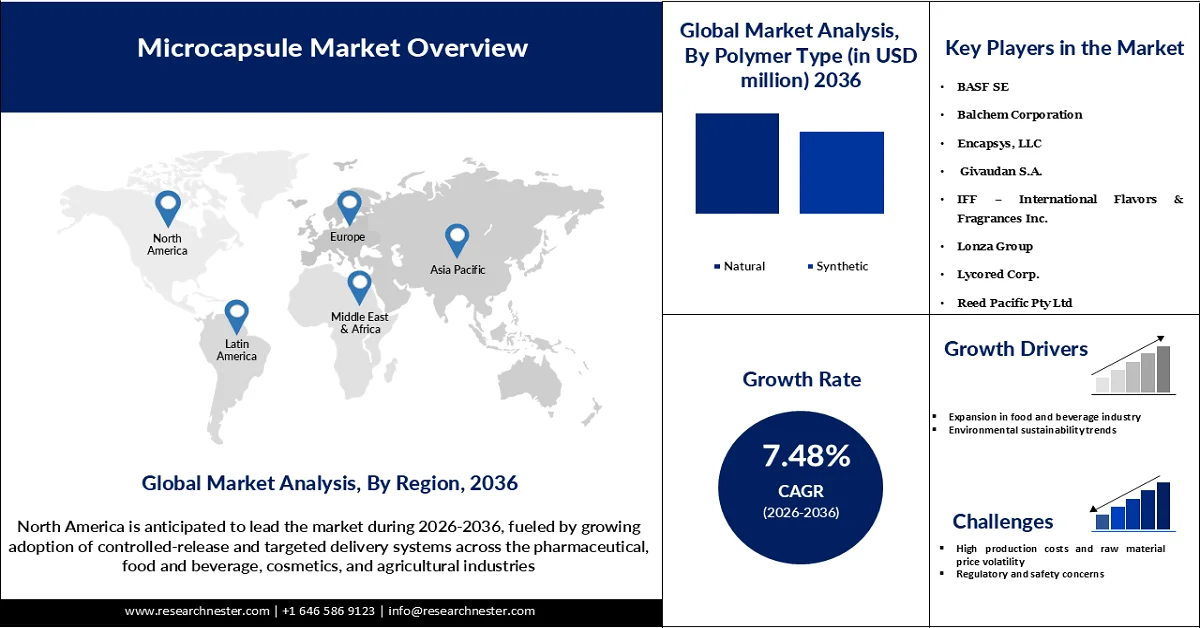
Microcapsule Market is valued at USD 12.36 billion in 2025 and is anticipated to surpass USD 27.17 billion by 2036, expanding at a CAGR of 7.48% during the forecast period, i.e., 2026 to 2036. In 2026, the industry size of microcapsule is evaluated at USD 13.20 billion.
The global microcapsule market is witnessing consistent growth as various industries, such as the pharmaceutical and healthcare, food and beverage, cosmetics, and personal care, search for reliable ways to protect active materials and ensure their controlled release. In the pharmaceutical and healthcare sectors, microencapsulation is commonly used to improve drug stability, mask unpleasant tastes, and support targeted delivery of medicines to specific parts of the body. For instance, in October 2022, the Aenova Group entered into a strategic partnership with Microcaps AG to enable the commercial production of high-precision microencapsulation systems. Through this collaboration, Microcaps contributes its patented microencapsulation technology platform, while Aenova provides large-scale manufacturing expertise and global market access to accelerate the development and production of pharmaceuticals, food supplements, and other products with improved properties such as controlled release, enhanced bioavailability, and better stability of active ingredients. Many companies are investing in improved coating processes and new encapsulating materials to increase the efficiency and effectiveness of these tiny capsules. At the same time, growing consumer demand for functional foods and nutraceuticals is encouraging manufacturers to adopt microencapsulation methods while developing new product formulations.
Across personal care, home care, and agriculture, microcapsules are seeing wider adoption. In cosmetics and skincare products, they allow active ingredients to be delivered over time, improving both performance and the consumer experience. In agriculture, they provide controlled delivery of fertilizers, pesticides, and other protective agents, enhancing efficiency while lowering ecological footprint. Producers are prioritizing the development of eco-friendly and biodegradable encapsulation materials to align with environmental standards. At present, breakthroughs in polymer technology and nanoscience, paired with ongoing research and development, are enhancing how microcapsules can be applied across diverse sectors.
Key Microcapsule Market Insights Summary:
Regional Highlights:
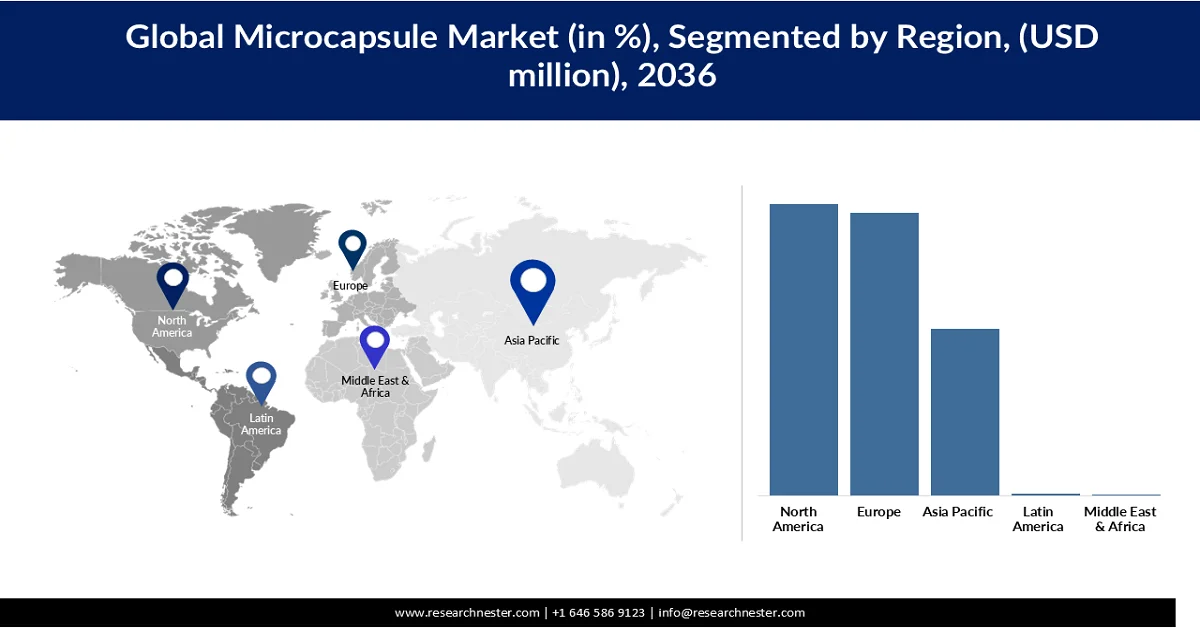
- North America microcapsule market is projected to account for 34.5% share by 2036, propelled by rising adoption of controlled-release and targeted delivery systems across pharmaceuticals, food, and cosmetics
- Europe is anticipated to hold a 33.49% share by 2036, attributed to stringent environmental regulations and increasing emphasis on biodegradable and bio-based materials
Segment Insights:
- Microcapsule market natural segment is forecast to capture 54.82% share by 2036, driven by growing demand for plant-based biodegradable materials enhancing stability and controlled delivery of active ingredients
- Spray drying segment is expected to hold 26.88% share by 2036, fueled by its cost-efficient, scalable, and protective encapsulation of sensitive compounds
Key Growth Trends:
- Expansion in food and beverage industry
- Environmental sustainability trends
Major Challenges:
- High production costs and raw material price volatility
- Regulatory and safety concerns
Key Players: BASF SE (Germany), Balchem Corporation (U.S.), Encapsys, LLC (U.S.), Givaudan S.A. (Switzerland), IFF – International Flavors & Fragrances Inc. (U.S.), Lonza Group (Switzerland), Lycored Corp. (Israel), Reed Pacific Pty Ltd (Australia), Royal FrieslandCampina N.V. (Netherlands), Syngenta Incorporated (Switzerland), Kapsera (France), DSM-Firmenich (Switzerland).
Global Microcapsule Market Forecast and Regional Outlook:
Market Size & Growth Projections:
- 2025 Market Size: USD 12.36 billion
- 2026 Market Size: USD 13.20 billion
- Projected Market Size: USD 27.17 billion by 2036
- Growth Forecasts: 7.48% CAGR (2026-2036)
Key Regional Dynamics:
- Largest Region: North America (34.5% Share by 2036)
- Fastest Growing Region: Asia Pacific
- Dominating Countries: United States, Germany, China, Japan, France
- Emerging Countries: India, South Korea, Brazil, Mexico, Indonesia
Last updated on : 23 March, 2026
Microcapsule Market - Growth Drivers and Challenges
Growth Drivers
- Expansion in food and beverage industry: In the food and beverage sector, the use of microencapsulation is growing as a method to protect sensitive components such as vitamins, flavors, antioxidants, and probiotics. These components tend to lose their stability when exposed to heat, oxygen, or light throughout processing and storage. By encapsulating them, manufacturers can preserve product quality, extend shelf life, and ensure consistent flavor, which are critical for consumer satisfaction. The growing popularity of functional foods and beverages, which provide health benefits beyond basic nutrition, is driving stronger demand for this technology. Through microencapsulation, producers can incorporate bioactive compounds without compromising flavor or texture. Building on this, in July 2024, Yili Innovation Centre Europe partnered with Xampla to pilot Xampla’s nutrient microcapsule technology. The collaboration aims to test and validate microscopic natural polymer capsules for fortifying vitamins and nutrients in a new range of products. The world-first plant-based microcapsules protect ingredients in beverages from production through digestion without affecting taste or texture. The partnership is expected to accelerate the deployment of Xampla’s nutrient microcapsules to global markets, supporting next-generation fortified food and beverage products. At the same time, the popularity of clean-label products is encouraging the use of natural, safe encapsulation materials. Ongoing innovation, combined with a heightened consumer focus on health and wellness, continues to act as a key growth driver.
- Environmental sustainability trends: Growing concern about environmental issues, combined with stricter rules on chemical use, is driving demand for sustainable microencapsulation solutions. In response, the industry is developing biodegradable and bio-based encapsulating materials that reduce ecological impact and promote circular economy practices. In line with this, in February 2021, Paris‑based clean tech company Calyxia began commercializing its world’s first readily biodegradable microcapsules, designed to replace conventional plastic microcapsules and reduce microplastic pollution across industries such as agriculture and consumer goods. Environmentally friendly microcapsules reduce pollution and waste, particularly in fields like agriculture and personal care, where residual products can negatively impact ecosystems. Rising consumer demand for green and sustainable products is encouraging manufacturers to adopt eco-conscious encapsulation methods. Governments around the world are now enforcing regulations to promote sustainable production and limit hazardous chemical usage. Alongside growing consumer demand for sustainable products, these regulations are driving the global microcapsule market toward eco-friendly solutions, opening new avenues for growth and expanding its range of applications.
- Innovations in cosmetic and personal care products: Microcapsule technology in the personal care and cosmetics microcapsule market enables active ingredients to be released gradually and accurately, improving product performance with longer-lasting hydration, fragrance, and targeted skin effects. Delicate ingredients are safeguarded from light and air, preserving their efficacy over time. Increasing consumer preference for multifunctional and enduring beauty products is pushing manufacturers to implement innovative encapsulation solutions. Microcapsules improve both the feel and sensory experience of products, making them more desirable to consumers. At the same time, the shift toward natural ingredients and clean beauty practices has promoted wider implementation of biodegradable and skin-safe encapsulation materials, supporting ongoing development in the microcapsule market.
Challenges
- High production costs and raw material price volatility: The microcapsule market is challenged by high production costs, which are further influenced by changes in raw material prices. Key polymers, coatings, and encapsulating agents often experience price swings caused by supply chain disruptions, limited availability, or shifts in global commodity markets. These unpredictable expenses can reduce profit margins and make it harder to price products competitively. In addition, producing microcapsules involves precise manufacturing processes and specialized equipment, adding to overall complexity. As a result, these factors may impede market growth and introduce financial uncertainty for manufacturers.
- Regulatory and safety concerns: Microcapsule producers often encounter challenges in adhering to safety regulations, especially in the pharmaceutical, food, and agriculture industries. Ingredients enclosed within microcapsules must pass thorough testing to confirm they are safe for consumption or for release into the environment, a process that can be both lengthy and expensive. Differences in regulations across countries make it challenging for companies to standardize production processes. Worries about the long-term effects of some encapsulating materials or nanoparticles can also slow market acceptance. These challenges can lead to delayed product releases and higher operational costs, limiting overall expansion.
Microcapsule Market Size and Forecast:
| Report Attribute | Details |
|---|---|
|
Base Year |
2025 |
|
Forecast Period |
2026-2036 |
|
CAGR |
7.48% |
|
Base Year Market Size (2025) |
USD 12.36 billion |
|
Forecast Year Market Size (2036) |
USD 27.17 billion |
|
Regional Scope |
|
Microcapsule Market Segmentation:
Polymer Type Segment Analysis
The natural segment is expected to hold 54.82% of the microcapsule market share. Microcapsules from plant-based, biodegradable materials are gaining attention for safeguarding sensitive nutrients and bioactives without synthetic polymers. To illustrate, in May 2025, the Royal Society of Chemistry journal confirmed that Xampla’s plant-protein microcapsules effectively protect ingredients during processing and digestion, releasing them specifically in the intestine, highlighting their commercial potential in food and beverage products. Made from starches, proteins, or gums, they boost ingredient stability, prolong shelf life, and satisfy growing consumer demand for sustainable solutions. Their versatility allows use in functional foods, beverages, nutraceuticals, and personal care items, while offering controlled release and precise delivery of active compounds.
Technology Segment Analysis
The spray drying segment is expected to hold a 26.88% microcapsule market share by 2036, driven by its efficiency, adaptability, and cost-effective approach to encapsulating sensitive ingredients. This technique quickly converts liquids into powders while protecting nutrients, bioactive compounds, and flavors from heat and oxidation. It is widely used in the food, beverage, and pharmaceutical industries because it supports large-scale production, delivers uniform particle size, and ensures product stability. Spray drying is compatible with both natural and synthetic encapsulating materials, making it versatile across many applications. Its ability to produce free-flowing powders suitable for instant products, functional foods, and nutraceuticals further boosts its adoption and strengthens its market position.
Application Segment Analysis
The pharmaceuticals & healthcare segment is expected to grow at a microcapsule market share of 34.28% by 2036. The growth is driven in large part by the use of microcapsules. These delivery systems allow controlled and prolonged release of drugs, improve bioavailability, protect sensitive APIs, and permit precise dosing for oral, injectable, and implantable products. For instance, in July 2025, Evonik forged a strategic distribution partnership with IMCD to broaden worldwide availability of its RESOMER bioresorbable polymers, commonly employed in controlled-release drug delivery systems and implantable medical devices. This collaboration underscores growing commercial demand and the expansion of supply networks for polymer-based encapsulation materials, further establishing microcapsules as a key technology supporting next-generation pharmaceutical delivery solutions. They play a crucial role in chronic conditions, long-acting treatments, and innovative biologics by ensuring reliable performance, suitable materials, and regulatory compliance, directly contributing to treatment success and patient commitment.
Our in-depth analysis of the microcapsule includes the following segments:
|
Segments |
Sub-segments |
|
Polymer Type |
|
|
Technology |
|
|
Application |
|

Vishnu Nair
Head - Global Business DevelopmentCustomize this report to your requirements — connect with our consultant for personalized insights and options.
Microcapsule Market - Regional Analysis
North America Market Insights
North America is expected to dominate the microcapsule market, accounting for 34.5% of the total share by 2036, fueled by growing adoption of controlled-release and targeted delivery systems across the pharmaceutical, food and beverage, cosmetics, and agricultural industries. With a strong base of pharmaceutical and biotech leaders and growing consumer focus on functional foods and sustainable personal care, North America is seeing increased demand for microcapsules that boost the stability, efficacy, and bioavailability of active ingredients. Investments in R&D, cutting-edge manufacturing facilities, and regulatory backing continue to propel market growth, while trends in precision medicine, personalized nutrition, and sustainable agrochemicals are strengthening the region’s status as a leader in microcapsule technology.
The U.S. microcapsule market is supported by a strong network of pharmaceutical, biotechnology, and functional food industries, which encourages continuous innovation in controlled-release medications, fortified nutraceuticals, and specialized personal care products. Extensive research and development, a well-established regulatory environment, and robust commercialization infrastructure facilitate the swift adoption of advanced microencapsulation technologies. At the same time, rising demand for eco-friendly formulations, clean-label ingredients, and precision nutrition, combined with growing applications in agriculture, cosmetics, and industrial sectors, is driving market growth and broadening opportunities across multiple industries.
Canada’s microcapsule market combines strong functional nutrition knowledge with sustainable material development, backed by clean-label initiatives, regulatory compliance, and a focus on bio-based innovation. Demand is especially high in food processing, agricultural sciences, and specialty industrial applications, where controlled-release techniques and improved stability enhance operational efficiency and ensure compliance with regulations. Rising interest in natural polymers, biodegradable materials, and precision nutrition is opening new market opportunities, while government initiatives and research programs continue to promote the adoption of advanced encapsulation technologies across a variety of industries.
Europe Market Insights
The microcapsule market in Europe is anticipated to hold a share of 33.49% by 2036, shaped by strict environmental and chemical safety frameworks such as REACH, food safety legislation, and pharmaceutical quality requirements. Market development is increasingly centered on biodegradable and bio-based materials, emphasizing sustainability and circular economy goals. Pharmaceuticals, functional foods, and personal care products drive most of the demand, while agrochemical and industrial sectors use encapsulation to boost precision, productivity, and environmental performance. Growing consumer demand for natural, safe, and environmentally friendly products, together with government initiatives and research support, is driving innovation and adoption, positioning Europe as a high-value microcapsule market focused on regulatory compliance and technological advancement.
The microcapsule market in Germany is growing consistently, supported by strong emphasis on innovation, sustainable operations, and advanced production capabilities. In food, microcapsules protect vitamins, flavors, and probiotics, meeting the increasing need for functional and clean-label products. In healthcare, they allow controlled-release and targeted delivery of medications, enhancing therapeutic effectiveness and supporting patient adherence. Supported by strong research and development capabilities, a well-established chemical and biotechnology industry, and heightened consumer awareness of health and environmental issues, Germany is establishing itself as a key market for microcapsule technologies.
France’s microcapsule market continues to grow as consumers increasingly seek functional foods, fortified beverages, and nutraceuticals. Microencapsulation preserves vitamins, probiotics, and natural flavors, keeping products fresh and nutritionally rich for longer. Rising interest in health, wellness, and clean-label items is motivating manufacturers to use microcapsules to boost product stability, taste, and performance.
Asia Pacific Market Insights
Asia Pacific’s microcapsule market will grow with a market share of 19.71% by 2036, led by developments in pharmaceuticals, food and nutraceuticals, and agrochemicals, underpinned by advanced production capabilities. Key nations including China, India, Japan, and South Korea are boosting output of encapsulated APIs, vitamins, probiotics, and functional ingredients to meet domestic and international requirements. Increasing health awareness, urban growth, and a rising middle-class population are boosting the use of microencapsulation to improve ingredient stability, extend shelf life, mask flavors, and enable controlled release in dietary supplements, fortified foods, and oral solids. By 2030, almost 55% of the Asia-Pacific population is projected to live in urban areas, driving increased demand for food, housing, infrastructure, and services. Acting as a major contract manufacturing hub, the region draws multinational companies to entrust complex encapsulation projects, driving market development and technological progress.
China’s microcapsule market is steadily growing, driven by expansion in pharmaceuticals, healthcare, and functional foods. In April, 2025, China’s dairy giant Yili partnered with UK-based Xampla to use microencapsulation in dairy products, protecting sensitive nutrients like vitamins, probiotics, and omega‑3s in heat‑treated beverages. Microencapsulation protects the stability, taste, and longevity of fortified foods, dietary supplements, and probiotics, meeting the needs of health-conscious consumers. Agrochemical and industrial industries are using microcapsules to boost precision and operational performance. The expanding urban population and increasing middle-class income levels are fueling demand, and China’s strong production infrastructure coupled with government support motivates global companies to outsource sophisticated encapsulation work, supporting both growth and innovation.
The microcapsule market in India is witnessing steady growth, supported by increasing demand in pharmaceuticals, functional foods, and nutraceuticals. Microencapsulation protects nutrients, maintains flavor, and enables accurate drug delivery. Rising urbanization, a growing middle-class population, and well-developed manufacturing and contract development infrastructure are driving adoption and long-term market expansion.
Key Microcapsule Market Players:
- BASF SE (Germany)
- Balchem Corporation (U.S.)
- Encapsys, LLC (U.S.)
- Givaudan S.A. (Switzerland)
- IFF – International Flavors & Fragrances Inc. (U.S.)
- Lonza Group (Switzerland)
- Lycored Corp. (Israel)
- Reed Pacific Pty Ltd (Australia)
- Royal FrieslandCampina N.V. (Netherlands)
- Syngenta Incorporated (Switzerland)
- Kapsera (France)
- DSM-Firmenich (Switzerland)
- Company Overview
- Business Strategy
- Key Product Offerings
- Financial Performance
- Key Performance Indicators
- Risk Analysis
- Recent Development
- Regional Presence
- SWOT Analysis
- BASF SE is one of the leading producers of microcapsules globally due to its strong expertise in chemical formulation, polymer science, and encapsulation technologies. The company develops advanced microencapsulation solutions used in agriculture, pharmaceuticals, personal care, and home care products, where controlled release and protection of active ingredients are essential. BASF also invests heavily in research and development, enabling innovation in biodegradable and high-performance encapsulation materials. Its extensive global manufacturing network and strong partnerships with end-use industries further strengthen its ability to supply customized microcapsule solutions at large scale.
- Balchem Corporation is a major player in the microcapsule market due to its strong specialization in encapsulation and nutrient delivery technologies, particularly for food, nutraceutical, pharmaceutical, and animal nutrition applications. The company develops advanced microencapsulation solutions that protect sensitive ingredients such as vitamins, minerals, and bioactive compounds, improving stability, shelf life, and controlled release. Balchem also focuses on innovative ingredient systems and proprietary encapsulation technologies, enabling manufacturers to enhance product performance and nutritional value. Its extensive product portfolio, strong R&D capabilities, and established presence in global nutrition markets further strengthen its position in the microcapsule industry.
- Encapsys, LLC has established a strong presence in the microcapsule market through its advanced microencapsulation technologies and large-scale manufacturing capabilities. The company specializes in producing high-performance microcapsules used in home care, personal care, agriculture, and industrial applications, particularly for fragrance delivery and controlled release systems. Encapsys is known for its proprietary encapsulation processes, which enhance product stability, durability, and performance in detergents, fabric care, and specialty chemicals. Additionally, the company’s strong partnerships with global consumer goods manufacturers and its continuous focus on innovation and customized encapsulation solutions have strengthened its position in the market.
- Givaudan S.A. is a key player in the global microcapsule market due to its strong expertise in flavor, fragrance, and active ingredient delivery technologies. The company utilizes advanced microencapsulation techniques to protect and control the release of flavors, fragrances, and bioactive compounds used in food, beverages, and personal care products. Its continuous investment in research, innovation, and sensory science enables the development of high-performance encapsulation solutions that enhance product stability, shelf life, and consumer experience. Additionally, Givaudan’s global presence, strong partnerships with consumer goods manufacturers, and focus on sustainable and natural ingredient solutions further strengthen its leadership in the microcapsule industry.
Below is the list of the key players operating in the global microcapsule market:
Key players in the microcapsule market such as BASF SE, Givaudan SA, DSM‑Firmenich, and Symrise AG are driving market growth through continuous innovation and technological advancements in microencapsulation. They invest heavily in research and development to create improved controlled-release systems used in pharmaceuticals, food, agriculture, and cosmetics. These companies also expand their product portfolios by developing new applications such as nutrient protection, fragrance release, and slow-release agrochemicals. Strategic partnerships, acquisitions, and expansion into emerging markets further strengthen their global presence. Additionally, the focus on sustainable and biodegradable microcapsules helps meet growing environmental and consumer demands, accelerating overall market growth.
Corporate Landscape of the Global microcapsule Market:
Recent Developments
- In November 2024, Kapsera, a company specializing in natural microencapsulation technologies, secured roughly USD 4.5 million in funding to advance its industrialization and commercialization plans. The investment round was led by Banque des Territoires, with additional backing from The Yield Lab Europe and Demeter Investment Managers. The funds will be used to build Kapsera’s first industrial-scale manufacturing facility in Bordeaux, France, scheduled for completion by Q2 2025, with an anticipated annual production capacity of over 200 tons by 2027. The capital injection will also support the expansion of R&D efforts, enabling Kapsera to grow its portfolio of sustainable, natural microcapsule solutions in response to increasing demand for bio-based and environmentally responsible formulations.
- In April 2024, DSM-Firmenich introduced Humiome B2, a microencapsulated vitamin designed for precise intestinal delivery, reflecting rising innovation-led demand in functional nutrition for encapsulation solutions that enhance nutrient stability, boost bioavailability, and offer distinct health benefits.
- Report ID: 8458
- Published Date: Mar 23, 2026
- Report Format: PDF, PPT
- Explore a preview of key market trends and insights
- Review sample data tables and segment breakdowns
- Experience the quality of our visual data representations
- Evaluate our report structure and research methodology
- Get a glimpse of competitive landscape analysis
- Understand how regional forecasts are presented
- Assess the depth of company profiling and benchmarking
- Preview how actionable insights can support your strategy
Explore real data and analysis
Frequently Asked Questions (FAQ)
About this Report
Connect with our Expert


Report, 2026-2036



Copyright @ 2026 Research Nester. All Rights Reserved.
